
TL;DR:
Tracking supplement results with subjective and objective data helps determine individual effectiveness.
Consistent measurements over several weeks reveal meaningful trends beyond daily fluctuations.
Personal testing is more reliable than population studies due to individual variability.
You invest real money in supplements every month, but do you actually know if they’re working? Most people don’t, and that’s a costly blind spot. Most people struggle to tell whether their supplements are delivering results or whether they’re just experiencing a placebo effect or natural fluctuation. This guide gives you a practical, evidence-based system to track your supplement results step by step, using both subjective and objective data so you can stop guessing and start knowing.
Table of Contents
Key Takeaways
Point Details
Set a baseline Always measure your starting point before using any supplement to ensure clear results later.
Track daily metrics Log subjective and objective outcomes each day for clarity and unbiased verification.
Interpret with skepticism Use N-of-1 testing and review trends critically to avoid being misled by placebo or hype.
Avoid tracking pitfalls Consistency, the right tools, and awareness of personal factors help you overcome common mistakes.
Choose evidence-based supplements Third-party tested products and referencing expert reviews are key for trustworthy results.
What you need before tracking supplement results
Before you log a single data point, you need the right setup. Think of it like a science experiment: without a controlled starting point and the right tools, your results won’t mean much. The good news is that you don’t need a lab. You need a few key materials, a clear baseline, and a commitment to consistency.
Here’s what to gather before you start:
-
A tracking journal or app (Cronometer, MyFitnessPal, or a simple notebook)
-
A wearable device that measures heart rate variability (HRV), sleep stages, or resting heart rate (Garmin, Whoop, or Oura Ring)
-
Baseline test results, such as a DEXA scan for body composition, a standard scale reading, or a blood panel if relevant
-
Supplement details: brand, batch number, dose, and the specific form of each ingredient
-
A calendar to mark your start date, planned check-ins, and any changes in routine
Your baseline is the most important piece. Without it, you have nothing to compare your results against. If you’re tracking a protein supplement for muscle gain, measure your lean mass before you start. If you’re taking magnesium for sleep, rate your sleep quality for one full week before your first dose.
Using supplement tracking methods like apps, journals, and wearables gives you a consistent, unbiased record. That consistency is what separates real insight from guesswork.
Tools vs. what they measure:
Tool Type of metric What it captures
Journal or app Subjective Energy, mood, focus, digestion
Wearable (HRV tracker) Objective Recovery, sleep stages, heart rate
Scale or DEXA scan Objective Body weight, lean mass, fat percentage
Performance log Objective Strength, endurance, reps, times
Blood panel Objective Nutrient levels, biomarkers
Pro Tip: Always choose third-party tested supplements before you start tracking. Contaminated or mislabeled products will corrupt your data before you even begin. Look for NSF Certified for Sport or Informed Sport seals.
Also, review the dosage guidelines for each supplement you’re taking. Underdosing is one of the most common reasons people see no results, and it’s entirely avoidable with a quick check before you start.
One more thing: track only one new supplement at a time when possible. Stacking multiple new products simultaneously makes it nearly impossible to attribute any change to a specific ingredient. Patience here pays off in clarity later.
Step-by-step guide to tracking supplement outcomes
Once your tools are ready and your baseline is set, the daily tracking process is straightforward. The key is structure. Random check-ins won’t give you reliable trends. Here’s how to do it right:
-
Log energy and mood daily on a 1 to 10 scale, ideally at the same time each morning before caffeine or food.
-
Record sleep quality using your wearable’s sleep score or a simple 1 to 10 rating if you don’t have a device.
-
Track performance metrics at each workout: weight lifted, reps completed, distance run, or time to fatigue.
-
Note body composition changes weekly, not daily. Daily weight fluctuates too much to be meaningful.
-
Log HRV and resting heart rate each morning before getting out of bed for the most accurate reading.
-
Record your supplement dose and timing every single day, including whether you took it with food or on an empty stomach.
Combining subjective tracking with objective wearable data prevents the bias that comes from relying on memory or feeling alone. You might feel great one week because you slept well, not because the supplement worked. Your data will tell the difference.

Sample one-week tracking snapshot:
Day Energy (1-10) Sleep score HRV (ms) Workout performance
Baseline avg 5.5 62 48 3 sets x 8 reps @ 185 lbs
Day 3 6 65 50 3 sets x 8 reps @ 185 lbs
Day 7 7 70 54 3 sets x 9 reps @ 185 lbs
Small upward trends across multiple metrics are far more meaningful than one big spike in a single category. Look for patterns, not peaks.
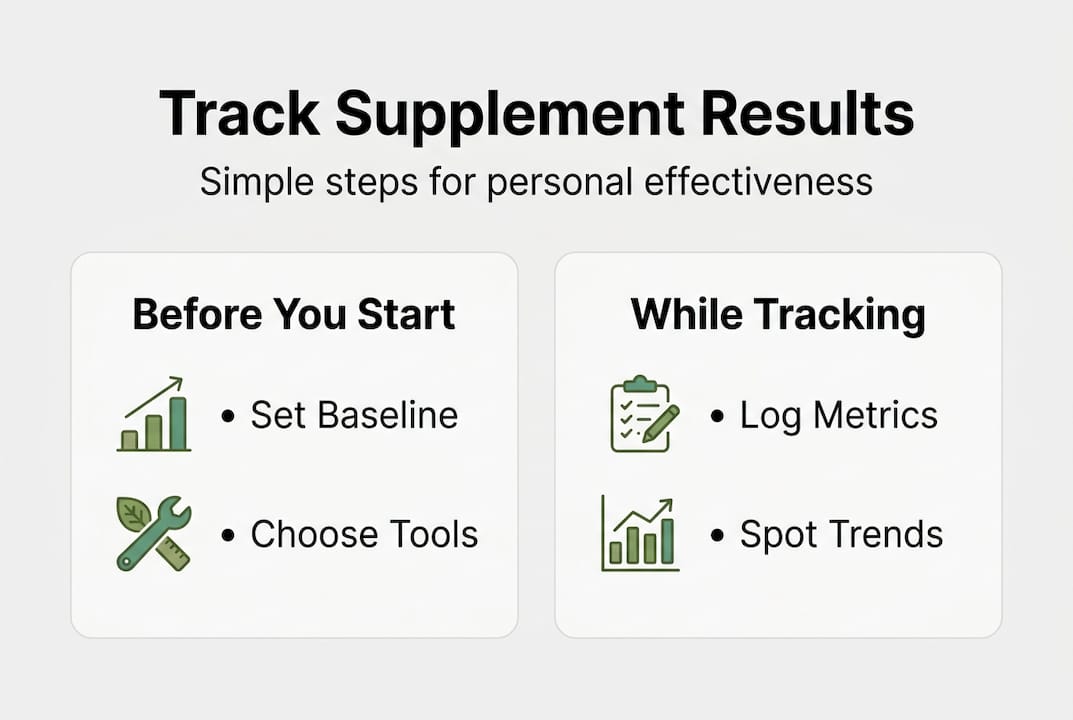
Research on elite athlete supplement use consistently shows that combining structured logging with objective performance data produces the most reliable picture of supplement efficacy. Even professionals can’t rely on feel alone.
Pro Tip: Take your measurements at the same time of day, every time. Morning HRV readings taken after waking are not comparable to evening readings. Consistency in method is just as important as consistency in supplementation.
For supplements that work in combination with training, check out how supplements synergy with exercise can amplify your results. And if you’re comparing products, reviewing supplement rankings can help you choose the most evidence-backed options before you even start tracking.
How to interpret and verify your supplement data
With a few weeks of logs in hand, it’s time to look at what your data actually means. Raw numbers don’t tell a story on their own. You need a structured review process to separate real change from noise.
Here’s how to review your data effectively:
-
Compare your baseline averages to your week-two and week-four averages. Don’t compare single days. Averages smooth out the natural variation that happens day to day.
-
Look for directional consistency. If your sleep score improved in 10 out of 14 days, that’s a trend. If it went up and down randomly, that’s noise.
-
Check multiple metrics together. A supplement that genuinely works often shows improvement across related markers, not just one.
-
Rule out confounders. Did you change your diet, sleep schedule, or training volume during the tracking period? If so, note it and factor it in.
Signs your supplement may not be working:
-
No consistent upward trend in your target metric after three to four weeks
-
Random fluctuation with no clear direction
-
Improvement in one metric but decline in another related one
-
Side effects that interfere with training or recovery
-
No change even after confirming correct dosage and timing
Population RCTs show mixed results for many popular supplements, which is exactly why personal N-of-1 testing (tracking your own individual response) is so valuable. What works for 60% of a study group may not work for you, and what was ineffective in a trial may be exactly what your body needs.
“Personal N-of-1 testing matters more than generic claims.”
Pro Tip: Give most supplements at least two full weeks before drawing conclusions. Some compounds like creatine require a loading phase, while adaptogens like ashwagandha may take four to eight weeks to show measurable effects. Check your dosage safety guidelines for timing expectations specific to each product.
If your data shows no improvement after a full month of consistent use at the correct dose, that’s meaningful information. It means that particular supplement, at that dose, isn’t delivering results for you. That’s not failure. That’s exactly what tracking is supposed to reveal.
Troubleshooting common tracking mistakes and edge cases
Even with the best intentions, tracking errors are common. They don’t mean you’re doing it wrong. They mean you’re human. Here’s how to catch and correct the most frequent problems.
Common tracking mistakes to avoid:
-
Skipping log entries and trying to fill them in from memory later. Memory is unreliable and introduces bias.
-
Mixing subjective and objective metrics without distinguishing between them. “I feel stronger” and “I lifted 10 more pounds” are different types of data.
-
Ignoring batch and brand differences. Switching brands mid-tracking period can invalidate your results, since formulations vary significantly.
-
Tracking too many variables at once, making it impossible to isolate which supplement is responsible for any change.
-
Stopping too early. Many people quit tracking after one week, which is rarely enough time for most supplements to show measurable effects.
“Supplements can act differently for everyone.”
Edge cases are worth addressing separately. Quick-onset supplements like caffeine show effects within 30 to 60 minutes, making them ideal for short N-of-1 tests. You can feel the difference in focus and performance almost immediately, and pharmacokinetics for quick-onset supplements make washout periods easy to plan. Simply stop for a few days and retest.
For slower-acting compounds, a washout period (stopping the supplement for one to two weeks before retesting) helps you confirm whether changes were real or coincidental. This is especially useful when you’re comparing two similar products, such as different protein formulas or creatine brands. For a detailed product-level example, the Nutrigo Lab analysis shows how ingredient quality affects real-world outcomes.
Gender and BMI also matter more than most people realize. Research shows that protein supplementation, for example, tends to produce stronger lean mass gains in older or overweight women compared to younger, leaner individuals. If your results don’t match what you read online, your demographics may be a key variable. Supplements for specific health needs, like those reviewed under varicose veins support, often show similarly variable individual responses.
Pro Tip: If your results are inconclusive after four weeks, don’t just give up. Try adjusting the timing of your dose, confirm you’re taking it with or without food as recommended, and rule out any lifestyle factors that could be masking the effect.
The uncomfortable truth about supplement tracking
Here’s something the supplement industry doesn’t want you to focus on: most product marketing is built on population-level study results that may have little to do with your biology, your training, your diet, or your goals.
Population RCTs show mixed results for a wide range of popular supplements. That doesn’t mean supplements don’t work. It means they don’t work the same way for everyone. The study that showed a supplement boosted endurance in 65-year-old sedentary men tells you almost nothing about whether it will improve your performance as a 32-year-old recreational athlete.
This is why we believe that personal, methodical tracking isn’t just a nice-to-have. It’s the only honest way to evaluate a supplement for yourself. Generic recommendations, even from credible sources, are starting points, not conclusions.
The most useful mindset shift is this: stop asking “does this supplement work” and start asking “does this supplement work for me, at this dose, at this time, with my current training and diet.” That question can only be answered with your own data.
When you use effective ranking evaluation alongside your personal tracking logs, you get the best of both worlds: population-level evidence filtered through your individual experience. That combination is far more powerful than either source alone.
Tracking for yourself beats chasing universal answers every time.
Discover supplements that deliver proven results
Now that you know how to track supplement effectiveness with real data, the next step is making sure you’re starting with products that have solid evidence behind them.
At RankOfSupplements.com, every review and ranking is built on science, not sponsorships. Whether you’re evaluating a pre-workout like the Nutrigo Lab review, browsing immune support products for year-round wellness, or comparing options like the Fat Burn Active review for body composition goals, you’ll find transparent, evidence-driven analysis that pairs perfectly with your personal tracking system. Start with a product you can trust, track it with the methods above, and let the data guide your decisions.
Frequently asked questions
How long should I track supplement results?
Most supplements need at least two weeks of consistent use before you can draw reliable conclusions, though some adaptogens and hormonal support supplements may take four to eight weeks depending on your goals.
What tools are best for monitoring supplement outcomes?
Apps, journals, and wearables like HRV trackers are the most effective combination, since they capture both subjective experience and objective physiological data without relying on memory.
How do I know if a supplement is actually working for me?
Compare your baseline averages to your ongoing tracked metrics and look for consistent directional improvement. N-of-1 personal testing gives you far more relevant insight than relying solely on general study results.
Do gender or BMI affect how supplements work?
Yes, significantly. Gender and BMI moderate supplement effects in measurable ways, with protein supplementation, for example, showing stronger lean mass benefits in older or overweight women than in younger, leaner individuals.