
Most supplement users assume the dosage on the label is the right dose for them. That assumption is understandable, but it overlooks something important: supplement dosage guidelines are built for general populations, not for you specifically. Regulatory oversight varies widely, and many products carry no binding safety limits at all. This guide breaks down how guidelines are established, what labels actually tell you, how personal factors shift your needs, and what mistakes to avoid. By the end, you will have a clear, practical framework for making supplement decisions that are both safe and effective.
Table of Contents
-
Individual needs: Factors affecting optimal supplement dosage
-
Applying dosage guidelines: Safe supplement use in daily life
-
Explore evidence-based supplement reviews and recommendations
Key Takeaways
Point Details
Understand DRIs and ULs Official guidelines help set safe lower and upper supplement dosages.
Labels are imperfect Always double-check supplement facts, as regulations and evidence can differ by product and region.
Personal needs vary Age, health conditions, and activity level affect how much is safe and optimal for you.
Professional advice matters Work with health professionals, especially for long-term or high-dose supplementation.
Action beats assumption Use checklists, monitor effects, and consult reliable sources to ensure safe, effective supplement use.
How supplement dosage guidelines are established
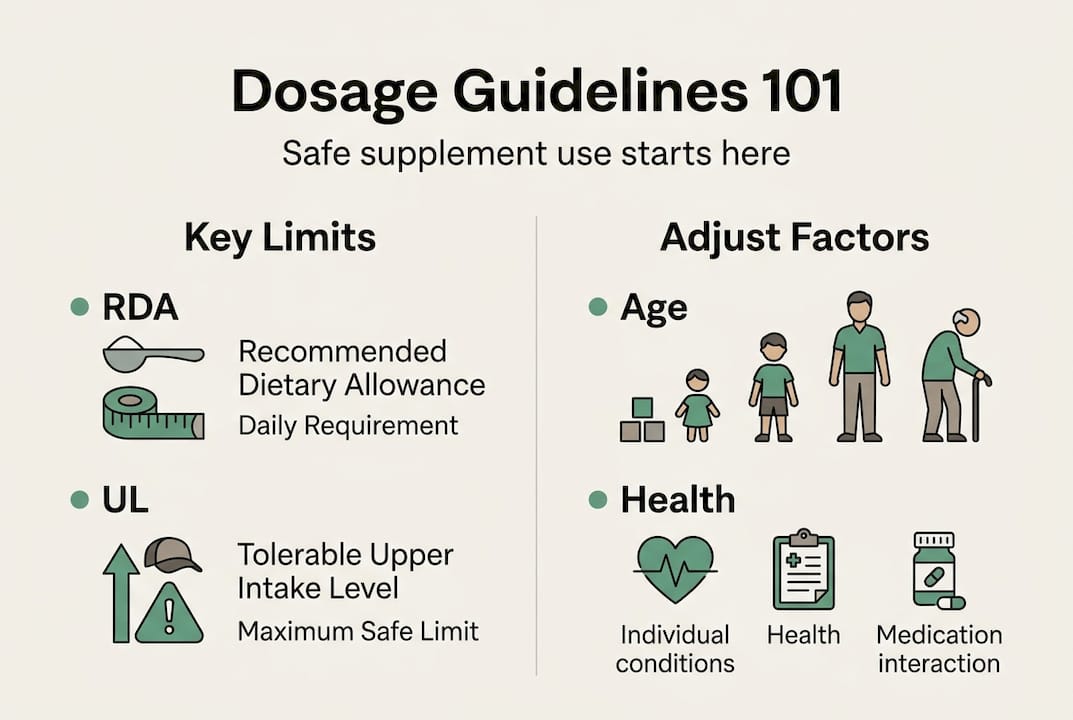
Understanding where dosage numbers come from changes how you use them. Most guidelines in the United States originate from the Dietary Reference Intakes (DRIs), a system developed by the National Academies of Sciences, Engineering, and Medicine. The DRIs provide evidence-based guidelines for supplement dosages, including four key values: the Estimated Average Requirement (EAR), the Recommended Dietary Allowance (RDA), the Adequate Intake (AI), and the Tolerable Upper Intake Level (UL).
Here is what each term means for you as a supplement user:
-
EAR: The intake level estimated to meet the needs of 50% of healthy individuals in a specific group. It is a research benchmark, not a personal target.
-
RDA: Set higher than the EAR, this covers the needs of about 97% of healthy people. It is the number most often referenced on labels.
-
AI: Used when there is not enough data to set an RDA. It is an educated estimate based on observed intake in healthy populations.
-
UL: The highest daily intake unlikely to cause harm for most healthy adults. Exceeding this level increases risk of adverse effects.
These values apply to healthy adults in standard age and sex categories. They are not designed for people with chronic illness, pregnant women, or athletes with unusual demands. That distinction matters more than most users realize.
The UL is particularly important. ULs are based on risk assessment including hazard identification, dose-response analysis, uncertainty factors, and risk characterization. In plain terms, scientists look at what dose starts causing harm, then apply a safety buffer. The result is a conservative ceiling, not a target.
Vitamins and minerals have well-established DRIs. Other supplement categories, including herbal extracts, amino acids, and proprietary blends, often lack formal DRIs entirely. For products like Nutrigo Lab Strength, which combine multiple active compounds, checking each ingredient against its individual DRI is the responsible approach.
Term Definition Practical use
EAR Meets needs of 50% of population Research reference only
RDA Meets needs of ~97% healthy adults General supplementation target
AI Estimate when RDA unavailable Use with caution
UL Maximum safe daily intake Never exceed without supervision
Reading supplement labels: What you can (and can’t) trust
Once you know how guidelines are set, the next step is understanding what product labels actually communicate. In the United States, the FDA requires that supplement labels list the serving size, amount per serving, and a suggested dose. However, the FDA does not mandate pre-market approval, meaning manufacturers are responsible for ensuring safety before a product reaches shelves. The EU and EFSA operate under stricter standards, setting ULs and label requirements that go further than current US rules.
Labels also frequently omit UL comparisons. A product might list 500 mg of magnesium per serving without noting that the UL for supplemental magnesium from non-food sources is 350 mg per day for adults. That gap between label dose and safety threshold is something you need to check yourself.
Key label elements and what they mean:
Label element What it shows What it may hide
Serving size Manufacturer’s suggested amount May not align with RDA or UL
% Daily Value Percentage of RDA per serving Not all nutrients have a DV
Proprietary blend Total blend weight Individual ingredient amounts
Warnings Known contraindications May not cover all interactions
Here is a practical checklist for evaluating any supplement label:
-
Identify the active ingredients and their amounts per serving.
-
Cross-reference each ingredient with its RDA and UL using a source like the NIH magnesium fact sheet.
-
Check whether a % Daily Value is listed and whether that value is based on the RDA.
-
Look for proprietary blends and note that individual doses within them are not disclosed.
-
Read all warnings and check for interactions with medications you take.
Pro Tip: Never exceed the label dosage unless a qualified healthcare provider has reviewed your specific needs and confirmed it is appropriate.
For specialized categories like eye health supplements or immune support supplements, label scrutiny is especially important because these products often combine multiple nutrients that each carry their own ULs.
Individual needs: Factors affecting optimal supplement dosage
Even a perfectly formulated supplement at the RDA level may not be right for you. Personal biology shifts what your body needs and how it processes what you take. Age, sex, health status, medications, pregnancy, and activity level all affect both the required dose and the risk profile of any supplement.
Magnesium is a clear example. The RDA for adult men is 400 to 420 mg per day, while for adult women it is 310 to 320 mg. During pregnancy, the requirement rises. Older adults often absorb magnesium less efficiently from food, which may affect supplemental needs. Different forms of magnesium, such as glycinate versus oxide, also vary in bioavailability, meaning the same labeled dose can deliver very different amounts to your cells.
The following groups should always consult a healthcare provider before starting or changing a supplement routine:
-
Pregnant or breastfeeding individuals
-
Children and adolescents
-
Adults over 65
-
People with kidney, liver, or cardiovascular conditions
-
Anyone taking prescription medications
-
Individuals with diagnosed nutrient deficiencies
Sensitive groups including pregnant, elderly, and those with disease may need dosage adjustments, and high-risk supplements require particular caution. This is not a bureaucratic formality. Drug-nutrient interactions are real, and some supplements actively interfere with medication absorption or metabolism.
The “more is better” mindset is one of the most persistent myths in supplementation. Higher doses do not automatically produce better outcomes. In many cases, they increase the risk of toxicity while providing no additional benefit. For example, the Mass Extreme review highlights how stacking high-dose products without tracking total intake can push certain nutrients past their UL without the user realizing it. If you want to understand how supplements interact with training, the science behind exercise and supplement synergy is worth reading before you build your stack.

Pro Tip: Keep a simple log of every supplement you take, including dose and timing. Share this list with your doctor or pharmacist at every visit.
Common pitfalls: Risks of incorrect supplement dosing
Knowing the guidelines is one thing. Avoiding the mistakes that undermine them is another. The most common error is stacking multiple products without checking for overlapping ingredients. Two supplements might each contain 80% of the UL for a given nutrient. Together, they push you over the limit without any single product appearing problematic.
Exceeding the UL is not a theoretical concern. Supplements carry risk of overdose, especially for nutrients with no binding UL or those in higher-bioavailability forms that the body absorbs more efficiently. Fat-soluble vitamins like A, D, E, and K accumulate in tissue and can reach toxic levels over time. Water-soluble vitamins are generally safer, but high-dose B6 supplementation, for example, is linked to nerve damage with prolonged use.
Symptoms that may signal you are taking too much of a supplement include:
-
Nausea, vomiting, or digestive discomfort
-
Unusual fatigue or muscle weakness
-
Headaches or dizziness
-
Changes in urine color or frequency
-
Skin reactions or unusual bruising
Herbal supplements and products with unknown or proprietary ingredients carry the highest risk because they often lack established ULs entirely. The Femin Plus review is an example of how a thorough ingredient-by-ingredient breakdown helps users understand what they are actually taking.
“High-dose studies such as melatonin at 40 to 200 mg are experimental and not guideline-approved for routine use. Standard low doses are considered safe, but escalating beyond them without clinical oversight is not supported by current evidence.”
The lesson here is straightforward: always audit your full supplement stack, not just individual products.
Applying dosage guidelines: Safe supplement use in daily life
Putting all of this into practice does not require a science degree. It requires a consistent process. Using supplements is most appropriate when a deficiency is confirmed and professional advice supports the decision, as noted in the NIH magnesium guidelines. That principle applies broadly across supplement categories.
Here is a numbered routine to follow for guideline-compliant, individualized supplementation:
-
Identify your goal. Are you addressing a confirmed deficiency, supporting performance, or targeting a specific health outcome? Clarity here prevents unnecessary supplementation.
-
Get baseline testing. Blood work or dietary analysis gives you real data. Guessing at deficiencies leads to over-supplementation.
-
Research each ingredient. Use sources like the NIH Office of Dietary Supplements to find the RDA and UL for every active compound in your stack.
-
Calculate your total daily intake. Add up the amount from all supplements plus dietary sources. Compare this to the UL, not just the RDA.
-
Review with a professional. A doctor, registered dietitian, or pharmacist can flag interactions and confirm your plan is appropriate for your health status.
-
Reassess every three to six months. Needs change with age, health status, and lifestyle. A supplement routine that made sense a year ago may need updating.
For joint-focused users, the Flexomore review walks through ingredient dosages in detail. If testosterone support is your goal, the Testolan review applies the same evidence-based lens to that category.
Why one-size-fits-all supplement advice can be risky
Here is something worth saying directly: official dosage guidelines are a starting point, not a guarantee. They are built on population averages, and you are not an average. Diet quality, gut health, genetic variation in nutrient metabolism, and the specific form of a supplement all influence how much of a nutrient your body actually uses.
Experienced practitioners do not simply match a label dose to an RDA and call it done. They look at the whole picture: what a person eats, how they absorb nutrients, what medications they take, and what outcomes they are actually seeing. That kind of individualized approach consistently produces better results than label reliance alone.
The uncomfortable truth is that following a label blindly can be just as problematic as ignoring it. Generic advice, even from credible sources, requires interpretation. The goal is to use guidelines as a framework while staying alert to how your body responds. Tracking symptoms, retesting periodically, and staying informed through resources like exercise and supplement synergy gives you the feedback loop that generic guidelines cannot provide.
Explore evidence-based supplement reviews and recommendations
Applying dosage guidelines correctly starts with knowing what is actually in your supplements and whether the doses are supported by science. At RankOfSupplements.com, every review is built around ingredient transparency, dosage accuracy, and real evidence.
Whether you are evaluating a performance product like Nutrigo Lab Strength, exploring eye health supplement reviews, or comparing immune support supplement reviews, our breakdowns give you the dosage context you need to make a confident, safe choice. Stop guessing at what works. Use reviews that do the research for you.
Frequently asked questions
What is the safest way to determine my supplement dosage?
The safest approach is to confirm a nutritional need through testing and then follow professional guidance using established DRIs. Consult professionals for personalized dosing rather than relying on label suggestions alone.
Can I combine multiple supplements without risk?
Combining supplements raises the risk of exceeding safe intake levels, particularly when the same ingredient appears in more than one product. Supplements differ in bioavailability, and exceeding the UL across a stack can happen without any single product appearing problematic.
Why do some supplements lack upper intake levels?
Many bioactive compounds, including herbal extracts and certain amino acids, have not been studied enough to establish a formal UL. DRIs and ULs are not established for all supplement types, which makes independent research and professional guidance especially important for those categories.
Are high supplement doses sometimes safe?
Higher-than-guideline doses are explored in research settings, but they are not recommended for routine use without clinical supervision. High-dose studies exist but their safety outside controlled conditions has not been established for general populations.
Do I always need supplements if I exercise?
Not necessarily. A well-structured diet covers most needs for active individuals. Prioritize diet over routine supplementation and use supplements only when a specific deficiency or performance need has been confirmed.