
TL;DR:
- Creatine cycling is unnecessary for most athletes because long-term daily use maintains muscle saturation and performance benefits.
- Research shows continuous supplementation improves power and recovery, with no tolerance development or safety issues.
Creatine cycling is defined as alternating planned periods of creatine intake with deliberate off periods, and the scientific consensus is clear: it is unnecessary for most athletes. The question of why cycle creatine supplementation persists in gym culture despite strong evidence favoring continuous daily use. The International Society of Sports Nutrition (ISSN) confirms that long-term daily creatine use is both safe and effective, with no adverse kidney or liver effects observed over five years of monitored supplementation. A 2026 study published in a peer-reviewed sports medicine journal found that creatine monohydrate improved mean power output by 8.4% and peak power output by 8.0% in active individuals. Those gains depend on sustained muscle saturation, which cycling actively undermines.
Why cycle creatine supplementation? The science explained
Creatine cycling is a protocol borrowed from bodybuilding steroid culture, and it does not apply to creatine’s actual biochemistry. Creatine is a naturally occurring compound that supports the phosphocreatine energy system in muscle tissue. It does not interact with the hormonal axis, and it does not cause receptor downregulation at recommended doses. The logic behind steroid cycling simply does not transfer.
How creatine works in muscle tissue
Creatine enters muscle cells and bonds with phosphate to form phosphocreatine (PCr). During high-intensity efforts like sprinting or heavy lifting, PCr rapidly regenerates adenosine triphosphate (ATP), the body’s primary energy currency. Higher intramuscular PCr stores mean more ATP available per second of effort. That is the entire performance mechanism, and it depends entirely on keeping those stores full.

Muscle saturation from supplementation takes 3 to 4 weeks to reach its peak. After stopping, stores return to baseline gradually over 4 to 6 weeks. Short breaks of a few days have negligible effect on physiological saturation levels. This means a weekend off does not reset your stores, but a planned four-week off cycle absolutely does.
The origin of the cycling myth
Creatine cycling follows bodybuilding steroid traditions but is unsupported by creatine’s distinct biochemical mechanisms. Steroids require cycling because they suppress natural hormone production. Creatine does nothing of the sort. Creatine transporters in muscle do not downregulate at recommended doses, so no tolerance develops from continuous intake. Treating creatine like a steroid is a category error that costs athletes real performance.
Key facts about creatine physiology that debunk cycling logic:
- Creatine is not a hormone and does not affect the endocrine system
- Muscle creatine transporters remain active at standard 3 to 5 gram daily doses
- No peer-reviewed study has demonstrated a tolerance effect from continuous creatine use
- The body produces creatine naturally from glycine, arginine, and methionine, making it a normal metabolic substrate
- Stopping supplementation does not “reset” sensitivity; it simply depletes stores
Pro Tip: If you hear someone recommend cycling creatine “to give your body a break,” ask them what specific mechanism they are referring to. There is no documented physiological reason for a break in healthy adults.
Is cycling creatine supported by current scientific research?
The 2026 research consensus is unambiguous: continuous creatine supplementation outperforms cycling protocols for athletes focused on power and recovery. The ISSN position statement supports ongoing daily use without scheduled off periods. No credible study has shown that cycling produces superior results compared to uninterrupted supplementation.
What the 2026 power output data shows
A 2026 study using the Wingate anaerobic test measured creatine monohydrate’s effect on trained individuals. Mean power output rose from 526 W to 570 W, an 8.4% improvement. Peak power output climbed from 738 W to 797 W, an 8.0% gain. These are not marginal numbers. An 8% power increase at competition level separates podium finishers from also-rans.
Those gains are only accessible when muscle creatine stores are fully saturated. Cycling off for four to six weeks before a competition to drop water weight means arriving at peak effort with depleted PCr stores. The trade-off is measurable and negative for most athletes.
“Cycling creatine creates sub-optimal muscle saturation periods that dilute ergogenic benefits. Continuous use maintains consistent performance advantages, while typical off cycles leave athletes desaturated for roughly 40% of their training time.”
The table below summarizes the key research findings on continuous versus cycled creatine use:
| Metric | Continuous use | Cycled use |
|---|---|---|
| Muscle saturation | Maintained year-round | Depleted during off phases |
| Power output | Sustained improvement | Reduced during off periods |
| Recovery speed | Consistently supported | Impaired when stores are low |
| Safety profile | Confirmed safe over 5 years by ISSN | No additional safety benefit |
| Desaturation risk | None | Up to 40% of training time affected |
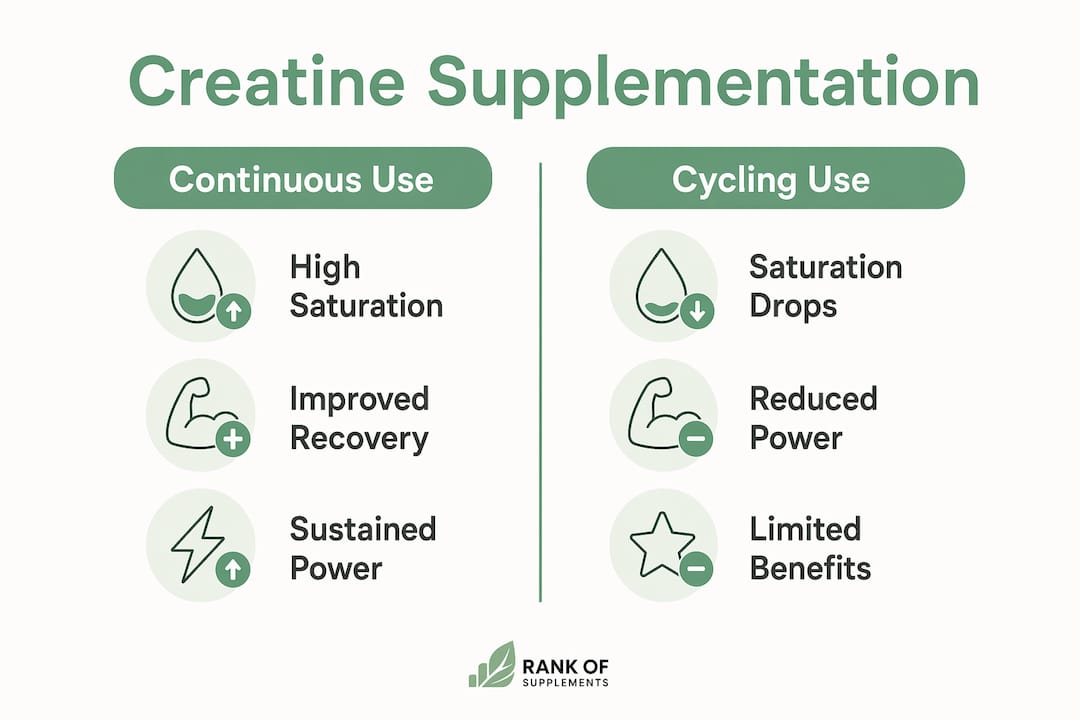
Maintaining high intramuscular phosphocreatine year-round is the key to performance edges like faster recovery and higher repeated power output. Cycling removes that edge for weeks at a time with no compensating benefit for most athletes.
Benefits and drawbacks of cycling creatine vs. continuous use
Continuous supplementation wins on performance metrics, but cycling has one narrow legitimate use case. Understanding both sides helps athletes make decisions based on their actual goals rather than gym folklore.
The case for continuous supplementation
Sustained creatine saturation delivers three concrete advantages. First, power output stays elevated across every training session, not just the ones that happen to fall during an “on” phase. Second, recovery benefits from creatine include reduced muscle damage and inflammation, which support training consistency over weeks and months. Third, cognitive function research increasingly links phosphocreatine availability to mental sharpness during fatigue, a benefit that disappears during off cycles.
The practical cost of cycling is also underappreciated. Athletes who cycle must manage two separate supplementation states, track their phase timing, and accept reduced performance during off periods. Continuous use at 3 to 5 grams per day requires no phase management at all.
When cycling might make sense
Weight-class athletes represent the one group where cycling has a defensible rationale. Some weight-sensitive athletes cycle off 4 to 6 weeks pre-competition to reduce water weight. Creatine draws water into muscle cells, and stopping supplementation can drop 1 to 2 kg of intracellular water weight. That matters in sports like wrestling, powerlifting with strict weight classes, or combat sports where making weight is a competitive requirement.
The trade-off is explicit. Water weight loss during cycling off reflects water, not fat loss. Power output and recovery speed both decline during the off phase. Athletes choosing this approach are trading performance capacity for a number on a scale.
Drawbacks of cycling creatine for most athletes:
- Reduced power output during desaturation phases
- Slower recovery between training sessions
- No hormonal or receptor-based benefit from the break
- Increased complexity in supplement management
- Risk of arriving at key competitions with depleted stores if timing is miscalculated
Pro Tip: If you compete in a weight-class sport and are considering a pre-competition creatine taper, plan the off phase to end at least two weeks before your event. Stores take time to rebuild, and you want full saturation on competition day, not during the week after.
For athletes focused on muscle recovery support, the evidence consistently favors keeping creatine stores topped up rather than cycling them down.
How to optimize creatine supplementation protocols for performance
The best creatine protocol is the one you will actually follow consistently. Here is how to structure it for maximum effect without unnecessary complexity.
-
Start with a loading phase if you want faster results. Take 20 grams per day divided into four 5-gram doses for five to seven days. This saturates muscle stores in roughly one week instead of three to four weeks. Loading is optional, not mandatory. Skipping it and going straight to maintenance simply delays full saturation.
-
Shift to a maintenance dose of 3 to 5 grams per day. This is the dose confirmed by the ISSN as both effective and safe for long-term daily use. Larger athletes or those with higher muscle mass may benefit from the upper end of that range. Smaller athletes or those new to creatine can start at 3 grams.
-
Take creatine with carbohydrates or protein. Insulin release from carbohydrate intake increases creatine uptake into muscle cells. A post-workout shake with carbs and protein is an effective delivery window. Timing matters less than consistency, but pairing with food improves absorption.
-
Stay hydrated. Creatine pulls water into muscle cells. Inadequate hydration can cause cramping or a bloated feeling, particularly during the loading phase. Aim for at least 2 to 3 liters of water daily while supplementing.
-
Monitor your personal response over the first four weeks. Some athletes are non-responders, meaning their baseline dietary creatine intake from meat and fish is already high enough that supplementation produces minimal additional saturation. Vegetarians and vegans typically see the largest performance gains because their baseline stores are lower.
-
Do not cycle off unless you have a specific weight-class reason. Stopping supplementation for general “reset” purposes has no physiological basis. If you want to assess your baseline performance without creatine, a structured break is fine, but do not expect any benefit beyond the data point.
-
Pair creatine with a broader recovery strategy. Creatine works best as part of a complete approach. Adequate sleep, protein intake, and consistent recovery routines amplify the gains that creatine enables. No supplement operates in isolation.
For athletes who want to understand how creatine fits into a full supplement stack, the creatine monohydrate guide at Rankofsupplements covers dosing, timing, and product selection in detail.
Key Takeaways
Continuous daily creatine supplementation at 3 to 5 grams maintains full muscle saturation, delivers sustained power and recovery benefits, and is confirmed safe long-term by the ISSN, making cycling unnecessary for most athletes.
| Point | Details |
|---|---|
| Cycling is not necessary | The ISSN confirms continuous daily use is safe and effective with no tolerance development. |
| Desaturation costs performance | Off cycles leave athletes with depleted phosphocreatine stores for up to 40% of training time. |
| Power gains require saturation | A 2026 study showed 8.4% mean power improvement, only achievable with full muscle stores. |
| Weight-class athletes are the exception | Cycling off 4 to 6 weeks pre-competition can drop 1 to 2 kg of water weight at a performance cost. |
| Maintenance dose is simple | 3 to 5 grams per day taken consistently, ideally with carbs or protein, is all most athletes need. |
The creatine cycling debate: what I actually see in practice
The cycling myth is one of the most persistent in sports nutrition, and I have watched it cost athletes real results for years. The pattern is always the same. An athlete reads something online, decides their body needs a “reset,” stops creatine for six weeks, then wonders why their strength numbers have dropped and their recovery feels sluggish. They attribute it to overtraining or sleep. It is almost never either of those things.
What makes this frustrating is that the science is not ambiguous. Creatine transporters do not downregulate. There is no hormonal axis involved. The cycling logic was borrowed wholesale from anabolic steroid protocols and applied to a compound that works through a completely different mechanism. The gym culture transmission of this idea has been remarkably durable despite having no biochemical foundation.
The athletes I have seen get the most out of creatine are the ones who treat it like they treat sleep or protein: a non-negotiable daily input, not something to periodize. They load once, shift to maintenance, and never think about it again. Their phosphocreatine stores stay full, their recovery is consistent, and their power numbers trend upward across months of training.
The one exception I take seriously is the weight-class athlete with a genuine need to make a specific number on a scale. That is a real constraint, and the water weight trade-off is worth calculating. But for the vast majority of fitness enthusiasts and general athletes, cycling creatine is a solution to a problem that does not exist.
If you want to get the most from your supplementation, check out the supplement cycling guide at Rankofsupplements. It covers which supplements actually benefit from cycling and which ones, like creatine, do not.
matteo
Rankofsupplements resources for smarter creatine use
Choosing the right creatine product and protocol should not require sorting through conflicting advice from supplement marketing.

Rankofsupplements provides science-backed reviews and rankings built on the same research standards covered in this article. The ingredient library includes a detailed creatine monohydrate profile covering absorption, dosing, and product quality markers. For athletes ready to act on what the research shows, the best creatine for beginners over 30 ranking cuts through the noise with evidence-based picks. Every review on the platform prioritizes transparency and clinical evidence over brand relationships.
FAQ
Does creatine cycling prevent tolerance?
No. Creatine transporters do not downregulate at recommended doses, so no tolerance develops from continuous daily intake. Cycling off provides no receptor-reset benefit.
How long does it take to lose creatine stores after stopping?
Muscle phosphocreatine stores return to baseline gradually over 4 to 6 weeks after stopping supplementation. Short breaks of a few days have negligible impact on stored levels.
Should I cycle creatine before a competition?
Only if you compete in a weight-class sport and need to reduce water weight. The trade-off is reduced power output and slower recovery during the off phase, which carries real performance risk near a key event.
What is the recommended daily dose for continuous use?
The ISSN recommends 3 to 5 grams per day for maintenance after an optional loading phase. This dose is confirmed safe for long-term use in healthy adults with no adverse kidney or liver effects.
Does creatine cycling help with water retention?
Stopping creatine can reduce intracellular water weight by 1 to 2 kg, but this reflects water loss, not fat loss. For most athletes, the minor water weight gain from creatine is outweighed by improved power output and recovery speed.
Recommended
- Related article: How to Cycle Supplements for Bodybuilding in 2026
- Top list: Best Creatine Supplements for Beginners Over 30
- Product review: Nutrigo Lab Strength Review
- Guide: Vitamins for Muscle Recovery: What Athletes Need to Know