
TL;DR:
“Clean label” means minimal, recognizable ingredients, but lacks a universal legal standard.
Clean label supplements often avoid synthetics but may have shorter shelf life and less consistent taste.
Effectiveness depends on formulation and evidence, not just label claims or ingredient transparency.
The supplement aisle has never been more crowded, and the phrase “clean label” has become one of the loudest buzzwords in the space. But here’s the uncomfortable truth: most people using that term can’t fully define it, and many brands exploit that confusion to charge premium prices for products that aren’t meaningfully different from conventional alternatives. Clean label doesn’t have a universal legal definition, which means a product can carry that identity based almost entirely on marketing. This guide cuts through the noise with science-backed analysis, real comparisons, and practical advice so you can make supplement choices grounded in evidence rather than packaging.
Table of Contents
Key Takeaways
Point Details
Clean label basics Clean label supplements use simple, recognizable ingredients but are not always more effective or safer.
Compare with evidence Scientific research does not prove clean label products perform better than conventional options.
Smart selection Choose supplements based on independent testing, ingredient transparency, and fit for your health needs.
Pros and trade-offs Clean label can offer clarity and less additives but may lack some benefits of more advanced formulations.
What are clean label supplements?
At its core, a clean label supplement is one formulated with minimal, recognizable ingredients and no artificial additives. Think short ingredient lists, names you can actually pronounce, and nothing that sounds like it belongs in a chemistry lab. The idea is transparency: you should know exactly what you’re putting in your body and why each ingredient is there.
But here’s where it gets tricky. There is no federal regulatory body that legally defines “clean label” for dietary supplements. The FDA regulates supplement safety and labeling accuracy, but it doesn’t certify or define “clean” as a category. That means any brand can slap “clean label” on their product without meeting a standardized set of criteria. The definition shifts depending on who you ask.
Some brands interpret clean label as:
-
No artificial colors, flavors, or sweeteners
-
No synthetic preservatives
-
No proprietary blends (so every ingredient and dose is disclosed)
-
Minimal excipients (fillers, binders, and flow agents)
-
Non-GMO or organic sourcing
Certifications like non-GMO Project Verified, Certified Gluten-Free, or NSF Certified for Sport are sometimes associated with clean label products, but they address specific concerns rather than the broader clean label concept. A product can be non-GMO and still contain artificial sweeteners. A gluten-free supplement can still use synthetic fillers. These certifications are useful data points, but they don’t automatically make something “clean.”
Consumer expectations also vary widely. Some shoppers define clean as vegan-friendly. Others focus purely on the absence of allergens. Still others prioritize organic sourcing above everything else. The lack of a shared definition creates fertile ground for misleading marketing.
Pro Tip: Always flip to the supplement facts panel and read the full ingredient list before buying. No front-of-label claim tells you more than what’s actually inside the product. When evaluating supplement rankings, ingredient transparency is one of the first filters worth applying.
What you’re really looking for is a product where every ingredient serves a clear, documented purpose. If you see a long list of additives with no obvious function, that’s worth questioning regardless of whether the label says “clean” or not.
How clean label compares to conventional supplements
Knowing what sets clean label apart, it’s key to compare them directly to regular supplements to understand what you’re actually gaining or giving up.
Conventional supplements often use a range of additives that serve real functional purposes. Synthetic preservatives extend shelf life. Artificial flavors make products more palatable. Binders and fillers help tablets hold their shape and ensure consistent dosing. Some of these additives, like certain emulsifiers, can actually improve how your body absorbs the active ingredients.
Clean label supplements, by contrast, avoid many of these synthetic components. That sounds like a clear win, but there are trade-offs. Without certain stabilizers, clean label products can degrade faster, taste less consistent, or require more careful storage. The absence of synthetic processing aids doesn’t automatically make a supplement more effective.

Here’s a structured look at the key differences:
Feature Clean label supplements Conventional supplements
Ingredient list Short, recognizable Longer, may include synthetics
Additives Minimal or none Stabilizers, fillers, artificial flavors
Shelf life Often shorter Typically longer
Taste/texture Less consistent More uniform
Bioavailability Not proven superior May benefit from advanced delivery
Certifications Varies by brand Varies by brand
Price Generally higher Generally lower
One area where this comparison gets particularly interesting is bioavailability, meaning how much of an ingredient your body actually absorbs and uses. Advanced delivery technologies like nanoencapsulation, which wraps nutrients in tiny carriers to improve absorption, are increasingly used in high-performance supplements. But these technologies often require processing methods and excipients that don’t fit clean label criteria. No direct empirical data shows superior bioavailability for clean label versus conventional supplements; enhancements like nanoencapsulation may require non-clean processing for better absorption.
That’s a critical point. If your goal is maximum nutrient uptake, a conventionally formulated supplement with advanced delivery technology might outperform a clean label version of the same product. The Primordial Vigor X review is a solid example of how formulation complexity can serve a real performance purpose.
The takeaway here isn’t that conventional is better. It’s that “clean” and “effective” aren’t synonyms, and the best choice depends on your specific goals and sensitivities.
Pros and cons: The real impact of choosing clean label
With the basic comparison covered, let’s go deeper into the actual upsides and downsides of clean label choices so you can weigh them against your own health priorities.
Advantages of clean label supplements:
-
Greater ingredient transparency so you know exactly what you’re consuming
-
Lower additive load which matters if you’re sensitive to certain synthetic compounds
-
Alignment with dietary preferences like vegan, paleo, or allergen-free lifestyles
-
Easier to cross-reference ingredients with clinical research
-
Reduced risk of hidden allergens from undisclosed compound ingredients
These are genuine benefits. For someone managing food sensitivities or following a strict dietary protocol, a clean label supplement removes a layer of uncertainty that a conventional product might introduce.
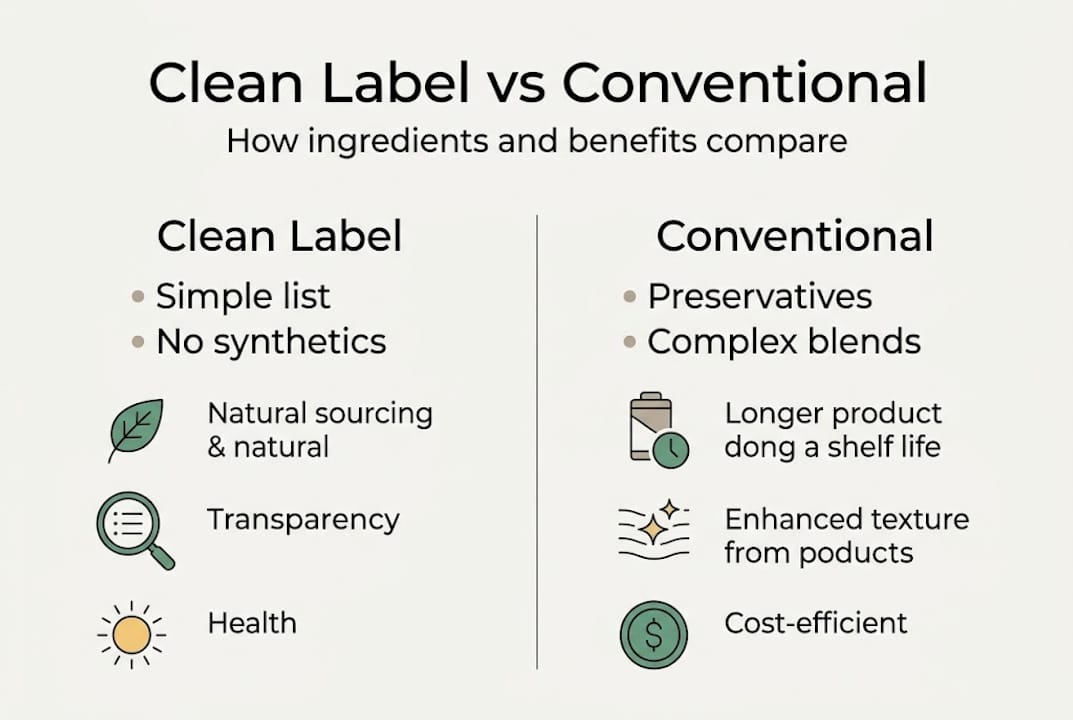
Drawbacks to consider:
Trade-off Clean label Conventional
Shelf stability Lower without preservatives Higher with stabilizers
Taste consistency Can vary batch to batch More predictable
Bioavailability Not proven superior May be enhanced by delivery tech
Cost Premium pricing common More budget-friendly
Efficacy evidence Often limited to ingredients May have full-formula studies
The science adds another layer of nuance here. Nanoencapsulation improves bioavailability of nutraceuticals but involves complex carriers that typically don’t qualify as clean label ingredients. This means that for certain nutrients, particularly fat-soluble vitamins and some antioxidants, a conventional supplement using advanced delivery may actually serve your body better.
It’s also worth noting that “clean” doesn’t automatically mean safe at any dose. Even naturally sourced ingredients can cause adverse effects in high amounts. Following safe supplement dosage guidelines is just as important with clean label products as with any other. You can also look at products like the Fibre Select review to see how a transparently formulated product balances simplicity with effectiveness.
Pro Tip: Before choosing a supplement based on its clean label status, write down your top three health goals. Then ask whether the clean label version actually supports those goals better, or whether you’re paying for a marketing identity rather than a functional upgrade.
When clean label matters most: Use cases and considerations
Understanding the pros and cons, here’s how to decide if and when clean label supplements are truly worth seeking out for your specific situation.
Clean label genuinely earns its value in certain contexts. If you have diagnosed food allergies, intolerances, or autoimmune sensitivities, a shorter, recognizable ingredient list significantly reduces your exposure risk. The fewer unknowns in a formula, the easier it is to identify any ingredient causing a reaction. For people following strict dietary frameworks like veganism, paleo, or kosher, clean label products are often the only ones that fit their criteria without requiring extensive research.
Situations where clean label is worth prioritizing:
-
You have known allergies or intolerances to common additives like carrageenan, titanium dioxide, or artificial dyes
-
Your diet excludes certain ingredient categories and you need full transparency
-
You’re supplementing during pregnancy or for children, where additive caution is heightened
-
You’re already eating a whole-food diet and want your supplements to align with that philosophy
-
You’re stacking multiple supplements and want to minimize your total synthetic additive load
On the other hand, there are scenarios where conventional supplements may be the smarter choice. Athletes chasing peak performance often benefit from formulas that use advanced bioavailability technology. People with clinically diagnosed deficiencies may need pharmaceutical-grade delivery systems that don’t fit clean label criteria. In medical supplementation contexts, efficacy data matters far more than ingredient aesthetics.
“Efficacy and safety in dietary supplements depend on the quality of the formulation, the evidence behind each ingredient, and manufacturing standards, not on whether the product carries a clean label identity.”
This perspective aligns with the research. No direct empirical evidence supports clean label as having superior bioavailability over all conventional supplements. If you’re evaluating a pre-workout or a strength formula, check out the Nutrigo Lab Strength review to see how ingredient quality and dosing transparency work together regardless of clean label status.
The honest answer is that clean label is a useful filter in specific situations, not a universal standard of quality.
How to choose clean label supplements wisely
Once you know when clean label matters, here’s how to make smart, safe choices in a crowded market without getting burned by clever branding.
Step-by-step checklist for evaluating clean label supplements:
-
Read the full ingredient list. Don’t stop at the front label. Every ingredient, including excipients, should be disclosed and purposeful.
-
Look for third-party testing. Certifications from NSF International, Informed Sport, or USP confirm that what’s on the label is actually in the bottle.
-
Check the dosing transparency. Proprietary blends hide individual ingredient amounts. A genuinely transparent product lists exact doses for every active ingredient.
-
Research the active ingredients independently. A clean label means nothing if the core ingredients lack clinical support. Verify that each ingredient has evidence behind it at the dose provided.
-
Evaluate the brand’s manufacturing standards. Look for GMP (Good Manufacturing Practice) certification. This applies to both clean label and conventional products.
-
Compare price against value. Clean label often commands a premium. Make sure that premium reflects genuine quality, not just positioning.
-
Watch for red flags. Vague claims like “support,” “all-natural,” or “chemical-free” without substantiation are marketing noise, not science.
Pro Tip: The word “natural” on a supplement label has no regulated definition in the US. An ingredient can be naturally derived and still be heavily processed. Focus on whether the ingredient has clinical evidence, not whether it sounds wholesome.
When ranking supplements effectively, the most credible products combine transparent labeling with third-party verification and published ingredient research. Products like the Lean Bliss review show how a well-formulated product communicates its value through evidence rather than buzzwords.
The market rewards savvy shoppers who ask hard questions. Don’t let a clean label identity substitute for the due diligence that every supplement purchase deserves.
A fresh perspective on clean label choices
Here’s something the wellness industry rarely admits: many of the most effective, well-researched supplements on the market are not clean label by any strict definition. They use encapsulation technologies, stabilizers, or delivery agents that a clean label purist would reject. And yet they consistently outperform simpler formulas in clinical outcomes.
That doesn’t mean clean label is a scam. It means the conversation has been framed incorrectly. Clean label is a useful proxy for transparency, and transparency is genuinely valuable. But transparency is a starting point, not a finish line. Knowing what’s in your supplement is only useful if what’s in it actually works.
The real problem is that “clean” has become a trust signal that bypasses critical thinking. Consumers see a short ingredient list and assume quality. Brands know this and price accordingly. The result is a market where clean label identity is sometimes more about premium positioning than proven outcomes.
What we advocate for at RankOfSupplements.com is a higher standard: demand both transparency and evidence. Ask for the clinical data behind each ingredient. Ask whether the dose matches what research supports. Ask whether the product has been independently tested. These questions apply equally to clean label and conventional supplements.
The brands worth trusting are the ones that can answer all of those questions clearly, regardless of what their label says. Choosing evidence-backed supplement choices over trend-driven ones is the most reliable path to results that actually show up in your health.
Explore top-rated clean label supplements for your goals
You now have a solid framework for evaluating clean label supplements on their actual merits. The next step is finding products that hold up under that scrutiny, and that’s exactly what RankOfSupplements.com is built to help you do.
Our team analyzes supplements using science-backed criteria: ingredient transparency, clinical evidence, third-party testing, and real-world user outcomes. Whether you’re looking for clean label options that genuinely deliver or conventional formulas with superior bioavailability, our curated rankings save you the research time. Explore our eye health supplements rankings for a category where ingredient quality is especially critical. Or check out detailed breakdowns like Nutrigo Lab Strength and Fibre Select to see how top-rated products stack up across the criteria that actually matter for your wellness goals.
Frequently asked questions
Are clean label supplements always safer than conventional supplements?
No, clean label supplements are not always safer. Safety depends on the full formulation, ingredient quality, and manufacturing standards. No direct empirical evidence supports the superiority of clean labels for safety or efficacy over conventional alternatives.
Do clean label supplements work better than regular supplements?
Not necessarily. Clean label supplements aren’t shown to outperform conventional ones in absorption or effect. No direct empirical data shows superior bioavailability for clean label versus conventional formulas.
Can athletes benefit from choosing clean label supplements?
Athletes may value clean label products for ingredient transparency, but top performance formulas sometimes require advanced delivery systems that use non-clean carriers to maximize bioavailability and effect.
What should I watch out for when buying clean label supplements?
Always check for independent third-party testing, read the complete ingredient list including excipients, and be skeptical of vague claims like “all-natural” or “chemical-free” that have no regulatory definition or scientific backing.