
TL;DR:
- A natural testosterone booster supports the body’s own hormone production through lifestyle, nutrition, and herbal supplements. Lifestyle changes like weight loss and sleep optimization have the strongest scientific evidence, while supplements often do not significantly raise testosterone in healthy men. Correcting deficiencies in vitamin D or zinc can yield measurable increases, but most commercial boosters lack substantial effectiveness.
A natural testosterone booster is any non-synthetic method that supports the body’s own testosterone production, including lifestyle changes, targeted nutrition, and herbal supplements. Testosterone declines at 0.4% to 1.6% per year after age 30, which means the cumulative drop over a decade is real and measurable. For men dealing with low energy, reduced muscle mass, or declining libido, understanding what actually works is the first step. This guide cuts through the marketing noise and focuses on what the evidence actually supports.
What is a natural testosterone booster and how does it work?
A natural testosterone booster works by removing barriers to testosterone production or by supplying the raw materials the body needs to make it. Testosterone synthesis depends on adequate sleep, healthy body weight, micronutrient availability, and hormonal signaling. When any of these inputs are deficient, testosterone output drops. Natural boosters address those deficiencies rather than introducing synthetic hormones from outside.
The term “natural testosterone booster” covers three broad categories. The first is lifestyle interventions: sleep, exercise, and weight management. The second is nutritional correction: fixing deficiencies in zinc, vitamin D, and magnesium. The third is herbal and dietary supplements: ingredients like fenugreek, Tribulus terrestris, and D-aspartic acid. Each category has a different level of scientific support, and knowing the difference matters before you spend money or change your routine.
Lifestyle interventions have the strongest evidence. Weight loss outperforms supplements as the most effective natural approach for men with excess body weight. Supplements, by contrast, work best as adjuncts to correct specific nutritional gaps rather than as standalone solutions. If you want to learn more about testosterone after 50, the hormonal picture shifts further and the interventions need to be more targeted.
What are the most effective natural ways to boost testosterone?
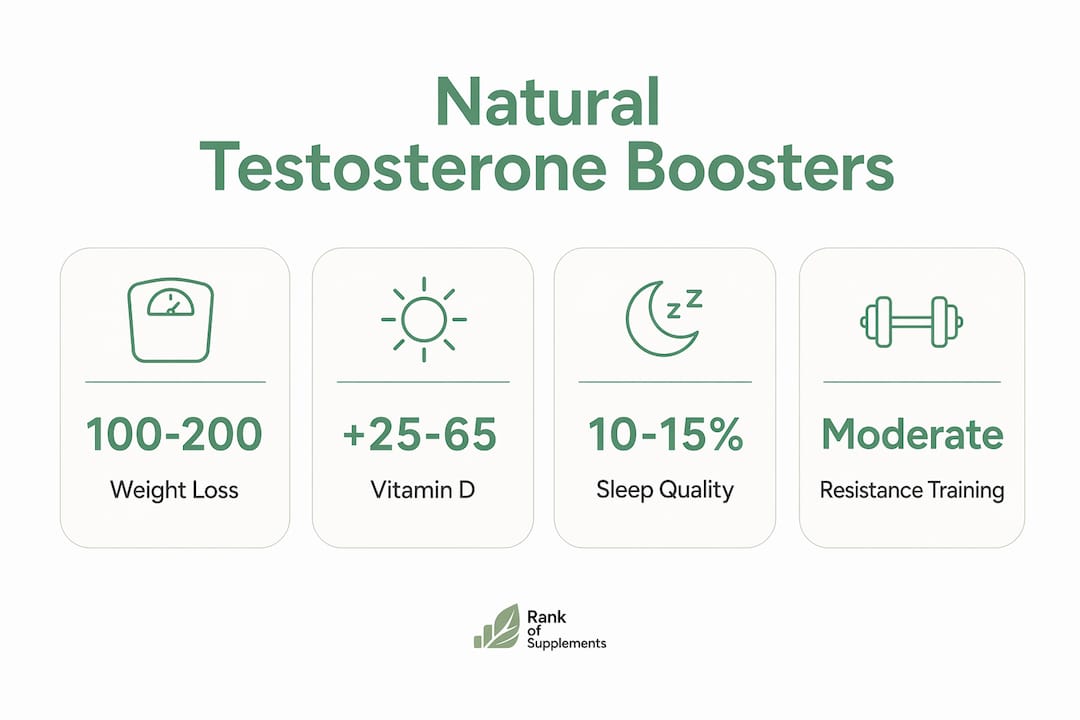
Weight loss is the single most powerful natural testosterone intervention for overweight men. Losing 10% or more of body weight in men with a BMI of 27 or higher can raise testosterone by 100 to 200 ng/dL within 3 to 12 months. That is a clinically meaningful increase, equivalent to what some low-dose hormone therapies produce.
Resistance training and exercise
Resistance training raises testosterone both acutely after each session and modestly over time through improved lean body mass. Compound movements like squats, deadlifts, and bench press produce the largest hormonal response. High-intensity interval training (HIIT) also triggers a short-term testosterone spike. Chronic endurance cardio at high volumes, however, can suppress testosterone, so balance matters.

Sleep quality
Sleep deprivation reduces testosterone production by 10 to 15%. Most testosterone release happens during deep sleep, particularly in the early morning hours. Men who consistently sleep fewer than 6 hours per night show measurably lower morning testosterone levels. Fixing sleep is free, requires no supplements, and delivers results faster than most dietary changes.
Vitamin D and zinc correction
Correcting vitamin D deficiency in men with low serum 25-OH-D levels can increase testosterone by 25 to 65 ng/dL within 3 to 6 months. Zinc deficiency directly impairs testosterone synthesis because zinc is a cofactor in the enzymatic pathway that produces testosterone. Both nutrients are worth testing before supplementing, since excess zinc and vitamin D carry their own risks.
| Natural method | Impact magnitude | Onset time |
|---|---|---|
| Weight loss (10%+ body weight) | High (100 to 200 ng/dL) | 3 to 12 months |
| Resistance training | Moderate (acute + chronic) | 4 to 8 weeks |
| Sleep optimization (7 to 9 hours) | Moderate (10 to 15% recovery) | 1 to 2 weeks |
| Vitamin D correction | Moderate (25 to 65 ng/dL) | 3 to 6 months |
| Zinc correction | Low to moderate | 4 to 8 weeks |
Pro Tip: Get a full hormone panel and micronutrient test before starting any supplement. Correcting a confirmed deficiency produces far better results than taking a broad-spectrum booster without knowing your baseline.
Are natural testosterone booster supplements effective and safe?
Most supplements marketed as testosterone boosters do not significantly raise serum testosterone in healthy men. A systematic review of 52 studies found that commercial boosters fail to produce meaningful increases in total testosterone for men with normal baseline levels. What many of these products do instead is improve libido, mood, or energy, which feels like a hormonal change but is not the same thing.
What the evidence says about popular ingredients
The evidence base varies widely across common ingredients:
- Zinc: Supported for men with confirmed zinc deficiency. No significant effect in men with adequate zinc levels.
- Vitamin D3: Supported when correcting deficiency. Supplementing in men with normal levels shows little benefit.
- Fenugreek: Mixed evidence. Some trials show modest improvements in libido and free testosterone; others show no effect on total testosterone.
- Tribulus terrestris: Largely unsupported for raising testosterone. May improve sexual function through non-hormonal pathways.
- D-aspartic acid (DAA): Inconsistent results. Some trials at 2.66g to 6g doses showed no effect or even a decrease in testosterone at higher doses.
- Maca root: No direct effect on testosterone. Improves libido and energy through separate mechanisms.
- Ashwagandha: Moderate support. Reduces cortisol, which indirectly supports testosterone in stressed men.
The pattern is clear. Ingredients that correct a deficiency or reduce a suppressor (like cortisol) tend to work. Ingredients marketed as direct testosterone stimulants rarely deliver what the label implies.
Safety and risks
Herbal testosterone boosters are generally low-risk when used as directed, but underdosed herbal supplements are a real problem in the industry. Many products contain active ingredients at doses far below what clinical trials used. That means you may be paying for a product that cannot physiologically do what it claims. Checking for third-party testing and transparent labeling is non-negotiable when selecting any supplement.
Pro Tip: Look for supplements that list exact milligram amounts per ingredient, not proprietary blends. A proprietary blend hides individual doses and makes it impossible to verify clinical relevance.
How do diet and nutrition support natural testosterone production?
Diet directly affects testosterone through macronutrient balance and micronutrient availability. Healthy diets rich in protein, healthy fats, magnesium, and zinc consistently correlate with better testosterone levels in nutritional studies. Crash diets and severe caloric restriction, by contrast, suppress testosterone even in lean men.
Macronutrients and hormone production
Dietary fat is the structural precursor to testosterone. Cholesterol, derived from dietary fats, is the raw material the body uses to synthesize all steroid hormones, including testosterone. Men on very low-fat diets show lower testosterone levels than men eating adequate fat. Protein supports lean muscle mass and reduces body fat, both of which indirectly support testosterone. Carbohydrates fuel intense training sessions, and cutting them too aggressively can impair workout performance and blunt the hormonal response to exercise.
Key micronutrients and food sources
Specific foods deliver the micronutrients testosterone production depends on most directly.
| Nutrient | Top food sources | Testosterone-related benefit |
|---|---|---|
| Zinc | Oysters, beef, pumpkin seeds | Cofactor in testosterone synthesis |
| Vitamin D | Fatty fish, egg yolks, fortified milk | Supports Leydig cell function |
| Magnesium | Spinach, almonds, dark chocolate | Reduces SHBG, increasing free testosterone |
| Healthy fats | Avocado, olive oil, whole eggs | Provides cholesterol for steroid synthesis |
| Antioxidants | Berries, leafy greens, tomatoes | Reduces oxidative stress in testicular tissue |
What to avoid
Excess sugar and ultra-processed foods raise insulin and promote fat gain, both of which suppress testosterone. Alcohol, even at moderate levels, impairs testosterone synthesis in the testes. Soy-based foods in very large quantities may affect estrogen signaling, though normal dietary amounts are not a concern for most men. The dietary strategy for testosterone is not complicated: eat whole foods, get enough fat and protein, and avoid chronic caloric extremes.
What lifestyle habits influence testosterone beyond supplements?
Chronic stress is one of the most underrated testosterone suppressors. Cortisol and testosterone operate on a seesaw: when cortisol rises, testosterone falls. Men in high-stress jobs or with untreated anxiety often show lower testosterone levels even when their diet and exercise are solid. Stress management through practices like meditation, structured recovery days, and adequate social connection directly supports hormonal health.
Circadian rhythm alignment matters more than most men realize. Testosterone peaks in the early morning and follows a predictable daily cycle tied to sleep timing. Shift workers and men with irregular sleep schedules show disrupted testosterone patterns even when total sleep hours are adequate. Going to bed and waking at consistent times protects this cycle.
Several common habits actively suppress testosterone:
- Alcohol: Regular heavy drinking reduces testosterone production and increases estrogen conversion.
- Smoking: Tobacco use impairs testicular function and increases oxidative stress in hormone-producing cells.
- Excess endurance cardio: Marathon-level training volumes chronically suppress testosterone without adequate recovery.
- Sedentary behavior: Long periods of sitting reduce circulation and metabolic rate, both of which affect hormone production.
- Chronic undereating: Sustained caloric deficits signal the body to downregulate non-essential functions, including testosterone production.
- Plastics and endocrine disruptors: BPA and phthalates found in some plastics interfere with hormone signaling. Reducing plastic food and drink containers lowers exposure.
The most effective approach combines multiple habits rather than relying on any single change. Sleep, weight management, resistance training, and stress control each contribute independently. Together, they create conditions where the body produces testosterone at its natural ceiling.
Key takeaways
Lifestyle interventions are the most evidence-backed natural testosterone boosters, and supplements work best when correcting confirmed deficiencies rather than acting as standalone solutions.
| Point | Details |
|---|---|
| Weight loss leads results | Losing 10%+ body weight can raise testosterone by 100 to 200 ng/dL within 3 to 12 months. |
| Sleep is non-negotiable | Sleep deprivation cuts testosterone by 10 to 15%; consistent 7 to 9 hours is a free and fast fix. |
| Most supplements underdeliver | Commercial boosters rarely raise serum testosterone significantly in healthy men. |
| Deficiency correction works | Fixing low vitamin D or zinc produces measurable testosterone gains in deficient men. |
| Diet sets the foundation | Adequate fat, protein, zinc, and magnesium are the nutritional floor for testosterone production. |
Why I think most men are solving the wrong problem
After years of reviewing supplement research and tracking what actually moves the needle for men concerned about testosterone, the pattern is hard to ignore. The supplement industry has done a masterful job of convincing men that low energy and reduced drive are primarily a testosterone problem that a pill can fix. The reality is more uncomfortable.
Most men who come to this topic are not clinically deficient. They are sleep-deprived, overstressed, carrying excess weight, and eating poorly. Those four factors alone explain the majority of testosterone complaints I see reflected in the research. A fenugreek capsule cannot undo 6 hours of sleep per night or a diet built on processed food.
The men who see the best results from natural testosterone enhancement are the ones who treat supplements as the last 10% of a solid lifestyle, not the foundation. They fix sleep first, then weight, then training, then nutrition. By the time they add a targeted supplement to correct a confirmed deficiency, the lifestyle work has already done most of the heavy lifting.
My honest advice: get your testosterone and micronutrient levels tested before buying anything. If your vitamin D is at 18 ng/mL, a D3 supplement will likely help. If your levels are normal and you are still fatigued, the answer is almost certainly in your sleep, stress, or diet, not in a bottle. Consult a physician or endocrinologist if you suspect a clinical issue. Natural strategies work well for functional decline, but primary hypogonadism requires medical treatment, not lifestyle tweaks.
matteo
Rankofsupplements can help you choose the right supplement
Sorting through hundreds of testosterone-related supplements is time-consuming, and the marketing claims rarely match the clinical evidence.
Rankofsupplements publishes science-backed reviews and rankings built on ingredient-level analysis. The Supplement Ingredient Library breaks down every major testosterone-related ingredient, including zinc, ashwagandha, fenugreek, and vitamin D3, with evidence ratings and dosage context. For men ready to compare specific products, the best testosterone supplements rankings cut through the noise with transparent scoring. Whether your goal is hormone balance, muscle support, or energy, Rankofsupplements gives you the data to make a confident, informed choice.
Recommended
- Related article: How to Increase Testosterone Levels After 50
- Top list: Best Testosterone Supplements 2026
- Specific product: Primordial Vigor X Review
- Guide: Top 5 Supplements to Boost Testosterone and Energy Naturally
FAQ
What is a natural testosterone booster, exactly?
A natural testosterone booster is any non-synthetic method that supports the body’s own testosterone production, including lifestyle changes, dietary adjustments, and herbal or nutritional supplements. Unlike hormone replacement therapy, these approaches work with the body’s existing pathways rather than introducing external hormones.
Do natural testosterone boosters actually work?
Lifestyle-based boosters like weight loss, resistance training, and sleep optimization have strong clinical support. Most commercial supplement products, however, fail to raise serum testosterone significantly in healthy men, though some improve libido or energy through non-hormonal mechanisms.
Which supplement ingredients have the best evidence for testosterone?
Zinc and vitamin D3 have the strongest evidence, but only in men with confirmed deficiencies. Ashwagandha shows moderate support by reducing cortisol. D-aspartic acid and Tribulus terrestris have inconsistent or weak evidence for raising total testosterone.
How long does it take to see results from natural testosterone boosters?
Sleep improvements can show hormonal effects within 1 to 2 weeks. Weight loss and vitamin D correction take 3 to 12 months to produce measurable testosterone increases. Supplement effects, where they exist, typically appear within 4 to 8 weeks of consistent use.
When should I see a doctor about low testosterone?
See a physician if you have symptoms like severe fatigue, loss of muscle mass, depression, or sexual dysfunction alongside a confirmed low testosterone reading. Primary hypogonadism requires medical treatment and does not respond adequately to lifestyle or supplement interventions alone.