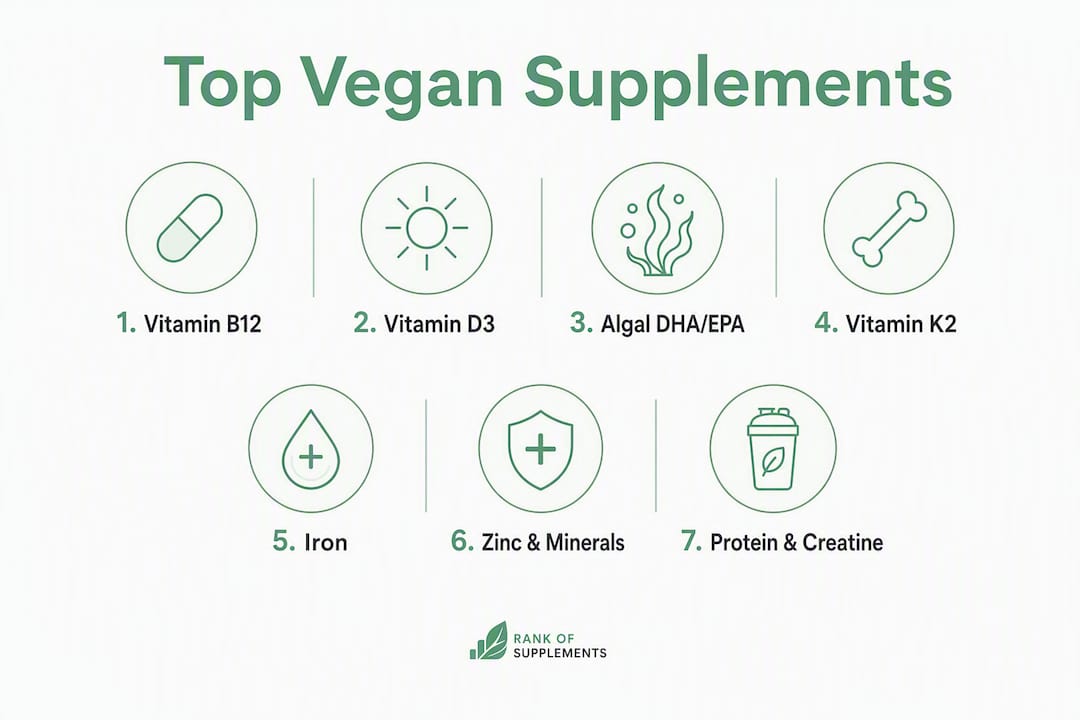
Every vegan needs B12 and vitamin D3 without exception. After those two, algal DHA/EPA, vitamin K2 (MK-7), and iodine round out the non-negotiables for most people. Iron, zinc, calcium, selenium, and creatine belong on your list only after testing or if you fall into a clear risk group. Here is the priority order:
Non-negotiable for all vegans:
- Vitamin B12 (methylcobalamin or cyanocobalamin): a daily or weekly dose as commonly recommended
- Vitamin D3 (lichen-derived): test first; typically a moderate daily dose for maintenance, with higher doses used if insufficiency is detected
- Algal DHA/EPA: a daily dose suitable for general health; higher doses may be used for specific cardiac or cognitive support
- Iodine: a daily dose recommended if iodized salt is not used regularly
Highly recommended (test or assess first):
- Vitamin K2 (MK-7): a daily dose in a range often recommended, especially when supplementing D3
- Iron: ferrous bisglycinate only if ferritin is low; confirm with labs
- Zinc: a daily elemental zinc amount commonly suggested, preferably in chelated form
Situational or optional:
- Calcium: prioritize food sources; consider supplementing if dietary intake appears low
- Selenium: a daily amount typically recommended if Brazil nuts are not consumed regularly
- Plant protein powder: when food doesn’t cover your protein targets
- Creatine: 3 to 5 g/day if you train or want cognitive support
Start here: Get a baseline blood panel that includes serum B12, 25(OH)D, ferritin, CBC, and a thyroid panel before adding anything beyond B12 and D3. Those two you can start today, no labs required.
Table of Contents
- Top vegan supplements 2026: at a glance
- ## 1. Vitamin B12: the one supplement every vegan must take
- ## 2. Vitamin D3 (lichen-derived): test before you dose
- ## 3. Algal DHA/EPA: why flax seeds aren’t enough
- ## 4. Vitamin K2 (MK-7): the supplement that makes D3 safer
- ## 5. Iron: test first, supplement second
- ## 6. Zinc, calcium, iodine, and selenium: the four minerals vegans often miss
- ## 7. Plant protein powder and creatine: when food isn’t enough
- How to choose a quality vegan supplement
- How to build a smart vegan supplement routine
- How long supplements take to work and what they cost in the U.S.
- Red flags and when to see a clinician
- Key Takeaways
- The case for testing before stacking
- What Rankofsupplements recommends for vegan nutrition
- Useful sources and further reading
- FAQ
Top vegan supplements 2026: at a glance
The table below gives you a fast reference for every supplement covered in this guide.
| Supplement | Main role | Recommended vegan form | Typical dose | Monitoring note |
|---|---|---|---|---|
| Vitamin B12 | Nerve function, DNA synthesis, red blood cells | Methylcobalamin or cyanocobalamin | 1,000 mcg/day or 2,500 mcg/week | Serum B12, MMA, homocysteine |
| Vitamin D3 | Bone health, immune function, mood | Lichen-derived D3 | 1,000 to 4,000 IU/day | 25(OH)D every 6 months |
| Omega-3 (DHA/EPA) | Brain, heart, inflammation | Algal oil | 250 to 1,000 mg DHA/day | Omega-3 index (optional) |
| Vitamin K2 | Calcium routing, bone, vascular health | MK-7 (menaquinone-7) | 150 mcg/day | Consult clinician if on warfarin |
| Iron | Oxygen transport, energy | Ferrous bisglycinate | Clinician-guided only | Ferritin, CBC, TIBC |
| Zinc | Immunity, enzyme function | Zinc bisglycinate or picolinate | 8 mg/day elemental | Serum zinc if symptomatic |
| Calcium | Bone structure | Food-first; calcium citrate if needed | 500 mg/day supplement max | Dietary assessment |
| Iodine | Thyroid hormone production | Potassium iodide (not kelp) | 150 mcg/day | TSH, free T4 if symptomatic |
| Selenium | Antioxidant, thyroid support | Selenomethionine | 55 mcg/day | Serum selenium if at risk |
| Creatine | Muscle energy, cognitive function | Creatine monohydrate (vegan) | 3 to 5 g/day | None required |
| Plant protein | Muscle maintenance, satiety | Pea, rice, or hemp blend | 20 to 40 g/serving as needed | Dietary protein tracking |
## 1. Vitamin B12: the one supplement every vegan must take
B12 is a well-recognized nutritional gap in a plant-based diet. No whole plant food reliably delivers enough of it. Deficiency develops slowly and, if untreated, can lead to neurological issues.

Which form? Methylcobalamin is the active coenzyme form and the preferred choice for most people. Cyanocobalamin is cheaper, well-studied, and works fine for the majority of healthy adults. The practical difference between them is small for most vegans; what matters far more is actually taking one consistently.
Dosing:
- Maintenance (daily): 250 to 1,000 mcg cyanocobalamin or methylcobalamin
- Maintenance (weekly): 2,500 mcg once weekly
- Repletion (confirmed deficiency): 1,000 to 2,000 mcg daily for 4 to 8 weeks, then retest
- Sublingual tablets dissolve under the tongue and can bypass gastric intrinsic factor, which matters for anyone with absorption issues or older adults
How to test: Ask your clinician for serum B12, methylmalonic acid (MMA), and homocysteine. Serum B12 alone can look normal even when functional deficiency exists. MMA and homocysteine are more sensitive. Retest 8 to 12 weeks after starting or changing a dose.
Statistic callout: Research indicates vegans who do not supplement B12 have a notably higher risk of deficiency compared to omnivores.
Nutritional yeast is often cited as a B12 source, but only fortified varieties count, and the amount per serving varies widely by brand. Spirulina and fermented foods do not provide bioavailable B12. Supplement.
## 2. Vitamin D3 (lichen-derived): test before you dose
Many individuals have low vitamin D status, and vegans face the challenge that standard D3 supplements are often derived from lanolin (sheep’s wool). Lichen-derived D3 is a vegan-certified alternative that raises serum 25(OH)D levels effectively.
Statistic callout: The Endocrine Society defines vitamin D insufficiency and deficiency based on 25(OH)D blood levels with recommended target ranges for adults.
Dosing by status:
- Maintenance (25(OH)D above 40 ng/mL): 1,000 to 2,000 IU/day
- Insufficiency (20 to 30 ng/mL): 2,000 to 4,000 IU/day
- Deficiency (below 20 ng/mL): 4,000 IU/day or clinician-guided higher dose; retest in 8 to 12 weeks
Take D3 with your largest meal of the day. It is fat-soluble, so absorption improves meaningfully with dietary fat. Pair it with vitamin K2 (MK-7) when supplementing at higher doses; more on that in the K2 section.
Retest 25(OH)D every 6 months until stable, then annually. If you live north of roughly 37° latitude (think Chicago, Denver, or anywhere north of that line), assume near-zero sun synthesis from October through March and dose accordingly.
## 3. Algal DHA/EPA: why flax seeds aren’t enough
Flaxseed, chia, and walnuts supply ALA, a short-chain omega-3 fatty acid. However, conversion of ALA to the longer-chain EPA and DHA used by the brain and cardiovascular system is very limited in most adults. Eating a tablespoon of flaxseed daily does not meaningfully raise your DHA levels.

Algae is where fish get their omega-3s in the first place. Algal oil supplements cut out the middleman and deliver preformed DHA and EPA directly.
Dosing:
- General health doses usually start at a moderate daily amount of DHA
- Higher combined DHA+EPA doses may be used for cognitive or cardiac support
- Pregnancy/lactation: 300 to 600 mg DHA/day (consult your OB or midwife)
What to look for when buying:
- Triglyceride form absorbs better than ethyl ester form
- Check for third-party oxidation testing; rancid fish or algal oil is a real problem
- Store in the refrigerator after opening
- Look for NSF or USP certification on the label
Pro Tip: Take algal oil with your fattiest meal of the day. Absorption can increase by 50% or more when omega-3s are consumed alongside dietary fat, compared to taking them on an empty stomach.
## 4. Vitamin K2 (MK-7): the supplement that makes D3 safer
When you supplement vitamin D3, your body absorbs more calcium from food. That calcium needs somewhere to go. MK-7 activates proteins that direct calcium into bone and away from arterial walls. Skip K2 while taking higher-dose D3 and you may be routing calcium in the wrong direction.
MK-7 (menaquinone-7) is the preferred form over MK-4. It has a longer half-life in the body, meaning a single daily dose maintains active levels throughout the day, and research supports its role in maintaining carboxylation of osteocalcin, the protein that binds calcium to bone matrix.
Dosing: A daily MK-7 dose within a typical recommended range; most individuals do well with moderate amounts taken with D3 and a fat-containing meal.
Critical interaction: If you take warfarin or any other vitamin K antagonist anticoagulant, do not add K2 without talking to your prescribing clinician first. K2 affects clotting factor activity and can alter your INR. This is a hard stop, not a soft caution.
Vegans are particularly low in K2 because the richest food sources are fermented animal products (like cheese and certain fermented meats). Natto is the one plant-based exception, with very high MK-7 content, but it is an acquired taste and not a staple for most Americans.
## 5. Iron: test first, supplement second
Iron is the supplement most likely to cause harm when taken without clinical indication. Excess iron is pro-oxidant, and supplementing without confirmed deficiency can raise ferritin to levels associated with increased oxidative stress.
Who is actually at risk: Groups such as premenopausal women, pregnant individuals, athletes with high training volumes, and persons with specific health conditions may have higher iron needs.
Before you supplement:
- Get ferritin, serum iron, total iron-binding capacity (TIBC), and a CBC
- Ferritin below 30 ng/mL typically indicates depleted stores; below 12 ng/mL is frank deficiency
- A clinician should interpret results in context, not just against a reference range
If supplementation is indicated:
- Preferred form: Ferrous bisglycinate (gentler on the GI tract than ferrous sulfate, and better absorbed in plant-forward diets)
- Dose: A clinician-guided elemental iron dose may be recommended for repletion.
- Pair with: 250 to 500 mg vitamin C at the same time to enhance non-heme iron absorption
- Avoid taking with: Coffee, tea, calcium supplements, or high-phytate foods within 1 to 2 hours
- Retest: Ferritin and CBC at 8 to 12 weeks
Red flags that need urgent evaluation: extreme fatigue, pallor, shortness of breath at rest, heart palpitations, or pica (craving non-food items like ice or clay). These warrant a clinician visit, not a supplement purchase.
## 6. Zinc, calcium, iodine, and selenium: the four minerals vegans often miss
These four don’t get the same attention as B12 or D3, but gaps are common and the consequences are real.
Zinc Plant foods contain zinc, but phytates in whole grains and legumes bind to it and reduce how much you actually absorb. Chelated forms like zinc bisglycinate or zinc picolinate sidestep this problem. Dose levels commonly suggested differ by gender; long-term excess intake should be avoided to prevent nutrient imbalances. Soaking and sprouting legumes reduces phytate content meaningfully.
Calcium A well-planned vegan diet can cover calcium needs through fortified plant milks, tofu made with calcium sulfate, kale, bok choy, and white beans. Supplement only if dietary intake appears insufficient based on assessment. If you do supplement, calcium citrate absorbs better than calcium carbonate, especially if stomach acid is low. Cap any single supplement dose at 500 mg; the body absorbs smaller doses more efficiently. Check out magnesium alongside calcium for bone health, since the two minerals work together.
Iodine This one catches many vegans off guard. Seaweed is unreliable because iodine content varies wildly by species and harvest location. Kelp tablets can deliver 10 to 20 times the safe upper limit in a single dose. Potassium iodide is the predictable, safe form. Dose: a moderate daily amount typically recommended if iodized salt is not regularly used. Test with TSH and free T4 if you have thyroid symptoms.
Selenium Brazil nuts are the famous food source, but one nut can contain anywhere from 68 to 91 mcg of selenium, and some batches from selenium-poor soil contain far less. A moderate daily selenomethionine dose is commonly used; excessive intake can cause toxicity with symptoms such as hair loss and digestive issues. Don’t stack multiple selenium sources without tracking total intake.
## 7. Plant protein powder and creatine: when food isn’t enough
Protein powder Most vegans who eat varied whole foods hit adequate protein without a supplement. The threshold shifts for athletes, older adults losing muscle mass, and anyone recovering from illness or surgery. If your food-based protein falls below 1.2 to 1.6 g per kilogram of body weight and you’re training regularly, a plant protein powder fills the gap efficiently.
Pea protein has the strongest evidence base among plant proteins for muscle protein synthesis. A pea-rice blend covers the amino acid profile more completely than either alone. Look for products that list amino acid profiles on the label and carry third-party testing for heavy metals; independent testing has found elevated lead and cadmium in some plant protein powders, particularly brown rice protein.
Creatine Vegans tend to have lower baseline muscle creatine stores than omnivores because creatine is found almost exclusively in meat and fish. Supplementation at 3 to 5 g/day can restore stores and has shown benefits for strength, recovery, and some cognitive measures in vegan populations. Creatine monohydrate is the most studied form and the most affordable. There is no meaningful advantage to “enhanced” forms like creatine HCl or buffered creatine for most users.
Dosing notes:
- Protein: 20 to 40 g per serving, timed around training or as a meal supplement
- Creatine: 3 to 5 g/day; loading (20 g/day for 5 to 7 days) speeds saturation but isn’t necessary
- No creatine cycling needed; daily use is safe long-term for healthy adults
How to choose a quality vegan supplement
The label tells you a lot if you know what to read. Here is a practical checklist:
- Check the form, not just the nutrient. Methylcobalamin, lichen D3, algal DHA, MK-7, ferrous bisglycinate, zinc bisglycinate, selenomethionine. Generic forms are cheaper but often less bioavailable.
- Look for third-party seals. USP, NSF International, and ConsumerLab each verify that a product contains what the label claims, at the stated dose, without dangerous contaminants. NSF Certified for Sport adds testing for banned substances if you compete.
- Verify vegan certification. “Vegan-friendly” on marketing copy means nothing. Look for the Certified Vegan logo (Vegan Action) or Non-GMO Project verification.
- Check the expiry date and batch code. Oils (algal, vitamin E) degrade fastest. Buy from retailers with high turnover and store oils in the refrigerator.
- Read the “other ingredients” list. Magnesium stearate, silicon dioxide, and most capsule materials are fine. Watch for hidden gelatin capsules, carmine (red coloring from insects), and lanolin-derived D3 in products marketed as vegan.
- Understand multivitamin limits. A good vegan multi covers B12, D3, iodine, zinc, and selenium in reasonable doses. It cannot adequately cover long-chain omega-3s or therapeutic iron. Use it as a safety net, not a complete solution.
- Avoid proprietary blends for minerals. When a label lists a “mineral complex” without individual amounts, you cannot verify you’re getting a meaningful dose of anything.
Pro Tip: Use the Rankofsupplements supplement buying guide to cross-reference label claims against third-party test results before purchasing. A $10 price difference between two B12 products often disappears when you factor in actual dose delivered.
How to build a smart vegan supplement routine
Priority order for starting:
- Start immediately (no labs needed): B12 and lichen D3 at maintenance doses
- Add after baseline labs: Iron (if ferritin is low), zinc (if dietary intake is poor), iodine (if not using iodized salt)
- Add alongside D3: K2 as MK-7, especially at doses above 2,000 IU/day
- Add based on goals: Algal DHA/EPA (most vegans benefit), creatine (athletes and older adults), plant protein (if food intake is insufficient)
Sample daily routine with timing:
- Morning with breakfast (fat-containing meal): D3 (lichen-derived) + K2 (MK-7) + algal DHA/EPA
- Morning or evening: B12 (sublingual or standard tablet)
- With lunch or dinner: Zinc bisglycinate (away from calcium and iron)
- With dinner: Iron bisglycinate + vitamin C (if clinically indicated; separate from zinc by 2+ hours)
- Post-workout or with any meal: Creatine monohydrate 3 to 5 g; plant protein if needed
12-week recheck plan:
- Week 0: Baseline labs (B12, MMA, 25(OH)D, ferritin, CBC, TSH, free T4, serum zinc if symptomatic)
- Week 8 to 12: Retest B12, 25(OH)D, and ferritin (if iron was low at baseline)
- Week 24: Retest 25(OH)D and adjust D3 dose; annual labs thereafter if stable
When to bring in a clinician:
- Serum B12 below 200 pg/mL or MMA elevated
- 25(OH)D below 20 ng/mL despite supplementing
- Ferritin below 12 ng/mL or above 300 ng/mL
- Any neurological symptoms (tingling, numbness, balance issues)
- Pregnancy or planning pregnancy
Bring your full supplement list, doses, and lab results to the appointment. A registered dietitian (RD) with plant-based experience is often the most useful first stop; they can review your diet alongside your labs and avoid unnecessary supplementation. For evidence-backed supplement stacks tailored to specific goals, the Rankofsupplements stacking guide covers the combinations that have the strongest research support.
How long supplements take to work and what they cost in the U.S.
| Supplement | Typical onset / timeline | Broad U.S. monthly cost |
|---|---|---|
| Vitamin B12 | Energy improvement: 2 to 6 weeks; neurological repair: months | $8, $20 |
| Vitamin D3 (lichen) | Serum 25(OH)D rises in 8 to 12 weeks | $10, $25 |
| Algal DHA/EPA | Plasma DHA rises in 4 to 8 weeks; clinical effects: 3+ months | $25, $50 |
| Vitamin K2 (MK-7) | Functional effects on osteocalcin: 4 to 8 weeks | $10, $25 |
| Iron (bisglycinate) | Ferritin repletion: 3 to 6 months | $12, $25 |
| Zinc (bisglycinate) | Serum zinc normalizes in 4 to 8 weeks | $8, $16 |
| Creatine monohydrate | Muscle saturation: 3 to 4 weeks (or 1 week with loading) | $10, $20 |
| Plant protein powder | Immediate; muscle gains over 8 to 12 weeks with training | $30, $60 |
Money-saving notes: Subscribe-and-save programs at major retailers typically cut 10 to 15% off repeat orders. Generic forms (cyanocobalamin vs. methylcobalamin, calcium carbonate vs. citrate) cost less but may absorb less efficiently. For oils and probiotics, cheap is often false economy because quality control matters more. Lab testing for 25(OH)D and ferritin is often covered by insurance with a clinician order; out-of-pocket through direct-to-consumer lab services typically runs $30, $60 per panel.
Red flags and when to see a clinician
Some symptoms and lab findings require professional evaluation, not a supplement adjustment.
Stop supplementing and seek urgent care if you notice:
- Neurological symptoms: numbness, tingling, balance problems, cognitive changes (possible B12 deficiency)
- Severe fatigue, pallor, or shortness of breath at rest (possible severe anemia)
- Signs of iron overload: joint pain, bronze skin discoloration, abdominal pain, fatigue (especially with high ferritin)
- Unusual bleeding or bruising while taking K2 alongside anticoagulants
- Syncope (fainting) or heart palpitations
Key medication interactions to flag with your prescribing clinician:
| Supplement | Drug interaction | Risk |
|---|---|---|
| Vitamin K2 | Warfarin / anticoagulants | Alters INR; can reduce anticoagulant effect |
| Iron | Levothyroxine, quinolone antibiotics, PPIs | Reduces drug absorption; take 2+ hours apart |
| Calcium | Bisphosphonates, thyroid medications | Impairs drug absorption |
| Zinc | Antibiotics (tetracyclines, quinolones) | Reduces antibiotic absorption |
| High-dose D3 | Thiazide diuretics | Increases hypercalcemia risk |
| Selenium | Chemotherapy agents | Potential interference; consult oncologist |
When to see an RD or clinician: Any time you are pregnant, breastfeeding, managing a chronic condition, or taking prescription medications that interact with the supplements above. Bring your full supplement list with doses and your most recent labs.
This article is general information, not medical advice. Confirm dosing and safety for your specific situation with a qualified clinician or registered dietitian.
Key Takeaways
Vegans who start with B12 and lichen-derived D3, test before adding iron or high-dose D3, and choose high-bioavailability forms (methylcobalamin, MK-7, algal DHA, chelated minerals) cover the most critical nutritional gaps with the least risk of overtreatment.
| Point | Details |
|---|---|
| B12 and D3 are non-negotiable | Start methylcobalamin or cyanocobalamin and lichen D3 immediately; no labs required to begin. |
| Test before adding iron | Get ferritin and CBC first; supplementing iron without confirmed deficiency can cause harm. |
| Choose high-bioavailability forms | Methylcobalamin, lichen D3, algal DHA, MK-7, and chelated minerals absorb reliably in plant-forward diets. |
| Pair D3 with K2 (MK-7) | MK-7 at 150 mcg/day directs calcium to bone and away from arteries when D3 is supplemented. |
| Use Rankofsupplements for product-level picks | The site’s ingredient library and ranked reviews help you identify third-party tested products for each gap. |
The case for testing before stacking
Most vegan supplement guides hand you a list and tell you to take everything on it. That approach has a real problem: it treats every vegan as identical, which they are not. A 28-year-old woman eating fortified foods in a sunny climate has completely different gaps than a 55-year-old man who has been vegan for a decade and never tested his B12.
The supplements in this guide are ranked by evidence and urgency, not by what sells. B12 and D3 come first because deficiency is common, the consequences are serious, and the supplements are cheap and safe. Iron comes last on the “start immediately” list because excess iron is genuinely harmful and the deficiency is easy to confirm with a $30 lab test.
One thing worth saying plainly: the shift toward high-bioavailability vegan forms (methylcobalamin, lichen D3, algal DHA) has made the supplement quality gap between vegan and conventional products essentially disappear. You are not compromising by going plant-based here. In some cases, you are getting a cleaner product.
The routine that works is the one you actually follow. Two supplements taken consistently beat ten supplements taken sporadically. Start with B12 and D3, get your baseline labs, and build from there.
What Rankofsupplements recommends for vegan nutrition
Finding supplements that are genuinely third-party tested, in the right bioavailable form, and priced fairly takes more time than most people want to spend. Rankofsupplements does that work for you.
The site’s ingredient library breaks down every major vegan supplement ingredient with sourced evidence on forms, doses, and what the research actually shows, not what the marketing copy claims. For product-level picks, the Nutrigo Lab Strength review is a good example of the depth of analysis applied to each product: ingredient forms, third-party testing status, dose adequacy, and value. The top wellness supplements guide covers the broader supplement landscape if you want context beyond vegan-specific gaps.
Browse the ingredient library to find the specific nutrients you need, then follow the links to ranked product picks that have been evaluated against the criteria in this guide.
Useful sources and further reading
The claims in this guide draw on the following primary and peer-reviewed sources:
- NIH Office of Dietary Supplements: Vitamin K Fact Sheet, authoritative dosing reference for K1 and K2, including MK-7 evidence and safety thresholds
- PubMed: B12 deficiency in plant-based diets, peer-reviewed data on deficiency prevalence in vegan populations
- PubMed: Algal DHA and plasma omega-3 status, evidence for algal oil raising plasma DHA in plant-based eaters
- PubMed: Vitamin D supplementation and 25(OH)D response, dose-response data for D3 supplementation
- PubMed: Iron bioavailability in plant-based diets, evidence on non-heme iron absorption and chelated form advantages
- PubMed: Creatine supplementation in vegetarians, data on baseline creatine stores and supplementation response in vegans
- PubMed: Zinc absorption and phytate interaction, evidence on phytate effects and chelated zinc bioavailability
- PubMed: Iodine status in vegan populations, iodine deficiency risk data and supplementation guidance
- PubMed: Selenium and selenomethionine bioavailability, comparative bioavailability of selenium forms
- Life Extension: Vegan supplements overview, accessible summary of ALA conversion limits and lichen D3 evidence
- One Green Planet: Vegan multivitamins 2026, current product landscape and third-party certification standards
FAQ
What supplements do all vegans need without exception?
Vitamin B12 and vitamin D3 (lichen-derived) are the two supplements every vegan should take regardless of diet quality, because no whole plant food reliably provides B12 and sun exposure alone is insufficient for most people in northern latitudes.
Is methylcobalamin better than cyanocobalamin for vegans?
Both forms raise B12 status effectively. Methylcobalamin is the active coenzyme form and preferred by some clinicians, but cyanocobalamin is cheaper, more stable, and backed by decades of research. Either works for most healthy adults.
How often should vegans test their nutrient levels?
Get a baseline panel (B12, MMA, 25(OH)D, ferritin, CBC, TSH) before starting supplements, retest B12 and vitamin D at 8 to 12 weeks after starting, then annually once levels are stable.
Are vegan supplements as effective as conventional ones?
Yes, for the nutrients covered here. High-bioavailability vegan forms like methylcobalamin, lichen D3, and algal DHA perform comparably to their animal-derived counterparts in clinical studies.
Can a vegan multivitamin replace individual supplements?
A quality vegan multi covers B12, D3, iodine, zinc, and selenium at reasonable doses, but it cannot deliver adequate long-chain omega-3s (DHA/EPA) or therapeutic iron. Use it as a foundation, not a complete solution.