
TL;DR:
Nearly 30% of multivitamins fail quality checks, with gummies performing worse.
Third-party testing by independent labs verifies label accuracy, ingredient purity, potency, and safety.
Most supplements are not third-party tested, so consumers should use certification seals and recent COAs for assurance.
Nearly 30% of multivitamins tested in 2023 failed quality checks, and gummy formats performed even worse. That is not a fringe statistic. It means a significant portion of the supplements sitting in your cabinet right now may not contain what the label promises. The FDA does not approve dietary supplements before they hit store shelves, which leaves a serious gap between marketing claims and actual product quality. Third-party testing exists to close that gap. In this article, you will learn exactly what third-party testing involves, how labs run these tests, which supplement categories carry the highest risk, and how to use this knowledge to make smarter purchasing decisions.
Table of Contents
Key Takeaways
Point Details
Third-party testing explained Independent labs verify supplement label accuracy and purity to protect consumers from hidden risks.
Failure rates highlight risks Up to 30% of supplements fail tests for potency, contaminants, or correct ingredients, especially gummies and proteins.
Not all certifications equal Certified supplements offer more trust but are not guaranteed to be effective or entirely safe for everyone.
Special screening for athletes Athletes and high-risk users should seek supplements certified for banned substances and batch-tested for further safety.
Use reviews and rankings Expert supplement reviews help identify trustworthy, thoroughly tested products matching your health goals.
What is third-party supplement testing?
Third-party supplement testing is when an independent laboratory, one with no financial stake in the product, evaluates a supplement to confirm it matches its label. The lab is not the manufacturer, and it is not the retailer. That independence is what makes the results trustworthy.
These labs check for several things at once. According to testing standards, third-party testing verifies label accuracy, ingredient identity, potency, purity, and the absence of contaminants like heavy metals, microbes, and pesticides. In plain terms, the lab is asking: does this product contain what it claims, at the dose it claims, without anything dangerous hiding inside?
Several organizations lead this space. The most recognized names are:
-
USP (U.S. Pharmacopeia): Sets official standards for ingredient quality and runs a voluntary certification program.
-
NSF International: Offers NSF Certified for Sport, which is critical for competitive athletes.
-
ConsumerLab: Independently purchases and tests products, then publishes results publicly.
-
Informed Sport: Screens specifically for banned substances used in doping.
Each organization has its own testing criteria, but all share the same core goal: independent verification.
The reason this matters so much comes down to regulation. The FDA oversees supplements under the Dietary Supplement Health and Education Act (DSHEA), but it only steps in after a product is already on the market. Manufacturers are responsible for safety before launch, but there is no mandatory pre-market approval. This creates a system where lab quality control becomes the only real safeguard consumers have before purchase.
“The supplement industry operates largely on the honor system. Third-party testing is the external check that holds manufacturers accountable when self-regulation falls short.”
For health-conscious consumers, understanding this regulatory gap is essential. Our supplement purity guide breaks down exactly what purity means in practice and why it should be a non-negotiable factor in every purchase you make.
How supplements are tested: Methods and standards
Knowing that testing happens is useful. Knowing how it happens gives you real leverage when evaluating a product’s credibility.
Labs use a range of validated scientific methods depending on what they are looking for. Testing methodologies include HPLC (high-performance liquid chromatography) for ingredient identity and potency, ICP-MS for heavy metal detection, microbial assays under USP standards, PCR for species identification in botanicals, and GC-MS for pesticide and adulterant screening. Each method targets a specific type of risk.

Test method What it detects Common use case
HPLC Ingredient identity and potency Vitamins, amino acids, herbal extracts
ICP-MS Heavy metals (lead, arsenic, mercury) Protein powders, greens, botanicals
PCR Species verification Herbal and botanical products
GC-MS Pesticides, solvents, adulterants Weight loss, pre-workout supplements
Microbial assay Bacteria, mold, yeast All supplement types
Here is how a standard third-party testing process typically unfolds:
-
A sample is purchased or submitted to the lab.
-
The lab prepares the sample using validated extraction protocols.
-
Instruments analyze the sample against reference standards.
-
Results are compared to label claims and regulatory limits.
-
A certificate of analysis (COA) is issued with pass or fail findings.
One detail that separates rigorous testing from basic checks is reagent quality control. If the reagents used in testing are degraded or contaminated, results become unreliable. Reputable labs run internal controls on every batch to prevent this.
Batch testing is especially important for products like pre-workouts and protein powders, where ingredient concentrations can shift between production runs. A product that passed testing six months ago may not reflect what is in today’s bottle.
Pro Tip: Always request a current COA dated within the last 12 months. An outdated certificate tells you nothing about what is in the batch you are buying.
If you want to understand how testing quality connects to actual athletic results, our breakdown of exercise supplement performance explains which product categories benefit most from rigorous verification.
Failure rates and risk categories: What the evidence says
Real-world testing data paints a sobering picture. ConsumerLab found roughly one in five supplements failed quality checks in 2015. By 2023, nearly 30% of multivitamins tested failed, with gummy formats performing worse than traditional capsules or tablets. The Clean Label Project found that 47% of protein powders exceeded California’s Proposition 65 lead limits.
More recent lab data from Qalitex in 2025 adds further detail:
-
18% of tested supplements failed potency standards.
-
12% showed heavy metal contamination above acceptable thresholds.
-
8% had microbial contamination.
Key stat: Nearly 1 in 5 supplements tested in 2025 did not contain the ingredient dose shown on the label.
Some supplement categories carry significantly higher risk than others.
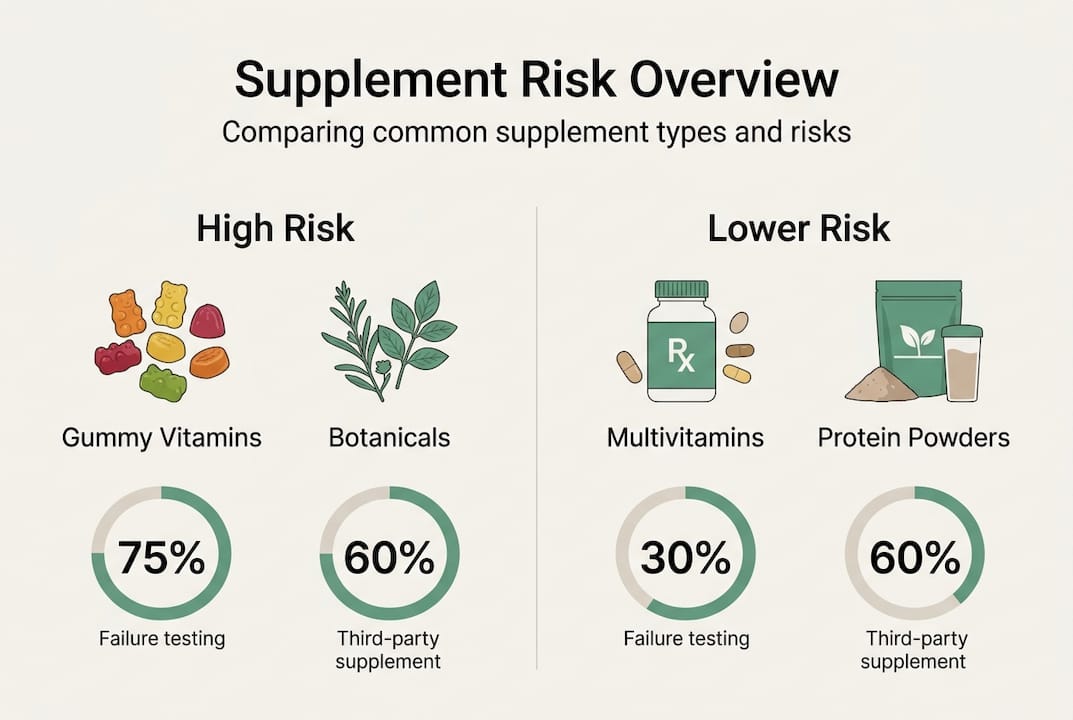
Category Primary risk Failure rate trend
Gummy vitamins Overdosing, instability High
Protein powders Heavy metals, label fraud High
Botanical extracts Species mislabeling, adulterants High
Standard capsules/tablets Potency variation Moderate
Certified products Residual risk Low
Gummies are particularly prone to problems because the manufacturing process involves heat and moisture, which degrade certain vitamins quickly. Vitamin C and B vitamins are especially unstable in gummy form, meaning the dose you see on the label may have degraded significantly by the time you open the bottle.
Botanical supplements carry a different kind of risk. Species substitution, where a cheaper plant is swapped for the labeled ingredient, is well-documented in the herbal supplement space. This is not just a quality issue. It can be a safety issue if the substitute plant has different pharmacological effects.
Certified products are not immune to problems, but they fail at dramatically lower rates. Using our supplement rankings guide alongside certification data gives you a more complete picture than either source alone. For category-specific picks, our immune support supplements section highlights products with strong third-party verification records.
Beyond basic testing: Special requirements for athletes and high-risk groups
For most people, standard third-party testing covers the essential bases. For athletes, it is not enough.
Competitive athletes face a unique risk: contamination with banned substances. Many supplements are manufactured in facilities that also process performance-enhancing compounds. Cross-contamination can happen even when the finished product formula contains no banned ingredients. Athletes require banned substance screening beyond standard purity testing, which is why programs like NSF Certified for Sport and Informed Sport exist specifically for this population.
Key considerations for athletes and high-risk users:
-
Choose products with NSF Certified for Sport or Informed Sport logos, not just general third-party seals.
-
Verify the specific lot number tested, since certification applies per batch, not per brand.
-
Avoid proprietary blends, which make it impossible to confirm individual ingredient doses.
-
Be especially cautious with weight loss, testosterone support, and pre-workout products, which historically show the highest rates of undisclosed additives.
Botanical and protein supplements deserve extra scrutiny regardless of your athlete status. Botanicals are prone to species mislabeling and pesticide residues. Proteins are frequently found to contain heavy metals at levels that accumulate with daily use.
Pro Tip: If you take a supplement daily, the cumulative exposure matters more than a single-dose risk assessment. A product with borderline heavy metal levels becomes a real concern when you take it every day for months.
Standard testing also does not guarantee efficacy. A supplement can pass every purity and potency test and still not produce the health outcome you are looking for. Certification tells you the product is what it claims to be, not that what it claims to be will work for you. For condition-specific products, our varicose veins supplements and Mass Extreme review pages show how we factor both testing quality and clinical evidence into our assessments.
Our take: Why trust but verify is the best strategy
Third-party seals are genuinely useful signals. We rely on them heavily in our reviews at RankOfSupplements.com. But treating a certification seal as a guarantee is a mistake we see health-conscious consumers make repeatedly.
Here is the uncomfortable reality: fewer than 5% of supplements are officially certified, and even certified products can fail between certification cycles. Batch-to-batch variation is real. A manufacturer can reformulate, switch suppliers, or change production facilities without immediately updating their certification status.
The smarter approach is to treat third-party certification as a strong starting filter, not a final answer. Combine it with COA review, brand transparency, and category-specific risk awareness. A certified protein powder from a brand with a long track record of consistent COAs is far more trustworthy than a newly certified product with no testing history.
We also think the conversation around supplement purity needs to shift from “is it certified?” to “how consistently does it pass?” Consistency over time is the real signal of quality.
Find trustworthy supplements with expert reviews
Understanding third-party testing is the first step. Applying that knowledge to actual purchasing decisions is where most people get stuck.
At RankOfSupplements.com, every review we publish factors in third-party testing status, COA availability, and category-specific risk. Our Nutrigo Lab Strength review is a strong example of how we break down both safety credentials and performance evidence in one place. If you are looking for products across specific health goals, our eye health supplements section and other category pages apply the same rigorous standard. We do the verification work so you can make faster, smarter decisions with confidence.
Frequently asked questions
What does third-party supplement testing verify?
Third-party testing checks label accuracy, purity, potency, and the absence of contaminants such as heavy metals, microbes, and pesticides. It confirms the product matches what the manufacturer claims on the label.
How do I know if a supplement is third-party tested?
Look for seals or logos from organizations such as NSF, USP, or ConsumerLab printed on the packaging, and check the brand’s website for a current certificate of analysis linked to the specific product lot.
Are all supplements tested by third parties?
No. Third-party testing is entirely voluntary, and fewer than 5% of supplements on the market carry an official certification from a recognized independent organization.
Does third-party testing guarantee supplement efficacy?
No. Testing confirms safety and label accuracy, but it does not prove the supplement will produce the health benefits claimed. Efficacy depends on clinical evidence, not purity certification.
Which supplements should always be third-party tested?
Athletes, botanical users, and protein powder consumers face the highest risk. High-risk categories like botanicals and proteins require batch-level testing to catch contamination and species mislabeling that standard checks may miss.