
TL;DR:
Synergistic supplementation combines nutrients to produce effects greater than individual nutrients alone.
Evidence supports specific pairings like curcumin with Boswellia and magnesium with B6 for health benefits.
Proper timing and consultation are essential to avoid negative interactions and optimize results.
Most people approach supplements the same way they approach a grocery list: grab what looks useful, take it daily, and hope for the best. But that logic misses something fundamental. The real power of supplementation isn’t in individual nutrients working alone. It’s in how specific nutrients interact, amplify each other, and fill gaps that single supplements simply can’t cover. Synergistic supplementation means pairing nutrients intentionally so their combined effect exceeds what either delivers separately. This article walks you through the science behind nutrient synergy, the most evidence-backed pairings for fitness and wellness, the pitfalls that quietly sabotage results, and a practical framework you can start using right now.
Table of Contents
-
Practical guide: How to incorporate synergistic supplementation
-
A fresh perspective: What most guides get wrong about synergy
-
Explore trusted supplement reviews for your synergy strategy
Key Takeaways
Point Details
Synergy amplifies results Pairing supplements intelligently maximizes their health benefits compared to single use.
Watch for antagonism Some nutrients compete for absorption, so timing and spacing are crucial for safety.
Evidence guides pairing Use scientific research to select supplement combinations proven effective for your goals.
Professional advice matters Consult health experts to tailor supplementation and avoid negative interactions.
What is synergistic supplementation?
Synergistic supplementation is the practice of combining two or more nutrients or compounds so they work together to produce a greater effect than either would alone. Think of it less like stacking ingredients and more like building a team where each player makes the others better.
Standard supplementation usually means taking a single nutrient to address a single deficiency. You’re low on vitamin D, so you take vitamin D. Simple. Synergistic supplementation asks a different question: what does vitamin D need to work optimally, and what else benefits when vitamin D is in play? That shift in thinking changes everything.
The science behind synergy operates on a few key mechanisms:
-
Bioavailability enhancement: One nutrient helps your body absorb another. Piperine from black pepper, for example, dramatically increases curcumin absorption.
-
Co-factor action: Some nutrients act as coenzymes, meaning they’re required for another compound to perform its biological function.
-
Complementary pathways: Two nutrients may target the same health outcome through different biological routes, compounding the benefit.
-
Receptor sensitization: One compound can upregulate receptors or enzymes that make a second compound more effective.
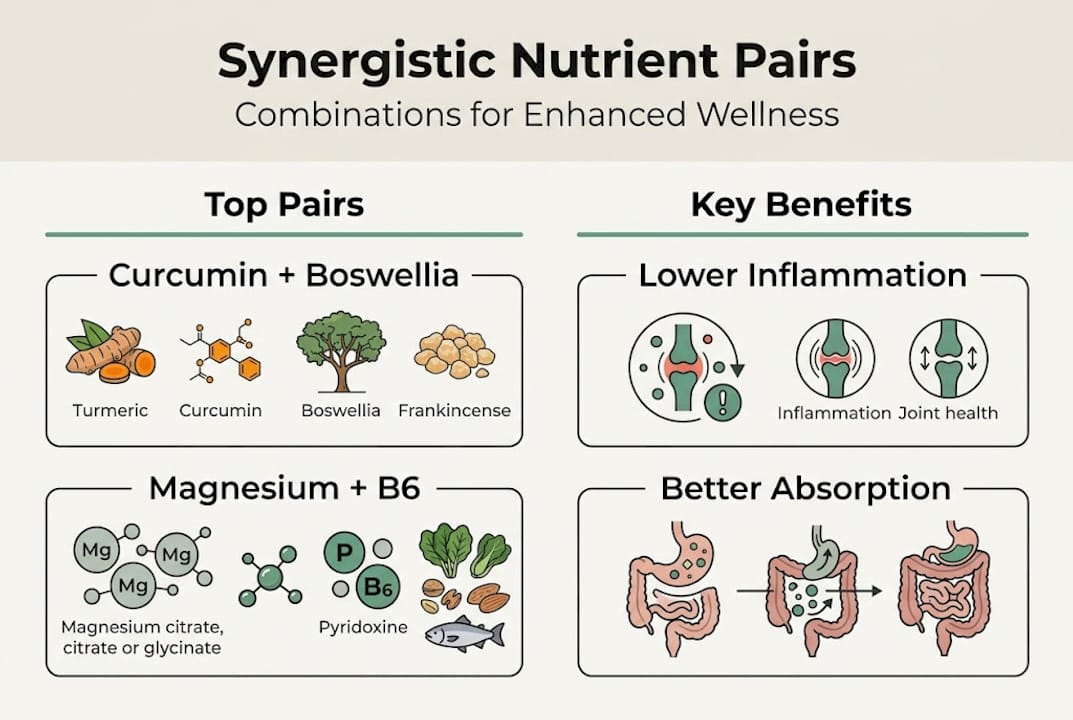
A standout example is the curcumin and Boswellia pairing. Both are anti-inflammatory compounds, but they work through distinct mechanisms. Curcumin inhibits the NF-kB pathway (a key driver of inflammation), while Boswellia blocks 5-LOX enzymes. Together, they hit inflammation from two angles simultaneously. Springer’s review of synergistic supplementation confirms that pairings like curcumin and Boswellia reduce inflammation more effectively than either compound alone, and that B vitamins function as metabolic coenzymes essential for energy production at the cellular level.
B vitamins are another textbook example. B2 (riboflavin), B3 (niacin), and B5 (pantothenic acid) all participate in the Krebs cycle, the process your cells use to generate ATP (adenosine triphosphate, your body’s primary energy currency). They don’t just coexist. They depend on each other to keep the cycle running efficiently.
Why does this matter for performance and wellness? Because isolated supplementation often produces diminishing returns. You can take a high-dose magnesium supplement and see modest results. But pair it with vitamin B6, which enhances magnesium transport into cells, and you get measurably better outcomes for muscle recovery and nerve function.

The contrast between standard and synergistic approaches is stark. Standard supplementation is reactive: fix the deficiency, move on. Synergistic supplementation is strategic: understand the biological network, then support it intelligently. For anyone serious about optimizing their health, the synergistic model isn’t optional. It’s the logical next step.
Scientific evidence for synergistic nutrient pairings
With a clear definition in place, let’s examine how science validates and explains true synergy between nutrients.
The research on nutrient synergy has grown significantly over the past decade, and several pairings now have strong empirical support. Here’s a breakdown of the most studied combinations and what the evidence actually shows:
Nutrient pairing Primary benefit Mechanism
Curcumin + Boswellia Reduced inflammation Dual pathway inhibition (NF-kB + 5-LOX)
Omega-3 + Vitamin D Immune and cardiovascular support Complementary receptor activity
Magnesium + Vitamin B6 Muscle and nerve health B6 enhances cellular magnesium uptake
Vitamin D + Vitamin K2 Bone density and arterial health K2 directs calcium to bones, not arteries
Iron + Vitamin C Iron absorption Vitamin C converts iron to absorbable form
The curcumin and Boswellia pairing deserves special attention. Springer’s data on synergistic supplementation shows that combining these two compounds produces anti-inflammatory effects that neither achieves independently at equivalent doses. For athletes dealing with chronic joint inflammation or anyone managing inflammatory conditions, this pairing represents one of the most cost-effective strategies available.
Omega-3 fatty acids and vitamin D are another well-researched duo. Omega-3s influence immune cell membranes, making them more responsive to vitamin D signaling. Vitamin D, in turn, regulates genes involved in immune modulation. The result is a compounded effect on immune resilience that’s particularly relevant during high-training periods when immune suppression is a real risk.
“The synergistic interaction between nutrients reflects the complexity of human physiology. Isolated supplementation often fails to account for the interdependence of biological pathways, which is why combination strategies consistently outperform single-nutrient approaches in clinical settings.”
Magnesium and vitamin B6 is a pairing that’s especially relevant for fitness enthusiasts. Magnesium is involved in over 300 enzymatic reactions, including muscle contraction and protein synthesis. But magnesium absorption and intracellular transport are significantly improved when vitamin B6 is present. Studies show that the combination reduces muscle cramps, improves sleep quality, and supports nervous system recovery after intense training.
Key takeaways from the research:
-
Synergistic pairings often work at lower individual doses than single-nutrient approaches
-
The mechanism matters: understanding why two nutrients work together helps you apply the pairing correctly
-
Timing and form of the supplement affect how well synergy plays out in practice
-
Not all claimed synergies have equal evidence. Some are well-established; others are still being studied
The science is clear enough to act on, but nuanced enough to require careful application. That’s exactly why understanding the pitfalls is just as important as knowing the benefits.
Potential pitfalls and antagonistic interactions
While combining supplements can boost results, it’s essential to watch out for negative interactions that can actually harm your progress.
Not all nutrient combinations are beneficial. Some nutrients actively compete with each other, and taking them together can reduce the effectiveness of both. These are called antagonistic interactions, and they’re more common than most people realize.
Here’s a direct comparison of synergistic versus antagonistic pairings:
Pairing Interaction type Effect
Calcium + Iron Antagonistic Calcium blocks iron absorption
Zinc + Copper Antagonistic High zinc depletes copper
Vitamin D + Vitamin K2 Synergistic Works together for bone health
Calcium + Zinc Antagonistic Compete for the same transporters
Magnesium + B6 Synergistic B6 enhances magnesium uptake
National Geographic’s analysis of nutrient synergy confirms that calcium, zinc, and iron compete for the same intestinal absorption transporters. Taking high doses of one mineral can significantly inhibit absorption of the others, which is a serious concern for anyone supplementing multiple minerals simultaneously.
Common mistakes to avoid:
-
Taking calcium and iron together. This is one of the most frequent errors. If you need both, separate them by at least two hours.
-
Megadosing a single mineral. High-dose zinc supplementation, for example, can deplete copper over time, leading to neurological issues.
-
Ignoring fat-soluble vitamin timing. Vitamins A, D, E, and K are fat-soluble, meaning they need dietary fat to absorb properly. Taking them without food reduces their effectiveness.
-
Stacking stimulants without considering interaction. Caffeine and certain adaptogenic herbs can interact in ways that amplify or blunt each other’s effects unpredictably.
-
Assuming more is always better. Synergy is about precision, not volume. More supplements don’t equal more benefit.
Pro Tip: Before adding any new supplement to your stack, cross-check it against what you’re already taking. Use supplement rankings guidance to identify evidence-backed products and flag potential conflicts. A qualified nutritionist or sports dietitian can help you map out a timing schedule that minimizes antagonistic interactions while maximizing synergistic ones.
Timing and spacing are practical tools that most people overlook. Iron absorbs best on an empty stomach with vitamin C. Calcium is best taken with meals. Magnesium works well in the evening because of its relaxation effects. These aren’t arbitrary rules. They reflect the biology of how each nutrient is processed.
Practical guide: How to incorporate synergistic supplementation
Now that you understand the risks and benefits, let’s walk through exactly how to use synergistic supplementation for your wellness and performance goals.
Getting started with synergistic supplementation doesn’t require a complete overhaul of your routine. It requires a more intentional approach to what you’re already doing.
Here’s a step-by-step process:
-
Identify your actual needs. Don’t start with supplements. Start with a health assessment. Blood work, fitness goals, dietary gaps, and lifestyle factors all inform which nutrients you genuinely need.
-
Find evidence-based pairings. Once you know your needs, look for synergistic combinations that address them. Use peer-reviewed sources and trusted review platforms rather than marketing claims.
-
Prioritize whole foods first. The NIH Office of Dietary Supplements consistently emphasizes that whole foods provide natural nutrient synergies that supplements can’t fully replicate. Supplements fill gaps; they don’t replace a solid nutritional foundation.
-
Consult a professional. A sports dietitian or integrative medicine practitioner can help you design a stack that’s both effective and safe, avoiding excesses and missed interactions.
-
Start with one or two pairings. Don’t try to optimize everything at once. Add one synergistic pair, assess how your body responds over four to six weeks, then adjust.
-
Track your results. Keep a simple log of energy, recovery, sleep, and performance. Synergistic effects can be subtle, and tracking helps you distinguish real improvements from placebo.
Pro Tip: The omega-3 and vitamin D pairing is one of the safest and most broadly effective starting points for most people. Take both with your largest meal of the day (which typically contains fat) to maximize absorption of both fat-soluble compounds.
Example routines worth considering:
-
For joint health: Curcumin with Boswellia, taken with a fat-containing meal. Check out the JointEternal review for a product that combines these compounds effectively.
-
For immune support: Omega-3 with vitamin D3 and K2, taken at lunch.
-
For energy and recovery: Magnesium glycinate with vitamin B6, taken in the evening.
-
For general wellness: A whole-food greens blend like TonicGreens, which provides multiple synergistic micronutrients in one formula.
When evaluating specific products, use structured supplement rankings guidance to filter out noise and focus on what the evidence actually supports.
Evaluating supplement research and making informed choices
Smart supplementation means not just following trends, but understanding the science and knowing when to seek guidance.
Not all supplement research is created equal. Learning to read it critically is one of the most valuable skills you can develop as a health-conscious consumer.
Here’s what to look for when assessing synergistic supplement claims:
-
Study design matters. Randomized controlled trials (RCTs) are the gold standard. Case studies and animal research are interesting but not definitive for human application.
-
Check the dose. Many studies show synergistic effects at specific doses that don’t match what’s in commercial products. A supplement containing 50mg of curcumin won’t replicate results from a study using 500mg.
-
Look at the funding source. Industry-funded research isn’t automatically invalid, but it warrants extra scrutiny. Independent replication of results is a stronger signal.
-
Distinguish between synergy and addition. True synergy means the combined effect exceeds the sum of parts. Many products claim synergy when they simply combine ingredients without evidence of interaction.
-
Watch for proprietary blends. These hide individual ingredient doses behind a total weight, making it impossible to verify whether you’re getting effective amounts.
The NIH Office of Dietary Supplements Strategic Plan explicitly acknowledges significant research gaps in how supplement mixtures interact in the human body. While the Springer review supports several synergistic pairings, the NIH notes that many combination products lack sufficient clinical evidence to make confident efficacy claims. That tension is important to hold: some synergies are well-established, others are plausible but unproven.
Using supplement rankings guidance from platforms that apply rigorous evaluation criteria helps you separate the well-supported from the speculative. Professional oversight remains the most reliable safeguard when navigating complex stacks.
A fresh perspective: What most guides get wrong about synergy
Most synergistic supplementation guides hand you a list of popular pairings and call it a day. Take curcumin with Boswellia. Pair vitamin D with K2. Done. But that approach treats synergy like a formula when it’s actually a framework. The difference matters enormously.
The uncomfortable reality is that nutrient synergy is highly individual. Your absorption rates, gut microbiome composition, genetic variants affecting nutrient metabolism, and baseline deficiencies all determine whether a given pairing will work for you the way it worked in a clinical trial. The NIH Office of Dietary Supplements Strategic Plan acknowledges that research on how supplement mixtures interact in real human populations remains incomplete. That’s not a reason to avoid synergistic supplementation. It’s a reason to approach it with calibrated expectations.
At RankOfSupplements.com, we’ve seen too many people chase trending stacks without asking the most important question: what does my body actually need right now? True optimization isn’t about copying someone else’s routine. It’s about combining solid evidence, personal health data, and professional input into a strategy that’s genuinely yours.
Don’t dismiss synergy. But don’t outsource your judgment to a trending supplement stack either. Use supplement rankings guidance as a starting point, not a final answer. The best synergistic strategy is one built around your specific biology, not a generic blueprint.
Explore trusted supplement reviews for your synergy strategy
Ready to make more informed choices? Start your journey with trusted resources tailored to synergistic supplement strategies.
Finding the right products to support your synergistic approach takes more than a quick search. You need reviews that evaluate ingredient quality, dosing accuracy, and actual evidence behind formulas. That’s exactly what RankOfSupplements.com is built for.
Whether you’re exploring eye health supplements that combine lutein with zeaxanthin for compounded visual support, or looking for performance products like Nutrigo Lab Strength that leverage synergistic amino acid and mineral combinations, our platform gives you the science-backed analysis to make confident decisions. Visit RankOfSupplements.com to browse rankings, compare products, and build a supplement strategy that’s grounded in evidence, not marketing.
Frequently asked questions
How do synergistic supplements differ from regular supplements?
Synergistic supplements are paired intentionally to enhance each other’s effectiveness, while regular supplements are typically used alone to address a single deficiency. Research confirms that pairings like curcumin and Boswellia produce measurably greater anti-inflammatory effects than either compound taken independently.
Can taking too many supplements cause negative interactions?
Yes. Some nutrients actively compete for the same absorption pathways, and excess of one mineral can block uptake of another. Calcium, zinc, and iron are a well-documented example of minerals that interfere with each other when taken simultaneously.
What are the best synergistic supplement pairs for fitness?
The most evidence-backed pairings for fitness include curcumin and Boswellia for joint inflammation, magnesium and vitamin B6 for muscle recovery and nerve function, and omega-3 with vitamin D for immune resilience during intense training. Springer’s review supports these combinations with clinical data.
Should I consult a professional before combining supplements?
Absolutely. The NIH Office of Dietary Supplements recommends professional guidance to avoid excess intake, missed interactions, and gaps in your nutritional strategy. A sports dietitian can help you build a stack that’s both safe and genuinely effective for your goals.