
TL;DR:
- A structured supplement decision workflow uses baseline testing, clear goals, and quality verification to select effective supplements. Applying a four-pillar scoring system and trialing one product at a time enhances health outcomes and prevents waste. This method relies on objective data and careful monitoring to ensure supplements meet individual needs.
A supplement decision workflow is a systematic, evidence-based process for selecting, evaluating, and trialing dietary supplements aligned with your specific health or fitness goals. Most people skip this process entirely, choosing products based on packaging or influencer recommendations instead. That approach wastes money and, in some cases, creates real health risks. A structured supplement selection process changes that by replacing guesswork with measurable criteria, quality checkpoints, and controlled trials. This guide walks you through every stage, from setting baseline health targets to troubleshooting a product that isn’t working.
What does a supplement decision workflow actually require?
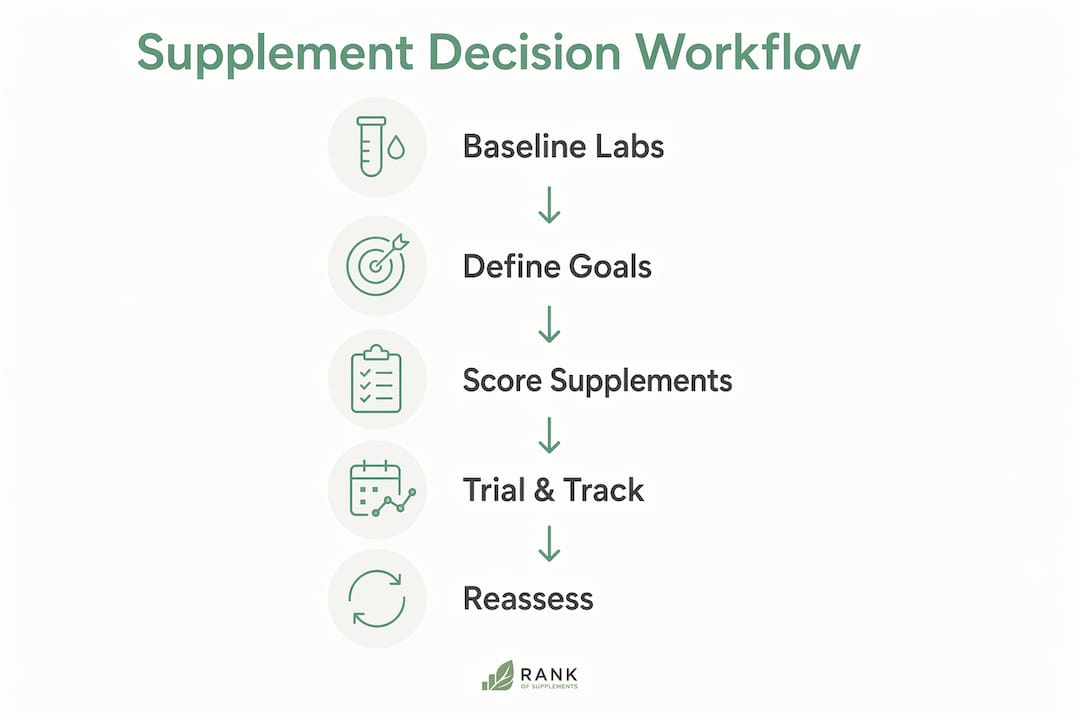
The supplement decision workflow begins before you ever read a product label. Two prerequisites define whether your entire process will succeed or fail: a baseline health assessment and a set of measurable, evidence-based goals.
Start with baseline lab work
Baseline testing tells you what your body actually needs, not what marketing says it needs. Common starting points include serum Vitamin D levels, iron and ferritin panels, a complete blood count, and a basic metabolic panel. These numbers give you a factual foundation. Without them, you are guessing at deficiencies and have no way to measure whether a supplement worked.
Expert users treat supplement selection as a controlled experiment using baseline biometrics. That framing matters. A controlled experiment has a hypothesis, a measurement, and a result. Your supplement trial should work the same way.
Define goals you can actually measure
Vague goals produce vague results. “I want more energy” cannot be measured. “I want serum Vitamin D above 30 ng/mL within 12 weeks” can be. Set clear measurable objectives and plan to reassess supplement effectiveness after 6 to 12 weeks. That reassessment window gives your body enough time to respond while keeping you from wasting months on a product that isn’t delivering.
For fitness goals, the same principle applies. If you are supplementing for muscle recovery, define a target: reduced soreness within 48 hours, improved training volume over 8 weeks, or a specific body composition change. Measurable targets also make it easier to know when to stop a supplement that isn’t earning its place in your routine.
Core prerequisites and validation tools
The table below summarizes the key preparatory steps and the tools used to validate each one.
| Prerequisite | Validation Tool |
|---|---|
| Baseline nutrient status | Lab tests: Vitamin D, iron, ferritin, CBC |
| Defined health or fitness goal | Written target with a measurable outcome and timeline |
| Product purity confirmation | Certificate of Analysis (COA) from the manufacturer |
| Third-party quality verification | USP, NSF International, or Informed Sport seals |
| Dosing accuracy check | Comparison of label dose vs. clinical research dose |
| Manufacturer transparency | Full ingredient disclosure, no proprietary blends |
Before moving to product selection, confirm you have addressed each row in this table. Skipping any step increases the chance of choosing a product that looks credible but delivers nothing.
How do you apply a step-by-step supplement selection process?
With your baseline data and goals in place, the supplement selection process becomes a ranking exercise. You are not choosing the most popular product. You are choosing the product that scores highest across four objective pillars.

The four-pillar scoring framework
A scoring framework evaluates supplements on four equally weighted pillars: dosing and form, purity verification, value, and transparency. Each pillar is worth 25 points out of a possible 100. This structure, used by evidence-based reviewers, removes the subjective pull of branding and forces you to evaluate what is actually in the bottle.
Dosing and form asks whether the product delivers the clinically studied dose in a bioavailable form. Magnesium glycinate and magnesium oxide are both “magnesium,” but their absorption rates differ significantly. Form matters as much as dose. You can check supplement dosage guidelines to confirm whether a product’s listed dose matches what clinical studies actually used.
Purity verification means confirming the product contains what the label says and nothing it shouldn’t. A Certificate of Analysis from a third-party lab is the minimum standard here. Quality control units govern supplier approval, batch release, labeling controls, and post-market signals. Brands that publish COAs and name their testing labs are operating at a higher standard than those that don’t.
Value is not the price per pill. The true cost is cost per clinically effective dose, not cost per serving. If a product contains 150mg of an ingredient but the clinical dose is 600mg, you are effectively paying four times the apparent price. This single calculation exposes more misleading products than any other metric.
Transparency covers full ingredient disclosure, clear sourcing information, and the absence of proprietary blends. Avoid proprietary blends because they obscure exact ingredient doses, making it impossible to assess safety or efficacy. A blend labeled “Muscle Matrix 2,000mg” tells you nothing about whether any individual ingredient reaches a useful dose.
Step-by-step selection process
Follow these steps in order. Skipping ahead is how people end up with a cabinet full of products that don’t work.
- Identify your nutrient gap or goal. Use your baseline labs and written targets from the prerequisite stage.
- Search for clinical evidence. Look for human clinical trials, not animal studies or in vitro research. PubMed is the standard starting point.
- Identify the clinically effective dose and form. Note the exact compound studied (e.g. ashwagandha KSM-66, not just “ashwagandha”).
- Find products that match that dose and form. Filter out anything that uses a proprietary blend or underdoses the key ingredient.
- Verify purity. Request or download the COA. Check for USP, NSF, or Informed Sport certification.
- Calculate cost per effective dose. Divide the product price by the number of servings that deliver the clinical dose.
- Score each candidate across all four pillars. The highest-scoring product with verified purity wins.
Pro Tip: When calculating cost per effective dose, always check whether a product requires two or three servings to reach the clinical dose. Brands frequently list a half-dose per serving to make the price per serving look lower.
How do you implement and monitor supplement trials safely?
Selecting the right product is only half the process. The trial phase is where you confirm whether that product actually works for your body. This stage is where most people make their biggest mistake: they start two or three supplements at once.
The single-supplement trial rule
A 2 to 4 week single supplement trial is the safest way to track side effects and efficacy. When you add one supplement at a time, any change in how you feel, positive or negative, can be attributed to that product. Add three supplements simultaneously and you lose that signal entirely. You won’t know which one caused the headache or which one improved your sleep.
“Treat each new supplement as a single variable in an experiment. Change one thing at a time, measure the outcome, then decide whether to continue, adjust, or stop.”
This principle is standard in clinical research for a reason. It works in personal health management for the same reason.
Tracking and reassessment
Keep a symptom diary during every trial. Record how you feel each morning, note any side effects, and track the specific outcome you defined in your goal-setting stage. After the initial 2 to 4 week window, you will have enough data to make a preliminary judgment. The full reassessment, including follow-up lab work if applicable, should happen at 6 to 12 weeks.
Monitoring best practices for supplement trials:
- Log daily: Record energy, digestion, sleep quality, and any symptoms in a simple notes app or paper journal.
- Track the specific metric: If your goal is serum Vitamin D above 30 ng/mL, retest at 8 to 12 weeks.
- Note timing and food interactions: Some supplements absorb better with fat, others on an empty stomach. Inconsistent timing creates inconsistent results.
- Document dose changes: If you adjust the dose mid-trial, mark the date so you can interpret the data correctly.
- Set a stop date: Decide in advance how long you will trial a supplement before concluding it isn’t working.
When to involve a healthcare professional
Consult a physician or registered dietitian before starting any supplement if you take prescription medications, have a diagnosed condition, or are pregnant. Drug-nutrient interactions are real and sometimes serious. St. John’s Wort, for example, reduces the effectiveness of several common medications including oral contraceptives and certain antidepressants. A pharmacist can run an interaction check in minutes and it costs nothing.
What are the most common pitfalls in choosing supplements?
Even with a solid framework, specific mistakes derail the supplement selection process repeatedly. Recognizing them in advance is faster than learning them through failed trials.
Many consumers make decisions by marketing claims rather than clinical context. This pattern, sometimes called “shopping from the bottle outward,” means you start with a product and work backward to justify it. The correct direction is the opposite: start with your goal, identify the evidence, then find a product that matches.
The second most common error is treating third-party seals as proof of effectiveness. USP and NSF seals verify product integrity, not health outcomes. A certified product contains what it claims and nothing harmful. That is valuable. But it says nothing about whether the ingredient works for your goal at the dose provided.
The table below maps common pitfalls to their corrective actions.
| Pitfall | Corrective Action |
|---|---|
| Choosing based on marketing claims | Start with your goal and find clinical evidence first |
| Relying on third-party seals for efficacy | Verify the clinical dose separately from purity certification |
| Starting multiple supplements at once | Trial one product at a time over 2 to 4 weeks |
| Ignoring proprietary blends | Reject any product that doesn’t disclose individual ingredient doses |
| Measuring the wrong outcome | Define a specific, measurable target before the trial begins |
| Abandoning too early | Allow 6 to 12 weeks before concluding a supplement is ineffective |
How to refine your process after a failed trial
A supplement that doesn’t work is data, not a failure. When a trial produces no measurable result, ask three questions. First, did the product actually deliver the clinical dose? Second, did you take it consistently and correctly? Third, was your baseline goal realistic for that supplement and timeline?
If the answer to all three is yes and the supplement still produced nothing, the ingredient may simply not be effective for your specific physiology or goal. That is a legitimate conclusion. Move to the next candidate on your ranked list and repeat the process. Defining specific health needs before selecting a supplement is the single most reliable way to avoid this cycle.
Pro Tip: If a supplement trial fails, check whether the ingredient has a known “responder” profile in the literature. Some compounds, like creatine, show strong responses in most people. Others, like beta-alanine, produce highly variable results depending on baseline carnosine levels.
Key takeaways
A structured supplement decision workflow built on baseline data, four-pillar scoring, and single-supplement trials produces better health outcomes and fewer wasted purchases than any other approach.
| Point | Details |
|---|---|
| Start with baseline labs | Test Vitamin D, iron, and ferritin before choosing any supplement. |
| Use the four-pillar framework | Score every product on dosing, purity, value, and transparency before buying. |
| Calculate cost per effective dose | Divide product price by servings needed to reach the clinical dose, not the label dose. |
| Trial one supplement at a time | A 2 to 4 week single-supplement trial isolates effects and catches side effects accurately. |
| Reassess with data | Follow up with lab work or symptom tracking at 6 to 12 weeks to confirm results. |
Why most people get supplement decisions wrong (and how to fix it)
I’ve spent years reviewing supplement research and watching the same pattern repeat. Someone finds a product with a compelling label, a celebrity endorsement, or a five-star rating and buys it without ever asking whether the ingredient is dosed correctly. They take it for two weeks, feel nothing, and conclude “supplements don’t work.” The problem was never the category. The problem was the process.
The four-pillar scoring model changed how I evaluate products. Before I used it, I was also susceptible to the purity trap: assuming that a USP-certified product was a good product. Certification confirms what’s in the bottle. It says nothing about whether that ingredient, at that dose, does anything for your goal. Those are two completely separate questions and they require two completely separate checks.
The single-supplement trial rule is the other piece most people skip. I understand the impatience. You want results fast, so you stack five products on day one. But when something goes wrong, or when something goes right, you have no idea which product caused it. You’ve turned your health into a noise machine instead of a signal.
The workflow I’ve described here isn’t complicated. It takes more time upfront than grabbing whatever is on sale. But it saves money over a full year because you stop buying products that were never going to work for your specific situation. And it produces better health outcomes because you are making decisions based on your actual biology, not a marketing team’s best guess about what you want to hear.
If you are serious about optimizing your supplement choices, treat the workflow as non-negotiable. Every shortcut you take is a variable you can’t control.
matteo
Find the right supplements faster with Rankofsupplements
Applying a supplement decision workflow is far easier when you have reliable, pre-screened product data to work with. Rankofsupplements does the heavy lifting on purity verification, dosing accuracy, and ingredient transparency so you can focus on matching products to your specific goals.
The supplement ingredient library at Rankofsupplements covers hundreds of compounds with clinical context, standard effective doses, and quality indicators. For goal-specific decisions, the expert supplement reviews and rankings give you scored comparisons built on the same four-pillar framework described in this guide. Use both resources as your research layer before running any trial.
FAQ
What is a supplement decision workflow?
A supplement decision workflow is a structured, step-by-step process for selecting and trialing dietary supplements based on personal health data, clinical evidence, and quality verification criteria. It replaces marketing-driven purchasing with measurable, goal-oriented decision making.
How long should a supplement trial last?
A 2 to 4 week trial period is the standard for monitoring initial physiological response and side effects. Full efficacy reassessment, including lab work where applicable, should occur at 6 to 12 weeks.
Does a third-party seal mean a supplement is effective?
No. USP, NSF, and Informed Sport seals confirm that a product contains what it claims and is free from contaminants. They do not verify that the ingredient or dose produces the health outcome you are targeting.
What is cost per effective dose?
Cost per effective dose is the actual price you pay to receive one clinically studied dose of an ingredient. If a product contains 150mg per serving but the clinical dose is 600mg, your real cost is four times the listed serving price.
Why should i avoid proprietary blends?
Proprietary blends obscure the exact amount of each ingredient, making it impossible to confirm whether any single compound reaches a clinically useful dose. Full ingredient disclosure is a baseline requirement for any supplement worth trialing.