
TL;DR:
- Amino acids, especially all nine essential amino acids, are crucial for muscle protein synthesis after exercise. While leucine triggers the signaling pathway, complete EAAs supply the raw materials needed to build new muscle. Supplementing with full EAAs around training enhances recovery and long-term muscle adaptation more effectively than BCAAs alone.
Amino acids are the immediate limiters of muscle protein synthesis (MPS) after exercise, and the single most important rule is this: you need all nine essential amino acids (EAAs) available at once, not just leucine, to complete new muscle protein. The International Society of Sports Nutrition (ISSN) confirms that free-form EAA ingestion stimulates MPS more rapidly than an equivalent amount of intact protein, with MPS plateauing around 15 to 18 g of EAAs at rest. mTOR signaling, the molecular switch that starts MPS, gets activated by leucine, but the rest of the EAAs are the raw material that finishes the job. Rankofsupplements covers this distinction throughout its evidence-based guides, because it changes what you buy and when you take it.
Key principles at a glance:
- Leucine triggers mTOR but cannot complete MPS alone; all nine EAAs are required.
- Free-form EAAs raise blood amino acid levels faster than whole protein, useful around training.
- Total daily EAA/protein intake drives long-term adaptation more than any narrow timing window.
- β-alanine, glutamine, and arginine/citrulline each serve distinct, secondary roles in performance.
Pro Tip: Aim for a meal or supplement delivering 2 to 3 g of leucine and a full EAA profile within two hours of a high-volume resistance session. That single habit covers the leucine threshold and the substrate requirement simultaneously.
Table of Contents
- How do amino acids actually affect your muscles during exercise?
- Which amino acids and supplements actually move the needle?
- When should you take amino acids: pre, during, or after training?
- Food vs. supplements: when does whole protein actually suffice?
- What are the right doses, and who needs to be careful?
- What does the evidence actually recommend by training goal?
- What does high-quality research actually say vs. what you’ve heard?
- Key Takeaways
- Why the “just take BCAAs” advice keeps failing athletes
- Rankofsupplements makes evidence-based amino acid choices easier
- Recommended reading
- Useful sources
- FAQ
How do amino acids actually affect your muscles during exercise?
Amino acids work on two levels at once: they are the structural material for new muscle protein, and they are signaling molecules that tell the cell to start building. Those two functions are related but not the same, and understanding the gap between them is what separates smart supplementation from expensive urine.
When you train, mechanical stress and hormonal signals activate mTOR complex 1 (mTORC1), the master regulator of protein synthesis in skeletal muscle. Leucine is the primary dietary activator of this pathway, binding to sensors that phosphorylate downstream targets like S6K1, which in turn initiates translation of mRNA into new protein. The catch: mTOR activation is only the ignition. Without adequate intracellular concentrations of all nine EAAs, the ribosome stalls. Think of leucine as the key that starts the engine and the remaining EAAs as the fuel that actually moves the car.

Beyond MPS, amino acids regulate several other processes that matter during and after a session. According to a Nutrients review, EAA availability supports mitochondrial biogenesis, which is the process by which muscle cells build new mitochondria in response to training stress. That adaptation underpins endurance capacity and long-term aerobic power. EAAs also help maintain immune function, which matters because heavy training transiently suppresses immune defenses and increases susceptibility to upper respiratory infections.
Glutamine plays a specific role here: during intense exercise, skeletal muscle exports glutamine to the liver to clear ammonia produced by BCAA catabolism, as PMC research on skeletal muscle regulation describes. Arginine-derived nitric oxide (NO) dilates blood vessels, improving nutrient and oxygen delivery to working muscle. β-alanine feeds carnosine synthesis inside muscle fibers, buffering the hydrogen ions that accumulate during high-intensity efforts and cause the burning sensation that forces you to slow down.
Which amino acids and supplements actually move the needle?
Essential amino acids (EAAs)
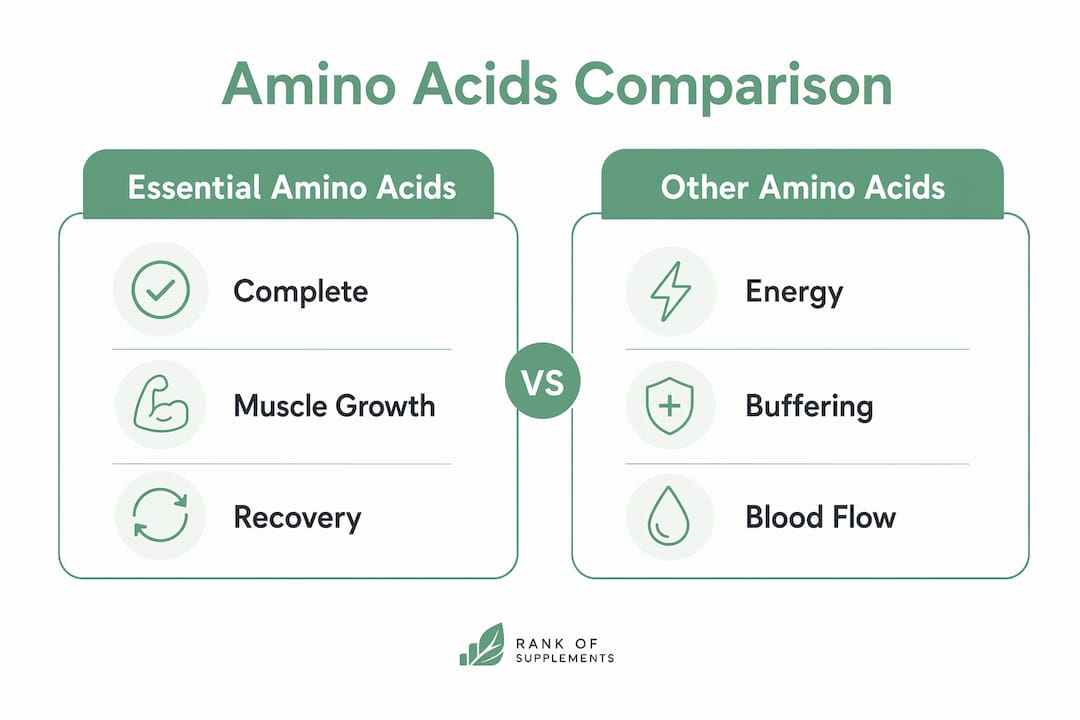
EAAs are the non-negotiable foundation. All nine must be present for MPS to complete, which is why a complete EAA formula or a high-quality whole protein consistently outperforms BCAA-only products in clinical comparisons. The ISSN position stand rates EAA supplementation’s effect on MPS as among the strongest in the sports nutrition literature. Evidence strength: strong for stimulating MPS and supporting recovery.
Leucine
Leucine is the mTOR trigger. Research points to a “leucine threshold,” roughly 2 to 3 g per serving, below which the mTOR signal is suboptimal. Older adults need more leucine per meal to overcome anabolic resistance, a phenomenon where the muscle’s sensitivity to amino acid signaling declines with age. Leucine-enriched supplements have been shown to improve muscle mass, strength, and walking speed in elderly populations. Evidence strength: strong for mTOR activation; the threshold concept is well-supported in human trials.
BCAAs (branched-chain amino acids)
BCAAs, leucine, isoleucine, and valine, can activate mTOR and contribute energy during prolonged exercise via the TCA cycle. The problem is structural: BCAA-only supplementation lacks the six remaining EAAs needed to complete protein synthesis. BCAAs may reduce perceived exertion and central fatigue during endurance events, but as a standalone hypertrophy strategy they are mechanistically incomplete. Evidence strength: limited for long-term muscle gain when used without a complete protein source.
β-alanine
β-alanine is the direct precursor to carnosine, the primary intracellular buffer against acid accumulation in fast-twitch muscle fibers. Loading at 4 to 6.4 g per day for 4 to 10 weeks raises muscle carnosine by 40 to 100% and measurably improves performance in repeated sprints, high-intensity intervals, and resistance training sets lasting 60 to 240 seconds. The tingling sensation (paresthesia) is harmless but can be reduced by splitting doses. Evidence strength: moderate to strong for high-intensity buffering; less clear for pure strength or endurance events.
Glutamine
Glutamine is the most abundant free amino acid in muscle and blood. It supports nitrogen transport, gut integrity, and immune function. After very heavy training blocks, plasma glutamine can drop, which correlates with increased infection risk. For healthy athletes eating adequate protein, however, glutamine supplementation shows limited benefit for performance or hypertrophy. Evidence strength: limited to mixed for performance; more relevant for immune support during overreaching phases.
Arginine and citrulline
Arginine is a precursor to NO, which relaxes blood vessel walls and increases blood flow to active muscle. Citrulline is more bioavailable than arginine orally and converts to arginine in the kidney, making it the preferred supplemental form. Both can reduce perceived fatigue and improve endurance performance, particularly in longer sessions. Evidence strength: moderate and variable, with stronger effects in endurance contexts than in pure strength training.
Pro Tip: When choosing between a BCAA product and an EAA formula for post-workout recovery, always pick the EAA formula. The extra cost is small; the mechanistic gap is not.
When should you take amino acids: pre, during, or after training?
Total daily EAA and protein intake is the primary driver of adaptation. Timing is real but secondary, and for most athletes who eat regular meals, the difference between perfect timing and “close enough” is smaller than supplement marketing suggests.
That said, free-form EAAs do raise blood amino acid concentrations faster than intact protein, which can matter in specific scenarios: fasted morning training, back-to-back sessions, or very long endurance events where solid food is impractical.
| Timing Window | Recommended Approach | Typical Dose |
|---|---|---|
| Pre-workout (30 min prior) | High-quality protein meal or EAA supplement | |
| Intra-workout (sessions >90 min) | Free-form EAAs + electrolytes in water | 6 to 10 g EAAs |
| Post-workout (within 2 hours) | Complete EAA/protein source with leucine | |
| β-alanine loading | Split doses throughout the day | 3.2 to 6.4 g/day for 4 to 10 weeks |
| Citrulline (pre-workout) | 30 to 60 min before session | 6 to 8 g citrulline malate |
Protocols by training type:
- Strength/hypertrophy: Prioritize a leucine-rich protein meal 1 to 2 hours before and within 2 hours after. No need for intra-workout EAAs unless sessions exceed 90 minutes.
- Endurance: Add 6 to 10 g free-form EAAs to your intra-workout hydration for sessions over 90 minutes. Citrulline pre-session can reduce perceived effort.
- Fasted training: A small EAA dose (10 g) before the session blunts muscle catabolism without breaking a meaningful fast for most protocols.
Pro Tip: If you can’t eat immediately after training, an EAA-containing meal within two hours is nearly as effective as an immediate post-workout shake. Don’t stress the exact minute; stress the daily total.
Food vs. supplements: when does whole protein actually suffice?
Whole-food protein is the baseline. A chicken breast, Greek yogurt, or a couple of eggs delivers all nine EAAs alongside micronutrients, satiety signals, and digestive cofactors that no powder replicates. MedlinePlus notes that you don’t need every EAA at every single meal, as long as daily balance is met across the day.
Supplements add genuine value in specific situations:
- Fasted training: Whole food before a 5 AM session is impractical; 10 g EAAs in water takes 30 seconds.
- Caloric deficit or weight-cut: Appetite is suppressed; free-form EAAs deliver the MPS signal without significant calories.
- Aging athletes: Older adults often eat less protein overall and benefit from leucine-enriched EAA supplements to overcome anabolic resistance.
- Repeated same-day training: Two-a-day athletes need rapid amino acid availability between sessions; free-form EAAs absorb faster than a full meal.
- Long endurance events: Solid food is impractical mid-race; EAAs dissolved in a sports drink work.
- Travel or inconsistent meal access: A single-serve EAA packet is more reliable than hoping the airport has a quality protein option.
For athletes hitting 0.7 to 1.0 g of protein per pound of bodyweight daily through regular meals, protein benefits plateau above roughly 1.2 g/lb, so chasing higher intakes through supplements offers diminishing returns. The benefits of protein supplements guide on Rankofsupplements breaks down exactly where intact protein and free-form EAAs each earn their place.
What are the right doses, and who needs to be careful?
| Supplement | Typical Effective Dose | Notes |
|---|---|---|
| EAAs (total) | 15 to 18 g per dose; MPS plateaus at this range at rest | Repeat across the day for sustained anabolism |
| Leucine per serving | 2 to 3 g minimum | Higher (3 to 4 g) for older adults |
| β-alanine (loading) | 3.2 to 6.4 g/day for 4 to 10 weeks | Split doses to reduce paresthesia |
| β-alanine (maintenance) | 1.2 g/day after loading | Sustains elevated carnosine |
| Citrulline malate | 6 to 8 g, 30 to 60 min pre-workout | Prefer citrulline over arginine for oral use |
| Glutamine | 5 to 10 g/day during heavy blocks | Limited evidence for healthy athletes |
Safety checklist:
- Renal impairment: High single-amino-acid supplementation can stress the kidneys. Anyone with existing kidney disease should consult a physician before using concentrated EAA or BCAA products.
- Pregnancy and lactation: Amino acid supplements beyond normal dietary protein have not been adequately studied in pregnant or breastfeeding individuals. Consult an OB-GYN before use.
- Methionine and homocysteine: Chronically high methionine intake (from very high protein diets or methionine-specific supplements) can raise homocysteine, a cardiovascular risk marker. Balanced EAA formulas are safer than isolated methionine.
- Drug interactions: Amino acids can interact with levodopa (for Parkinson’s disease) and certain diabetes medications. Check with a pharmacist if you take prescription drugs.
- GI distress: Large single doses of free-form amino acids can cause nausea or cramping. Split doses and take with water.
Pro Tip: Track your total daily protein from food first, then layer in supplements only where gaps exist. If β-alanine causes uncomfortable tingling, split the dose into 800 mg servings spread across the day.
For a broader look at supplement safety, the common supplement mistakes guide on Rankofsupplements covers the most frequent errors athletes make with dosing and stacking.
What does the evidence actually recommend by training goal?
Where the evidence is strongest: EAAs and total daily protein for MPS, strength, and hypertrophy. Where it is more modest: glutamine for performance in healthy athletes, and arginine (versus citrulline) for blood flow.
Strength and hypertrophy:
- Target 0.7 to 1.0 g protein per pound of bodyweight daily from high-quality sources.
- Include 2 to 3 g leucine per meal to reliably hit the mTOR threshold.
- Add β-alanine loading (3.2 to 6.4 g/day) if your sessions include high-rep sets or conditioning work lasting 60 to 240 seconds.
- Free-form EAAs are most useful around training when whole food is not practical.
Endurance athletes:
- Intra-session EAAs (15 to 18 g) during efforts over 90 minutes reduce muscle catabolism and support immune function.
- Citrulline malate (6 to 8 g pre-race) can lower perceived effort and improve time-to-exhaustion in longer events.
- Vitamins for muscle recovery alongside EAAs covers the full micronutrient picture for endurance athletes.
Older adults:
- Anabolic resistance means the leucine threshold is higher; aim for 3 to 4 g leucine per meal rather than 2 g.
- EAAs reverse muscle catabolism in sarcopenic populations and support gene expression tied to muscle maintenance, making them more valuable than BCAAs alone for this group.
- Leucine-enriched EAA supplements have shown improvements in muscle mass, strength, and functional mobility in clinical trials.
Athletes in caloric deficit:
- Protein targets should stay at or above 0.8 to 1.0 g/lb to preserve lean mass while cutting.
- Free-form EAAs between meals help maintain MPS signaling without adding significant calories.
- BCAA supplements are less useful here than complete EAA formulas for the same mechanistic reasons.
What does high-quality research actually say vs. what you’ve heard?
Several widely repeated claims about amino acids and training do not hold up well against controlled human trials.
| Popular Claim | What the Evidence Shows |
|---|---|
| “You must take protein within 30 minutes of training” | The anabolic window is real but wider than marketed; consistent daily intake matters far more than hitting a 30-minute deadline. |
| “BCAAs are the best muscle-building supplement” | BCAAs trigger mTOR but lack the six other EAAs needed to complete MPS; complete EAAs or whole protein are superior. |
| “More protein always means more muscle” | MPS plateaus around 15 to 18 g EAAs per dose at rest; total daily protein beyond ~1.2 g/lb shows diminishing hypertrophy returns. |
| “Glutamine builds muscle in healthy athletes” | Evidence for performance or hypertrophy benefits in well-nourished athletes is limited; immune support during overreaching is the stronger use case. |
| “Arginine supplements significantly boost pumps and strength” | Oral arginine has poor bioavailability; citrulline converts to arginine more effectively and shows more consistent results. |
The BCAA and recovery research guide on Rankofsupplements examines the age-specific evidence in more detail, including where BCAAs do retain value for older athletes even if they are not the complete answer. One area where research still needs clarity: long-term EAA supplementation effects across different sexes, age groups, and sport-specific demands are underrepresented in the current literature, which skews heavily toward young men doing resistance training.
Key Takeaways
EAAs, not BCAAs alone, are the rate-limiting factor for muscle protein synthesis, and consistent daily protein intake across meals matters more than any narrow post-workout timing window.
| Point | Details |
|---|---|
| EAAs over BCAAs | Complete EAA formulas or whole protein outperform BCAA-only products because all nine EAAs are required to finish MPS. |
| Leucine threshold | Aim for 2 to 3 g leucine per serving (3 to 4 g for older adults) to reliably activate mTOR and initiate protein synthesis. |
| β-alanine loading | 3.2 to 6.4 g/day for 4 to 10 weeks raises muscle carnosine 40 to 100% and improves high-intensity buffering capacity. |
| Timing is secondary | Total daily EAA/protein intake drives adaptation; an EAA-rich meal within two hours of training is sufficient for most athletes. |
| Rankofsupplements guidance | Rankofsupplements provides evidence-based EAA and amino acid supplement reviews to help athletes choose complete formulas over marketing-driven BCAA products. |
Why the “just take BCAAs” advice keeps failing athletes
The supplement industry has a structural incentive to sell BCAAs: they are cheap to manufacture, easy to flavor, and the leucine-mTOR story is compelling enough to put on a label. What that label never mentions is that mTOR activation without the remaining EAAs is like hiring a construction crew with no materials. The framing of “branched-chain amino acids for muscle” is not wrong, exactly, it is just incomplete in a way that costs athletes real results.
What I find more interesting is the anabolic window myth’s persistence. Even after multiple ISSN position statements clarifying that total daily protein is the primary variable, the 30-minute post-workout shake ritual survives in nearly every gym. The ritual probably does no harm, but it distracts from the harder, less marketable truth: eating enough complete protein consistently across the day, every day, is the intervention. Free-form EAAs are a genuinely useful tool for specific scenarios, fasted training, travel, rapid recovery between sessions, but they are not a shortcut around the daily total.
The athletes who get the most out of amino acid science are not the ones with the most elaborate supplement stacks. They are the ones who understand which mechanisms are real, which are marketing, and how to match the right tool to the right situation.
Rankofsupplements makes evidence-based amino acid choices easier
Sorting through amino acid supplements is genuinely confusing when every label claims “clinically studied” and most products lead with BCAAs instead of complete EAA profiles. Rankofsupplements cuts through that by reviewing formulas against the actual mechanisms covered in this guide: leucine content per serving, full EAA spectrum, β-alanine dosing, and citrulline bioavailability.
Whether you are optimizing for strength, endurance, or recovery during a caloric deficit, the ingredient library gives you sourced dosing ranges and evidence grades for every major amino acid and related compound. For a specific strength-focused formula reviewed against these criteria, the Nutrigo Lab Strength review is a practical starting point. Browse the supplements by health goal page to find options matched to your specific training objective.
Recommended reading
- Related article: Do BCAA Supplements Help with Muscle Recovery After 40?, age-specific analysis of BCAA efficacy and when to upgrade to full EAA formulas.
- Top list: Best Supplement Reviews & Rankings, Rankofsupplements’ ranked supplement lists by category and training goal.
- Product review: Nutrigo Lab Strength, a strength-focused formula reviewed against leucine content and EAA completeness criteria.
- Guide: What Is Sports Nutrition? A 2026 Performance Guide, broader context on macronutrient targets, recovery strategies, and supplement integration.
Useful sources
| Source | What it covers |
|---|---|
| ISSN Position Stand: EAA Supplementation | Definitive position on EAA vs. BCAA for MPS, dosing, and timing; primary reference for this guide. |
| Regulation of Skeletal Muscle Function by Amino Acids (PMC) | Detailed mechanistic review of how amino acids and their metabolites regulate muscle during exercise and aging. |
| Clinical Use of Amino Acids as Dietary Supplement (PMC) | Clinical evidence for EAAs in reversing catabolism and supporting sarcopenia; relevant for older-adult protocols. |
| Amino Acids Regulating Skeletal Muscle Metabolism (Springer) | Covers β-alanine loading doses, carnosine response, and adverse effects; key source for buffering claims. |
| Nutrients Review on Amino Acids and Metabolic Regulation | Reviews EAA roles in mitochondrial biogenesis and immune function beyond MPS. |
| Do Amino Acids Build Bigger Muscles? (Scientific American) | Accessible overview of protein intake thresholds and diminishing returns at high intakes. |
| Amino Acids: MedlinePlus Medical Encyclopedia | Public-facing primer on dietary amino acid balance and daily intake principles. |
| Amino Acids (Cleveland Clinic) | Clear breakdown of each EAA’s specific physiological role; useful for understanding individual functions. |
| NCBI Bookshelf: Amino Acids and Protein | Explains why BCAA-only supplementation is mechanistically insufficient for complete MPS. |
This article is general information, not medical or nutritional advice. Confirm dosing and safety for your specific situation with a registered dietitian or physician, particularly if you have kidney disease, are pregnant, or take prescription medications.
FAQ
Should you take amino acids while working out?
For sessions under 90 minutes, intra-workout amino acids are optional if you ate a protein-containing meal beforehand. For longer sessions, 15 to 18 g of free-form EAAs in your water bottle can reduce muscle catabolism and support performance.
What kills muscle gains the most?
Chronically low total protein intake is the biggest limiter, followed by inadequate sleep and excessive caloric deficit. No supplement overcomes a consistent shortfall in daily EAAs.
Which is better, amino acids or creatine?
They serve different functions. EAAs provide the substrate and signaling for MPS; creatine replenishes ATP for short, explosive efforts. Both are well-supported by evidence and work through separate mechanisms, so they stack without conflict.
What is the downside of BCAAs?
BCAAs can activate mTOR signaling but lack the six remaining EAAs needed to complete muscle protein synthesis, making them an incomplete recovery tool on their own. A complete EAA formula or whole protein source delivers the same leucine signal plus the full building-block set.