
Probiotics are live microorganisms; prebiotics are the nondigestible fibers those microorganisms eat. For most healthy adults, the smarter move is food first: a variety of fiber-rich plants plus one fermented food with live cultures, before spending money on a supplement aisle that mostly sells insurance you don’t need. Save the targeted supplement for a specific, evidence-backed goal, ideally one a clinician has signed off on.
TL;DR:
- A varied diet of fermented foods and high-fiber plants generally provides sufficient probiotics and prebiotics for most healthy adults, reducing the need for supplements.
- Probiotic products must specify the full strain ID, be tested for potency through expiration, and include clear storage instructions to ensure quality and efficacy.
- Benefits from probiotics are strain-specific and supported mainly for conditions like antibiotic-associated diarrhea, not as broad wellness insurance.
- Increasing prebiotic fiber intake gradually from foods helps avoid side effects like gas and bloating, especially when adding supplements.
- Valid probiotic supplements should be backed by evidence for the exact strain and dose, rather than relying on generic claims or broad-spectrum labels.
Table of Contents
- Probiotics vs Prebiotics: The Core Difference
- Where to Actually Find Them in Food
- What the Research Actually Supports
- Choosing a Supplement Without Wasting Your Money
- How Long Before You Know It’s Working
- What a Real Label Comparison Looks Like
- The One Habit That Beats Most Supplement Stacks
- Compare Evidence, Not Marketing, Before You Buy
- Sources
- FAQ
Probiotics vs Prebiotics: The Core Difference
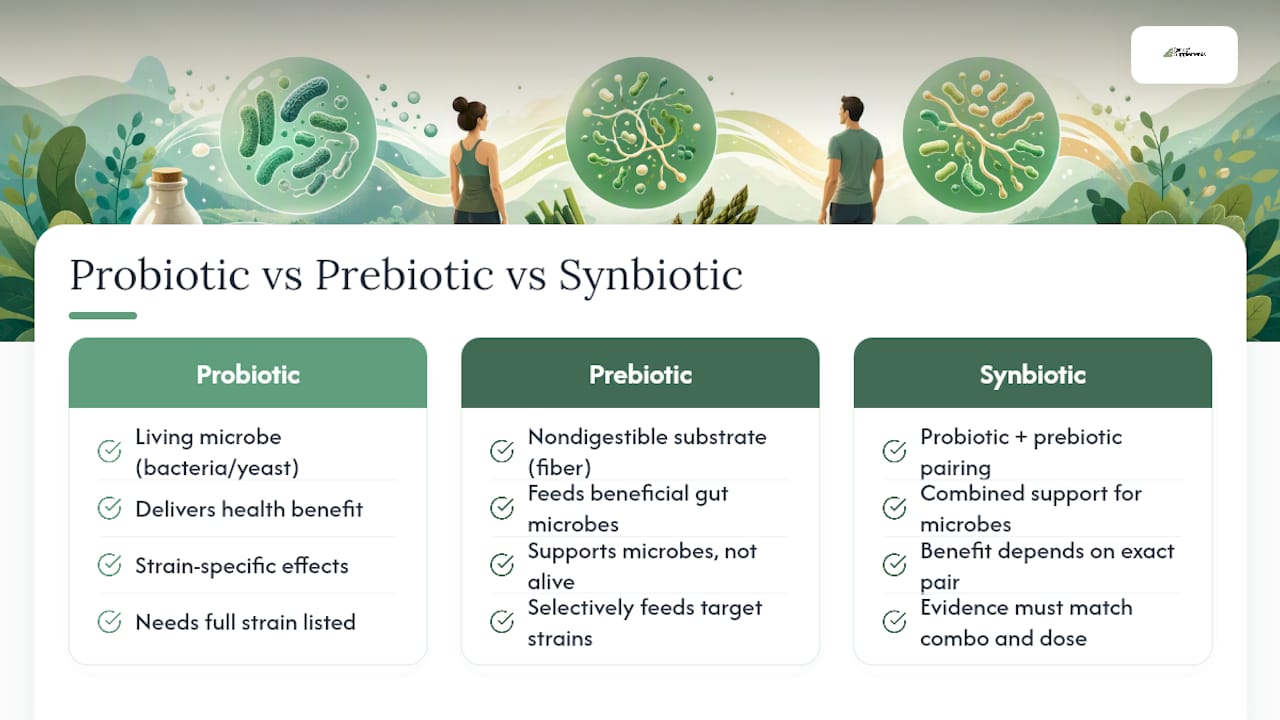
A probiotic is a living organism, usually a bacterial or yeast strain, that delivers a measurable health benefit when you consume enough of it. A prebiotic is not alive at all. It’s a nondigestible substrate, mostly fiber, that selectively feeds the beneficial microbes already living in your gut, according to the NIH Office of Dietary Supplements. One is the organism. The other is its food supply.
That distinction matters more than most labels let on. Clinical effects tend to be strain-specific, not species-specific. Lactobacillus rhamnosus GG and a generic “Lactobacillus” blend are not interchangeable, even though both might say “Lactobacillus” on the front of the bottle. If a product doesn’t list the full strain designation, there’s no way to connect it to any actual trial data.
When you combine a specific probiotic strain with a prebiotic fiber shown to support it, you get a synbiotic. The International Scientific Association for Probiotics and Prebiotics points out that a synbiotic’s benefit depends entirely on that particular pairing. A synbiotic label alone proves nothing. What proves something is evidence for that exact combination, at that exact dose.
Where to Actually Find Them in Food
You don’t need a supplement to start. Fermented foods with live cultures deliver probiotics, and fiber-dense plants deliver prebiotics, according to the Mayo Clinic.
Common probiotic food sources include:
- Yogurt with live and active cultures
- Kefir
- Sauerkraut (unpasteurized, refrigerated)
- Kimchi
- Miso and tempeh
Common prebiotic food sources include:
- Asparagus, garlic, and onions
- Legumes and lentils
- Whole grains like oats and barley
- Bananas (especially slightly underripe)
- Chicory root and Jerusalem artichoke
Fermentation doesn’t guarantee live microbes survive to your plate. Pasteurization and long shelf storage routinely kill the cultures that made the food probiotic in the first place. Check for “contains live cultures” on the label, and favor refrigerated over shelf-stable versions when a live count matters to you.
Pro Tip: Start small and build a habit instead of overhauling your diet overnight: add one fermented food and one high-fiber prebiotic food daily for two weeks before layering in anything else. Rotating eight different fiber sources a week does more for microbial diversity than any single “superfood” ever will.

What the Research Actually Supports
The honest answer is: less than the supplement aisle implies. A recent umbrella review of biotic interventions found that benefits are selective, strain-dependent, and population-specific, with enough heterogeneity across studies that broad claims don’t hold up. That’s the researcher’s way of saying “it depends,” and in this case, it really does.
Some indications have decent evidence behind them. Certain probiotic strains, for example, show a real effect on antibiotic-associated diarrhea, and specific strains have supported outcomes in pediatric diarrhea. But these results are tied to the exact strain and dose used in the trial, not to the entire probiotic category. The NIH fact sheet is direct about this: effects documented for one species, strain, or dose don’t automatically transfer to another.
That’s the trap. A shopper sees “clinically studied” on a label and assumes the whole bottle is validated, when only one strain inside a multi-strain blend may have ever been tested, and often at a different dose than what’s on the shelf.
For general digestive health in an otherwise healthy adult, a varied diet rich in fiber and fermented foods is the more defensible starting point than a supplement bought on a hunch. Supplements earn their place when you have a defined problem, like recovering gut flora after a course of antibiotics, and a strain with trial data that actually matches your situation. Matching the intervention to the goal, rather than treating probiotics as general wellness insurance, is what separates a useful purchase from a wasted one.
Choosing a Supplement Without Wasting Your Money
If you’ve decided a supplement fits your goal, the label needs to answer specific questions before it earns a spot in your cart.
Run through this checklist:
- Full strain ID, not just genus and species (e.g., Bifidobacterium animalis subsp. lactis BB-12, not just “Bifidobacterium”)
- Evidence for that exact strain and your specific goal, not general category claims
- CFU count guaranteed through expiration, not just “at time of manufacture”
- Storage instructions clearly listed (refrigerated vs. shelf-stable)
- Third-party testing for potency and contamination
CFU, or colony-forming units, measures viable cells at some point in the product’s life. The FDA’s draft guidance on live microbial labeling notes that viability can decline over shelf life, so a high CFU number at manufacture means little if the bottle doesn’t guarantee potency through its expiration date. A high CFU count with the wrong strain also isn’t proof of anything, since the number tells you quantity, not clinical relevance.
Prebiotic supplements carry their own caution. Introducing inulin or chicory fiber too fast commonly causes gas and bloating, according to UR Medicine. Start with small, food-based portions and increase gradually rather than jumping straight to a concentrated powder.
Pro Tip: Change one variable at a time. If you add a new probiotic and a new fiber supplement in the same week, you won’t know which one caused the bloating, or the improvement.
Most healthy people tolerate probiotics with only mild, temporary effects. But the NIH fact sheet flags rare, serious infections like bacteremia and fungemia in severely ill or immunocompromised individuals, with premature infants at particular risk. Anyone in those categories should talk to a clinician before starting either a probiotic or a synbiotic supplement.
How Long Before You Know It’s Working
Digestive changes, like stool consistency or bloating frequency, often shift within days to a couple of weeks. Broader outcomes, like reduced frequency of antibiotic-associated diarrhea or sustained changes in regularity, generally take longer to confirm, sometimes a few months of consistent use.
Track the basics: stool consistency, symptom frequency, and any flare-ups tied to a specific trigger like antibiotics. Give a new fermented food or supplement two to four weeks before judging it. If symptoms worsen, new pain appears, or you notice fever alongside digestive changes, stop and check with a clinician rather than pushing through.
What a Real Label Comparison Looks Like
A review of Saccharomyces boulardii provides a useful illustration of why label reading matters. Trials on this yeast strain typically use doses in a specific range for specific outcomes, yet commercial products don’t always match that dose, some land well under it. That gap between what a trial tested and what a bottle actually contains is exactly what a shopping checklist should catch.
Before buying anything, confirm:
- Full strain identity, not just species
- CFU guaranteed through expiration, not manufacture date
- Storage requirements clearly stated
- Third-party testing disclosed
- Dose matched to the trial that generated the evidence
For deeper, product-level breakdowns, the supplement buying guide walks through how to apply this checklist across categories beyond gut health.
The One Habit That Beats Most Supplement Stacks
Food-first works because variety, not any single strain, drives a resilient gut microbiome. Aim for eight different fiber sources weekly plus one refrigerated fermented food daily. Save supplements for a defined goal, and check Rankofsupplements reviews before you buy one.
— matteo
Compare Evidence, Not Marketing, Before You Buy
Expert reviewers check whether a product’s dose matches the clinical trial behind its marketing claims, and publicly flag it when a popular pick comes in underdosed. That’s a different standard than most supplement roundups apply, and it’s the one that matters if you’re trying to avoid paying full price for a bottle that doesn’t hit the dose its own research used.
If your goal is general digestive and immune support rather than a specific clinical target, the general health supplements rankings compare products on strain identity, third-party testing, and label accuracy, the same checklist covered above. For a broader look at how different supplement categories stack up against each other, the supplement comparisons hub lets you weigh options side by side before you commit to a purchase. Start by checking whether the product you’re considering publishes its strain ID and CFU-through-expiration guarantee.
This article is general information, not a substitute for advice from a qualified doctor. Consult a qualified healthcare professional about your own circumstances before acting on anything here.
Sources
- Probiotics - Health Professional Fact Sheet (NIH ODS)
- Probiotics and prebiotics: What you should know - Mayo Clinic
- Umbrella review on biotics and health
- Prebiotics vs probiotics: What’s the difference and do you need both? - UR Medicine
- Draft guidance: Quantitative labeling of dietary supplements containing live microbials - FDA
FAQ
What Is the Simplest Way to Explain Probiotics vs Prebiotics?
Probiotics are live microorganisms that can benefit health when consumed in the right amount; prebiotics are the nondigestible fibers that feed the microbes already in your gut, according to the NIH. One is the bacteria, the other is its dinner.
Do I Need Both Probiotics and Prebiotics?
Most healthy adults get both from a varied diet of fermented foods and high-fiber plants without needing separate supplements. A synbiotic supplement, which pairs a specific strain with a matching fiber, only makes sense when evidence supports that exact combination for your goal, per ISAPP.
Can Prebiotics Cause Side Effects?
Yes, gas and bloating are common when fiber intake increases too quickly, according to UR Medicine. Increasing fiber gradually, rather than starting with a concentrated supplement, usually reduces this.
Who Should Avoid Probiotic Supplements?
Severely ill or immunocompromised people, along with premature infants, face a small but real risk of serious infection from probiotics and should consult a clinician first, per the NIH fact sheet. Otherwise, healthy adults typically tolerate them well.
How Do I Know if a Probiotic Supplement Is High Quality?
Check for the full strain designation, a CFU count guaranteed through the expiration date rather than manufacture date, clear storage instructions, and third-party testing. Rankofsupplements’ probiotics review breaks down how these factors separate a well-evidenced product from a generic blend.