For most people who need an iron supplement but can’t tolerate the standard drugstore pill, iron bisglycinate is the better choice. It causes fewer gastrointestinal side effects than ferrous sulfate while producing comparable increases in ferritin and hemoglobin in most trials, often at a lower elemental dose. Ferrous sulfate still has a place, especially when a clinician needs aggressive, fast repletion and cost is the deciding factor.
The reason comes down to chemistry. Ferrous sulfate is an iron salt that dumps free ferrous iron into the gut, where it can irritate the lining and trigger nausea, cramping, and constipation. Iron bisglycinate chelates the iron to two glycine molecules, so it moves through digestion in a more stable, controlled form.
- A randomized trial found 25 mg of bisglycinate matched 50 mg of ferrous sulfate for preventing anemia in pregnancy, with significantly fewer GI complaints (P = 0.001).
- Not every trial confirms low-dose bisglycinate matches high-dose sulfate. Choosing the right form still depends on your baseline iron status and how aggressively you need to correct it.
Key Takeaways
Iron bisglycinate matches ferrous sulfate’s efficacy for most prevention and mild-deficiency cases while causing fewer GI side effects, often at a lower elemental dose.
| Point | Details |
|---|---|
| Chelation drives tolerability | Bisglycinate binds iron to glycine, reducing free iron contact with the gut lining and cutting GI complaints. |
| Dose equivalence isn’t fixed | Trials show ratios from roughly 2 to 1 up to nearly equal doses, depending on baseline iron status. |
| Sulfate wins at high doses | When elemental doses are far apart, ferrous sulfate produces larger ferritin gains than very low bisglycinate doses. |
| Adherence beats potency | A tolerable form taken consistently often outperforms a stronger form abandoned after a week. |
| Compare before buying | Rankofsupplements’ ingredient library lists elemental iron per serving so you can check dose equivalence before purchasing. |
This article is general information, not a substitute for advice from a qualified doctor. Consult a qualified healthcare professional about your own circumstances before acting on anything here.
Table of Contents
- Iron Bisglycinate vs Ferrous Sulfate: How Absorption Actually Works
- Ferrous Sulfate: Strengths and Limitations
- Iron Bisglycinate: What Chelation Actually Buys You
- What the Head-to-Head Trials Actually Show
- Dosing Equivalence: How Much Bisglycinate Replaces How Much Sulfate
- Which Form Fits Your Situation
- Getting the Most Out of Any Iron Supplement
- The Bottom Line on Iron Bisglycinate vs Ferrous Sulfate
- Sources
- FAQ
Iron Bisglycinate vs Ferrous Sulfate: How Absorption Actually Works
Dietary iron mostly enters your gut as ferric iron (Fe3+), which your body can’t absorb directly. Stomach acid and an enzyme on the intestinal lining reduce it to ferrous iron (Fe2+), the form that can cross into the enterocytes lining your small intestine and eventually get stored as ferritin.
That reduction step is where things get messy with ferrous sulfate. Because it releases iron as a free ferrous ion right in the gut, it can drive oxidative reactions against the intestinal wall, which is a big part of why nausea and cramping show up so often.
- Chelation changes this picture: bisglycinate holds iron bound to glycine, limiting how much free iron actually contacts gut tissue.
- Enhancers like vitamin C boost absorption of both forms; inhibitors like calcium, tannins in tea, and coffee reduce it.
- The compound name only tells part of the story. Excipients, tablet coating, and release speed shape how much iron your body actually uses.
Pro Tip: Check the “elemental iron” line on the label, not just the total compound weight. A 325 mg ferrous sulfate tablet only delivers around 65 mg of usable iron.
Ferrous Sulfate: Strengths and Limitations
Ferrous sulfate is the inorganic iron salt doctors have reached for since it dominates the Cleveland Clinic’s own guidance on treating iron-deficiency anemia. It’s cheap, sold nearly everywhere, and backed by decades of research on dosing and outcomes.
Its downside is well documented: constipation, stomach cramps, and nausea are common enough that a meaningful share of patients simply stop taking it. Extended-release versions exist to soften the GI hit, but slower release can also mean less iron actually gets absorbed before it passes the primary absorption zone in the duodenum.
- Standard tablets run 325 mg ferrous sulfate, delivering a typical amount of elemental iron.
- Lower-dose 200 mg tablets deliver closer to 40 mg elemental iron.
- A 12-week noninferiority trial found 60 mg of ferrous sulfate outperformed 18 mg of bisglycinate for raising ferritin in a mostly iron-replete population, showing sulfate still wins when the dose gap is too wide to bridge.
Iron Bisglycinate: What Chelation Actually Buys You
Iron bisglycinate binds each iron atom to two glycine amino acids, creating a compound that stays intact through much of digestion instead of dissociating into free iron early. That structural difference is the whole reason “gentle iron” products built around bisglycinate exist, and it isn’t just marketing language. The chelation itself is what reduces free iron exposure in the gut, which lines up with why tolerability improves across multiple trials.
In a randomized trial of schoolchildren, 30 mg/day of bisglycinate produced a modestly higher ferritin level at 6 months than the same elemental dose of ferrous sulfate (a modestly higher ferritin level at 6 months, which was statistically significant), with no difference in hemoglobin. That’s a durable, real-world signal, not just a short-term lab bump.
- Before buying, confirm three things on the label: elemental iron per serving, whether it’s a supplement or a medicinal-grade product, and any added cofactors like vitamin C or folate.
- Bisglycinate products often cost more per milligram of elemental iron than plain ferrous sulfate, so weigh adherence against price.
- Look for third-party testing where available, since chelated minerals vary more in purity between manufacturers than simple salts do.
Pro Tip: If a bisglycinate product doesn’t list milligrams of elemental iron separately from total compound weight, skip it. That omission usually means the manufacturer is inflating the dose on paper.
What the Head-to-Head Trials Actually Show
The clinical evidence splits along a predictable line: when doses are matched sensibly, bisglycinate tends to match or beat sulfate on tolerability without sacrificing much efficacy. When the dose gap gets too extreme, sulfate wins on raw ferritin gains.

| Trial | Population | Dose comparison | Primary outcome |
|---|---|---|---|
| Schoolchildren trial | School-age children | 30 mg bisglycinate vs 30 mg sulfate (equal elemental dose) | Bisglycinate showed modestly higher ferritin at 6 months |
| Pregnancy observational study | Pregnant patients | Real-world use, not fixed dose | Bisglycinate group had higher compliance and treatment effectiveness |
Three variables explain most of the disagreement between these trials: baseline iron status, study duration, and whether the doses being compared were actually equivalent to begin with. A 12-week trial in a population that starts with decent iron stores will look very different from a 6-month study in genuinely iron-deficient people. Clinicaltrials continue testing these variables directly, since dose-matching remains the central unresolved question in this comparison.
Dosing Equivalence: How Much Bisglycinate Replaces How Much Sulfate
Elemental iron, not total tablet weight, is what determines a dose. A standard 325 mg ferrous sulfate tablet contains close to 65 mg of elemental iron; a 200 mg tablet contains roughly 40 mg.
| Ferrous sulfate dose | Elemental iron | Bisglycinate equivalent seen in trials |
|---|---|---|
| 50 mg elemental | ~50 mg | 25 mg elemental (prevention/prophylaxis) |
| 60 mg elemental | ~60 mg | 18 to 30 mg elemental (mixed results) |
| 30 mg elemental | ~30 mg | 30 mg elemental (equal dose, similar or better outcome) |
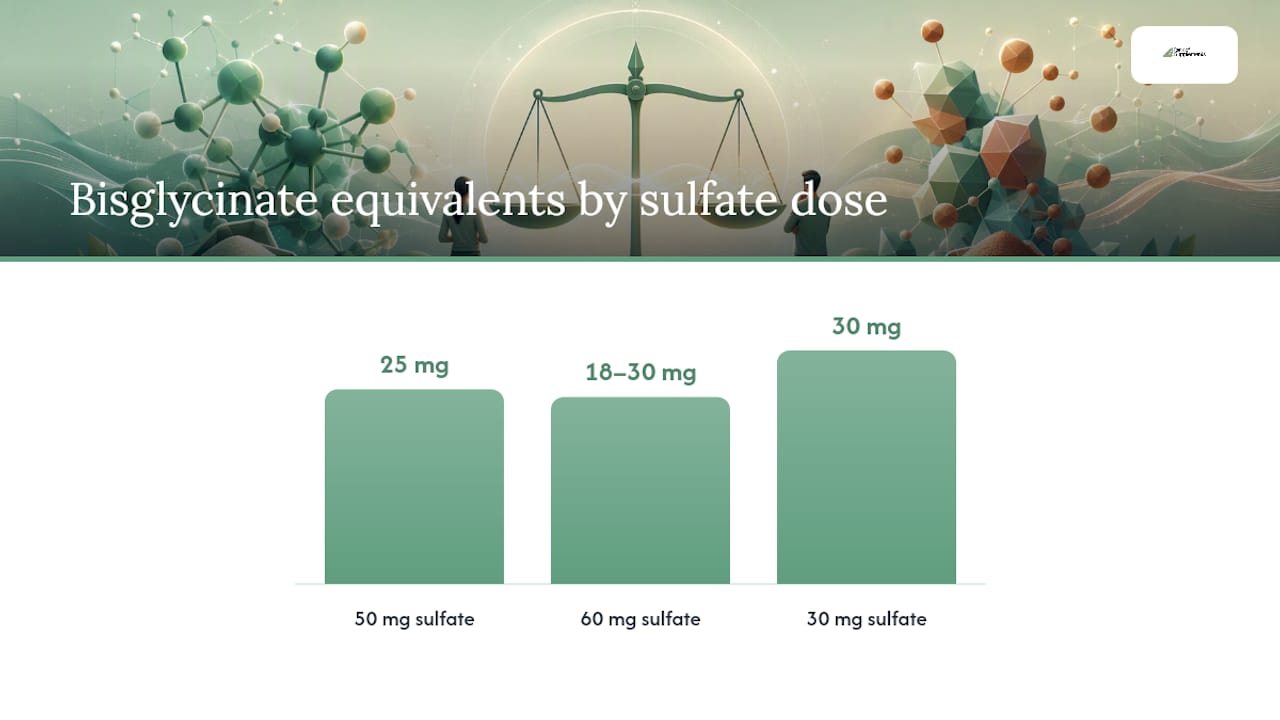
The pregnancy prevention trial found 25 mg bisglycinate matched 50 mg sulfate, roughly a 2 to 1 ratio. But the Cambodian trial showed that ratio breaks down at higher doses in already iron-replete people, where 18 mg of bisglycinate couldn’t keep pace with 60 mg of sulfate. Equivalence isn’t a fixed multiplier. It shifts with how depleted you actually are.
Never adjust doses based on trial averages alone if you’re being treated for diagnosed anemia. Follow your ferritin and hemoglobin lab results and your clinician’s specific target.
Which Form Fits Your Situation
Pregnancy prevention, GI sensitivity, and pediatric use tend to favor bisglycinate because adherence matters more than squeezing out the last few points of ferritin. Active anemia treatment under clinical supervision, tighter budgets, and situations needing a specific elemental dose targeted precisely still often call for ferrous sulfate.
- Pregnancy, prevention only: bisglycinate at lower elemental doses performed as well as sulfate with far fewer complaints.
- Confirmed iron-deficiency anemia needing rapid correction: ferrous sulfate at a clinician-directed elemental dose remains the standard.
- Children and adolescents: matched elemental doses show bisglycinate can edge out sulfate on ferritin without added side effects.
- GI intolerance history or IBS: bisglycinate is the more forgiving starting point.
- On a proton pump inhibitor or with malabsorption issues: talk to a clinician before either form. Reduced stomach acid impairs the ferric to ferrous conversion both forms rely on, and IV iron may be the better route.
If ferritin isn’t rising after 8 to 12 weeks on either form at an appropriate dose, that’s the signal to escalate the conversation toward prescription-strength options or IV iron rather than switching brands again.
Getting the Most Out of Any Iron Supplement
Take oral iron on an empty stomach when you can tolerate it. Food, especially dairy, cuts absorption meaningfully. Pairing your dose with a small amount of vitamin C (a splash of orange juice works) helps counteract that inhibition, particularly with ferrous sulfate.
- Space iron at least two hours from calcium supplements, antacids, or PPI doses.
- Avoid taking it with coffee or tea, which contain tannins that block absorption.
- If nausea persists, try every-other-day dosing instead of daily. Research increasingly supports this for improving net absorption while cutting GI complaints.
- If constipation is the main problem, ginger has some evidence for easing nausea tied to supplement use.
Pro Tip: If you’ve tried a sulfate product and quit within a week due to side effects, don’t assume iron itself is the problem. Switching formulations is worth trying before giving up on oral supplementation entirely.
The Bottom Line on Iron Bisglycinate vs Ferrous Sulfate
Bisglycinate is the better default for people who need to actually finish their supplement course without giving up from side effects. Ferrous sulfate still holds its ground for clinician-directed, aggressive repletion.
- Get ferritin and hemoglobin checked before starting either form.
- Pick a dose based on your specific deficiency, not a generic trial average.
- Track side effects for two weeks and switch forms if they’re derailing adherence.
- Escalate to your clinician if ferritin hasn’t moved after 8 to 12 weeks.
An evidence-first take on choosing iron
Adherence usually decides whether an iron supplement works, more than the compound name on the label. Rankofsupplements prioritizes formulation transparency and tolerability data over marketing claims like “gentle iron,” because the label often overstates what chelation alone can deliver.
Find the Right Iron Product Without Guessing at Labels
Comparing elemental iron content across dozens of bisglycinate and sulfate products by hand is tedious, and manufacturers don’t make it easy. Rankofsupplements built its supplement ingredient library specifically to cut through that, breaking down elemental iron per serving, formulation type, and third-party testing status for each entry.
If you’re also researching related chelated minerals, the magnesium glycinate deep dive shows how the same chelation principle plays out with a different mineral. And if you want a sense of how Rankofsupplements structures head-to-head product evaluations, the Profolan vs Folicerin comparison is a useful model. Start by pulling up the ingredient library and checking the elemental iron dose on whatever product you’re currently considering.
Sources
- Ferrous bisglycinate 25 mg iron is as effective as ferrous sulfate 50 mg iron in the prophylaxis of iron deficiency and anemia during pregnancy (randomized trial)
- Is a Lower Dose of More Bioavailable Iron (18-mg Ferrous Bisglycinate) Noninferior to 60-mg Ferrous Sulfate in Increasing Ferritin Concentrations While Reducing Gut Inflammation and Enteropathogen Detection in Cambodian Women? (Journal of Nutrition / trial)
- Mechanistic review: chelated iron forms and gastrointestinal tolerance (PMC3867244)
- Daily supplementation with 30 mg elemental iron as ferrous sulfate or iron bis-glycinate chelate increased ferritin in schoolchildren; bis-glycinate showed higher ferritin at 6 months (randomized trial)
- Comparison of oral iron formulations for anemia in pregnancies with non-severe hemoglobinopathies (AJOG observational study)
FAQ
Is 25 mg iron bisglycinate equivalent to ferrous sulfate?
In one prevention-focused pregnancy trial, 25 mg of bisglycinate matched 50 mg of ferrous sulfate for preventing anemia, but that ratio doesn’t hold in every population or dose range.
Which is better absorbed, ferrous sulfate or iron bisglycinate?
Bisglycinate’s chelated structure tends to produce comparable or better ferritin outcomes at lower elemental doses in several trials, largely because it causes fewer GI side effects that would otherwise interrupt consistent use.
Will iron bisglycinate raise ferritin levels?
Yes. A schoolchildren trial found 30 mg/day of bisglycinate raised ferritin as effectively as equal-dose ferrous sulfate, with a modestly higher level at 6 months.
Is ferrous bisglycinate the best iron supplement?
It’s one of the better-tolerated options for people who struggle with GI side effects, but ferrous sulfate remains appropriate for clinician-directed rapid repletion, so the “best” choice depends on your specific deficiency and tolerance.