TL;DR:
- Supplements offer modest 3-5% performance gains beyond solid training and nutrition.
- Accurate baseline measurements over two weeks are essential before testing new supplements.
- Sequential, data-driven testing ensures you identify what truly benefits your performance.
You’ve spent real money on a shelf full of supplements, followed the dosing instructions, and still feel like your workouts aren’t meaningfully different. That frustration is far more common than the fitness industry wants you to admit. The problem isn’t usually the supplement itself, it’s the lack of a strategic system around it. Evidence shows that marginal gains of 3-5% are the realistic ceiling for most supplements when layered on top of solid training and nutrition. This guide walks you through exactly how to build that system, measure what matters, and invest only in what genuinely moves your performance forward.
Table of Contents
- Identifying your workout goals and supplementation needs
- Baseline measurement: Assessing your current performance
- Evidence-based supplement selection and timing
- Testing and verifying supplement effects
- Why supplement optimization is about marginal gains, and why that’s a good thing
- Explore the best supplement stacks for your goals
- Frequently asked questions
Key Takeaways
| Point | Details |
|---|---|
| Set clear fitness goals | Define your workout objectives before selecting any supplement for maximum effectiveness. |
| Measure performance baseline | Record your current metrics so you can track how supplements impact your results. |
| Apply evidence-based stacking | Choose and time supplements according to proven research, not marketing hype. |
| Test and verify effects | Add supplements one by one and measure real changes, avoiding placebo-driven decisions. |
| Expect incremental gains | Supplements rarely offer drastic results, focus on small improvements that accumulate over time. |
Identifying your workout goals and supplementation needs
Every good supplement strategy starts with a brutally honest look at what you’re actually trying to accomplish. Not what sounds good on paper. Not what your training partner is using. What you need, for your specific goal, in your specific context.
Fitness goals generally fall into four major categories: endurance improvement, strength development, muscle hypertrophy (building size), and fat loss. Each category draws on different physiological systems, and each one responds to a different set of supplements. Throwing a muscle-building stack at a marathon runner is like bringing a hammer to a chess match. Understanding dietary supplement basics gives you the vocabulary to start matching solutions to problems.
Here’s a breakdown of common goal categories and the supplements most aligned with each:
- Endurance athletes benefit most from caffeine, nitrates, and sodium-based electrolytes during long training sessions
- Strength and power athletes see the clearest returns from creatine monohydrate, caffeine, and beta-alanine for high-intensity efforts
- Muscle gain (hypertrophy) focus calls for protein supplementation (especially leucine-rich sources), creatine, and strategic carbohydrate timing
- Fat loss goals are supported by caffeine (thermogenic and performance effects), protein (to preserve lean mass), and potentially HMB during caloric restriction
Once you’ve locked in your primary goal, the next step is to measure where you currently stand. This is where most people skip ahead and make expensive mistakes.
| Fitness goal | Top supplement priorities | What to avoid |
|---|---|---|
| Endurance | Caffeine, electrolytes, nitrates | Unnecessary protein overloading |
| Strength/Power | Creatine, caffeine, beta-alanine | High-dose antioxidants chronically |
| Muscle gain | Protein, creatine, carbs | Cutting calories too aggressively |
| Fat loss | Caffeine, protein, HMB | Stacking too many stimulants |
One thing worth noting: supplements provide marginal gains of roughly 3-5% above a well-optimized training and nutrition base. That means if your sleep is wrecked, your calorie intake is inconsistent, or you’re skipping recovery days, no supplement stack is going to paper over those gaps. Fix the foundation first. Then supplements can actually do their job.
Baseline measurement: Assessing your current performance
After identifying which supplements suit your goals, it’s critical to measure where your performance stands so you can gauge real progress. This step is the one most people skip entirely, and it’s the reason they end up saying “I tried that, it didn’t work” without any actual data to back up the claim.
A baseline is simply your current performance level measured before introducing any new supplement. Think of it as your control condition. Without it, you have no reference point for comparison, and you’re essentially guessing whether something is helping.

Two key metrics to prioritize are HRV and RPE. HRV (heart rate variability) is a measure of the variation in time between your heartbeats, and it reflects your body’s recovery and readiness to train. Higher HRV generally means better recovery. RPE (rate of perceived exertion) is a subjective scale (typically 1-10) of how hard a given effort feels. When a supplement is actually working, you’ll often see your RPE drop for the same objective workload, or your output increase at the same perceived effort.
Here’s a practical baseline data table to guide your tracking:
| Metric | Tool | Recording frequency | What to look for |
|---|---|---|---|
| HRV | Whoop, Garmin, Elite HRV app | Daily (morning) | Stable or rising trend |
| RPE | Training journal or app | Per session | Drop at same workload |
| Performance output | Stopwatch, barbell weight, GPS | Per session | Measurable improvement |
| Body composition | Scale + progress photos | Weekly | Slow, consistent shifts |
| Sleep quality | Fitness tracker or app | Nightly | Duration and consistency |
Collect at least two weeks of baseline data before introducing anything new. This is non-negotiable if you want meaningful results. Two weeks gives you enough data points to account for natural day-to-day variability in performance, mood, and recovery.
The tools don’t need to be expensive. A basic fitness tracker, a free HRV app like Elite HRV, and a handwritten training log can do everything you need. What matters is that you’re consistent with your recording conditions: same time of day, same warm-up protocol, same testing environment. Variability in your measurement setup creates noise that makes real effects invisible.
Once you have solid baseline data in place, review your supplement dosage guidelines so you enter the testing phase with accurate doses from day one.
Pro Tip: Record your RPE immediately after each workout while the effort is still fresh. Waiting until the next day introduces memory bias that skews your data toward how you feel right now rather than how the workout actually felt.
- Use a consistent morning measurement window for HRV (within 5 minutes of waking, lying still)
- Keep nutrition and sleep as constant as possible during the baseline phase
- Note any factors that might affect data: illness, stress, travel, poor sleep
- Avoid starting a new training program and a new supplement simultaneously
Evidence-based supplement selection and timing
Once baseline is set, selecting the right supplements, timed strategically, amplifies your performance gains. This section is where the research gets specific, and specificity is exactly what separates people who see results from those who waste money.
Let’s start with the most researched and universally applicable ergogenic (performance-enhancing) supplement: caffeine.
Caffeine at 3-6mg/kg bodyweight, taken 30-60 minutes before your workout, consistently improves endurance, power output, alertness, and reduces perceived effort across virtually every training modality. For a 180-pound (82kg) athlete, that’s roughly 246-492mg. That’s a meaningful range, so start at the lower end, especially if you’re caffeine-sensitive or training in the evening. Tolerance builds quickly, so cycling off every 2-3 weeks preserves the ergogenic effect.
Here’s a ranked breakdown of evidence-backed supplements by goal:
- Creatine monohydrate for strength and power, 3-5g daily (timing is flexible; consistency matters more than the exact window)
- Caffeine for endurance, strength, and fat loss, 3-6mg/kg, 30-60 minutes pre-workout
- Beta-alanine for high-intensity efforts lasting 60-240 seconds, 3.2-6.4g daily, expect tingling (paresthesia), which is harmless
- Dietary nitrates (beetroot juice or sodium nitrate) for endurance, roughly 400-500mg nitrates, 2-3 hours pre-exercise
- Protein supplementation for muscle gain and recovery, target 1.6-2.2g/kg bodyweight daily, spread across 4-6 meals
For women and highly active individuals specifically, research published in 2024 confirms that high-carbohydrate pre-exercise fueling, at least 5-6 protein meals exceeding 25g each daily, and strategic use of caffeine, beta-alanine, and nitrates are all effective strategies. This isn’t just a male-focused performance picture. The mechanisms work broadly across populations when dosed correctly.
“A disciplined approach to supplementation means treating each product as a hypothesis, not a guarantee. You test it with good data, and you keep it only if the data supports it.”, RankOfSupplements.com editorial team
Electrolytes deserve special attention because they’re frequently misunderstood. You don’t need electrolyte drinks for a 45-minute gym session at moderate intensity. But electrolytes, especially sodium, become essential for sessions exceeding 90 minutes, training in hot or humid conditions, or any situation where you’re a heavy sweater. Sodium drives fluid retention and nerve signaling. Potassium and magnesium round out the picture for muscle contraction and cramp prevention.
One edge case worth knowing: HMB (beta-hydroxy beta-methylbutyrate) is typically oversold as a mass-building supplement, but it does have a real, evidence-backed use case. When you’re in a caloric deficit or experiencing unusually high training stress, HMB can reduce muscle breakdown in ways that other supplements don’t replicate well. It’s a tool for specific situations, not a daily staple for everyone.
A word on antioxidants: many athletes reach for high-dose vitamin C, vitamin E, or similar antioxidant supplements thinking more protection equals better recovery. The evidence says otherwise. Chronically high antioxidant doses can actually blunt the training adaptations your body is trying to make, because some oxidative stress from exercise is a necessary signal for growth and strength improvement. Use antioxidant-rich foods freely, but avoid megadosing antioxidant supplements on a routine basis.
For more on how to keep your doses safe while maximizing effects, the safe dosage strategies guide covers the full picture. And for a foundational look at how understanding dietary supplements helps you evaluate marketing claims critically, it’s worth reviewing before building any stack.
| Supplement | Timing | Dose range | Primary benefit |
|---|---|---|---|
| Caffeine | 30-60 min pre-workout | 3-6 mg/kg bodyweight | Endurance, power, focus |
| Creatine | Any time, daily | 3-5g | Strength, muscle gain |
| Beta-alanine | Any time, daily | 3.2-6.4g | High-intensity capacity |
| Electrolytes | During long sessions | Varies; sodium 500-1000mg/hr | Hydration, cramp prevention |
| Protein | Post-workout or any meal gap | 25g+ per serving | Recovery, muscle synthesis |
| HMB | Daily in deficit phases | 3g | Muscle preservation |
Pro Tip: Don’t stack caffeine with other stimulants like high-dose synephrine or yohimbine unless you have specific guidance. Combining stimulants increases cardiovascular load without proportionally increasing performance benefits.
Testing and verifying supplement effects
You have your stack ready. Now it’s time to methodically test effects and verify what truly moves the needle. This phase is where the discipline pays off and where most athletes either see the clearest results or make the most common mistakes.
The core principle here is sequential testing: add one supplement at a time. Adding three things simultaneously makes it impossible to know which one is responsible for any change you see. It’s a fundamental issue of confounding variables (things that muddy your ability to attribute cause and effect).
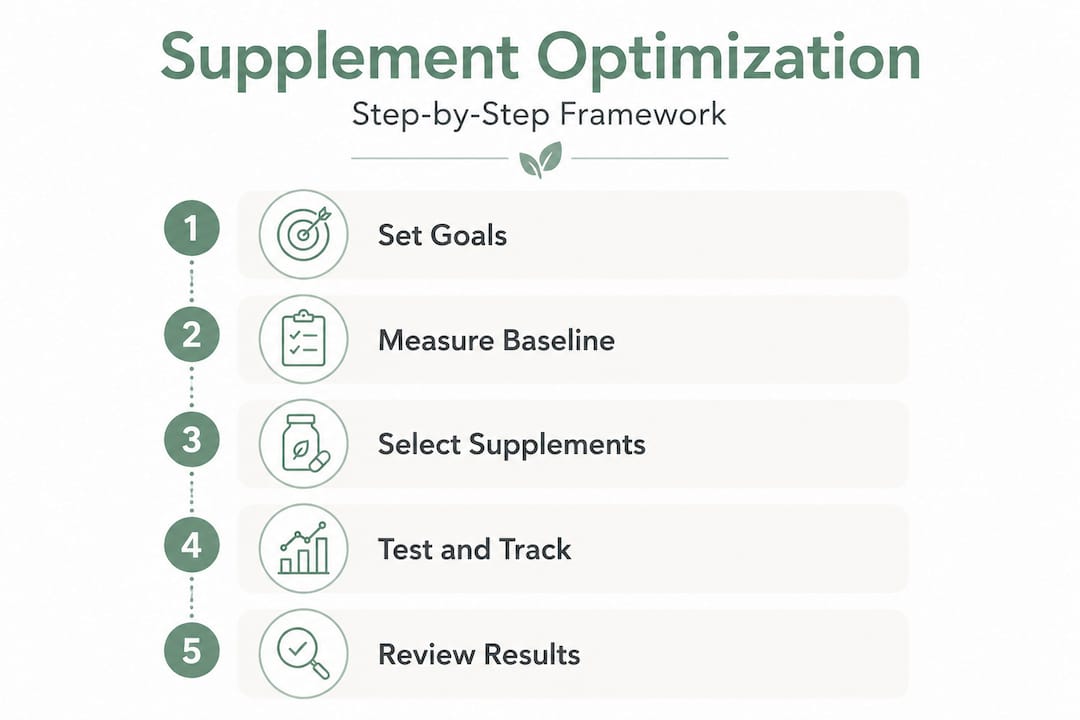
Here’s a step-by-step testing protocol:
- Complete your baseline measurement phase (minimum 2 weeks, as covered above)
- Introduce a single supplement at the target dose and timing
- Continue identical training, nutrition, and sleep habits from the baseline phase
- Record performance metrics, HRV, RPE, and subjective notes after every session
- Run the supplement for a minimum of 4 weeks (creatine may need 4-6 weeks to show full effects)
- Compare new average metrics to your baseline averages, not individual sessions
- Decide: keep, adjust dose, or remove based on the comparison
- Wait 1-2 weeks between removing one supplement and introducing the next
The sequential, evidence-based testing approach is what separates systematic optimization from guesswork. It takes patience, but the payoff is knowing precisely what works for your body, not just what works in a study population.
Recognizing the placebo effect is also part of the process. That rush of motivation you feel the first week after starting a new supplement? It’s real, but it’s not always the supplement. Genuine physiological effects tend to persist beyond the novelty period and show up in your objective metrics, not just your mood. If HRV and performance output don’t shift after 4 weeks, the subjective “feel” isn’t enough evidence to keep paying for it.
- Track both objective metrics (weight lifted, pace, HRV) and subjective feedback (energy, focus, motivation)
- Note any side effects: digestive discomfort, sleep disruption, headaches
- Keep your water intake consistent; many supplements, especially creatine and caffeine, affect hydration
- Avoid changing your training volume or intensity during a testing phase
Common troubleshooting issues:
- No effect from creatine? Check that you’re consistent with daily dosing, not just pre-workout. Creatine is a cumulative saturation supplement, not an acute stimulant.
- Caffeine not working as well? Tolerance is likely the issue. A 10-14 day break from caffeine fully restores sensitivity.
- Electrolytes not helping cramps? Sodium is the primary driver, but magnesium deficiency can also contribute. Assess both.
- RPE not improving? Revisit sleep quality and overall training load before attributing it to a supplement failure.
For a broader framework on interpreting what your results actually mean, evaluating supplement effectiveness provides a useful decision framework to apply alongside your personal data.
Pro Tip: Take photos of your supplement labels and dose schedules alongside your training logs. This creates a clear, reviewable record when you’re trying to identify patterns weeks or months later.
Why supplement optimization is about marginal gains, and why that’s a good thing
There’s a pattern we see repeatedly in the fitness world: someone tries a supplement for two weeks, feels underwhelmed, and concludes it doesn’t work. Then they move on to the next product, repeat the cycle, and end up with a cabinet full of half-empty tubs and a lot of money spent on uncertainty.
The problem isn’t the supplements. It’s the expectation.
The research is consistent about what supplements can actually deliver: roughly 3-5% improvements above a well-built training and nutrition base. That sounds unimpressive until you do the math on what it means in practice. For a competitive cyclist who averages 40 minutes in a time trial, a 3% improvement is 72 seconds. For a powerlifter with a 400-pound squat, 3% is 12 pounds. These are not trivial numbers in competitive contexts.
Even outside competitive sport, those margins compound. If you’re optimizing sleep, nutrition, training, and recovery simultaneously, and each factor delivers its own marginal improvement, the total effect is far larger than any single component. Supplements are one piece of that system, not the headline act.
What concerns us at RankOfSupplements.com is the industry’s tendency to market supplements as transformative on their own. The products that make the boldest claims often have the thinnest evidence. Meanwhile, boring-but-proven options like creatine, caffeine, and protein powders get dismissed because their benefits sound too modest to justify the hype. They shouldn’t be dismissed. They should be the foundation.
The best athletes and coaches we’ve observed treat supplementation the way engineers treat marginal gains: systematically, patiently, and with measurements. They don’t expect a supplement to replace a year of training. They expect it to make a year of training slightly more effective. That’s the mindset that consistently produces results. The incremental benefits principle extends across wellness domains, and it’s no different in fitness.
Patience also has a compounding quality of its own. An athlete who spends two years methodically testing, keeping what works, and discarding what doesn’t ends up with a lean, effective supplement protocol that fits their unique physiology. Compare that to someone who chases trending products every month. The systematic tester will outperform every time.
The uncomfortable truth is that no supplement shortcuts the fundamentals. Sleep, nutrition, training quality, and stress management are responsible for 95% or more of your performance outcomes. Supplements are the final 5%, optimized. Get comfortable with that ratio. Embrace it. Then squeeze every honest percentage point out of it.
Explore the best supplement stacks for your goals
If this article has helped clarify what optimization actually looks like in practice, the next step is finding supplements that have been independently reviewed and ranked against research standards.
At RankOfSupplements.com, we apply the same systematic, evidence-first mindset to every review we publish. Whether you’re looking for a top-rated workout supplement to support strength and muscle gain, or a supplement for fat loss that’s backed by actual science rather than clever marketing, our rankings cut through the noise. Every product we evaluate is measured against the kind of evidence-based criteria covered in this guide. Explore the full supplement rankings to find your best starting point and build a stack that’s genuinely tailored to your training goals.
Frequently asked questions
How much improvement can I expect from optimized workout supplements?
Properly optimized supplements typically add a 3-5% performance boost above your nutrition and training baseline, which translates to meaningful real-world gains for both competitive athletes and dedicated fitness enthusiasts.
When should I take caffeine for best workout results?
Take caffeine 30-60 minutes pre-workout at a dose of 3-6mg/kg bodyweight. This window gives caffeine time to peak in your bloodstream exactly when your training intensity hits its highest point.
Do I need electrolytes for every workout?
Electrolytes are primarily needed for sessions over 90 minutes, hot or humid environments, and high-sweat scenarios. For shorter, moderate-intensity sessions, plain water is sufficient for most people.
How can I test if a supplement is working for me?
Test one supplement at a time, establish a clear baseline, and track both objective metrics like HRV and output alongside subjective RPE. Sequential, isolated testing over at least four weeks gives you data you can actually act on.