
TL;DR:
- Balanced nutrition relies on whole foods providing nutrient synergy, with supplements supporting identified gaps. Supplements cannot replace the complex benefits of food and should be used based on individual needs confirmed through dietary assessment and blood testing. Proper timing, spacing, and quality verification maximize their effectiveness and safety, emphasizing a foundation of a healthy diet first.
Balancing diet and supplements means using whole foods as your primary nutrient source while filling specific, identified gaps with targeted supplementation. Most people get this backward. They buy a cabinet full of pills hoping to compensate for a poor diet, when the research consistently shows that no supplement replicates the complexity of food. The Mediterranean and DASH dietary patterns remain the gold standard for foundational nutrition, and supplements work best when layered on top of a solid dietary base. This guide gives you a practical, science-backed framework for combining healthy diet and supplements without wasting money or risking your health.
How to balance diet and supplements: the core framework
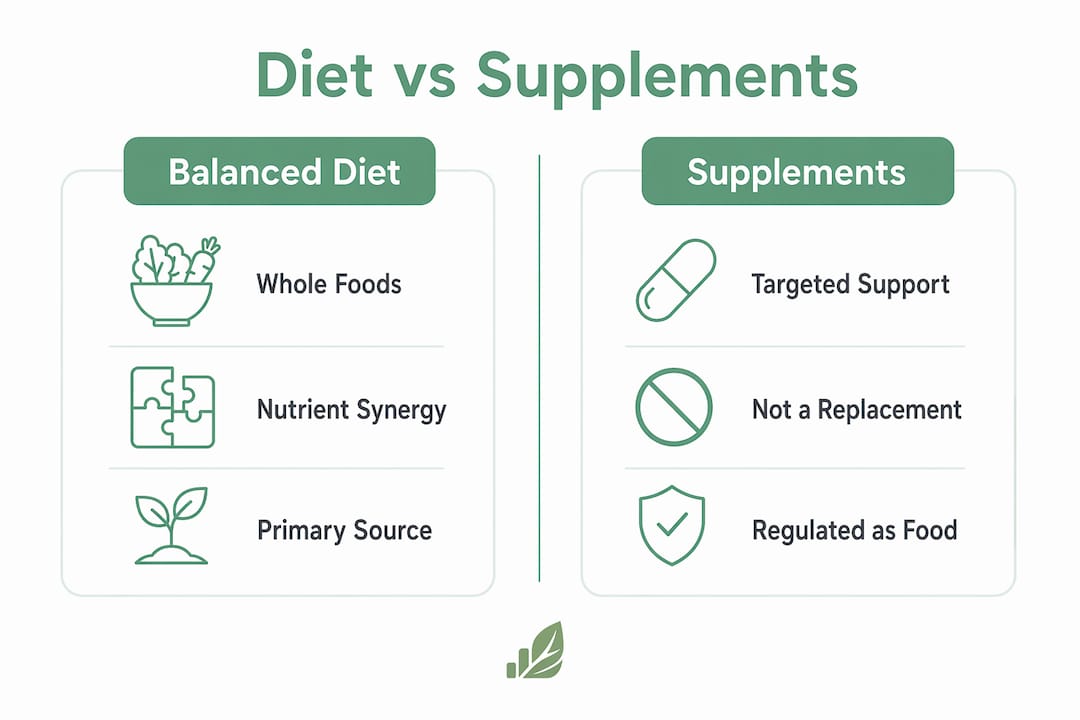
The single most important principle in nutritional balance is that supplements support nutrition. They do not create it. Whole foods provide what researchers call a “food matrix,” a complex combination of nutrients, fiber, and phytochemicals that supplements cannot replicate for absorption and health benefits. A spinach salad with lemon juice delivers iron alongside vitamin C, which increases iron absorption. A capsule of iron alone delivers none of that synergy.
The US Preventive Services Task Force has found insufficient evidence for multivitamins preventing cardiovascular disease or cancer, which means the widespread belief that a daily multivitamin covers your nutritional bases is not supported by current science. That finding should shift your default position: food first, supplements second, and only when there is a clear reason.
Understanding what a dietary supplement actually is helps clarify its role. Supplements are regulated as food products, not drugs, which means they are not FDA-approved for safety or efficacy before they reach store shelves. That distinction matters when you are deciding what to take and why.
What is a balanced diet and why food should come first
A balanced diet is one that consistently delivers adequate calories, macronutrients (protein, carbohydrates, and fat), and micronutrients (vitamins and minerals) from whole food sources. The key word is consistently. One green smoothie does not offset a week of processed food.
Whole foods deliver nutrients in combinations that improve how your body absorbs and uses them. Consider these examples:
- Iron + vitamin C: Pairing spinach or lentils with citrus or bell peppers significantly increases non-heme iron absorption.
- Fat + fat-soluble vitamins: Eating avocado or olive oil with a salad helps your body absorb vitamins A, D, E, and K from the vegetables.
- Calcium + vitamin D: Dairy or fortified plant milks alongside sunlight exposure or a vitamin D supplement creates the combination your bones actually need.
- Turmeric + black pepper: Piperine in black pepper increases curcumin bioavailability by up to 2,000%, a classic example of food synergy working in your favor.
Supplements strip nutrients out of this context. You get the isolated compound, but not the co-factors that make it work efficiently. Food-based nutrient synergy enhances absorption beyond what isolated supplements provide, which is why a diet built around vegetables, legumes, whole grains, lean proteins, and healthy fats will always outperform a supplement stack built on top of a poor diet.
The practical implication: before you spend money on supplements, audit your diet. Are you eating at least five servings of vegetables and fruit daily? Are you getting adequate protein from whole sources? Is your sodium intake dominated by processed foods? Over 70% of sodium intake comes from processed foods, which signals how far most diets stray from whole food foundations.
Pro Tip: Use a free app like Cronometer for one week to track your actual micronutrient intake. Most people discover specific gaps, not general deficiencies, and that data tells you exactly which supplements are worth considering.
When and why supplements become necessary
Supplements are not optional for everyone, but they are not universal either. Specific populations face genuine dietary gaps that food alone cannot reliably close.
- Vegans and vegetarians. Plant-based diets eliminate the most bioavailable sources of vitamin B12, heme iron, zinc, and long-chain omega-3s. Only 5-10% of plant-based ALA converts to EPA, which means algae-based omega-3 supplements are a practical necessity, not a preference.
- Pregnant and breastfeeding women. Folate, iron, iodine, and choline requirements increase significantly during pregnancy. Prenatal supplements exist precisely because food intake alone rarely meets these elevated demands.
- Adults over 65. Aging reduces the skin’s ability to synthesize vitamin D from sunlight and decreases stomach acid, which impairs B12 absorption. Both nutrients require supplementation in most older adults.
- People with restricted diets or malabsorption conditions. Celiac disease, Crohn’s disease, and bariatric surgery all compromise nutrient absorption in ways that diet alone cannot compensate for.
- Anyone with a confirmed deficiency. Blood testing is the only reliable way to confirm a deficiency. Guessing based on symptoms leads to over-supplementation, which carries its own risks.
The risk of over-supplementing is real and underappreciated. Fat-soluble vitamins A, D, E, and K accumulate in body tissue, and excess vitamin A is directly toxic. High-dose zinc supplementation over time depletes copper. Taking supplements without a diagnosed need is not neutral. Supplements should fill specific diagnosed gaps, not substitute for foundational nutrition pillars like adequate calories, protein, and sleep.
Blood testing through a primary care physician or a service like LabCorp or Quest Diagnostics gives you a baseline for vitamin D, B12, iron, ferritin, and magnesium. That data transforms supplement decisions from guesswork into targeted corrections.
How to optimize supplement timing, combinations, and absorption
Knowing which supplements to take is only half the equation. When and how you take them determines whether they actually work.

Fat-soluble vs. water-soluble vitamins
| Vitamin type | Examples | Best timing | Key rule |
|---|---|---|---|
| Fat-soluble | A, D, E, K | With a meal containing fat | Take once daily; avoid mega-dosing |
| Water-soluble | B vitamins, C | Any time; with or without food | Take consistently; body does not store them |
| Minerals | Calcium, iron, magnesium | Separate from each other | Avoid combining competing minerals |
Fat-soluble vitamins require a fat-containing meal for absorption. Taking vitamin D on an empty stomach wastes a significant portion of the dose. Water-soluble vitamins like vitamin C and the B complex are excreted in urine when taken in excess, so splitting doses throughout the day improves utilization.
The calcium and iron conflict
Calcium and iron compete for the same absorption pathway in the gut. Taking them together can reduce absorption of each by 30 to 50%. If you need both, take calcium with breakfast and iron with lunch or dinner, separated by at least two hours. This single adjustment can meaningfully improve the effectiveness of both supplements.
High-dose multivitamin and multimineral supplements create exactly this problem by combining competing minerals in one capsule. Targeted dosing and spacing are more effective than a “kitchen sink” multivitamin that delivers everything at once.
Synergistic combinations that work
Some supplements genuinely amplify each other. Vitamin D3 taken with vitamin K2 directs calcium into bones rather than arteries. Magnesium is required for vitamin D metabolism, so supplementing D without adequate magnesium is less effective. Iron absorption improves when taken with vitamin C. These pairings are worth building into your routine deliberately.
Pro Tip: Take magnesium glycinate at night. It supports sleep quality and muscle recovery, and the glycinate form is gentler on the digestive system than magnesium oxide, which is the cheapest and least absorbable form found in most drugstore products.
For more detail on supplement dosage guidelines, Rankofsupplements covers safe dosing ranges across the most commonly used nutrients.
How to build a personalized supplement plan
A personalized supplement plan starts with your diet, not a supplement catalog. Follow this sequence to build one that actually fits your needs.
- Audit your diet for two weeks. Use Cronometer or MyFitnessPal to log meals and identify consistent gaps. Look for nutrients you regularly fall below 80% of the recommended daily value.
- Get baseline blood work. Test vitamin D, B12, ferritin, magnesium, and a complete metabolic panel. This confirms whether dietary gaps translate into actual deficiencies.
- Apply the supplement pyramid. The supplement pyramid strategy starts with foundational nutrients (protein, key minerals, hydration) before layering in supportive supplements (omega-3s, vitamin D, probiotics) and only then considering performance or niche supplements. Most people skip straight to the top of the pyramid and ignore the base.
- Start with one or two supplements. Adding five supplements at once makes it impossible to identify what is working or causing side effects. Introduce one supplement, assess for four weeks, then add the next.
- Reassess every six months. Nutritional needs change with age, activity level, diet shifts, and health status. A supplement that was necessary at 30 may be unnecessary at 40 if your diet has improved.
The table below maps common health goals to the supplements most supported by evidence, assuming a reasonably balanced diet is already in place.
| Health goal | Foundational supplements | Notes |
|---|---|---|
| General wellness | Vitamin D3, magnesium, omega-3 | Test D levels before dosing |
| Vegan/plant-based diet | B12, algae omega-3, iron (if deficient) | B12 is non-negotiable |
| Bone health (40+) | Vitamin D3 + K2, calcium (if dietary intake is low) | Prioritize dietary calcium first |
| Energy and recovery | Magnesium, B complex, iron (if deficient) | Confirm iron deficiency before supplementing |
| Gut health | Probiotic, prebiotic fiber | Match probiotic strains to specific goals |
For goal-specific guidance, Rankofsupplements organizes supplements by health condition so you can cross-reference your goals with evidence-based options.
Common mistakes when combining diet and supplements
Most supplementation errors fall into predictable patterns. Recognizing them saves money and prevents harm.
- Treating a multivitamin as a nutritional safety net. A standard multivitamin delivers nutrients in forms and doses that may not match your actual needs. It also combines minerals that compete for absorption, reducing the value of each.
- Assuming supplements fix a poor diet. No supplement compensates for a diet built on ultra-processed foods. The food matrix that whole foods provide cannot be replicated in capsule form.
- Ignoring supplement-drug interactions. St. John’s Wort reduces the effectiveness of oral contraceptives and certain antidepressants. High-dose vitamin E increases bleeding risk when combined with blood thinners. Always disclose supplements to your prescribing physician.
- Adding fiber supplements too fast. Rapid increases in fiber without adequate water intake cause bloating, cramping, and constipation. Gradual dietary changes are recommended when increasing fiber from any source.
- Buying supplements without third-party certification. Supplements are not FDA-approved before sale. Third-party certifications from NSF International or USP verify that what is on the label is actually in the bottle, and that contaminants are absent.
“Supplements serve best as insurance to fill specific deficiencies rather than replacing a healthy diet.” This framing from Stanford Medicine cuts through the marketing noise and gives you the clearest possible decision rule for every supplement you consider.
Gut health also plays a direct role in how well you absorb nutrients from both food and supplements. Poor gut microbiome diversity, low stomach acid, and chronic inflammation all reduce absorption efficiency. Addressing digestion and gut health before adding a complex supplement stack often produces better results than the supplements themselves.
Key takeaways
Effective nutritional balance requires a whole-food diet as the foundation, with supplements used only to correct specific, confirmed gaps based on individual needs and timing.
| Point | Details |
|---|---|
| Food comes first | Whole foods provide nutrient synergy that isolated supplements cannot replicate. |
| Supplements fill gaps, not diets | Use blood work and dietary audits to identify real deficiencies before supplementing. |
| Timing changes everything | Separate calcium and iron by two hours; take fat-soluble vitamins with a fat-containing meal. |
| Build from the base up | Follow the supplement pyramid: foundational nutrients before niche or performance supplements. |
| Verify quality before buying | Choose supplements with NSF or USP third-party certification to confirm label accuracy. |
What I actually think about supplementing around your diet
The supplement industry has a financial interest in making you believe your diet is never quite enough. After years of reviewing the evidence at Rankofsupplements, I find that most healthy adults with a reasonably varied diet need far fewer supplements than they are taking.
The cases where I see supplements genuinely move the needle are specific and predictable: a vegan who adds B12 and algae-based omega-3s, an office worker in a northern climate who corrects a vitamin D deficiency confirmed by blood work, a woman in her 40s who adds magnesium glycinate and notices real improvements in sleep and muscle tension. These are targeted corrections, not general wellness insurance.
What I find more troubling is the number of people who spend significant money on adaptogens, collagen peptides, and nootropic blends while eating fast food five days a week. The supplement pyramid concept is genuinely useful here because it forces you to ask whether your base is solid before you add anything on top. If your protein intake is inadequate, your sleep is poor, and you are not drinking enough water, no supplement stack will compensate for those deficits.
My honest recommendation: get one round of blood work, spend two weeks tracking your diet honestly, and then make one or two targeted additions. Reassess in six months. That approach will serve you better than any supplement protocol you find online, including the ones on this site.
matteo
Find the right supplements for your diet and goals
Choosing supplements without reliable information is how people waste money and take unnecessary risks. Rankofsupplements exists to cut through that noise.
The Rankofsupplements ingredient library covers the science behind individual supplement ingredients, including dosing ranges, absorption factors, and known interactions. It is the fastest way to verify whether a specific ingredient is worth adding to your routine. For a broader view of what is actually working in 2026, the top wellness supplements guide covers the most evidence-backed options across health categories. Every review on the platform prioritizes third-party tested products and transparent ingredient sourcing.
FAQ
Can you rely on supplements instead of eating a balanced diet?
No. Supplements cannot replicate the nutrient synergy of whole foods, and the US Preventive Services Task Force finds no evidence that multivitamins prevent major diseases. They are designed to fill specific gaps, not replace dietary foundations.
How do you know which supplements you actually need?
Blood work is the most reliable method. Testing vitamin D, B12, ferritin, and magnesium gives you a factual baseline. Dietary tracking apps like Cronometer can reveal consistent intake gaps before deficiencies develop.
What supplements should most adults consider taking?
Vitamin D3, magnesium, and omega-3 fatty acids are the three most commonly deficient nutrients in adults eating a Western diet. Each should be confirmed by testing or clear dietary gaps before starting.
Is it safe to take multiple supplements at the same time?
Not always. Calcium and iron reduce each other’s absorption by 30 to 50% when taken together. Fat-soluble vitamins can accumulate to toxic levels with excessive dosing. Space competing minerals by at least two hours and stay within evidence-based dose ranges.
How often should you reassess your supplement routine?
Every six months is a practical interval. Nutritional needs shift with age, diet changes, activity level, and health status. A supplement that corrected a deficiency may no longer be necessary once diet and lifestyle improve.
Recommended
- Related article: Science-Backed Supplements to Slow Age-Related Vision Loss
- Top list: Best Supplements for Weight Management
- Product review: Nutrigo Lab Strength: Full Review
- Guide: What Is a Dietary Supplement? Complete Guide