
Glycine taken before bed, typically at a dose used in human trials, modestly improves sleep quality and shortens the time it takes to fall asleep in the small human trials that have tested it. It works differently than melatonin or sedatives; it does not knock you out, it nudges your body toward the temperature drop that naturally precedes sleep. The evidence base is real but thin: a handful of crossover trials, not decades of data.
Here is the practical bottom line:
- Typical dose: a moderate amount of glycine, taken 30 to 60 minutes before bedtime
- What it targets: sleep onset latency and subjective sleep quality, not sleep duration or architecture
- Main safety caveats: consult a clinician first if you are pregnant, breastfeeding, have kidney disease, or take medications affecting neurotransmitter activity
- Side effects: generally mild, occasionally gastrointestinal upset at higher doses
- Best fit: occasional or mild sleep-onset trouble, not diagnosed insomnia or untreated sleep apnea
The standard industry term for this compound is simply glycine, a nonessential amino acid your body already makes and uses in collagen synthesis and neurotransmission. That second role, as an inhibitory neurotransmitter and NMDA receptor co-agonist, is what makes it interesting for sleep.
Key Takeaways
Glycine at 3 g before bed produces modest, evidence-backed improvements in sleep onset and subjective sleep quality by working through a thermoregulatory pathway rather than sedation.
| Point | Details |
|---|---|
| Standard dose and timing | Take 3 g of glycine 30 to 60 minutes before bed, matching the dose used in human trials. |
| Mechanism is thermoregulatory | Glycine activates NMDA receptors in the SCN, lowering core temperature and boosting peripheral blood flow. |
| Modest, not dramatic, effects | Trials show shorter sleep latency and better subjective quality, not deeper or longer sleep overall. |
| No next-day grogginess reported | Unlike sedatives, trial participants did not report residual sleepiness the following day. |
| Evidence base is small | Trials involve small samples over days to weeks, so long-term nightly-use data does not yet exist. |
Table of Contents
- How Glycine Helps Sleep Without Acting Like a Sedative
- What Human Trials Actually Show About Glycine and Sleep Quality
- Glycine Sleep Dosage: How Much and When to Take It
- Glycine Side Effects, Contraindications, and Who Should Ask a Doctor First
- How to Test Glycine for Sleep: A Simple 2-Week Protocol
- Rankofsupplements’ Take: Who Should Actually Try Glycine
- Primary Research and Related Rankofsupplements Guides
- An Editorial Take on Glycine’s Real Place in a Sleep Routine
- Sources
- FAQ
How Glycine Helps Sleep Without Acting Like a Sedative
Most sleep aids work by suppressing central nervous system activity broadly. Benzodiazepines, Z-drugs, even melatonin at high doses, all lean on some version of “turn the brain down.” Glycine takes a different route entirely, and that difference is the reason researchers keep studying it despite a small evidence base.
Glycine’s sleep effect appears to run through thermoregulation. Core body temperature naturally drops in the evening as part of the circadian cycle, and that drop helps trigger sleep onset. Animal research indicates glycine lowers core body temperature by activating NMDA receptors in the suprachiasmatic nucleus (SCN), the brain’s master circadian clock, while simultaneously increasing blood flow to the skin’s surface. More blood at the periphery means more heat radiating outward, which cools the body’s core faster.

That mechanism depends entirely on an intact SCN. Researchers found that surgically lesioning the SCN in animal models abolished both the hypothermic and sleep-promoting effects of glycine, which tells you this is not some generic sedative pathway. It is tied specifically to the circadian clock, not a blanket dampening of brain activity.
Here is the sequence researchers propose, step by step:
- Glycine crosses into circulation and reaches NMDA receptors concentrated in the SCN.
- Receptor activation triggers a cascade that lowers core body temperature.
- Peripheral blood vessels dilate, increasing blood flow to hands, feet, and skin.
- Heat radiates outward faster than it would otherwise, accelerating the natural pre-sleep temperature drop.
- The body reaches its sleep-onset temperature threshold sooner, shortening the time it takes to fall asleep.
Glycine’s mechanism differs from sedatives in one key way: it signals a specific thermoregulatory pathway rather than broadly suppressing central nervous system activity. That distinction is why trial participants report improved sleep onset without the grogginess associated with benzodiazepines, which flood GABA receptors indiscriminately and often leave a pharmacological residue the next morning.
This is also why glycine does not show up in trials as a knockout sedative. It is not trying to shut your brain off. It is trying to help your body do something it was already trying to do, just a little faster and a little more efficiently. If you have ever noticed you sleep better after a warm bath (the rebound cooling effect afterward mimics this same thermoregulatory trigger), you already have an intuitive sense of the mechanism at work.
Worth noting: peripheral vasodilation and core cooling are the same physiological events behind the “warm hands and feet before sleep” phenomenon that sleep researchers have documented for years, independent of glycine. Glycine appears to be nudging a pathway your body already uses nightly, not introducing something foreign to it.
What Human Trials Actually Show About Glycine and Sleep Quality
The animal data explains a plausible mechanism, but the question that matters to you is simpler: does this translate to people who take a capsule or a scoop of powder before bed? The honest answer is yes, modestly, in a small number of well-designed trials.
The most frequently cited study is a randomized, double-blind, crossover trial in which participants took 3 g of glycine before bed on nights when their sleep was intentionally restricted. Researchers found that 3 g of glycine before bedtime shortened the time it took participants to reach slow-wave sleep, improved subjective ratings of sleep satisfaction and refreshed feeling upon waking, and reduced next-day sleepiness, all without changing the overall proportion of time spent in each sleep stage. That last part matters: glycine did not restructure sleep architecture. It just helped people get into deep sleep faster and feel better about the sleep they got.
A related study using polysomnography, the gold-standard objective sleep measurement that tracks brain waves, eye movement, and muscle activity overnight, backed this up on the physiological side. Researchers observed that glycine shortened the latency to both stage 2 sleep and slow-wave sleep in small clinical samples, without altering the relative time spent in each sleep stage. In plain terms: people got to the restorative parts of sleep sooner, but the overall shape of their night’s sleep stayed normal. That is a meaningfully different claim than “glycine makes you sleep more” or “glycine deepens your sleep.” It gets you there faster.
The daytime side of the data is arguably the more interesting piece for anyone whose real complaint is grogginess rather than sleep itself. A trial focused specifically on partially sleep-restricted volunteers reported that bedtime glycine reduced daytime sleepiness and improved measures of daytime performance, including memory recognition tasks, following a night of poor sleep. That is a rare thing for a sleep supplement to demonstrate: not just “did you sleep better” by self-report, but “did you perform better the next day” on an objective task.
Small, well-controlled crossover trials consistently find that 3 g of glycine before bed shortens sleep latency and improves subjective sleep quality, but every one of them involves a handful of participants over a few nights, not the large, long-duration trials that would let anyone call this settled science.
Where the evidence runs thin:
- Sample sizes are small. Most of these trials involve a dozen to several dozen participants, not hundreds.
- Duration is short. Trials typically span a few nights to a couple of weeks, not months or years of nightly use.
- Populations are narrow. Volunteers are often healthy adults with mild, self-reported sleep complaints or artificially restricted sleep, not people with diagnosed insomnia.
- Reviews call for more data. Broader reviews of the literature describe the evidence as consistent but small in scale, and specifically call for larger and longer trials before drawing firm conclusions.
None of that means the effect is not real. It means you should treat glycine as a promising, well-mechanized option with a genuine but limited evidence base, not a proven cure for insomnia. The gap between “this shows real physiological promise” and “this is clinically proven for chronic insomnia” is exactly where a lot of supplement marketing gets sloppy, and it is worth holding that line yourself.
Glycine Sleep Dosage: How Much and When to Take It
The dosage question has a clean answer, because nearly every human trial converged on a similar dose taken 30 to 60 minutes before bedtime that shows up again and again in the research behind glycine’s sleep effects.
That timing window matters more than people assume. Glycine needs time to circulate and reach the receptors involved in the thermoregulatory cascade described earlier. Taking it right as you climb into bed does not give that process room to work. Thirty to sixty minutes gives your body a head start on the temperature drop that helps trigger sleep onset.
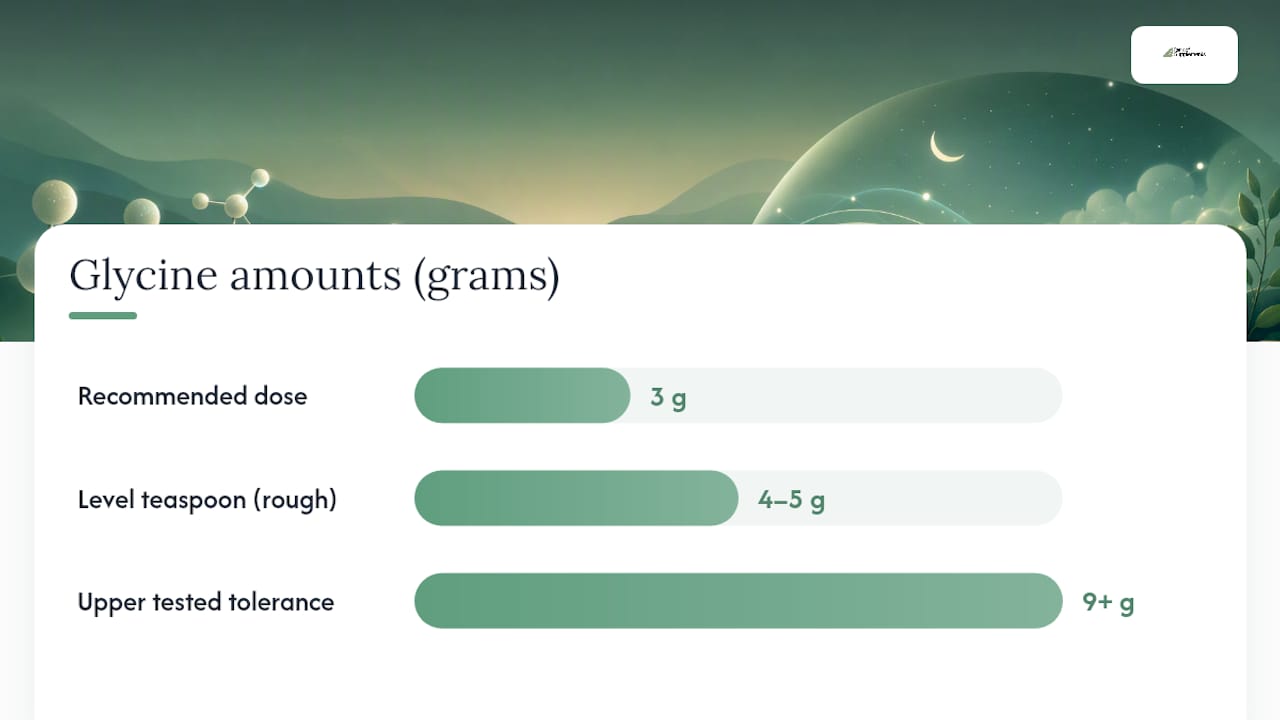
On the upper end, safety and tolerance data suggest glycine is forgiving at higher doses. Some safety and tolerance studies have tested oral glycine at doses up to 9 grams or more without serious adverse effects, though gastrointestinal upset, mild nausea, and loose stools become more common as the dose climbs. There is no established benefit to exceeding 3 g for sleep specifically. The higher-dose research exists mostly to establish an upper safety margin, not to suggest more is better.
A few practical formulation notes:
- Powder vs. capsule: Powder is the more economical option and dissolves easily in water or juice; capsules are more convenient if you travel or dislike the taste (glycine has a mild, slightly sweet flavor on its own).
- Measuring 3 g without a scale: A standard level teaspoon holds roughly 4 to 5 g of glycine powder, so a slightly rounded quarter teaspoon or a scant level teaspoon gets you close to 3 g. A kitchen scale is more precise if you have one.
- Mixing: Glycine dissolves readily in warm or room-temperature water; it does not require a fatty carrier the way some fat-soluble supplements do.
- Dietary context: Glycine occurs naturally in collagen-rich foods and gelatin, but the amount in a typical meal falls well short of the 3 g bolus used in trials, so food alone is unlikely to replicate the effect.
Pro Tip: Keep your dose and timing consistent for at least a week before judging whether it’s working. A single night tells you almost nothing; a thermoregulatory effect that shaves a few minutes off sleep onset is easy to miss unless you’re tracking it night over night.
Glycine Side Effects, Contraindications, and Who Should Ask a Doctor First
The safety profile that comes out of the trials is reassuring, with a few real caveats worth taking seriously.
The most consistently reported side effects are gastrointestinal: mild nausea, stomach discomfort, or loose stools, mostly at doses well above the standard 3 g sleep dose. At the trial-standard dose, side effects were uncommon. One genuinely notable finding across the clinical literature: participants did not report next-day grogginess or residual sedation, the exact complaint that plagues many prescription sleep aids and even higher doses of melatonin in some people. That absence of a hangover effect is one of the more practically useful takeaways from the entire body of research.
Certain groups should talk to a clinician before adding glycine to a nightly routine:
- Pregnant or breastfeeding individuals, since glycine has not been specifically studied for safety in these populations at supplemental doses.
- People with kidney disease, because amino acid metabolism and clearance can be affected by impaired kidney function.
- Anyone on medications that affect neurotransmitter activity, including certain psychiatric medications, since glycine’s role as an inhibitory neurotransmitter co-agonist could theoretically interact.
- Anyone with a diagnosed sleep disorder, such as sleep apnea, where the underlying problem is not sleep onset but airway obstruction that a supplement will not fix.
One honest gap in the research: there is no long-term data on nightly glycine use stretching across months or years. The trials that exist run for days to a couple of weeks. That does not mean nightly use is unsafe. It means nobody has specifically checked, so a reasonable approach is periodic self-monitoring rather than assuming indefinite use is risk-free simply because short-term trials looked clean.
How to Test Glycine for Sleep: A Simple 2-Week Protocol
Rather than guessing whether glycine is doing anything, run a short, structured trial on yourself.
- Set your baseline first. For three to four nights before starting glycine, track how long it takes you to fall asleep, one rating of sleep quality out of 10, and a same rating of how sleepy you feel around 2 p.m. the next day.
- Start the supplement. Take 3 g of glycine, powder or capsule, 30 to 60 minutes before your intended bedtime, every night for two weeks.
- Track the same three metrics nightly. Estimated minutes to fall asleep, a 1 to 10 sleep quality rating, and next-day afternoon sleepiness. A basic notes app or a wearable sleep tracker both work; consistency matters more than precision.
- Compare week two against your baseline. Look for a modest shift, not a dramatic one. A few minutes off sleep onset and a one or two point bump in subjective quality is consistent with what the trials found.
- Know when to stop. Discontinue and consult a clinician if you notice worsening sleep, new gastrointestinal symptoms that do not resolve, you start a new medication, or you become pregnant during the trial period.
Pro Tip: Rate your sleep quality before checking your phone or wearable data each morning. Anchoring your subjective rating to how you actually feel, rather than a device’s sleep score, keeps your tracking closer to what the human trials were actually measuring.
If you have a chronic, diagnosed sleep disorder rather than occasional trouble falling asleep, this self-trial is not a substitute for medical evaluation.
Rankofsupplements’ Take: Who Should Actually Try Glycine
Based on the trial evidence, our practical recommendation at Rankofsupplements is straightforward: glycine is worth a short, structured trial for people dealing with mild, occasional sleep-onset trouble, not a chronic diagnosed sleep disorder. The 3 g dose, taken 30 to 60 minutes before bed, is where the research clusters, and it is the dose we’d suggest starting with.
Poor candidates for glycine include people with severe or chronic insomnia and anyone with untreated sleep apnea. Insomnia that persists for months typically has drivers, anxiety, circadian misalignment, underlying medical conditions, that a thermoregulatory nudge from an amino acid is not built to address. Sleep apnea is a mechanical airway problem; no supplement fixes an obstructed airway, and masking daytime sleepiness from apnea with a sleep aid can delay a diagnosis that actually matters.
If you are exploring the broader sleep supplement category, our evidence-based guide to sleep and insomnia supplements walks through how glycine compares to other options. Two ingredients worth understanding alongside glycine:
- Magnesium glycinate, which pairs magnesium with glycine and is often used for relaxation and muscle tension alongside sleep support.
- L-theanine, a calming amino acid from tea leaves that some people stack with glycine for a non-sedating wind-down effect.
Our evaluation criteria across the ingredient library prioritize human trial data, transparent dosing, and an honest accounting of what the evidence does and does not show, which is exactly the standard we’ve applied here.
If you’re ready to compare specific formulations, our supplement ingredient library breaks down dosing, sourcing, and third-party testing standards across amino acid supplements, including the glycine and glycinate products most commonly used for sleep.
Primary Research and Related Rankofsupplements Guides
The mechanistic and clinical claims in this guide draw on peer-reviewed research available through PubMed and PMC, alongside Rankofsupplements’ own ingredient coverage:
- The Sleep-Promoting and Hypothermic Effects of Glycine are Mediated by NMDA Receptors in the Suprachiasmatic Nucleus, the core mechanistic study on the SCN pathway.
- Glycine ingestion improves subjective sleep quality in human volunteers, the primary randomized crossover trial at the 3 g dose.
- The Effects of Glycine on Subjective Daytime Performance in Partially Sleep-Restricted Healthy Volunteers, covering next-day performance outcomes.
- For related biology on amino acids and sleep, see this research overview on peptides for sleep.
- Rankofsupplements’ sleep and insomnia supplement guide and magnesium glycinate ingredient page for related options.
An Editorial Take on Glycine’s Real Place in a Sleep Routine
The conventional advice on glycine tends to oversell it as a “natural sleep aid” in the same breath as melatonin, and that framing undersells what actually makes it interesting. Glycine is not a sedative substitute. It is a thermoregulatory nudge, and treating it as a knockout pill sets people up to feel disappointed by an effect that was only ever going to be modest.
What the research actually supports is narrower and, frankly, more useful: a specific starter protocol, 3 g, 30 to 60 minutes before bed, aimed at people whose main problem is taking too long to fall asleep, not people with entrenched insomnia. The mechanism, working through NMDA receptors in the SCN to trigger the same core-cooling process your body already relies on, is what separates glycine from the sedate-and-hope approach of most sleep supplements.
If there’s one thing worth prioritizing, it’s tracking your own response for two weeks before deciding whether this belongs in your routine. The trials were short. Your test should be too.
Sources
- The Sleep-Promoting and Hypothermic Effects of Glycine are Mediated by NMDA Receptors in the Suprachiasmatic Nucleus - PMC
- The Effects of Glycine on Subjective Daytime Performance in Partially Sleep-Restricted Healthy Volunteers
- Glycine ingestion improves subjective sleep quality in human volunteers, correlating with polysomnographic changes
FAQ
Is It Okay to Take Glycine Every Night?
Short-term nightly use, at the 3 g trial dose, appears well tolerated based on existing studies, but long-term data on continuous nightly use over months or years does not currently exist, so periodic reassessment is a reasonable precaution.
Who Should Not Take Glycine for Sleep?
People who are pregnant or breastfeeding, those with kidney disease, anyone on medications that affect neurotransmitter activity, and people with untreated sleep apnea or severe chronic insomnia should consult a clinician before trying glycine.
Which Is Better for Sleep, Glycine or Melatonin?
They work through different mechanisms: melatonin signals your circadian clock that it’s nighttime, while glycine promotes the thermoregulatory temperature drop that supports sleep onset; melatonin tends to suit circadian issues like jet lag, while glycine suits occasional trouble falling asleep without next-day grogginess.
Is It Better to Take Glycine or Magnesium Glycinate for Sleep?
Magnesium glycinate combines magnesium’s relaxation and muscle-tension benefits with glycine’s own sleep-onset effects, making it a reasonable option if you also deal with muscle tension or suspect a magnesium shortfall, while plain glycine is more targeted if sleep onset is your only concern.