
TL;DR:
- EAAs are the nine essential amino acids crucial for muscle protein synthesis and recovery.
- EAA supplements provide all nine EAAs quickly, aiding muscle growth especially when dietary protein is inadequate.
- They are most effective around workouts and are beneficial for certain populations like older adults or calorie-restricted athletes.
Walk into any supplement store or scroll through a fitness forum and you’ll find EAA supplements sitting right next to protein powders and BCAA products, with almost no clear guidance on what makes them different or when they’re actually worth buying. Most athletes and gym-goers know they need protein, but the line between whole protein, branched-chain amino acids, and essential amino acid blends gets blurry fast. This guide cuts through that confusion by explaining exactly what EAA supplements are, what the research says about their benefits, and how to use them strategically for muscle recovery, lean mass gain, and better athletic performance.
Table of Contents
- Understanding EAAs: What they are and how they work
- How do EAA supplements differ from protein and BCAA supplements?
- Science-backed benefits: What can EAA supplements do for you?
- Dosage, timing, and practical tips for EAA supplement success
- The real story on EAAs: What most supplement guides won’t tell you
- Find the best EAA and muscle-building supplements for your goals
- Frequently asked questions
Key Takeaways
| Point | Details |
|---|---|
| EAAs support muscle growth | Essential amino acids are critical for building muscle and aiding recovery, especially when dietary protein is limited. |
| Supplements differ in benefits | EAAs, BCAAs, and protein powders serve different roles—EAAs fill dietary gaps, BCAAs offer only a partial solution, and protein powders offer completeness. |
| Evidence guides optimal use | EAAs work best when paired with resistance training and used at the right time and dosage for your specific needs. |
| Context matters for supplement choice | EAAs are most useful for those with insufficient protein intake or during periods of high training stress. |
Understanding EAAs: What they are and how they work
To lay the foundation for smart supplement choices, let’s get clear on exactly what EAAs are and why your muscles need them.
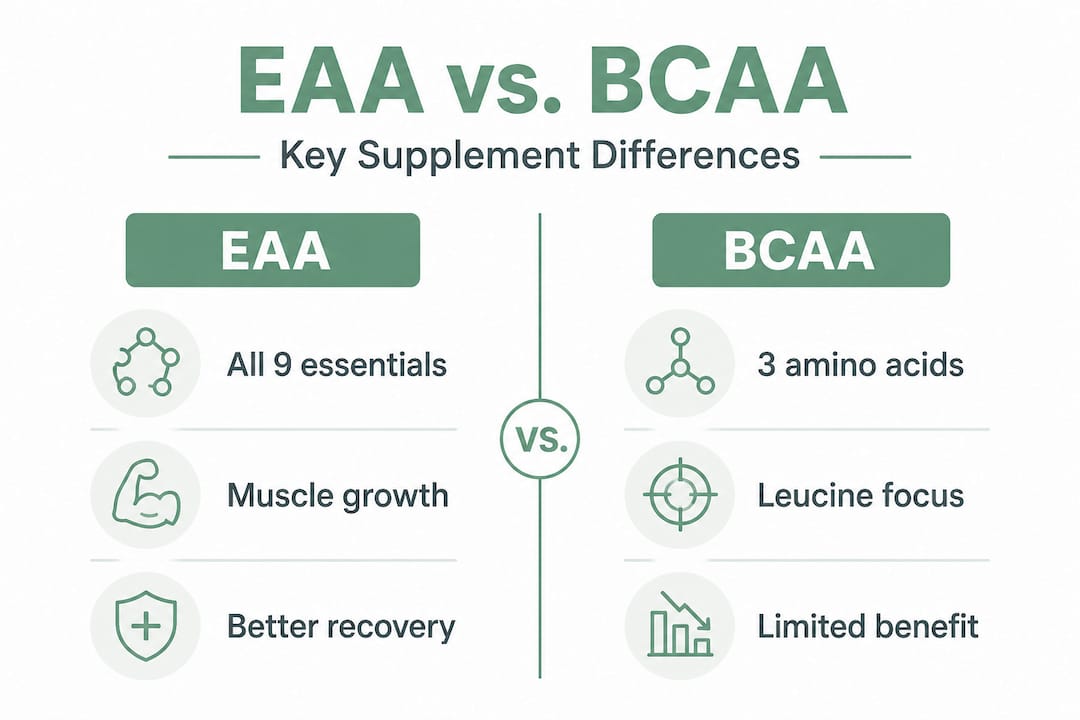
Amino acids are the building blocks of all proteins in your body, from muscle fibers to enzymes and hormones. There are 20 total amino acids, but only nine are classified as essential amino acids (EAAs). Your body cannot manufacture EAAs on its own, so they must come from food or supplements. The other 11, called non-essential amino acids, can be produced by your body from other compounds, which is why they’re considered optional from a dietary standpoint.
The nine EAAs every human requires are: histidine, isoleucine, leucine, lysine, methionine, phenylalanine, threonine, tryptophan, and valine. Each one plays a distinct role in keeping your body functioning, and when any one of them runs short, your body’s ability to build and repair muscle hits a wall.
The core reason EAAs matter for athletes is muscle protein synthesis (MPS). MPS is the cellular process your body uses to build new muscle proteins after physical stress like resistance training. Without adequate EAAs circulating in the blood, MPS simply cannot run efficiently. Research on dietary supplement basics shows that understanding how substrates like EAAs drive physiological processes helps you pick the right product for your goal.
“Only ingestion of EAAs is required to stimulate muscle protein synthesis, and effects are magnified with exercise; timing relative to exercise matters for maximal response.”
This point is significant. Non-essential amino acids don’t trigger MPS the same way. Taking an EAA supplement causes a rapid spike in blood amino acid levels, and when combined with a training stimulus, that spike becomes a powerful signal for muscle repair and growth.
The nine EAAs: Functions and food sources
| EAA | Primary function | Top food sources |
|---|---|---|
| Leucine | Triggers MPS directly | Chicken, whey, eggs |
| Isoleucine | Energy regulation, immune support | Beef, soy, lentils |
| Valine | Muscle repair, energy production | Dairy, grain, mushrooms |
| Lysine | Collagen synthesis, calcium absorption | Red meat, legumes, quinoa |
| Methionine | Antioxidant support, fat metabolism | Eggs, fish, Brazil nuts |
| Threonine | Connective tissue, immune function | Poultry, cottage cheese |
| Phenylalanine | Neurotransmitter precursor | Meat, seeds, dairy |
| Tryptophan | Serotonin and melatonin synthesis | Turkey, oats, dark chocolate |
| Histidine | Tissue repair, red blood cell production | Meat, tuna, whole grains |
Common misconceptions about EAA and protein supplements
- “All protein supplements are the same.” Not true. Whole protein sources deliver all amino acids, but the ratio and availability vary widely by source.
- “BCAAs cover everything EAAs do.” BCAAs (leucine, isoleucine, valine) are three of the nine EAAs. Using BCAAs alone leaves six essential amino acids out of the equation.
- “You only need EAAs if you’re a bodybuilder.” Endurance athletes, older adults, and anyone in a calorie deficit can benefit from ensuring EAA adequacy.
- “More amino acids always mean more muscle.” Your body can only use what it needs at a given time. Excess amino acids are oxidized for energy or excreted, not banked as extra muscle.
How do EAA supplements differ from protein and BCAA supplements?
Knowing what EAAs are, the next logical question is how EAA supplements stack up against the more familiar protein powders and BCAA products.
Protein powders are the most widely used category. They deliver all 20 amino acids, including all nine EAAs, along with carbohydrates, fats, and other micronutrients depending on the source. Whey protein, for instance, is a complete protein with a high leucine content, making it a strong driver of MPS. The downside is calories and the time it takes to digest and absorb the full amino acid load.
BCAA supplements zero in on just three EAAs: leucine, isoleucine, and valine. Leucine is the most studied trigger for MPS, which is why BCAAs became popular. But research has increasingly shown that providing only three of the nine EAAs creates an incomplete picture. Your body needs all nine to fully execute the MPS process.
EAA supplements are the middle ground. They provide all nine essential amino acids in concentrated, often pre-measured doses, without the caloric load of protein powder. They absorb quickly and deliver the full amino acid spectrum needed for MPS. As one review notes, EAA intake is most often positioned as an adjunct when total daily protein might be insufficient, or as an efficient way to raise circulating amino acids after training.
Comparison: Protein powder vs. BCAA vs. EAA supplements
| Factor | Protein powder | BCAA supplement | EAA supplement |
|---|---|---|---|
| Amino acid coverage | All 20 amino acids | 3 EAAs only | All 9 EAAs |
| Absorption speed | Moderate (20-40 min) | Fast (15-20 min) | Fast (15-25 min) |
| Caloric load | Higher (100-150 kcal/serving) | Low (5-20 kcal/serving) | Low to moderate |
| Best use case | Meal replacement, total protein gap | Intra-workout fuel | Targeted MPS support |
| Cost per serving | Low to moderate | Moderate | Moderate to high |
| Suitable for deficit diets | Yes, with planning | Yes | Yes |
Pros and cons at a glance
Protein powder:
- Pros: Cost-effective, versatile, nutritious, satisfying
- Cons: Calorie-dense, slower absorption, may not suit lactose-intolerant users
BCAA:
- Pros: Fast absorption, affordable, low calorie
- Cons: Incomplete EAA profile, less effective for MPS than full EAAs
EAA supplement:
- Pros: Complete essential profile, fast absorption, low calorie, flexible timing
- Cons: More expensive than BCAAs, less satiating than whole protein
Pro Tip: If your diet already provides 1.6 to 2.2 grams of protein per kilogram of bodyweight, a standard protein powder typically covers your EAA needs. Choose an EAA supplement when you’re training fasted, cutting calories, traveling with limited food options, or looking for a quick peri-workout amino acid boost without extra calories.
You can also explore building your supplement routine to see how EAAs might slot into a broader supplement stack without redundancy.
Science-backed benefits: What can EAA supplements do for you?
Armed with a sense of what makes EAA supplements unique, let’s see what the science actually says about their real-world benefits.
The strongest and most consistent evidence for EAA supplementation centers on three areas: stimulating muscle protein synthesis, supporting lean mass retention during calorie restriction, and improving body composition when paired with resistance training.
Muscle protein synthesis. EAAs are the direct substrate for MPS. Leucine, one of the nine, acts as a specific molecular switch that activates the mTOR pathway, the cellular signaling cascade that kicks off muscle protein production. Without all nine EAAs present in sufficient quantities, that pathway stalls partway through.

Body composition. One human trial found that 3.6g/day EAA plus arginine combined with resistance training led to greater gains in lean mass and greater reductions in fat mass compared to a placebo group. These kinds of results don’t happen from EAAs alone; training is essential. But the supplement helped optimize the environment for muscle growth.
Physical performance. Research across various study designs shows that EAA blends can improve strength and endurance performance metrics when used consistently alongside structured training programs.
Top evidence-backed effects for athletes and exercisers
- Accelerated muscle recovery after high-volume training sessions by providing the substrate for rapid MPS
- Lean mass preservation during caloric deficits where total protein intake may drop below optimal levels
- Reduced muscle protein breakdown during fasted training or long aerobic sessions
- Improved nitrogen balance, which is a measure of whether your body is in a muscle-building or muscle-degrading state
- Support for strength gains when combined with progressive resistance training over 8 to 12 weeks
- Better training consistency because faster recovery means less downtime between hard sessions
Readers looking for specific product options built around these goals can check out the Primordial Vigor X review or the Nutrigo Lab Strength review for evidence-assessed options.
The research suggests EAA blends can improve body composition and physical performance when combined with resistance training, though individual study designs vary. Results depend heavily on overall diet quality, training consistency, and how EAAs fit into the full nutritional picture.
One thing worth stating plainly: EAA supplements are not a shortcut. They work with a well-designed program, not instead of one. Marketing language that promises dramatic transformation from a few scoops a day is far outrunning the actual evidence.
Dosage, timing, and practical tips for EAA supplement success
To get the most value and avoid wasting money, it’s important to know how, when, and by whom EAA supplements are best used.
Timing matters more than most people realize. Because MPS is amplified by exercise, taking EAAs close to your training window is the smartest move. Pre-workout EAA intake (about 20 to 30 minutes before training) raises blood amino acid levels before the stimulus hits, so the building blocks are immediately available. Post-workout EAA intake (within 30 to 45 minutes after training) supports the recovery phase when MPS is elevated. Either approach works; some athletes use a split dose covering both windows.
Dosage guidelines vary by goal. Most human studies use doses between 3 and 10 grams of EAAs per session. The sweet spot for general muscle support appears to be around 6 to 10 grams, with leucine content being a critical subfactor. Look for a product where leucine makes up at least 2 to 3 grams of the total EAA dose, as that threshold is often cited as necessary to robustly activate MPS.
It’s also worth knowing that dose and practical expectations can differ significantly by population. For example, research in young females found that postexercise myofibrillar protein synthesis did not differ significantly between a 1.5g EAA dose and a matched whey protein dose at higher leucine levels, suggesting that in well-fed, trained individuals, differences between sources may be smaller than expected.
For broader guidance on optimizing your supplement intake, the EAA dosage guidelines resource covers population-specific considerations in more detail.
Steps to integrate EAAs effectively
- Calculate your total daily protein first. If you’re hitting 1.6 to 2.2 g/kg of bodyweight from whole food and protein supplements, EAAs may be redundant for most training days.
- Identify your gaps. Training fasted? Traveling? On a low-calorie phase? Those are prime scenarios for EAA use.
- Choose a product with a transparent label. You need to see the exact amounts of each EAA, not a proprietary blend with hidden quantities.
- Pick your timing window. Pre-training, post-training, or split dosing depending on your session length and goals.
- Stay consistent for at least 8 weeks. Muscle adaptations take time. A two-week trial won’t give you meaningful data on whether EAAs are making a difference.
- Track recovery quality and training performance. These are your real-world measures of whether EAAs are doing anything for you.
Population-specific considerations
Older adults often struggle with “anabolic resistance,” a condition where the muscle building signal from food becomes weaker with age. Higher EAA doses, particularly leucine-enriched formulas, may help counteract this effect.
Athletes in calorie deficits risk losing muscle along with fat. EAA supplementation during a cut helps preserve MPS when total food intake is lower.
Vegan and plant-based athletes may have incomplete EAA profiles from food depending on their variety and intake. An EAA supplement can be an efficient safety net.
Pro Tip: Don’t overlook total daily protein. EAAs work best as a precision tool, not a replacement for an adequate overall protein intake. Think of them like a targeted booster shot, not a substitute for real food and good eating habits.
Common mistakes to avoid
- Using EAAs when your protein intake is already optimal, adding cost without added benefit
- Choosing BCAA products and assuming they cover the full EAA spectrum
- Taking EAAs inconsistently, one scoop before a workout once a week won’t move the needle
- Ignoring leucine content and buying products where it’s listed vaguely or lumped into a blend
- Expecting rapid visible results without pairing EAAs with structured progressive training
The real story on EAAs: What most supplement guides won’t tell you
Having covered how to use EAA supplements, it’s time to look past the labels and get honest about when they’re truly worth it.
Here’s the uncomfortable truth: for most people eating enough high-quality protein across the day, an EAA supplement adds very little. The research is clear that marketing claims around EAAs being required for muscle growth are overly broad. The evidence most consistently supports EAAs as a way to ensure the amino acid substrate and signal for MPS, particularly when total protein intake is inadequate or when paired with resistance training. If neither condition applies to you, you’re likely spending money on something your diet already handles.
That’s not a knock on EAAs. It’s actually a clarifying insight that helps you spend smarter. EAA supplements shine in very specific contexts: the traveling athlete who can’t reliably hit protein targets from hotel food, the competitive athlete cutting weight for a meet, the older lifter fighting anabolic resistance, or the vegan endurance runner with a narrow food rotation.
What often gets buried in supplement marketing is the outsized role that resistance training plays compared to any supplement. Progressive overload, adequate volume, and recovery sleep do more for muscle growth than any amino acid blend ever will. EAAs support the process; they don’t replace the process.
We also think it’s worth flagging that EAA research, while promising, still has meaningful gaps. Many studies are short in duration, use specific populations (young males in controlled settings), or pair EAAs with other variables that make it hard to isolate the EAA effect alone. Reading a study that shows benefits doesn’t mean every product on the market will replicate those results.
When you evaluate a product’s claims, look for transparent dosing, third-party testing, and real published research rather than branded studies. The guide on evaluating supplement rankings is a practical resource for filtering out hype from evidence.
The bottom line: EAA supplements are a legitimate, well-supported tool with a clearly defined use case. They’re not magic, and they’re not for everyone. But when the fit is right, they can make a meaningful difference in recovery, body composition, and training consistency.
Find the best EAA and muscle-building supplements for your goals
Ready to use what you’ve learned? Explore expert-reviewed supplement options and rankings to support your athletic goals.
At RankOfSupplements.com, we’ve done the research so you don’t have to guess. Our reviews are built on published evidence, transparent ingredient analysis, and honest assessments of real-world performance. Whether you’re looking for a dedicated EAA formula or a broader muscle-building stack, our updated 2026 rankings help you match the right supplement to your specific needs and training style. Check out detailed breakdowns like the Nutrigo Lab Strength review and the Primordial Vigor X review to see exactly how top products measure up against the evidence covered in this guide.
Frequently asked questions
Do EAA supplements work better than BCAA supplements?
EAAs provide all nine essential amino acids needed for muscle protein synthesis, while BCAAs supply only three. Since only EAA ingestion is required to stimulate muscle protein synthesis, the full EAA profile makes them the more effective choice for muscle building.
Is an EAA supplement necessary if I eat enough protein?
If your daily protein intake is already adequate, EAA supplements are unlikely to add measurable benefits. They’re most valuable when total daily protein is insufficient or when dietary gaps arise during travel, calorie restriction, or plant-based eating.
When is the best time to take EAA supplements?
Taking EAAs in the window around your workout, either 20 to 30 minutes before or within 30 to 45 minutes after, is generally most effective. Research confirms that timing relative to exercise matters for getting a maximal muscle protein synthesis response.
What is the ideal dosage for EAA supplements?
Most studies support doses of 6 to 10 grams per session around training, with leucine making up at least 2 to 3 grams of that total. One study found that 3.6 g/day EAA combined with resistance training was effective for improving body composition and strength.
Are there side effects to EAA supplements?
EAA supplements are generally well tolerated and considered safe for healthy adults. Overuse or taking them on an empty stomach can occasionally cause digestive discomfort, and anyone with kidney conditions or serious metabolic issues should consult a healthcare professional before adding them to their routine.