
TL;DR:
- Nootropics can improve memory and focus, but only when using evidence-supported compounds at proper doses over appropriate durations. Most market products are under-dosed and lack reliable human trial evidence, making many claims misleading. Lifestyle factors such as exercise and sleep have stronger impacts on brain health than most supplements.
Nootropics are defined as substances intended to enhance cognitive functions such as memory, focus, and mental clarity, yet their real-world effectiveness depends entirely on which compound you take, at what dose, and for how long. The term “smart drugs” gets thrown around loosely in marketing, but the science draws a sharper line. Compounds like caffeine combined with L-theanine and Bacopa monnieri have genuine randomized controlled trial support. Many others sold in the same aisle do not. If you want to know whether nootropics can actually sharpen your memory and concentration, the honest answer is: some can, most won’t, and the difference lies in the evidence.
Do nootropics really improve memory and concentration?
The short answer is yes, but only for specific compounds, at clinical doses, used consistently. The nootropics market is enormous and largely unregulated, which means a product labeled “brain booster” tells you almost nothing about whether it works.
The strongest evidence-backed compounds
The caffeine and L-theanine stack is the most well-validated acute cognitive enhancer available without a prescription. At 40 to 200mg of caffeine paired with 100 to 200mg of L-theanine, multiple independent RCTs confirm improvements in sustained attention, accuracy, and reaction time within 30 to 60 minutes. L-theanine modulates caffeine’s excitatory effects, producing smoother, more sustained cognitive enhancement with less jitter or crash. That synergy is why this combination consistently outperforms caffeine alone in head-to-head trials.

Bacopa monnieri is the most evidence-backed compound for long-term memory improvement. At 300 to 450mg per day, a meta-analysis of nine RCTs with 518 participants found statistically significant improvements in verbal learning and memory consolidation after 8 to 12 weeks of daily use. The catch is patience. Most people quit after two weeks and conclude it doesn’t work.
Creatine monohydrate at 5g per day improves cognitive performance under stress, particularly under sleep deprivation and in older adults. This is not a stimulant effect. Creatine supports mitochondrial energy production in neurons, which means it helps your brain maintain output when it’s under metabolic pressure.
Phosphatidylserine carries FDA-qualified health claims for cognitive decline in elderly populations, with modest memory improvements demonstrated in RCTs. Citicoline and omega-3 fatty acids (specifically DHA) support neuronal membrane integrity and have meaningful evidence for memory support in populations with deficiencies or age-related decline.
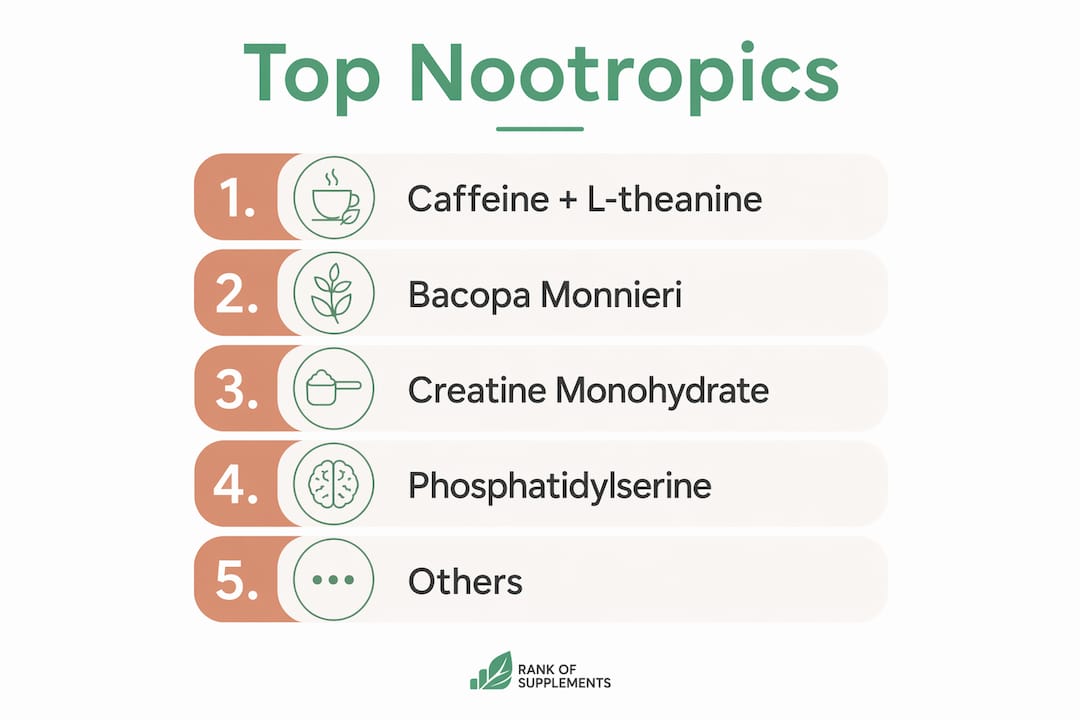
Comparison of top evidence-backed nootropics
| Compound | Primary benefit | Onset time | Minimum duration |
|---|---|---|---|
| Caffeine + L-theanine | Attention, reaction time | 30 to 60 minutes | Immediate |
| Bacopa monnieri | Verbal memory, consolidation | 8 to 12 weeks | 8 to 12 weeks |
| Creatine monohydrate | Cognitive resilience, fatigue | Days to weeks | 4+ weeks |
| Phosphatidylserine | Memory, cognitive decline | 4 to 8 weeks | 4 to 8 weeks |
| Citicoline / DHA | Neuronal support, memory | 4 to 12 weeks | 8+ weeks |
Pro Tip: Stack caffeine with L-theanine in a 1:2 ratio (e.g. 100mg caffeine to 200mg L-theanine) for the smoothest cognitive lift. This ratio is the most commonly studied in RCTs and produces the best attention outcomes with minimal side effects.
What the market gets wrong about dosing
Most brain supplements fail not because the ingredients are ineffective, but because they are under-dosed compared to clinical trial amounts. Manufacturers are not legally required to prove efficacy or match clinical dosages before marketing a product. A supplement containing 50mg of Bacopa monnieri is not the same as the 300 to 450mg used in trials. Reading labels critically is not optional. It is the difference between spending money on a working product and spending money on an expensive placebo.
How do acute and long-term nootropic effects differ?
Understanding this distinction prevents the most common mistake people make: expecting Bacopa to work like caffeine, or expecting caffeine to build lasting memory improvements over time.
Acute nootropics produce effects within minutes to hours and wear off as the compound clears your system. Caffeine, L-theanine, and certain multi-ingredient formulations fall into this category. Multi-ingredient nootropics can improve selective attention and executive function comparable to caffeine but without caffeine’s negative effects on mood and blood pressure. These are tools for a focused work session, not for building long-term memory capacity.
Long-term cognitive support agents work through entirely different mechanisms:
- Bacopa monnieri increases dendritic branching in the hippocampus, the brain region central to memory formation. This structural change takes weeks to develop.
- Creatine replenishes phosphocreatine stores in neurons, improving energy availability during high-demand cognitive tasks.
- Phosphatidylserine and DHA maintain the fluidity and integrity of neuronal membranes, supporting signal transmission over time.
- Citicoline serves as a precursor to acetylcholine, a neurotransmitter directly involved in learning and memory.
Pro Tip: If you start Bacopa monnieri, set a calendar reminder for week 8 before you evaluate results. Judging it at week 2 is like judging a strength training program after four workouts.
Cognitive fatigue is often metabolic, linked to oxygen and glucose supply to the brain. This means some nootropics support energy delivery rather than directly enhancing intelligence. Creatine and citicoline both work partly through this pathway. That distinction matters because it explains why these compounds help more under stress or fatigue than in a well-rested, well-fed state.
The most damaging misunderstanding in this space is treating acute effects as proof of long-term benefit. Feeling sharper after caffeine does not mean your memory is improving. Conversely, stopping a long-term agent like Bacopa after three weeks because you feel nothing means you quit before the mechanism had time to activate. Expectations of immediate benefits cause many people to abandon effective long-term nootropics prematurely.
What does the science actually say about nootropic effectiveness?
The research picture is more nuanced than either enthusiasts or skeptics admit. Strong evidence exists for a small number of compounds. Weak or no evidence exists for the majority of products on the market.
Harvard-affiliated research makes the regulatory situation clear: no legally marketed supplement has been studied for its ability to prevent Alzheimer’s disease or reverse memory loss. Many brain supplements contain ingredients with weak or no human evidence for cognitive enhancement. That is not a fringe opinion. It is the consensus from researchers who have reviewed the clinical trial literature systematically.
“The supplement industry is not required to prove that a product works before selling it. That burden falls entirely on the consumer to investigate.”
Here is a practical framework for evaluating any nootropic claim:
- Check for human RCT evidence. Animal studies and in-vitro research do not predict human outcomes reliably. Look for peer-reviewed trials in humans.
- Verify the dose matches clinical research. If a product contains 50mg of an ingredient that showed effects at 300mg in trials, the product is not equivalent to the research.
- Assess the trial population. Many nootropic studies are conducted in elderly or cognitively impaired populations. Effects in healthy young adults are often smaller or absent.
- Identify the cognitive domain tested. Memory consolidation, working memory, reaction time, and executive function are distinct. A nootropic that improves one does not necessarily improve others.
- Look for independent replication. A single positive study means little. Consistent results across multiple independent trials carry real weight.
Many commercial nootropics and exotic compounds, including research peptides and microdosing psilocybin, lack human trial evidence or have been refuted by recent RCTs. The nootropics market is predatory toward consumers seeking quick cognitive fixes. Focusing on Tier 1 evidence-backed compounds protects both your wallet and your health.
Lifestyle factors carry more weight than most people realize. Exercise and plant-based diets have stronger long-term evidence supporting memory and brain health than any currently marketed supplement. Aerobic exercise increases BDNF (brain-derived neurotrophic factor), which promotes neuroplasticity more reliably than any pill. Sleep quality directly determines how well memories consolidate overnight. No nootropic compensates for chronic sleep deprivation.
How can you safely incorporate nootropics to improve focus and memory?
Integrating nootropics effectively means treating them as additions to a solid cognitive foundation, not replacements for one. Here is how to approach this practically.
Start with the evidence tier. Caffeine plus L-theanine for acute focus, Bacopa monnieri for long-term memory, and creatine for cognitive resilience under stress represent the strongest starting points. These are the compounds with the most consistent human trial support. You can explore cognitive health supplements with verified ingredient profiles before spending money on anything else.
Respect the dosing requirements. Bacopa at 300 to 450mg daily, creatine at 5g daily, and L-theanine at 100 to 200mg per dose are the ranges studied in trials. Anything significantly below these thresholds is unlikely to produce the same effects.
Set a realistic timeline. Acute compounds work the same day. Long-term agents require 8 to 12 weeks of consistent daily use before you can fairly evaluate them. Missing doses frequently resets the clock on compounds that require steady-state tissue levels.
Key safety considerations:
- Avoid polypharmacy without guidance. Stacking five or more nootropics simultaneously makes it impossible to identify what is working or causing side effects.
- Check for drug interactions. Bacopa monnieri can interact with thyroid medications and sedatives. Phosphatidylserine may interact with blood thinners. Always review interactions if you take prescription medications.
- Avoid unregulated or exotic compounds. Products marketed as “research chemicals” or “peptide stacks” carry unknown risk profiles and no human safety data.
- Consult a physician if you have existing conditions. Cognitive decline, ADHD, anxiety, and depression all affect how nootropics interact with your baseline neurobiology.
- Track your results objectively. Use a simple cognitive test app or journaling to assess changes rather than relying on subjective “feel.” Placebo effects in nootropic research are substantial and well-documented.
The best supplements for brain fog are not always the most marketed ones. Prioritize products with transparent labeling, third-party testing, and ingredient doses that match published research.
Key takeaways
Nootropics can genuinely improve memory and concentration, but only when you choose evidence-backed compounds at clinical doses and use them consistently for the required duration.
| Point | Details |
|---|---|
| Best acute stack | Caffeine plus L-theanine at clinical doses improves attention and reaction time within 30 to 60 minutes. |
| Best long-term memory agent | Bacopa monnieri at 300 to 450mg daily shows significant memory gains after 8 to 12 weeks of consistent use. |
| Dosing is critical | Most commercial products under-dose ingredients relative to clinical trials, reducing real-world effectiveness. |
| Lifestyle outperforms supplements | Exercise and quality sleep have stronger evidence for brain health than any supplement currently on the market. |
| Avoid unregulated compounds | Research peptides and exotic nootropics lack human safety data and should be avoided without medical supervision. |
My honest view after years of tracking this research
I have followed the nootropics space long enough to watch the same cycle repeat. A new compound gets hyped, influencers stack it with six other things, and six months later the RCTs come back negative or inconclusive. The market moves on to the next molecule.
What I keep coming back to is how narrow the real evidence base actually is. Caffeine plus L-theanine, Bacopa, creatine, and phosphatidylserine. That is essentially the list of compounds with consistent, replicated human trial support. Everything else is either preliminary, population-specific, or outright unsupported. The gap between what the market sells and what the science validates is enormous.
The “limitless pill” framing does real damage. It convinces people that a supplement can compensate for poor sleep, no exercise, and a diet built around processed food. It cannot. I have seen people spend hundreds of dollars monthly on elaborate nootropic stacks while sleeping six hours a night and wondering why their memory is still poor. The answer is not a better stack.
What I find genuinely useful is treating nootropics as precision tools for specific situations. Caffeine plus L-theanine before a demanding cognitive task. Creatine during periods of high stress or disrupted sleep. Bacopa as a long-term investment in memory consolidation, taken daily with the same discipline you would apply to a training program. That framing produces realistic expectations and, more importantly, realistic results.
The readers who get the most out of nootropics are the ones who already have their fundamentals in place and are looking for a marginal edge. For everyone else, the fundamentals are the intervention.
matteo
How Rankofsupplements can help you choose the right cognitive supplements
Choosing a nootropic product without verified ingredient profiles is a gamble. Rankofsupplements takes the guesswork out of that process by providing science-backed reviews and rankings built on clinical evidence, not marketing claims.
The Supplement Ingredient Library at Rankofsupplements covers key nootropic compounds including L-theanine, Bacopa monnieri, citicoline, and phosphatidylserine, with detailed breakdowns of clinical dosages, evidence quality, and product recommendations. If you want to know whether a specific ingredient in a product you are considering actually works at the dose listed, that library is your starting point. Rankofsupplements updates its rankings for 2026 to reflect the latest trial data, so you are not relying on outdated information when making purchasing decisions.
Recommended
- Related article: Best supplements for brain fog and mental clarity 2026
- Top list: Best supplements by health goal and condition
- Specific product guide: L-theanine: benefits, dosage, and best supplements
- Condition guide: Cognitive decline supplements: evidence-based guide
FAQ
Do nootropics enhance memory in healthy adults?
Some do. Bacopa monnieri at 300 to 450mg daily shows statistically significant memory improvements in healthy adults after 8 to 12 weeks, based on a meta-analysis of nine RCTs. Most other marketed compounds lack equivalent evidence in healthy populations.
Can nootropics boost focus the same day you take them?
Yes, but only acute compounds. The caffeine and L-theanine combination improves sustained attention and reaction time within 30 to 60 minutes of ingestion. Long-term agents like Bacopa monnieri do not produce same-day focus effects.
Are nootropics effective for studying?
Caffeine plus L-theanine is the most evidence-backed option for study sessions, improving accuracy and sustained attention in multiple RCTs. For longer-term academic performance, Bacopa monnieri supports memory consolidation but requires consistent daily use for at least two months.
What is the biggest risk with commercial nootropic products?
Under-dosing is the primary problem. Manufacturers are not legally required to match clinical trial dosages, so many products contain far less of an active ingredient than the amount shown to work in research. Always compare label doses against published trial dosages before purchasing.
Do lifestyle factors matter more than nootropics for brain health?
Exercise and quality sleep have stronger and more consistent evidence for memory and brain health than any supplement currently on the market. Nootropics work best as additions to solid lifestyle foundations, not as substitutes for them.