
TL;DR:
- The best post-workout supplements in 2026 focus on effective protein, creatine, and omega-3 intake. Total daily protein intake and consistent creatine use are more important than timing, with third-party testing ensuring label accuracy. Additional supplements provide marginal benefits and should be based on individual soreness or specific goals.
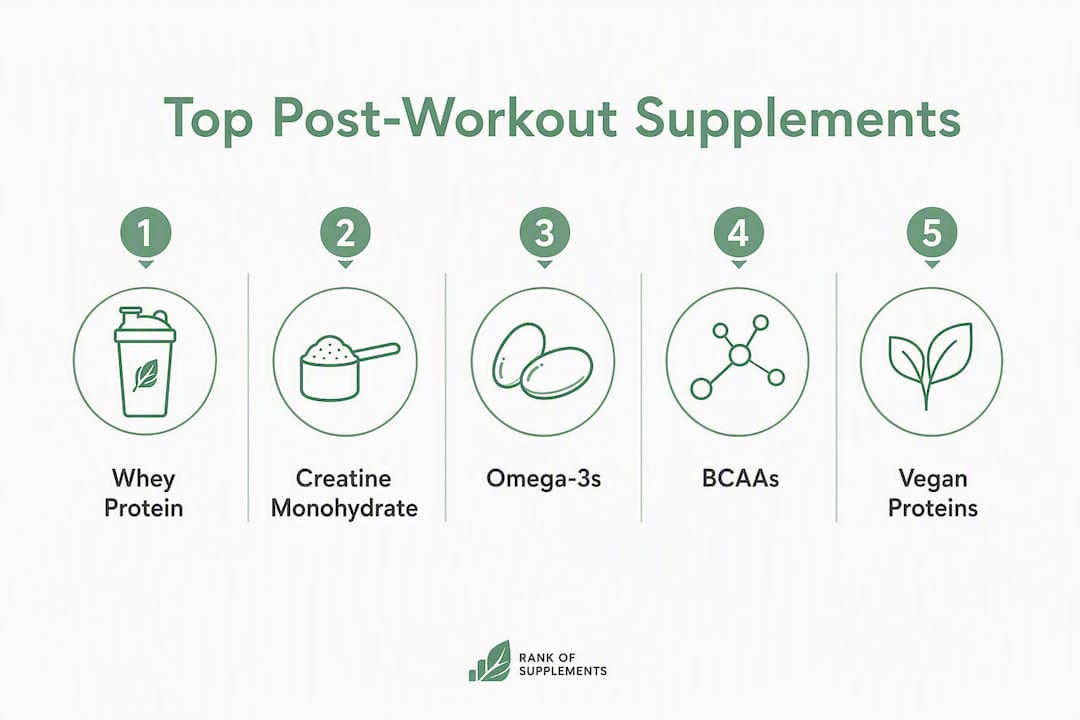
The best post-workout supplements in 2026 come down to a short, evidence-backed stack: a quality whey protein in a range consistent with effective doses, daily creatine monohydrate in typical supplementation amounts, and an omega-3 if soreness is a recurring problem. Everything else is situational. Here is the shortlist before the deep dive:
- Best overall: Transparent Labs Post, full-disclosure label, 5 g creatine and 5 g L-glutamine per serving, no proprietary blends
- Best for strength: Optimum Nutrition Gold Standard 100% Whey, consistent protein per serving, widely available, cost-effective
- Best budget creatine: The Protein Works 100% Pure Creatine Monohydrate, single ingredient, daily 3 to 5 g dosing, nothing hidden
- Best for soreness/DOMS: Momentous Recovery, high EPA+DHA omega-3 formulation targeting frequent soreness
- Best vegan protein: Form Performance Protein or PhD Smart Plant, complete amino acid profiles from plant sources
- Best carb-focused recovery: Jacked Factory Carb Surge, fast glycogen repletion after long or repeated sessions
- Best amino-acid add-on: Transparent Labs BCAA + Glutamine, transparent dosing, useful for fasted training only
TL;DR: If you buy one thing, make it a high-quality protein hitting 20 to 40 g per serving, and add daily creatine at 3 to 5 g. Total daily protein matters far more than hitting a 30-minute post-workout window.
Table of Contents
- Best post-workout supplements 2026: side-by-side comparison
- Full product profiles: what each pick actually delivers
- How we selected and tested these picks
- How to choose the right post-workout supplement for your goal
- What the science actually says about post-workout ingredients
- Why third-party testing matters more than the label
- Key Takeaways
- The case for simplicity in post-workout nutrition
- Authority sources and further reading
- Rankofsupplements: science-backed supplement research in one place
- FAQ
Best post-workout supplements 2026: side-by-side comparison
| Product | Best for | Key ingredients & doses | Price/serving (approx.) | Third-party testing | Form | Dietary suitability |
|---|---|---|---|---|---|---|
| Transparent Labs Post | All-in-one recovery | Creatine 5 g, L-Glutamine 5 g, Beta-Alanine, Betaine | $1.80, $3.00+ | Yes (Informed-Choice) | Powder | Gluten-free |
| Legion Recharge | High-volume athletes | Creatine, carbs, recovery blend | $0.80, $1.80 | Yes (Informed Sport) | Powder | Gluten-free |
| Optimum Nutrition Gold Standard 100% Whey | Reliable protein | Whey protein 24 g/serving | $0.80, $1.80 | Yes (Informed-Choice) | Powder | Contains dairy |
| Myprotein Clear Whey Isolate | Light, fast-digesting protein | Whey isolate ~20 g | $0.80, $1.80 | Yes | Powder | Dairy, gluten-free options |
| Transparent Labs BCAA + Glutamine | Fasted training | BCAAs + L-Glutamine (disclosed doses) | $0.80, $1.80 | Yes | Powder | Vegan-friendly |
| Momentous Recovery | DOMS reduction | High EPA+DHA omega-3 | $1.80, $3.00+ | NSF Certified | Softgel/Powder | Varies |
| Jacked Factory Carb Surge | Glycogen repletion | Fast carbohydrates | $0.80, $1.80 | Powder | Vegan, gluten-free | |
| The Protein Works 100% Pure Creatine Monohydrate | Budget creatine | Creatine monohydrate 3 to 5 g | $0.20, $0.80 | Powder | Vegan | |
| Optimum Nutrition Creatine Powder, Elite Series | Mainstream creatine | Creatine monohydrate 5 g | $0.20, $0.80 | Yes | Powder | Vegan |
| Form Performance Protein | Vegan athletes | Plant protein blend ~30 g | $1.80, $3.00+ | Yes | Powder | Vegan, gluten-free |
| PhD Smart Plant | Vegan protein | Pea/rice protein blend ~20 g | $0.80, $1.80 | Powder | Vegan | |
| Grenade High Protein Bars | On-the-go protein | ~20 g protein per bar | $1.80, $3.00+ | Bar | Varies | |
| Barebells Protein Bars | Taste-first protein bar | ~20 g protein per bar | $1.80, $3.00+ | Bar | Contains dairy |
Note: Price-per-serving figures are approximate retail estimates and will vary by retailer and pack size. Products carrying NSF Certified for Sport or Informed-Choice/Informed Sport badges have undergone independent batch testing for banned substances and label accuracy.
Full product profiles: what each pick actually delivers
Core recovery formulas
Transparent Labs Post is the clearest example of a full-disclosure recovery formula done right. Each serving lists 5 g creatine monohydrate, 5 g L-glutamine, beta-alanine, and betaine at stated doses. No proprietary blend, no guessing. Athletes who want a single scoop covering multiple recovery bases without stacking five separate products will find this the most efficient option.

Pros: Transparent dosing, multiple clinically relevant ingredients, Informed-Choice tested. Cons: Higher price per serving than buying creatine alone; beta-alanine causes tingling in some users. Bottom line: Best for athletes who value label honesty and want an all-in-one post-workout formula.
Legion Recharge targets performance athletes doing repeated high-volume sessions. It combines creatine with recovery-oriented nutrients and is positioned for glycogen resynthesis and muscle repair. Informed Sport certified, which matters if you compete in tested sports.
Pros: Reputable third-party testing, well-positioned for serious trainees. Cons: Pricier than standalone creatine; some users won’t need the full formula.
Jacked Factory Carb Surge takes a carb-first approach, making it the go-to for endurance athletes or anyone doing two-a-days who needs fast glycogen repletion. Pair it with a separate protein source rather than expecting it to cover muscle repair on its own.
Protein powders
Optimum Nutrition Gold Standard 100% Whey remains the benchmark for accessible, evidence-backed protein. Around 24 g of whey protein per serving, Informed-Choice certified, and available at virtually every supplement retailer in the US. Whey protein reliably increases muscle protein synthesis when combined with training, and a serving size of 20 to 40 g per dose is the practical target.
Myprotein Clear Whey Isolate and Myprotein Impact Whey Isolate both deliver solid whey protein in different textures. The Clear Whey is a lighter, juice-like drink that mixes easily and suits athletes who find thick shakes hard to stomach after intense training. Impact Whey Isolate is a more conventional powder with a higher protein-per-dollar ratio.
Bulk Pure Whey Protein Powder, Kinetica Whey Protein Powder, and Innermost The Strong Protein round out the whey category. Bulk and Kinetica are strong value picks; Innermost adds functional extras like adaptogens, which appeals to athletes who want more than just protein in their post-workout shake.
Bulk Beef Protein Isolate suits athletes with dairy sensitivities who still want an animal-based protein. Amino acid profile is solid, though leucine content can be slightly lower than whey.
ESN Clear Whey Isolate Protein Powder mirrors the clear-whey trend with a refreshing texture and fast digestion. Applied Nutrition Critical Oats Protein Porridge is a different animal entirely: a slow-digesting, oat-based protein meal that works better as a recovery breakfast than an immediate post-workout shake.
Vegan protein options
Form Performance Protein and PhD Smart Plant lead the plant-based category for athletes who need a complete amino acid profile. Form uses a multi-source blend that addresses the lysine and leucine gaps common in single-source plant proteins.

Optimum Nutrition 100% Plant Protein Isolate brings the ON brand’s quality standards to the vegan market. Innermost The Fit Protein is lighter and better suited to moderate-training athletes rather than heavy lifters.
ESN Flexpresso Vegan Protein Coffee doubles as a caffeine source, which can be convenient for morning training sessions. Huel Black Edition High Protein Complete Meal Replacement is not a traditional post-workout shake but covers protein, carbs, and micronutrients in one product for athletes who struggle to eat a full meal after training.
Bulk Vegan Protein Powder, Myprotein Clean Vegan Plant Protein Powder, Protein Works Vegan Wondershake, and MaxiNutrition MaxVegan Protein Powder are all solid budget-to-mid-range options. Myprotein’s vegan line has broad US availability; Protein Works Vegan Wondershake scores well on taste for a plant-based powder.
Protein bars
Bars are a convenience play, not a primary recovery tool. That said, Barebells Protein Bars and Grenade High Protein, Low Sugar Bars consistently top taste rankings while delivering around 20 g protein per bar. Fulfil Vitamin and Protein Bars add a micronutrient angle. PhD Smart Plant Protein Bars and Healthspan Elite Plant-Based HiLo Protein Bars cover the vegan bar segment.
Optimum Nutrition Marshmallow Crunch Crispy Protein Bars, MaxiNutrition Creamy Core Protein Bar, Eroica Natural Protein Bars, Bio&Me Blueberry Protein + Fibre Bars, and Trek High Protein Biscoff Bar each occupy a slightly different niche: Eroica leans natural/clean-label, Bio&Me adds fiber, Trek targets the snack-bar crossover crowd.
Pro Tip: For bars, check the protein source first. A bar listing “collagen peptides” as its primary protein source will not drive muscle protein synthesis the way whey or a complete plant blend will, because collagen lacks adequate leucine.
Creatine options
The Protein Works 100% Pure Creatine Monohydrate Powder and Myprotein Creatine Monohydrate are the budget champions. Single ingredient, a typical daily dose, no loading phase required. Optimum Nutrition Creatine Powder, Elite Series adds brand recognition and broad retail availability for buyers who prefer a mainstream name.
For a deeper look at creatine options by training age and goal, Rankofsupplements covers the best creatine for beginners over 30 in a dedicated round-up.
Amino acids and sleep
Transparent Labs BCAA + Glutamine (and the related Transparent Labs BCAA Glutamine formula) are worth considering for fasted training sessions or athletes in a caloric deficit. Outside those scenarios, BCAAs and glutamine add minimal recovery benefit if you already hit your daily protein target.
Transparent Labs Sleep Aid addresses overnight recovery, combining sleep-support compounds for athletes who struggle with sleep quality during high-training blocks. Sleep is the primary recovery driver; supplements are secondary to it.
Athletic Greens AG1 is not a post-workout formula in the traditional sense, but it covers micronutrient gaps that can affect recovery, particularly vitamin D and magnesium when dietary intake is low.
How we selected and tested these picks
Every product on this list was evaluated against five criteria, in priority order:
- Ingredient evidence: Does the active ingredient have support from randomized controlled trials or systematic reviews? Marketing claims without mechanistic or clinical backing were disqualifying.
- Clinical dosing: Does the label list doses that match what trials actually used? Products hiding active amounts in proprietary blends were excluded or flagged.
- Label transparency: Full-disclosure labels with clinical dosing are a non-negotiable selection criterion. Any product that lists a “recovery blend” without per-ingredient grams was deprioritized.
- Third-party testing: NSF Certified for Sport and Informed-Choice/Informed Sport are the two most recognized programs in the US market. Products with these certifications were ranked higher, all else equal.
- Price-per-serving and availability: A supplement that costs $5 per serving and requires international shipping is not a practical recommendation for most US athletes.
Taste and mixability were assessed from published user data and editorial reviews where available, not from proprietary in-house testing. Author matteo reviewed ingredient profiles and dosing against current meta-analyses; domain experts in sports nutrition were consulted on edge cases (e.g. omega-3 labeling conventions, collagen protein limitations).
How to choose the right post-workout supplement for your goal
The single biggest mistake athletes make is buying overlapping products. An evidence-based priority order saves money and produces better results:
- Meet daily protein first. Target 1.6 to 2.2 g of protein per kilogram of body weight per day. A post-workout shake is just one contribution to that total, not a magic window.
- Add daily creatine monohydrate. Three to five grams per day, taken consistently. Timing relative to the workout is largely irrelevant.
- Consider omega-3 if DOMS is frequent. Check the label for combined EPA+DHA grams, not “total fish oil.” Meaningful recovery effects in trials typically require 2 to 3 g combined EPA+DHA daily.
- Use tart cherry or curcumin situationally. A short loading window around a hard event (a few days before and after) is more practical than year-round daily dosing.
- Test vitamin D and magnesium before supplementing. Both support recovery when deficient, but blanket supplementation without a deficiency is unlikely to help.
Label red flags to watch for:
- “Proprietary recovery blend” with no per-ingredient grams
- “Total fish oil 1,000 mg” with no EPA+DHA breakdown (could be as little as 300 mg combined)
- “Rapid recovery” claims with no clinical dosing listed
- Missing allergen statements (dairy, soy, gluten)
Pricing brackets:
- Budget ($0.20, $0.80/serving): Standalone creatine monohydrate, basic whey concentrates
- Mid ($0.80, $1.80/serving): Quality whey isolates, clear whey, plant protein blends
- Premium ($1.80, $3.00+/serving): Multi-ingredient recovery formulas, NSF-certified omega-3s, all-in-one products like Transparent Labs Post
Stacking guidance: Protein + creatine is the core stack. Add omega-3 for soreness. Avoid stacking BCAAs on top of adequate protein, it is redundant spending. For a structured approach to supplement stacks that actually work, the Rankofsupplements stacking guide covers combinations by goal.
Quick action checklist:
- Calculate your daily protein target (body weight in kg × 1.6 to 2.2 g).
- Check whether your current diet already covers it before buying a protein powder.
- Confirm creatine is listed as “creatine monohydrate” with grams per serving.
- For omega-3s, verify EPA+DHA grams, not total fish oil.
- Look for NSF Certified for Sport or Informed-Choice on the label.
- Compare price per serving, not price per tub.
Pro Tip: If you train twice daily, prioritize fast-digesting protein (whey isolate or hydrolysate) between sessions and keep creatine consistent at the same time each day rather than trying to time it to each workout.
What the science actually says about post-workout ingredients
The evidence for core post-workout ingredients varies considerably. Here is the current picture, with clinical dosing ranges:
| Ingredient | Clinical dose | Evidence level | Key finding |
|---|---|---|---|
| Whey protein | 20 to 40 g/serving; 1.6 to 2.2 g/kg/day total | Strong | Increases muscle protein synthesis with training |
| Creatine monohydrate | 3 to 5 g/day | Strong | Improves strength and power; daily consistency matters most |
| Omega-3 (EPA+DHA) | 2 to 3 g/day combined | Moderate | Reduces DOMS markers; 4 to 6 weeks to judge effect |
| Tart cherry | Moderate | Faster strength return after hard sessions; mixed soreness data | |
| Curcumin | Moderate | Anti-inflammatory; bioavailability critical | |
| Magnesium | Correct deficiency first | Situational | Supports sleep and muscle relaxation when low |
| Vitamin D | Correct deficiency first | Situational | Supports muscle function when deficient |
| BCAAs / L-Glutamine | Situational only | Weak (if protein adequate) | Minimal benefit when daily protein needs are met |
The anabolic window myth. The idea that you must consume protein within 30 minutes of training or lose gains is not supported by current evidence. What drives muscle growth and recovery is hitting your total daily protein target, not the exact timing of a post-workout shake. Use the post-workout window as a convenient eating opportunity, not a hard deadline.
Omega-3 labeling trap. A product listing “1,000 mg fish oil” may contain only 300 mg of combined EPA+DHA. Check EPA+DHA grams specifically; meaningful effects in recovery trials are typically in the 2 to 3 g combined range. Momentous Recovery is one of the few sport-focused products that makes this transparent.
Tart cherry timing. For event-based recovery, a short loading window around the hard session (a few days before and after) is more practical than continuous daily use. A 2026 review of 19 trials found tart cherry helped athletes regain strength more quickly after hard sessions, though soreness results were mixed.
NSAIDs vs. omega-3. Reaching for ibuprofen after every hard session carries a real cost: recent evidence suggests NSAIDs may impair satellite cell activation, which is part of the long-term muscle adaptation process. Omega-3 fatty acids offer a safer anti-inflammatory strategy for athletes managing chronic training loads.
For a detailed breakdown of vitamins for muscle recovery, including vitamin D and magnesium protocols, Rankofsupplements covers the micronutrient angle in depth.
Why third-party testing matters more than the label
A supplement label is a manufacturer’s claim, not a verified fact. The FDA does not review dietary supplements for safety or efficacy before they reach shelves. That gap is where third-party testing programs step in.
NSF Certified for Sport (nsf.org) tests for over 270 substances banned by major sports organizations, verifies that label claims match actual contents, and audits manufacturing facilities. It is the gold standard for competitive athletes in tested sports.
Informed-Choice and Informed Sport (operated by LGC Group) run a similar banned-substance screening program and are widely recognized by UK and international sports bodies. Many US-available products carry this certification, including Optimum Nutrition Gold Standard 100% Whey and Legion Recharge.
What certification does NOT guarantee: Third-party testing confirms what is in the product and that it is free of banned substances. It does not validate that the ingredient doses are clinically effective. A product can be NSF certified and still be under-dosed. Always cross-reference the dose on the label against the clinical ranges in the evidence table above.
For products without certification, look for a Certificate of Analysis (COA) from an independent lab. Some brands publish these on their websites; others provide them on request. A brand that refuses to share a COA for a product making specific efficacy claims is a red flag.
Key Takeaways
The single most important move in 2026 is to prioritize total daily protein at 1.6 to 2.2 g/kg/day and add 3 to 5 g of creatine monohydrate daily before spending on anything else.
| Point | Details |
|---|---|
| Protein total beats timing | Hit daily protein targets consistent with established recommendations; the 30-minute window is not decisive. |
| Creatine daily, not timed | Take creatine monohydrate every day in commonly recommended amounts; consistency matters more than post-workout timing. |
| Omega-3 for DOMS | Use combined EPA+DHA supplements at clinically relevant doses if soreness is frequent; check the label for EPA+DHA grams, not total fish oil. |
| Third-party testing first | Prefer NSF Certified for Sport or Informed-Choice products; certification confirms label accuracy and banned-substance screening. |
| Rankofsupplements for deeper research | Use the Rankofsupplements ingredient library to verify clinical doses and interactions before purchasing. |
The case for simplicity in post-workout nutrition
Most athletes I see reviewing supplement stacks are spending money in the wrong order. They have three different amino-acid products and no consistent creatine habit. They are timing their protein shake to the minute but eating 80 g of protein per day when they need 160 g. The supplement industry profits from complexity; the evidence points toward simplicity.
The practical rule of thumb: get your protein total right first, take creatine like a daily vitamin, and add an omega-3 if your joints ache or soreness is slowing your training frequency. Everything else, from tart cherry to curcumin to sleep formulas, is a marginal gain on top of that foundation.
One thing worth flagging: sleep and hydration are the primary recovery drivers, and no supplement replaces them. A well-dosed supplement routine for fitness built on those foundations will outperform an expensive stack built on poor sleep every time.
Before buying any new product, pull the third-party lab report. If the brand does not publish one, ask for it. If they cannot provide it, that tells you something.
Authority sources and further reading
The sources below are the strongest references for the claims in this guide, plus Rankofsupplements resources for deeper product and ingredient research.
- Harvard T.H. Chan School of Public Health, Workout Supplements: The most authoritative US-based overview of post-workout supplement evidence, covering protein, carbohydrates, creatine, and electrolytes with primary citations. Start here for an unbiased baseline.
- Supp’ Intel, Post-Workout Supplements: What Actually Works: Covers the anabolic window myth, omega-3 pooled data, tart cherry trial synthesis, and BCAA limitations in one practical guide.
- FindYourSupplement, Supplements for Muscle Recovery: Strong on creatine dosing, whey protein trial data, and the vitamin D/magnesium “test first” principle.
- VitalGuide, Best Post-Workout Recovery Supplements 2026: Covers the NSAID vs. omega-3 debate and sleep-first recovery principles.
- NSF International: The primary resource for verifying whether a specific product holds NSF Certified for Sport status.
- Rankofsupplements, Supplement Buying Guide 2026: Label-check rules and buying criteria mapped to goals and budgets.
- Rankofsupplements, Top Wellness Supplements 2026: Connects supplement choices to sleep, hydration, and lifestyle recovery factors.
- Rankofsupplements, Role of Amino Acids in Workouts: Explains when BCAAs and EAAs genuinely add value versus when they duplicate your protein intake.
“Hitting total daily protein (1.6 to 2.2 g/kg/day) matters more than exact post-workout timing for muscle growth and recovery. Creatine’s real-world advantage is consistent daily use, athletes who treat it like a daily vitamin see the benefit rather than those who time it to workouts.”, Synthesis from current meta-analyses and systematic reviews on post-workout nutrition
For science-backed recovery supplement guidance that covers practical dosing and product picks from an additional industry perspective, the CP-1 recovery guide is worth reading alongside this one.
Rankofsupplements: science-backed supplement research in one place
Sorting through 48 products, checking third-party certifications, and cross-referencing clinical doses takes time most athletes do not have. Rankofsupplements cuts that research time significantly by doing the ingredient-level analysis for you.
The ingredient library at Rankofsupplements lets you look up any active compound, see the clinical dosing range, and check which products actually hit that dose. It is the fastest way to verify whether a product you are considering is worth the price per serving, or whether you are paying a premium for an under-dosed label. The site also publishes ranked product reviews across every major supplement category, so you can compare options by goal, budget, and certification status without wading through manufacturer marketing copy. Head to Rankofsupplements to check the current rankings and find the right product for your training goals.
FAQ
What is the best post-workout recovery supplement?
The strongest evidence-backed combination is a whey protein serving of 20 to 40 g plus 3 to 5 g of creatine monohydrate daily. For frequent soreness, adding 2 to 3 g combined EPA+DHA from omega-3 is the next logical step.
Which supplements are best for muscle building in 2026?
Whey protein (or a complete plant protein for vegans) and creatine monohydrate remain the top two for muscle building, supported by the strongest body of trial evidence. Everything else is a secondary addition once those two are consistent.
What are the “big three” supplements for athletes?
Protein, creatine monohydrate, and omega-3 (EPA+DHA) form the practical evidence-based core stack for most athletes. Protein drives muscle protein synthesis, creatine supports strength and power output, and omega-3 addresses inflammation and DOMS.
Does post-workout timing actually matter?
Timing is far less important than total daily intake. Total daily protein at 1.6 to 2.2 g/kg/day is the primary driver of muscle growth and recovery; the 30-minute anabolic window is not supported by current evidence as a decisive factor.
How do I know if a supplement is safe to buy?
Look for NSF Certified for Sport or Informed-Choice certification on the label. These programs independently test for banned substances and verify that label claims match actual contents. The FDA does not review supplements before sale, so third-party certification is the most reliable quality signal available to US consumers.