
TL;DR:
- Weight loss supplements support fat reduction, appetite control, or metabolism but cannot replace a calorie-controlled diet and exercise. Starting with protein powders or glucomannan offers a safer, evidence-based approach before considering stimulant-based products. Always verify supplement quality through third-party certifications and consult healthcare providers to avoid risks and interactions.
Dietary supplements for weight loss are products designed to support fat reduction, appetite control, or metabolism through specific ingredients, but they cannot replace a calorie-controlled diet and regular exercise. This beginner’s guide to supplements for weight loss covers which products have real evidence behind them, how to pick quality options, and how to use them without putting your health at risk. You will find names like glucomannan, chitosan, protein powder, and caffeine-based extracts discussed with honest assessments of what the science actually shows. The goal is simple: give you a clear, evidence-based starting point so your first experience with weight loss supplements is safe and realistic.
What are the most common supplements used for weight loss and how do they work?

Weight loss supplements fall into a few clear categories based on how they claim to work. Understanding each category helps you match a product to a specific goal rather than buying based on marketing alone.
Fiber-based supplements
Glucomannan is a soluble fiber derived from the konjac plant. It absorbs water in your stomach and expands, which creates a feeling of fullness before meals. Chitosan and glucomannan may support modest weight loss, but only when paired with calorie restriction. Without dietary control, neither fiber supplement produces meaningful results on its own.
Chitosan works differently. It is derived from shellfish shells and is marketed as a fat blocker that prevents dietary fat from being absorbed. The effect is real but small. Chitosan blocks some fat absorption, yet the calorie reduction it creates is modest compared to what a straightforward dietary change delivers.
Protein powders
Protein powders, including whey, casein, and plant-based options like pea or brown rice protein, support weight loss primarily through satiety and muscle preservation. Higher protein intake reduces hunger hormones and helps you hold onto lean muscle during a calorie deficit. Muscle tissue burns more calories at rest than fat tissue does, so preserving it matters for long-term results.
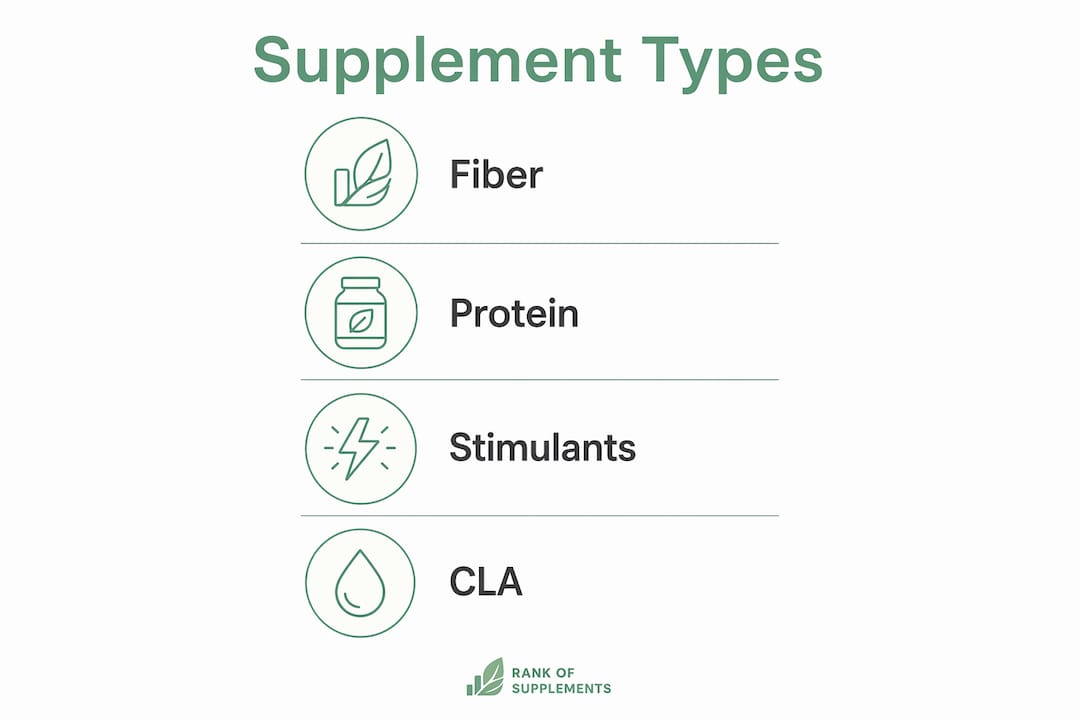
Stimulant-based supplements
Caffeine and green tea extract are the most studied stimulant-based weight loss ingredients. Caffeine raises metabolic rate temporarily and can improve exercise performance, which indirectly supports calorie burning. Green tea extract contains catechins, particularly EGCG, that may enhance fat oxidation during exercise. The effects are real but modest. Most weight-loss supplements lack strong evidence and some, like bitter orange, carry cardiovascular risks.
Conjugated linoleic acid (CLA)
CLA is a naturally occurring fatty acid found in dairy and meat. Supplement form CLA is marketed to reduce body fat and preserve muscle. Clinical results are inconsistent. Some trials show small reductions in body fat percentage over several months, while others show no significant effect.
| Supplement | Claimed mechanism | Evidence strength | Key caveat |
|---|---|---|---|
| Glucomannan | Increases satiety via fiber expansion | Moderate | Requires calorie restriction |
| Chitosan | Blocks dietary fat absorption | Low to moderate | Small calorie reduction only |
| Protein powder | Reduces hunger, preserves muscle | Strong | Works best with resistance training |
| Caffeine / green tea extract | Boosts metabolism and fat oxidation | Moderate | Tolerance builds over time |
| CLA | Reduces body fat, preserves muscle | Weak to moderate | Inconsistent clinical results |
Pro Tip: Start with a protein powder or glucomannan before considering stimulant-based products. Both have cleaner safety profiles and more consistent evidence for beginners.
How to choose quality and safe weight loss supplements as a beginner
Choosing a supplement safely is as important as choosing the right ingredient. The supplement industry operates under far less regulatory oversight than the pharmaceutical industry. The FDA does not approve dietary supplements before they reach store shelves. That means the burden of quality verification falls on you.
Understanding third-party certifications
Third-party certifications are your most reliable quality signal. USP and NSF certifications confirm that a product’s label accurately reflects its contents and potency. They do not confirm that the product will help you lose weight. That distinction matters. A certified glucomannan product contains what it claims, but you still need to evaluate whether glucomannan fits your specific goal.
The three certifications worth recognizing are:
- USP (United States Pharmacopeia): Verifies ingredient identity, strength, and purity.
- NSF International: Confirms the product is free from contaminants and matches label claims.
- GMP (Good Manufacturing Practices): Indicates the facility follows FDA manufacturing standards.
Look for at least one of these marks on any product you consider. Their absence is not automatically a red flag, but their presence is a meaningful quality signal.
Reading labels and spotting red flags
Labels reveal more than most beginners realize. Check the supplement facts panel for the exact ingredient name, the dose per serving, and the number of servings per container. Proprietary blends are a common problem. A proprietary blend lists multiple ingredients under one combined weight, which means you cannot tell how much of each ingredient you are actually getting.
Marketing claims like “clinically studied” or “doctor recommended” are not regulated phrases. Any company can print them. The phrase to look for instead is a specific citation to a peer-reviewed study, ideally one conducted on humans rather than animals or cell cultures.
| Label element | What to look for | Red flag |
|---|---|---|
| Ingredient list | Specific names and doses | Proprietary blends with no individual doses |
| Certifications | USP, NSF, or GMP seal | No third-party verification |
| Serving size | Clear and realistic | Unrealistically small serving to hide dose |
| Claims | Specific, referenced | “Clinically studied” with no citation |
| Manufacturer info | Full contact details listed | No address or contact information |
Consulting a healthcare provider
Consulting a healthcare professional before starting any supplement is the single most important step beginners skip. This matters especially if you take prescription medications. Drug-nutrient interactions are real. Glucomannan can slow the absorption of certain medications. Caffeine-based products can raise blood pressure. A physician or registered dietitian can flag these risks before they become problems.
Pro Tip: Bring the product label or a photo of it to your next medical appointment. Your provider can check for interactions with any medications you currently take.
Step-by-step guide to safely start and monitor supplements for weight loss
Starting supplements without a plan leads to confusion. You will not know what is working, what is causing side effects, or whether to continue. A structured approach removes that guesswork.
-
Choose one supplement. Start with a single product. Testing one supplement at a time is the standard safety recommendation for beginners. If you add three products simultaneously and experience nausea or disrupted sleep, you cannot identify the cause.
-
Set a trial period. Commit to four to eight weeks of consistent use before evaluating results. Appetite effects may appear quickly, but reliable weight loss requires weeks of consistent calorie deficit alongside supplement use. Do not judge a supplement after five days.
-
Keep a daily journal. Record the dose, the time you took it, your appetite level, energy, digestion, sleep quality, and any side effects. A simple notes app works fine. The journal gives you objective data rather than impressions.
-
Track your diet and activity separately. A supplement journal only tells part of the story. If your calorie intake drops during the trial period, you need to know whether the supplement drove that change or whether you simply ate less for other reasons.
-
Evaluate at the end of the trial. Review your journal. Did appetite change? Did weight shift? Did any side effects appear? Use that data to decide whether to continue, adjust the dose, or stop entirely.
-
Stop if side effects appear. Digestive distress, heart palpitations, significant sleep disruption, or mood changes are signals to stop immediately and consult a healthcare provider. No weight loss benefit justifies ongoing side effects.
-
Add a second supplement only after completing the first trial. If the first supplement shows benefit and no side effects, you can consider adding a second. Repeat the same tracking process.
Pro Tip: Use a free app like MyFitnessPal to track calories alongside your supplement journal. Separating supplement effects from dietary changes is only possible when you have data on both.
Common mistakes beginners make with weight loss supplements
The most expensive mistake in the supplement industry is buying a product based on a promise rather than evidence. Beginners are particularly vulnerable to this because the marketing is sophisticated and the claims sound scientific.
The most common pitfalls include:
-
Treating supplements as a substitute for diet and exercise. No supplement replaces portion control and physical activity. Supplements are adjuncts, not primary drivers. A glucomannan capsule before dinner does not cancel out a 600-calorie dessert.
-
Ignoring drug-nutrient interactions. Fiber supplements can reduce medication absorption. Stimulant-based products can interact with blood pressure medications, antidepressants, and thyroid drugs. Skipping the conversation with your doctor is a genuine safety risk.
-
Buying uncertified products. The supplement market includes products that contain ingredients not listed on the label, including banned substances. Purchasing from brands with USP, NSF, or GMP certification significantly reduces this risk.
-
Expecting fast results. Weight loss requires a sustained calorie deficit over weeks and months. A supplement that improves satiety may help you eat slightly less, but the scale will not reflect that in a week. Unrealistic timelines lead to abandoning products before they have a fair chance to work.
-
Confusing supplements with medications. Prescription weight-loss drugs differ categorically from dietary supplements in both effect and regulatory oversight. If you need significant appetite or absorption modulation, that conversation belongs with a physician, not a supplement retailer.
“Supplements are optional tools that complement lifestyle modifications. They are not a replacement for the foundational work of eating well and moving regularly.”, Ohio State physician guidance
The supplement industry spends heavily on before-and-after imagery and testimonials. Neither constitutes clinical evidence. A product that worked for one person in a social media post may have worked because of their diet change, not the supplement. Always trace results back to controlled evidence, not anecdotes.
Key takeaways
Weight loss supplements work only as additions to a calorie-controlled diet and consistent exercise, not as replacements for either.
| Point | Details |
|---|---|
| Supplements are adjuncts | No product replaces diet and exercise; use supplements to support, not substitute, lifestyle changes. |
| Certifications signal quality | Look for USP, NSF, or GMP marks to confirm ingredient accuracy, but verify the ingredient itself has evidence. |
| Start with one product | Test a single supplement for four to eight weeks before adding another to isolate effects and side effects. |
| Track everything | Log dose, timing, appetite, energy, sleep, and digestion daily to make evidence-based decisions. |
| Consult your doctor first | Drug-nutrient interactions are real; always check with a healthcare provider before starting any supplement. |
What I have learned after years of reviewing weight loss supplements
The supplement industry is full of products that sound convincing and deliver little. After reviewing hundreds of weight loss supplements at Rankofsupplements, the pattern is consistent: the products that help are the ones with the most boring mechanisms. Fiber that makes you feel full. Protein that reduces hunger. Caffeine that gives you a small metabolic nudge. None of these are exciting. None of them appear in dramatic transformation ads.
The products that disappoint are the ones with the most dramatic claims. “Supports metabolism while you sleep.” “Clinically studied to triple your metabolism.” These phrases signal that the marketing budget is larger than the research budget. I have yet to see a supplement with that kind of language backed by credible, independent clinical trials.
My honest recommendation for anyone starting out: pick glucomannan or a quality protein powder, track your intake carefully for six weeks, and see what happens. If you notice you are eating less and feeling more satisfied, the supplement is doing its job. If nothing changes, stop and redirect that money toward whole food sources of protein and fiber, which do the same thing more reliably.
The evidence-based supplement guide at Rankofsupplements is built on this same principle. We rank products by what the research supports, not by what the label promises. That approach is slower and less exciting than the industry would prefer. It is also the only approach that actually protects you.
matteo
Rankofsupplements can help you choose smarter from the start
Sorting through hundreds of weight loss supplements without a framework wastes time and money. Rankofsupplements exists to cut through that noise.
The supplement ingredient library at Rankofsupplements covers the mechanisms, evidence levels, and safety profiles of the most common weight loss ingredients, including glucomannan, CLA, caffeine, and protein sources. The best weight loss supplements ranking page applies the same evidence-first filter to finished products, so you can see which options hold up to scrutiny. For a broader starting point, the supplement buying guide walks through what to look for and what to avoid when making your first purchase.
FAQ
Do weight loss supplements actually work?
Most weight loss supplements produce modest effects at best, and only when combined with a calorie-controlled diet. No supplement effectively replaces portion control and exercise for meaningful, sustained weight loss.
What is the safest supplement for a beginner to start with?
Glucomannan and protein powders have the strongest safety profiles and the most consistent evidence for beginners. Both support satiety without the cardiovascular risks associated with stimulant-based products.
How do I know if a supplement is high quality?
Look for third-party certification marks from USP, NSF, or GMP on the label. These certifications confirm that the product contains what it claims, though they do not guarantee the ingredient will produce weight loss.
How long should I take a supplement before deciding if it works?
A four to eight week trial period is the standard recommendation. Appetite changes may appear sooner, but weight loss requires consistent calorie deficit over several weeks before the scale reflects meaningful change.
Are weight loss supplements the same as weight loss medications?
No. Prescription weight-loss drugs are FDA-approved medications with clinical evidence for significant weight reduction. Dietary supplements are not FDA-approved and are held to a much lower evidence standard.
Recommended reading:
- Supplement Buying Guide 2026: What Actually Works, a practical blog guide for beginners
- Best Weight Loss Supplements 2026, the top-ranked products by evidence
- Supplement Ingredient Library, detailed profiles on every major weight loss ingredient
- How to Check Supplement Quality: A 2026 Guide, a step-by-step quality verification guide