
What are fat burners and why do people use them?
Fat burners are dietary supplements designed to support weight loss by modestly increasing metabolism, suppressing appetite, or reducing how much fat your body absorbs from food. They don’t literally incinerate fat cells, despite the name. What they actually do is assist modestly by nudging a few biological levers that influence how your body processes and stores energy.
People reach for fat burners because they want an edge. Diet and exercise are the foundation of any fat loss plan, and most adults already know that. Fat burners are used as a secondary tool, something to layer on top of an already solid routine, not a replacement for it.
Here’s what fat burners typically claim to do:
- Increase resting metabolic rate so you burn more calories throughout the day
- Suppress appetite to make it easier to stay in a calorie deficit
- Reduce fat absorption in the digestive tract, limiting how much dietary fat enters circulation
- Boost energy levels to support more intense or consistent workouts
The key word across all of these is “support.” Fat burners are best used as aids alongside a calorie deficit and consistent exercise, not standalone solutions.
How fat burners work in the human body
The mechanisms behind fat burner supplements fall into a few distinct categories, and understanding them helps set realistic expectations.

Thermogenesis is the most commonly cited mechanism. Certain compounds, particularly caffeine, raise your core body temperature slightly, which increases calorie expenditure. Think of it as turning up the idle speed on an engine. The effect is real but modest, and it fades as your body adapts.
Appetite suppression works differently. Some ingredients act on hunger hormones or slow gastric emptying, making you feel fuller longer. When you’re less hungry, you naturally eat less, and that calorie reduction is where the real fat loss happens. The supplement isn’t burning fat directly; it’s making it easier for you to eat less.
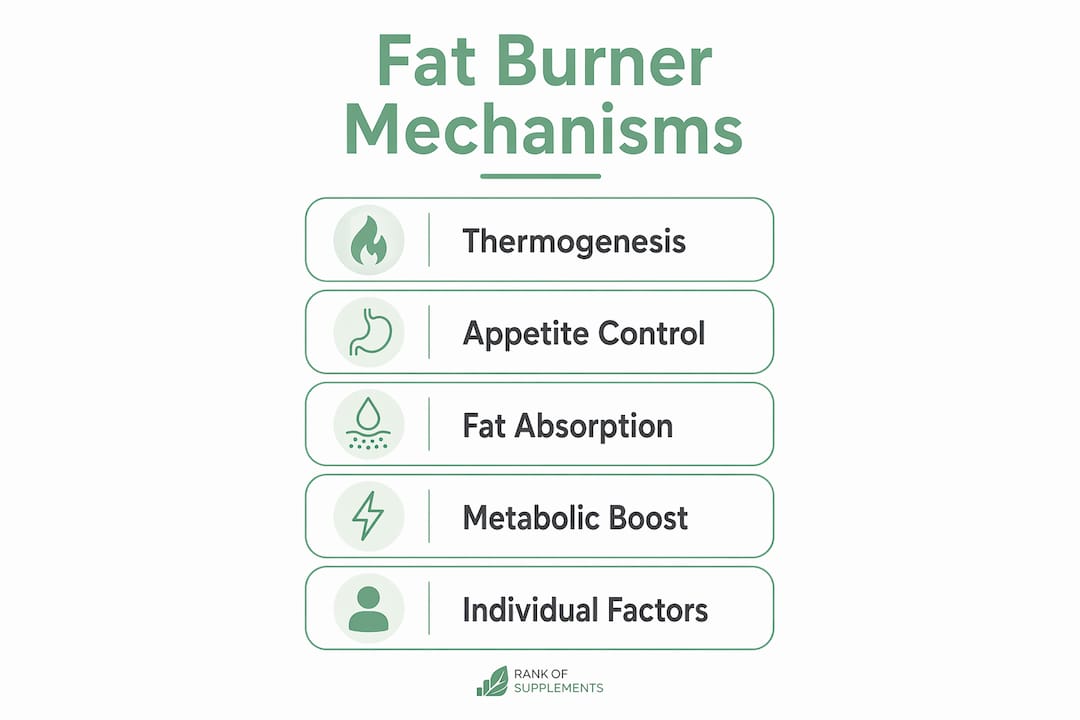
Fat absorption inhibition is the third pathway. Soluble fiber and certain plant compounds can bind to dietary fat in the gut, reducing how much gets absorbed into the bloodstream. This doesn’t eliminate fat from your diet, but it can reduce the caloric impact of a meal.
Effects vary considerably by ingredient and by the individual taking them. Age, body composition, caffeine tolerance, and baseline metabolic rate all influence how much you’ll actually notice. No formula works identically for two people.
What ingredients are actually in fat burner supplements?
The ingredient list is where fat burners either earn their place or fall apart. Here’s what the research actually says about the most common compounds:
Caffeine is the most studied and most effective ingredient in this category. It stimulates the central nervous system, raises resting metabolic rate, and promotes fat oxidation. Caffeine and green tea have more clinical data supporting fat metabolism enhancement than virtually any other supplement ingredients. The catch: supplements often contain far more caffeine than a cup of coffee, which raises the risk of jitteriness, insomnia, and elevated heart rate.

Green tea extract contains catechins, especially epigallocatechin gallate (EGCG), which work alongside caffeine to increase energy expenditure and promote fat breakdown. Registered dietitian Melissa Matteo at Cleveland Clinic notes that while green tea extract may help burn calories and reduce fat absorption, “the amount of weight loss isn’t that significant.” The extract is generally safer than many other stimulant-based ingredients, though concentrated doses in supplements carry more risk than brewed tea.
Carnitine transports long-chain fatty acids into the mitochondria, where they’re oxidized for energy. Your liver and kidneys produce it naturally, and it’s found in meat and dairy. Research on its weight loss benefits is mixed. Too much can cause nausea, vomiting, diarrhea, and a fishy body odor, according to clinical review data.
Yohimbe comes from the bark of an African evergreen tree and appears in many weight loss supplements. The research supporting it is thin, and the risk profile is not. Yohimbe can cause headaches, anxiety, agitation, and elevated blood pressure. At high doses, it’s linked to heart problems and kidney failure. It’s one of the more dangerous ingredients in common use.
Soluble fiber works differently from the stimulant-based ingredients above. It doesn’t increase fat burn directly. Instead, it slows digestion, helps control appetite, and can prevent your body from absorbing some dietary fat. Fiber-rich ingredients are generally the safest option in this category, though getting fiber from whole foods is more effective than from supplements.
Pro Tip: Before buying any fat burner, look up each ingredient individually. A product with five ingredients might have one with solid evidence, two with mixed evidence, and two with real safety concerns. The label won’t tell you that.
The broader issue is that the supplement industry introduces new ingredients faster than researchers can study them. The fat burner ingredient market is largely industry-driven, and the list of claimed metabolic compounds grows at a rate that scientific evidence simply doesn’t match.
Do fat burners actually work? What the science says
The honest answer is: modestly, sometimes, and not as much as the marketing suggests.
A systematic review and meta-analysis comparing thermogenic supplements to diet and exercise found a general trend toward effectiveness, but the 95% confidence interval for effect size crossed zero, indicating no statistically significant benefit over diet and exercise alone. In plain terms: the supplements showed a trend in the right direction, but researchers couldn’t rule out that the results were due to chance.
There is one notable exception worth mentioning. A 2025 randomized controlled trial found that chronic use of a thermogenic supplement over an 8-week resistance training program produced significantly greater reductions in fat mass and body fat percentage compared to placebo in resistance-trained males. The researchers noted this was among the first studies to document the chronic effect of thermogenic supplementation on body composition. That’s a meaningful finding, but it applies to a specific population (trained males) under specific conditions (structured resistance training), and it doesn’t translate automatically to the general population.
Cleveland Clinic experts also point out that a daily brisk walk would likely burn more calories than most fat burner supplements provide. That’s not a knock on walking; it’s a calibration of expectations.
The bottom line from the research: fat burners cannot overcome a sustained caloric surplus. Dietary discipline drives fat loss. Supplements, at best, provide a marginal assist.
Are fat burners safe? Risks and precautions you should know
Safety is where fat burners get complicated, and where the stakes are highest.
Fat burners are not regulated by the FDA, which means manufacturers can make claims without proving them. Labels may be inaccurate, ingredients may be undisclosed, and dosages may far exceed what’s been studied. A product marketed as “natural” isn’t automatically safe. Ephedra, once a popular fat burner ingredient, was banned after being linked to serious cardiovascular events.
Known risks from common fat burner ingredients include:
- Elevated heart rate and blood pressure from stimulants like caffeine and yohimbe
- Anxiety and agitation, particularly with high-dose yohimbe
- Insomnia from caffeine-heavy formulas taken later in the day
- Gastrointestinal distress including nausea, vomiting, and diarrhea
- Drug interactions, since fat burner ingredients can interfere with prescription medications
Certain groups should avoid fat burners entirely. Pregnant or breastfeeding women, people with cardiovascular conditions, those with kidney or liver disease, and anyone taking prescription medications should not use these supplements without explicit medical clearance. As Melissa Matteo puts it, “Patients aren’t always forthcoming about what supplements they’re taking. But ingredients in fat burners can interact with medications and cause serious problems.”
Consulting a healthcare provider before starting any fat burner is the single most important precaution you can take.
Pro Tip: Avoid any fat burner that doesn’t list exact dosages for each ingredient. “Proprietary blend” on a label means you have no way of knowing how much of anything you’re actually taking.
Natural ways to support metabolic without supplements
The most effective metabolic strategy doesn’t come in a capsule. These approaches have stronger evidence and fewer risks than any supplement on the market.
- Calorie deficit through food choices: No supplement overrides a caloric surplus. Tracking intake, reducing ultra-processed foods, and controlling portions are the foundational moves.
- Aerobic exercise: Cardio burns calories directly and improves cardiovascular health. Consistency matters more than intensity for most people.
- Resistance training: Building muscle increases your resting metabolic rate over time, meaning you burn more calories even at rest.
- High protein intake: Your body burns more calories digesting protein than carbohydrates or fat. Protein also keeps you fuller longer, which reduces overall intake. Chicken, turkey, eggs, and fish are practical sources, per Cleveland Clinic’s nutrition guidance.
- Dietary fiber from whole foods: Fiber slows digestion and helps control appetite. Getting it from vegetables, legumes, and whole grains is more effective than fiber supplements.
- Brewed green tea or coffee: These deliver the metabolism-supporting compounds found in many supplements, at safer doses and without the additives. Natural beverage forms of caffeine and green tea are consistently recommended over concentrated extracts.
Sustainable lifestyle changes outperform any supplement over the long run. That’s not a platitude; it’s what the research consistently shows.
Recommended resources from Rankofsupplements
If you’re evaluating fat burners or any weight loss supplement, Rankofsupplements has the evidence-based resources to help you make a genuinely informed choice.
- Related article: Do thermogenic fat burners work for women? covers the science behind thermogenic supplements with a focus on female physiology.
- Top list: Best weight loss supplements 2026 compares over-the-counter fat burners and prescription options side by side.
- Specific product: Browse the supplement ingredient library to look up every ingredient in a fat burner before you buy it.
- Guide: The beginner’s guide to supplements for weight loss explains why diet and exercise outperform fat burners and how to use supplements responsibly.
Key Takeaways
Fat burners offer modest support for weight loss at best, and dietary discipline combined with consistent exercise remains the primary driver of results.
| Point | Details |
|---|---|
| Fat burners don’t supports metabolism directly | They work by modestly increasing metabolism, suppressing appetite, or reducing fat absorption. |
| Scientific evidence is limited | A systematic review found thermogenic supplements showed no statistically significant benefit over diet and exercise alone. |
| Caffeine and green tea have the best data | Most other common fat burner ingredients lack robust clinical validation. |
| FDA does not regulate fat burners | Labels may be inaccurate, dosages may be unlisted, and drug interactions are a real risk. |
| Natural methods outperform supplements | Calorie deficit, resistance training, high protein intake, and brewed green tea or coffee deliver results with fewer risks. |
FAQ
Are fat burners good or bad for you?
Fat burners are not inherently dangerous, but many carry real risks from unregulated ingredients, undisclosed stimulants, and potential drug interactions. Whether they’re appropriate depends on your health status, medications, and which specific product you’re considering.
When should you use a fat burner?
Fat burners are most appropriate as a secondary tool once you’ve already established a consistent calorie deficit and exercise routine. Using them before those foundations are in place is unlikely to produce meaningful results.
Do fat burners work if you don’t exercise?
The evidence suggests they don’t produce meaningful fat loss without diet and exercise. A systematic review found that thermogenic supplements were less effective than exercise or diet and exercise combined, and the 2025 RCT showing fat loss benefits was conducted specifically within a structured resistance training program.
Which fat burner ingredients have the strongest evidence?
Caffeine and green tea extract have the most clinical data supporting fat metabolism enhancement. Most other commonly used ingredients, including carnitine, yohimbe, and various herbal compounds, lack robust scientific validation.
Who should avoid fat burners entirely?
Pregnant or breastfeeding women, people with heart conditions or kidney disease, and anyone taking prescription medications should avoid fat burners unless a healthcare provider explicitly approves their use.