
TL;DR:
- Collagen peptides are small protein fragments that stimulate your body’s collagen production for skin, joints, and tissues. They are most effective when taken consistently for at least 8 to 12 weeks with vitamin C. Proper sourcing and third-party certification help ensure safety and quality.
Collagen peptides are bioactive protein fragments that support skin elasticity, joint comfort, and connective tissue health by stimulating the body’s own collagen production. Your body produces collagen naturally, but output declines steadily after your mid-20s, making supplementation a practical strategy for many adults. Clinical trials show that daily oral collagen at doses of 5 to 15g improves skin hydration and elasticity after 8 to 12 weeks of consistent use. The reason to take collagen peptides is straightforward: they deliver highly absorbable fragments that signal your body to rebuild what age and lifestyle erode. This guide covers the science, the evidence, and the practical steps to use them well.
Why take collagen peptides? The biological case
Collagen peptides are produced through enzymatic hydrolysis, a process that breaks native collagen into short fragments weighing 2 to 5 kDa. That small size matters because it means the peptides cross the intestinal wall efficiently, entering the bloodstream intact rather than being broken down into generic amino acids. Hydrolysis improves intestinal absorption and bioavailability compared to gelatin or unhydrolyzed collagen.

Once absorbed, specific dipeptides and tripeptides do something more interesting than simply providing building blocks. The fragments Pro-Hyp and Hyp-Gly accumulate in skin tissue and cartilage, where they act as signaling molecules that trigger fibroblasts and chondrocytes to produce more collagen, elastin, and hyaluronic acid. This signaling function is what separates collagen peptides from a generic protein powder. A standard whey protein shake provides amino acids. Collagen peptides send a targeted repair signal.
Gelatin sits between native collagen and collagen peptides on the processing spectrum. It dissolves in hot water and gels when cooled, but its molecular weight is too high for efficient absorption. Native collagen, found in whole food sources like bone broth, requires significant digestion before any fragments reach the bloodstream. Hydrolyzed collagen peptides skip that step entirely.
One cofactor the body cannot skip is vitamin C. Collagen synthesis requires vitamin C as a critical enzyme cofactor. Without adequate vitamin C, the enzymes that stabilize collagen’s triple-helix structure cannot function properly, and supplemental peptides produce a weaker response.
Pro Tip: Mix your collagen peptide powder into a glass of orange juice or take it alongside a vitamin C supplement. The combination gives the enzymes everything they need to convert the peptides into new collagen fibers.
- Enzymatic hydrolysis produces peptides small enough to absorb intact
- Pro-Hyp and Hyp-Gly are the key bioactive fragments driving the repair signal
- Fibroblasts (skin) and chondrocytes (cartilage) are the target cells
- Vitamin C is a non-negotiable cofactor for collagen formation
- Gelatin and bone broth provide collagen precursors but with lower bioavailability
What does the clinical research actually show?
The evidence base for collagen peptides has grown substantially over the past decade, and the findings are consistent enough to draw clear conclusions.
Skin hydration and elasticity
A meta-analysis of 26 randomized controlled trials involving 1,721 participants found that collagen peptides improved skin hydration and elasticity versus placebo at doses of 2.5 to 5g per day over 8 to 12 weeks. The effect sizes were statistically significant and reproducible across different study populations. That consistency across 26 trials is the strongest signal in the literature.
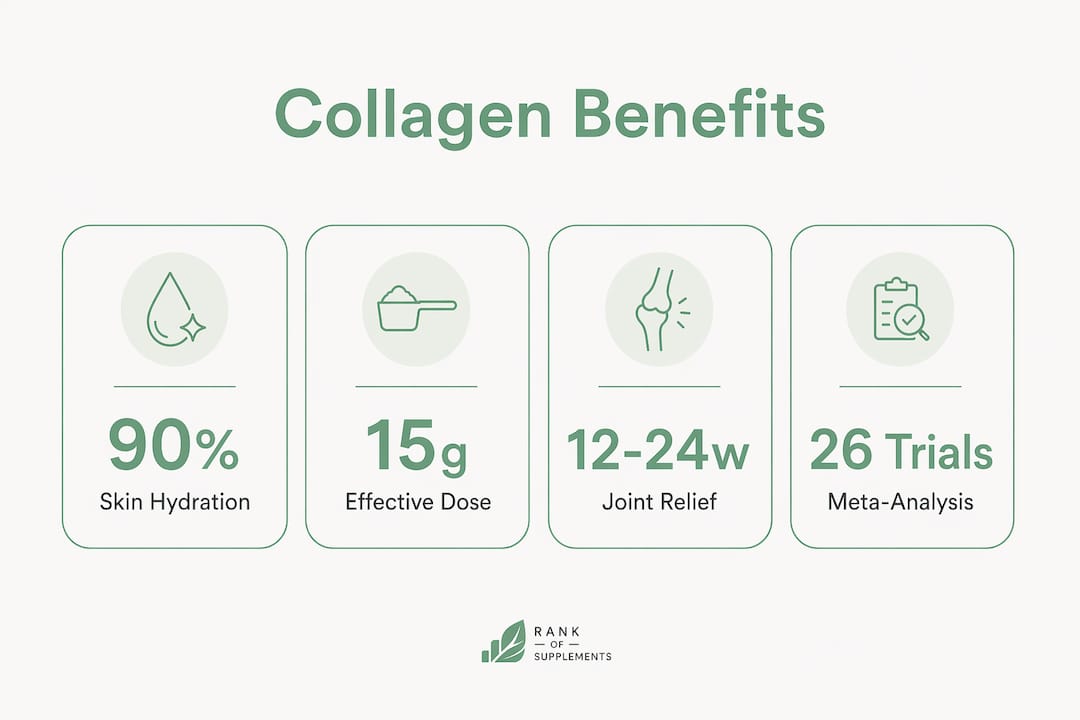
Wrinkle depth reduction is a secondary finding in several of these trials, though the magnitude varies. Skin hydration improvements tend to appear first, typically within 4 to 6 weeks. Elasticity changes follow, usually becoming measurable by week 8. Readers looking for a quick fix will be disappointed. Those willing to commit to 12 weeks will likely see a real difference.
Joint pain and stiffness
Collagen peptides reduce joint pain and stiffness in people with osteoarthritis after 12 to 24 weeks at doses of 10 to 15g per day. Multiple studies report meaningful subjective pain reduction within that timeframe. The mechanism is logical: chondrocytes stimulated by Pro-Hyp and Hyp-Gly produce more cartilage matrix, which cushions joints and reduces friction-related inflammation.
Athletes and active individuals also show benefits. Connective tissue around tendons and ligaments responds to collagen peptide supplementation, which is why sports medicine researchers have studied this population separately from osteoarthritis patients.
Bone mineral density
Long-term collagen peptide use shows early evidence of supporting bone mineral density, particularly in postmenopausal women. The research here is less mature than the skin and joint data, but the biological rationale is sound. Bone is approximately 30% collagen by weight, and the same fibroblast-signaling mechanism applies to osteoblasts.
Summary of clinical evidence
| Health Outcome | Effective Dose | Duration | Evidence Quality |
|---|---|---|---|
| Skin hydration | 2.5 to 5g/day | 8 to 12 weeks | Strong (26 RCTs) |
| Skin elasticity | 2.5 to 5g/day | 8 to 12 weeks | Strong (26 RCTs) |
| Joint pain relief | 10 to 15g/day | 12 to 24 weeks | Moderate (multiple RCTs) |
| Bone mineral density | 5 to 10g/day | 12+ months | Early/emerging |
Safety profile
Mild digestive side effects like bloating may occur when you first start taking collagen peptides, but they are generally safe at doses up to 15g per day. These symptoms are transient and typically resolve within one to two weeks. Starting at a lower dose (2.5g) and building up over two weeks reduces the likelihood of any digestive discomfort.
Who benefits most from collagen peptide supplements?
The collagen peptides health reasons vary by age, activity level, and specific symptoms. Not everyone needs to supplement, but several groups have a clear biological case for doing so.
Age is the most universal factor. Collagen production declines measurably after age 25 and accelerates after 40. The visible signs include skin that looks less plump, fine lines that deepen faster, and joints that feel stiffer in the morning. These are not cosmetic complaints. They reflect a real reduction in the structural proteins that hold tissue together.
Athletes and physically active people face a different pressure. High-impact training creates micro-damage in tendons, ligaments, and cartilage. The body repairs this damage using collagen, and supplementation gives it more raw material to work with. Research on athletes shows that collagen peptides support connective tissue maintenance under training stress, which translates to faster recovery and lower injury risk over time.
People with early osteoarthritis symptoms, particularly knee and hip stiffness, represent a third group with strong evidence behind supplementation. The 10 to 15g per day dose used in joint pain trials is higher than the skin dose, so readers in this group should plan accordingly.
Signs you may benefit from collagen peptide supplementation
- Skin that feels less firm or shows increased fine lines after your mid-30s
- Morning joint stiffness that takes more than 15 minutes to ease
- Slow recovery from exercise-related muscle or tendon soreness
- A diet low in animal connective tissue (no bone broth, organ meats, or skin-on poultry)
- Increased physical training volume without a corresponding increase in protein intake
Hydrolyzed collagen peptides also provide amino acids like glycine and proline that are underrepresented in modern diets dominated by muscle meat. This nutritional gap is one reason supplementation makes sense even for people without obvious symptoms.
Pro Tip: Give collagen peptides at least 8 weeks before evaluating results for skin, and at least 12 weeks for joint symptoms. Stopping at week 4 because you “don’t notice anything” is the most common reason people miss the benefit window.
How to choose and use collagen peptide supplements
Selecting a quality collagen peptide product requires more than reading the label. The supplement market is largely unregulated, which means label claims do not always match what is in the product.
Third-party testing is the most reliable way to verify purity and label accuracy. Look for products certified by NSF International, USP, or Informed Sport. These organizations test independently and publish results. A product without any third-party certification is a product you are taking on faith.
Collagen types and sources
Type I collagen is the most abundant in skin, tendons, and bone. Type II is specific to cartilage. Type III supports skin and blood vessels and is often found alongside Type I. Most skin-focused products use Type I and III from bovine (cattle) or marine (fish) sources. Joint-focused products often emphasize Type II from chicken cartilage.
Marine collagen has a slightly smaller molecular weight than bovine collagen, which some researchers argue improves absorption further. The practical difference between the two is small for most people. Porcine (pig) collagen is also available and closely resembles human Type I collagen structurally.
Dosage and duration
- Skin benefits: 2.5 to 5g per day for a minimum of 8 weeks
- Joint pain relief: 10 to 15g per day for 12 to 24 weeks
- General connective tissue support: 5 to 10g per day ongoing
Collagen peptides are not complete proteins. They lack essential amino acids in the proportions the body needs for muscle repair and general protein synthesis. They should complement your existing protein intake, not replace it. A person eating adequate whole protein (chicken, fish, eggs, legumes) and adding 5 to 10g of collagen peptides daily is using the supplement correctly.
Product selection criteria
- Third-party certification (NSF, USP, or Informed Sport)
- Collagen type matched to your primary goal (Type I/III for skin, Type II for joints)
- Source transparency (bovine, marine, or porcine clearly stated)
- No unnecessary fillers, artificial sweeteners, or proprietary blends that obscure dosing
- Unflavored options for flexible use in food and drinks
For a detailed breakdown of how to evaluate supplement quality before buying, the supplement quality guide from Rankofsupplements covers the full verification process.
Key Takeaways
Collagen peptides deliver measurable skin and joint benefits when taken consistently at the right dose for at least 8 to 12 weeks, but they require vitamin C, quality sourcing, and realistic timelines to work.
| Point | Details |
|---|---|
| Bioavailability is the key advantage | Hydrolysis produces 2 to 5 kDa peptides that absorb intact and signal collagen repair directly. |
| Dose depends on your goal | Use 2.5 to 5g/day for skin and 10 to 15g/day for joint pain relief over the appropriate timeframe. |
| Vitamin C is non-negotiable | Collagen synthesis enzymes require vitamin C; take both together for full effect. |
| Third-party testing matters | Choose products certified by NSF, USP, or Informed Sport to confirm label accuracy. |
| Collagen peptides complement, not replace, protein | They lack essential amino acids and should be added to an existing adequate protein intake. |
Collagen peptides work, but not the way most people expect
I have spent years reviewing supplement research, and collagen peptides are one of the few categories where the clinical evidence actually matches the marketing claims, with one important caveat. The benefits are real but moderate, and they require patience that most people underestimate when they first buy a tub.
The mistake I see constantly is people treating collagen peptides like a medication with a fast onset. They take it for three weeks, notice nothing dramatic, and conclude it does not work. The biology does not operate on that timeline. Skin cell turnover takes 28 to 40 days. Cartilage remodeling is even slower. The studies that show real results run for 8 to 24 weeks, and that is not an accident.
What I find genuinely underappreciated is the signaling mechanism. Most people think they are just “adding collagen” to their body like topping off a tank. The actual process is more interesting. The Pro-Hyp and Hyp-Gly fragments tell your fibroblasts to upregulate their own collagen production. You are not filling a deficit directly. You are sending a biological instruction. That distinction matters because it explains why the dose does not need to be enormous and why consistency beats quantity.
My practical advice: pick a product with third-party certification, pair it with vitamin C, and commit to 12 weeks before you evaluate. Also consider aging reversal methods that work alongside supplementation, because collagen peptides perform best as part of a broader approach that includes sleep, sun protection, and adequate whole protein. They are a strong supporting player. They are not the whole team.
matteo
Collagen peptide resources worth bookmarking
Choosing the right collagen peptide supplement is easier when you have reliable, evidence-based information in one place. Rankofsupplements maintains a full ingredient research library covering collagen peptides in depth, including dosing summaries, source comparisons, and what the current research actually supports.
For readers focused on joint health specifically, the joint pain supplement guide ranks the most evidence-backed options and explains how collagen peptides compare to other connective tissue supplements. If you want to verify a specific product before purchasing, the supplement reviews and rankings page at Rankofsupplements gives you science-backed assessments without the marketing noise.
FAQ
What are collagen peptides exactly?
Collagen peptides are short protein fragments produced by breaking down native collagen through enzymatic hydrolysis. They are highly absorbable and act as signaling molecules that stimulate the body’s own collagen production.
How long does it take for collagen peptides to work?
Skin hydration improvements typically appear within 4 to 6 weeks at 2.5 to 5g per day. Joint pain relief requires 12 to 24 weeks at 10 to 15g per day, based on clinical trial data.
Can I take collagen peptides every day?
Yes. Daily use at doses up to 15g per day is considered safe, with only mild and transient digestive side effects reported in some people during the first few weeks.
Do collagen peptides replace regular protein intake?
No. Collagen peptides lack the full spectrum of essential amino acids and should complement, not replace, whole protein sources like meat, fish, eggs, or legumes.
What is the best time to take collagen peptides?
Timing is less critical than consistency. Taking collagen peptides with a vitamin C source, whether food or a supplement, maximizes the enzymatic activity needed for collagen synthesis.