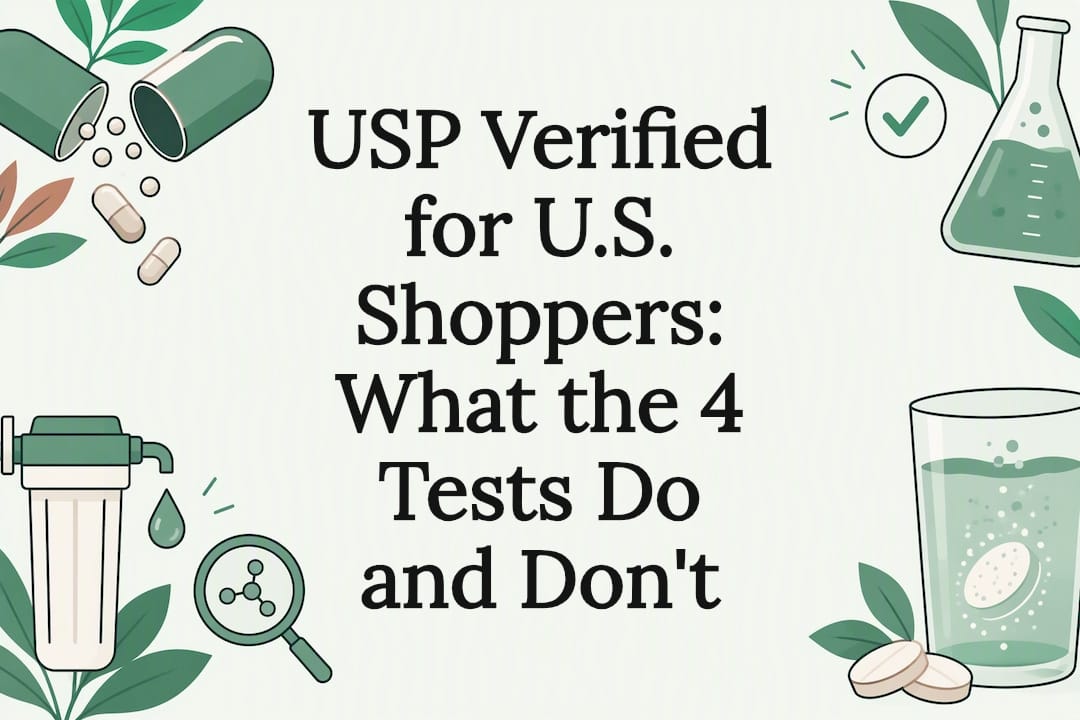
The USP Verified mark means an independent review confirmed a product contains the ingredients listed at the declared amounts, meets limits on specific contaminants, breaks down properly, and comes from an audited manufacturing facility. It does not mean the product works, and it is not FDA approval. The mark is a quality check, not a promise of results.
TL;DR:
- The USP Verified mark confirms that a supplement’s ingredients match label claims, are free from contaminants, and the manufacturing process follows GMP standards.
- Verification involves multiple steps, including pre-audit reviews, on-site GMP inspections, batch documentation checks, lab testing, and annual surveillance of products from retail shelves.
- The program tests for identity, potency, purity, and proper breakdown but does not assess whether the supplement improves health outcomes or interacts with medications.
- Consumers should verify the specific product and formulation using USP’s database and check if the lot or SKU matches verified standards for assurance.
- The mark is most valuable for high-dose products, botanicals prone to contamination, or supplements used by athletes to ensure ingredient integrity and safety.
Table of Contents
- What the USP Verified mark actually covers
- How a product earns and keeps the USP Verified mark
- What USP checks and what it leaves out
- How to check if a product is really USP Verified
- Why clinicians and consumer advocates trust the mark
- How we weigh USP verification in our rankings
- When the USP mark matters most
- Pair verification with evidence-based reviews
- Sources
- FAQ
What the USP Verified mark actually covers
The mark speaks to four things: identity, potency, purity, and performance. Identity and potency testing confirms the active ingredients on the label are actually in the bottle, at the strength claimed. Purity screening checks for heavy metals, pesticide residue, and microbial contamination against set limits. Performance testing looks at dissolution, whether a tablet or capsule breaks down properly so the body can absorb what is inside it. None of this tells you whether the ingredient does what the label implies for your goals, only that what is printed on the bottle matches what is inside it.

Manufacturing controls round out the picture. Facilities are audited against USP and FDA good manufacturing practice standards, which means the mark also reflects how consistently a product is made, not just what one lot contained on the day it was tested.
A very large number of product labels have carried the USP Verified mark since the program began, a scale that reflects how widely manufacturers use it to signal quality beyond the federal minimum.
- Identity and potency: lab assays confirm the listed ingredients are present at the stated strength.
- Purity: contaminant screens cover heavy metals, pesticides, and microbes.
- Performance: dissolution or disintegration testing checks that the product breaks down as intended.
- Manufacturing controls: facility audits confirm the plant follows GMP standards consistently, not just for the sample tested.
How a product earns and keeps the USP Verified mark
Getting verified is not a one-time lab test. USP runs a multistep process built to catch problems both before a product launches and after it is already on shelves.
- Pre-audit review: USP examines the manufacturer’s quality systems and documentation before any testing begins.
- On-site GMP audit: inspectors visit the facility to check compliance with 21 CFR Part 111 and USP’s general chapter on dietary supplement manufacturing.
- Documentation review: batch records, sourcing paperwork, and quality control files are checked lot by lot.
- Laboratory testing: selected lots go through identity, potency, purity, and performance testing in the lab.
- Annual surveillance: USP buys products off retail shelves and retests them, then re-audits the facility to confirm nothing has drifted.
This structure is what USP’s Dietary Supplement Verification Program describes as its core process, and it is also what separates the mark from a manufacturer simply stating its product meets its own internal specs. A failed retest or a facility that no longer meets GMP standards can trigger additional testing or suspension of the mark entirely.
Pro Tip: If a brand mentions “USP tested” without displaying the mark itself, ask for documentation. Testing once is not the same as maintaining ongoing verification.
What USP checks and what it leaves out
USP verification relies on established analytical methods rather than proprietary shortcuts. Assays confirm ingredient identity and strength, often using chromatography or mass spectrometry. Heavy metal panels and microbial tests catch contamination. Dissolution testing follows compendial methods, meaning the same validated procedures used across the pharmaceutical and supplement industries, drawing on USP and AOAC standards.
What the program does not do is just as important. USP verification does not test whether a supplement improves any health outcome, and it does not evaluate interactions between a supplement and medications a person might be taking. According to USP’s own FAQ page, the mark verifies identity, strength, purity, and performance characteristics, nothing more, and it explicitly does not equate to FDA approval.
- Assay testing confirms ingredient identity and concentration.
- Heavy metal and microbial panels screen for contamination.
- Dissolution testing checks whether the product breaks down properly.
- USP shares full results with manufacturers privately but does not publish raw lab data publicly, so consumers see the outcome (verified or not) rather than the underlying numbers.
Readers who want to understand how counterfeit or mislabeled products slip through gaps like these can find more detail in our guide on avoiding fake supplements.
How to check if a product is really USP Verified
Seeing the mark on a bottle is a start, but it is worth confirming the claim actually applies to the exact product in your hand.
- Check the label directly for the USP Verified mark and note the specific product name and formulation shown.
- Search USP’s Quality-Supplements.org database to confirm the brand and product currently participate in the program.
- Match the lot or SKU if possible, since verification can apply to a specific formulation rather than every product a brand sells.
- Contact the manufacturer for a verification letter if the label is unclear or the product does not appear in USP’s public listings.
Our own walkthrough on checking supplement quality covers this process in more depth, including how to spot brands that use similar-looking seals without actual verification.
Why clinicians and consumer advocates trust the mark
USP has developed pharmaceutical quality standards for more than two centuries, and its USP-NF compendium is referenced throughout U.S. drug and supplement manufacturing. That history carries weight with healthcare providers.
- Independent, third-party oversight fills a gap left by the FDA’s mostly post-market regulatory role for supplements.
- Annual surveillance testing catches’ ingredient drift or sourcing changes that could otherwise go unnoticed between audits.
- Compendial testing methods mean results are comparable across brands and manufacturers, not brand-specific claims.
Surveys and materials published by USP point to the mark as one of the top quality seals healthcare professionals recommend when patients ask which supplements to trust. That recognition matters because the FDA does not approve supplements before they reach shelves, leaving a trust gap that third-party verification programs like USP’s are built to address.
How we weigh USP verification in our rankings
When we score a supplement, third-party verification carries real weight alongside clinical dosing and label accuracy, but it does not override either one. A product with a USP Verified mark and ingredients dosed below what clinical research actually used still loses points for underdosing. The mark confirms what is in the bottle, not whether the amount is enough to matter.
In practice, we have kept products ranked higher specifically because they combined clinically relevant doses with USP verification, since that pairing gives a stronger label accuracy and safety signal than either factor alone. For anyone in a higher-risk group, pregnant, on prescription medication, or managing a chronic condition, we still recommend pairing any verified product with a conversation with a healthcare provider before starting it.
When the USP mark matters most
The mark earns its keep most clearly with high-dose products, botanicals prone to contamination, and anything athletes need to trust is free of banned substances. It matters less when the real question is whether an ingredient works at the dose provided, since verification confirms the label, not the science behind it. A verified product can still be dosed too low to do anything.
Verified products sometimes cost more, and that premium buys real risk reduction, not a guarantee of results. Pair the mark with dosing research, never substitute it for one.
— matteo
Pair verification with evidence-based reviews
Knowing a product is USP Verified answers the label question. Knowing whether the dose inside actually matches what clinical research used is a separate question, and it is the one our reviews focus on, scoring products on clinical dosing, label accuracy, and third-party testing status rather than marketing claims.
- Browse our General Health Supplements rankings for evidence-scored options across common health goals.
- Read our supplement buying guide for a framework that goes beyond any single seal.
- Check a specific product breakdown like our Nutrigo Lab Strength review to see how dosing and verification factor into one real ranking.
- See how common misconceptions about seals and claims get addressed in our piece on supplement myths.
This article is general information, not a substitute for advice from a qualified doctor. Consult a qualified healthcare professional about your own circumstances before acting on anything here.
Sources
- USP Verified Mark - Dietary Supplement Manufacturing
- Questions and answers on dietary supplements | FDA
FAQ
Is USP verification legitimate?
Yes. USP is an independent, nonprofit scientific organization, and its verification program involves facility audits, lab testing, and annual surveillance rather than manufacturer self-reporting.
What does USP verification mean for a supplement label?
It means an independent audit confirmed the product’s ingredients match the label, meet contaminant limits, and come from a GMP-audited facility, according to USP’s program details. It does not confirm the product is effective for any specific health outcome.
Which brands are USP Verified?
Participation changes over time, so the most reliable way to check is searching a specific product on USP’s Quality-Supplements.org lookup rather than relying on a fixed brand list.
What are USP certifications, and how do they differ from FDA approval?
USP verification is a voluntary, private-sector quality check, while the FDA does not approve dietary supplements before they go to market. The two are separate systems, and USP verification fills a gap the FDA’s premarket process does not cover.