
TL;DR:
- Standardized herbal extracts contain a verified percentage of active compounds for consistent potency. They remove variability caused by soil, harvest, and processing, ensuring products match clinical research formulas. Checking the label for specific marker compounds and third-party certificates ensures product quality and effectiveness.
A standardized herbal extract is a botanical preparation analytically tested to contain a defined percentage of specific marker compounds, guaranteeing consistent potency across every batch. This is the core distinction between standardized herbal supplements and raw herb powders, which vary widely in active compound content. Whole turmeric powder typically contains 2 to 5% curcuminoids, while a standardized turmeric extract can deliver up to 95%. Ginkgo biloba is routinely standardized to 24% flavone glycosides and 6% terpene lactones. These numbers are not marketing claims. They are verified through laboratory testing and represent the foundation of evidence-based supplementation.
What is a standardized herbal extract and how does it work?
Standardized herbal extracts exist because raw plant material is chemically inconsistent. Soil quality, harvest season, storage conditions, and plant genetics all affect the concentration of active compounds in an herb. A standardized extract removes that variability by concentrating and verifying a target compound to a reliable minimum level.
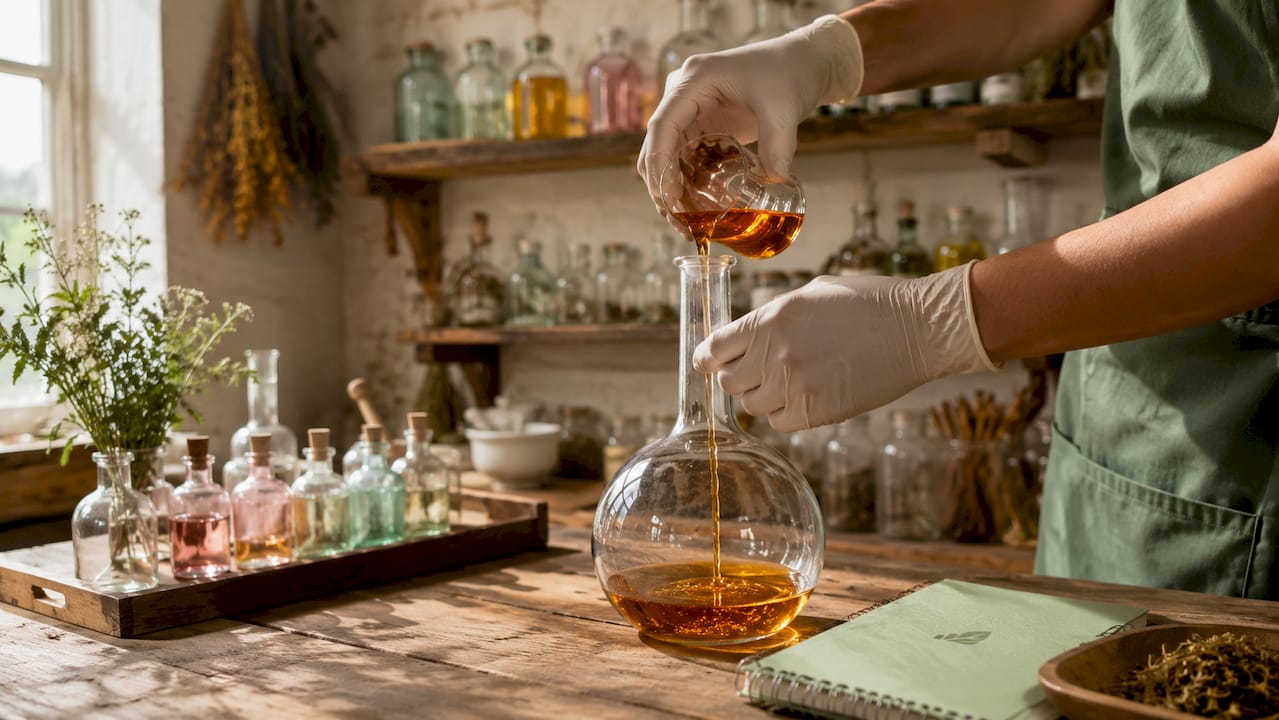
The process starts with extraction. Manufacturers use solvents such as water, ethanol, or CO2 to pull active compounds from dried plant material. The resulting liquid is then concentrated, dried, and tested. The goal is a finished ingredient with a predictable chemical profile, not just a concentrated version of the whole plant.
Approximately 80% of herbal products on the market lack ingredient consistency. That statistic explains why standardization matters so much for anyone relying on an herb for a specific health outcome. Without it, two bottles of the same product from the same brand can deliver meaningfully different amounts of active compounds.
Standardized extracts also connect traditional herbal knowledge to modern clinical research. Clinical trials typically use standardized formulas, which means the results from those studies apply only to products that match the tested formulation. A non-standardized herb product cannot guarantee it replicates what researchers actually studied.
Testing methods used in standardization
Manufacturers verify marker compound levels using analytical chemistry. High-Performance Liquid Chromatography (HPLC) is the most widely used method. It separates compounds in a sample and measures their concentration with high accuracy. Gas Chromatography (GC) is used for volatile compounds such as essential oils. UV spectrophotometry is a simpler and cheaper method, but it is less specific and can produce inflated readings.
The choice of testing method matters because different methods can produce different results for the same sample. A product tested by UV may show higher marker content than the same product tested by HPLC. Consumers comparing products across brands need to know which method was used.
Reputable manufacturers issue a Certificate of Analysis (COA) for each batch. A COA documents the test results, the testing method, and the identity of the testing laboratory. Requesting a COA is the single most reliable way to verify a standardization claim.
Key quality controls to look for in a standardized extract:
- HPLC-verified marker compound percentage listed on the COA
- Third-party laboratory testing from an independent, accredited lab
- Batch-specific COA available on request or published on the brand’s website
- Clearly named marker compound rather than a vague “active constituents” claim
- Manufacturing under Good Manufacturing Practices (GMP) certified by the FDA or NSF International
Pro Tip: Ask the brand directly for the COA before purchasing. A reputable manufacturer will provide it without hesitation. If they cannot or will not, treat that as a red flag.
What are the benefits and limitations of standardized extracts?
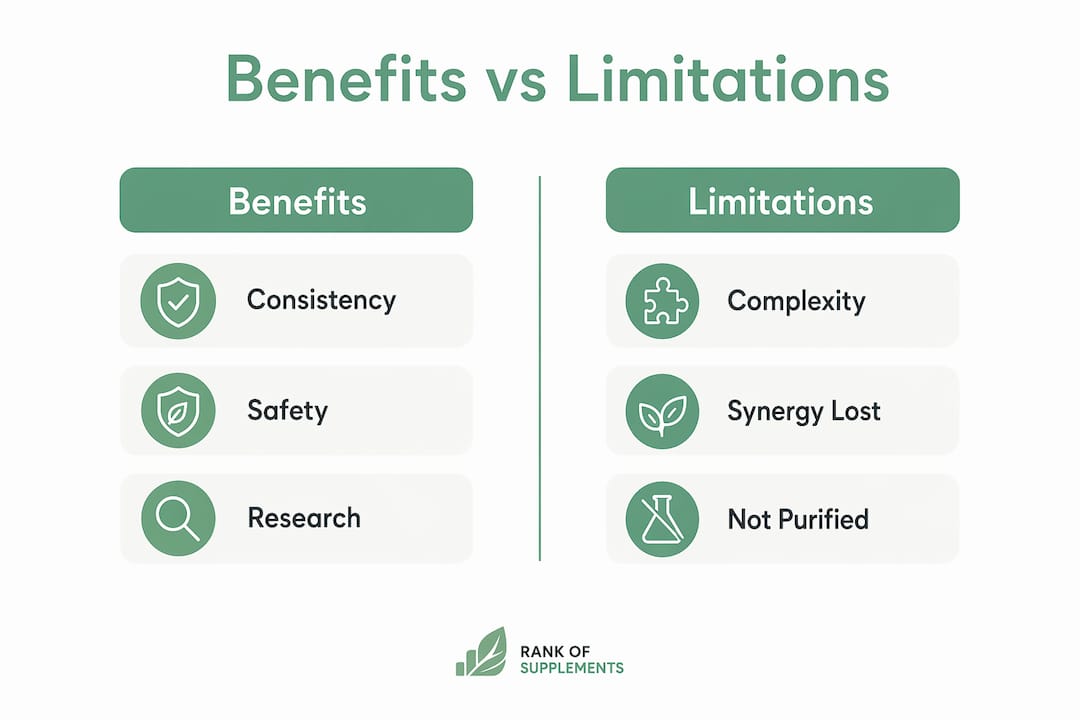
Standardized extracts offer real advantages, but they are not automatically superior to whole herb preparations. The right choice depends on your health goal, the herb in question, and the quality of the product you are considering.
Benefits worth knowing
The primary benefit of a standardized extract is consistency. You know what you are getting in every capsule, and that consistency matters for tracking results. If you take a standardized Ashwagandha extract with 5% withanolides and notice a benefit, you can replicate that experience with the next bottle because the formulation is controlled.
Standardization also enhances safety by reducing chemical variability. Unstandardized products may deliver inconsistent doses, which complicates both self-monitoring and clinical pharmacovigilance. A consistent constituent profile makes it easier to identify interactions and set appropriate dosing guidelines.
For clinical research, standardized extracts are non-negotiable. Reproducible results require reproducible formulations. This is why the most credible studies on herbs like Ginkgo biloba and turmeric use standardized preparations, and why those studies are the ones referenced in evidence-based health guidance.
Limitations to consider honestly
Standardization does not mean purification. A standardized extract remains a multi-compound botanical mixture, not a single isolated ingredient. Controlling the minimum content of one marker compound does not mean other compounds are absent or irrelevant.
Some researchers argue that focusing on a single marker compound misses the synergistic effects of the full plant matrix. Whole herb preparations retain the complete range of phytochemicals, which may work together in ways that a standardized extract does not fully replicate. This is an active area of debate in botanical medicine, and the evidence is not settled.
Pro Tip: For herbs with well-researched marker compounds and strong clinical trial data, standardized extracts are the better choice. For herbs where the full-spectrum effect is the point, such as certain adaptogenic mushrooms, a whole herb or broad-spectrum extract may serve you better.
| Feature | Standardized extract | Whole herb preparation |
|---|---|---|
| Potency consistency | Reliable minimum marker level | Varies by batch and source |
| Clinical research alignment | Matches study formulations | Often does not match |
| Full phytochemical profile | Partially reduced | Fully retained |
| Dosing predictability | High | Low to moderate |
| Safety monitoring | Easier due to consistency | More difficult |
| Cost | Generally higher | Generally lower |
How to read standardized herbal extract labels in 2026
The word “standardized” on a supplement label means very little on its own. The FDA does not require supplement standardization, and the term is not uniformly regulated across manufacturers. One brand’s “standardized” may refer to HPLC-verified curcuminoids. Another brand’s may refer to a loosely defined internal specification with no third-party verification.
Reading a label correctly requires looking past the marketing language and into the Supplement Facts panel. The marker compound and its percentage should appear there explicitly. A label that says “Turmeric Extract (standardized to 95% curcuminoids), 500 mg” tells you exactly what you are getting. A label that says “Turmeric Extract, 500 mg (standardized)” tells you almost nothing useful.
Marker compound percentage is a more reliable potency indicator than total milligram weight. A 500 mg capsule of a 95% curcuminoid extract delivers far more active compound than a 1,000 mg capsule of a 5% extract. The milligram number alone is misleading without the standardization percentage.
Extract ratios such as “10:1” are another common source of confusion. A 10:1 ratio means 10 parts of raw herb were used to produce 1 part of extract by weight. An extract ratio does not guarantee standardized marker content unless paired with assay-confirmed data. Ratio claims and standardization claims are different things, and a product can have one without the other.
Use this checklist when evaluating any standardized herbal supplement label:
- Named marker compound listed explicitly (e.g. “standardized to 5% withanolides”)
- Percentage of marker compound stated in the Supplement Facts panel
- Total milligrams per serving alongside the standardization percentage
- Third-party testing mentioned or COA available on request
- GMP-certified manufacturer noted on the label or brand website
- No vague claims such as “full-spectrum standardized” without specifics
For a deeper look at how to verify supplement quality beyond the label, the supplement quality guide at Rankofsupplements walks through the full verification process step by step. Understanding underdosed herbal supplements is equally worth your time, because a product can be technically standardized and still deliver too little active compound to matter.
Which herbs are most commonly standardized?
The herbs with the strongest standardization track records are those with well-identified marker compounds and substantial clinical research behind them. These are the herbs where standardization adds the most value because the research is tied to specific compound concentrations.
| Herb | Marker compound(s) | Typical standardization | Primary health relevance |
|---|---|---|---|
| Turmeric | Curcuminoids | 95% | Anti-inflammatory, antioxidant |
| Ginkgo biloba | Flavone glycosides, terpene lactones | 24% / 6% | Cognitive function, circulation |
| Ashwagandha | Withanolides | 5% | Stress response, energy |
| Milk thistle | Silymarin | 70 to 80% | Liver support |
| Valerian root | Valerenic acids | 0.8% | Sleep, relaxation |
| Green tea | EGCG (epigallocatechin gallate) | 50 to 98% | Antioxidant, metabolism |
These marker compounds align directly with clinical research formulations, which is why they are the ones manufacturers target. When a study on Ginkgo biloba shows cognitive benefits, it almost always used the 24%/6% standardized extract. Buying a non-standardized Ginkgo product and expecting the same result is not supported by that research.
Ashwagandha standardized to 5% withanolides is the formulation used in the most cited clinical trials on stress and cortisol. Products standardized to lower percentages or using different marker compounds may not replicate those outcomes. Checking the herbal extracts in wellness context helps clarify which formulations have the strongest evidence base.
Milk thistle is a useful case study in standardization done right. Silymarin, the active complex in milk thistle, is well-characterized and consistently standardized to 70 to 80% in clinical-grade products. Products below that threshold are unlikely to match the liver-support outcomes seen in research. The standardization percentage is not arbitrary. It reflects the concentration used in the studies that established the herb’s efficacy.
Key Takeaways
Standardized herbal extracts deliver reliable marker compound levels, making them the most reliable format for evidence-based supplementation and consistent health outcomes.
| Point | Details |
|---|---|
| Definition of standardization | A standardized extract offers a minimum percentage of a named marker compound, verified by laboratory testing. |
| Testing method matters | HPLC is the gold standard for verification; UV spectrophotometry can overstate marker content. |
| Labels require scrutiny | “Standardized” alone is insufficient. Look for the named compound, its percentage, and third-party COA availability. |
| Extract ratios are not standardization | A 10:1 ratio reflects concentration by weight, not confirmed marker compound content. |
| Match the research formulation | Clinical benefits are tied to specific standardization levels. Buy the percentage used in the studies. |
Why I think most people read herbal labels backwards
Most people buying herbal supplements look at the milligram number first. That instinct is understandable. Bigger numbers feel like more product. But in standardized extracts, the milligram weight is almost the least useful number on the label.
What I have found, after reviewing hundreds of supplement formulations, is that the marker compound percentage is the number that actually predicts whether a product will work. A 200 mg capsule of 95% curcuminoid extract delivers more active compound than a 1,000 mg capsule of generic turmeric powder. The math is simple, but the marketing obscures it.
The other thing I want to push back on is the assumption that standardized automatically means better. For some herbs, the full phytochemical matrix is the point. Reishi mushroom, for example, contains beta-glucans, triterpenes, and dozens of other compounds that may work together. Standardizing to a single marker could theoretically reduce the benefit. The evidence on this is still developing, but it is a real consideration.
What I recommend is a two-step approach. First, identify whether a clinical trial exists for the herb you want to use. If it does, find out what standardization level that trial used. Second, find a product that matches that level and has a COA to prove it. That process takes ten minutes and eliminates most of the guesswork in the supplement aisle.
Standardization is a quality tool, not a quality guarantee. A well-standardized product from a transparent manufacturer is a strong starting point. But the standardization percentage still needs to match the evidence, and the evidence still needs to be relevant to your actual health goal. Rankofsupplements covers both sides of that equation in its ingredient reviews, which is why I find it a useful reference when evaluating specific herbs.
matteo
Finding quality standardized herbal supplements
Knowing what a standardized extract is gives you a real advantage when shopping for supplements. Applying that knowledge to actual products is the next step.
Rankofsupplements reviews and ranks supplements based on ingredient transparency, standardization quality, and alignment with clinical evidence. The supplement ingredient library covers detailed profiles for standardized herbs including turmeric, Ginkgo biloba, Ashwagandha, and more, with notes on typical standardization levels and what the research actually supports. For readers looking to match a supplement to a specific health goal, the supplements by health condition section filters products by outcome, making it easier to find formulations that use clinically relevant standardization levels. Transparent labeling and verified potency are the baseline Rankofsupplements applies to every product it reviews.
FAQ
What is a standardized herbal extract in simple terms?
A standardized herbal extract is a plant-based supplement reliable to contain a specific percentage of a named active compound, verified by laboratory testing. This offers consistent potency in every batch.
How are herbal extracts standardized?
Manufacturers extract active compounds from plant material, concentrate them, and then test the finished product using methods like HPLC to confirm the marker compound reaches the target percentage.
Is a standardized extract better than a whole herb?
For herbs with strong clinical research tied to specific marker compounds, standardized extracts are more reliable. For herbs where the full plant matrix is the active element, whole herb or broad-spectrum preparations may be more appropriate.
What does a 10:1 extract ratio mean?
A 10:1 ratio means 10 parts of raw herb produced 1 part of extract by weight. It reflects concentration but does not confirm standardized marker content unless the label also states a verified compound percentage.
Does the FDA regulate herbal extract standardization?
The FDA does not require supplement standardization. This makes third-party testing and transparent labeling the primary tools consumers have for verifying that a product’s standardization claims are accurate.
Recommended
- Related article: The role of herbal extracts in health and wellness
- Top list: Examples of herbal supplements for better wellness
- Product: Best supplement reviews and rankings 2026
- Guide: Supplement buying guide 2026: what actually works