
TL;DR:
- Micronutrients are essential vitamins and minerals needed in small amounts to support health, and they must come from food or supplements since the body cannot produce them. The requirements for these nutrients vary based on age, sex, life stage, and health conditions, with deficiencies causing health problems and impacting energy, cognition, and disease resistance. Meeting micronutrient needs relies on dietary variety, targeted supplements, proper timing, and monitoring through blood tests and dietary tracking.
Micronutrients are defined as the vitamins and minerals your body requires in small amounts to sustain metabolism, immunity, and disease prevention. Unlike macronutrients, your body cannot synthesize these compounds on its own. That means every microgram must come from food or supplements. Around 30 essential micronutrients exist, including 13 vitamins and 16 minerals, each with a distinct physiological role. The National Academies establishes Recommended Dietary Allowances (RDAs) to define how much of each nutrient most healthy people need daily. Understanding micronutrient needs is not about memorizing a list. It is about knowing which nutrients matter for your life stage, your diet, and your health goals.
What are the main categories of essential vitamins and minerals?

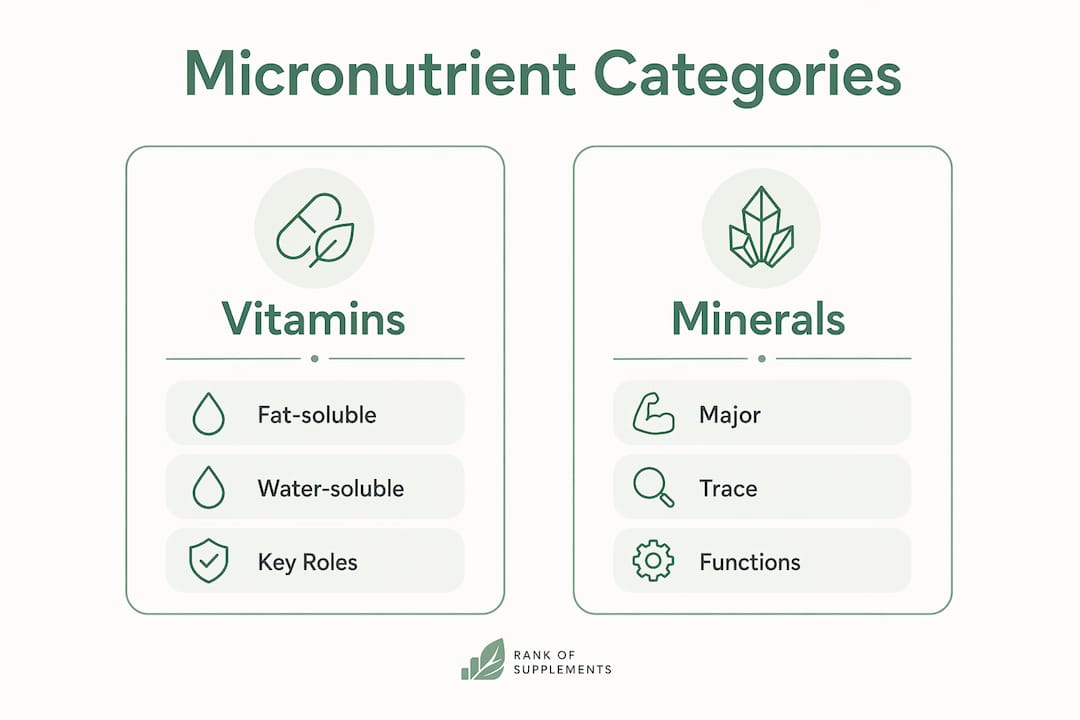
Vitamins split into two groups: fat-soluble and water-soluble. Fat-soluble vitamins, including A, D, E, and K, store in body fat and the liver. Water-soluble vitamins, including the eight B vitamins and Vitamin C, do not store well and require more consistent daily intake.
Minerals divide into major minerals and trace minerals. Major minerals, such as calcium, potassium, and magnesium, are needed in larger amounts. Trace minerals, such as iron, zinc, selenium, and iodine, are required in much smaller quantities but are no less critical.
Each micronutrient fills a role that no other nutrient can replace. Vitamin D regulates calcium absorption and supports bone density. Iron carries oxygen through the bloodstream via hemoglobin. Potassium controls muscle contractions and nerve signals. Iodine drives thyroid hormone production, which governs metabolic rate. This specificity is what separates micronutrients from macronutrients, where protein, fat, and carbohydrates can partially substitute for one another in energy production.
| Micronutrient | Category | Primary function |
|---|---|---|
| Vitamin D | Fat-soluble vitamin | Calcium absorption, bone health |
| Vitamin C | Water-soluble vitamin | Immune defense, collagen synthesis |
| Iron | Trace mineral | Oxygen transport via hemoglobin |
| Calcium | Major mineral | Bone structure, muscle contraction |
| Magnesium | Major mineral | Energy metabolism, nerve function |
| Zinc | Trace mineral | Immune response, wound healing |
| Potassium | Major mineral | Electrolyte balance, heart rhythm |
| Iodine | Trace mineral | Thyroid hormone production |
The importance of micronutrients extends beyond preventing deficiency. Adequate intake supports energy levels, cognitive function, and long-term disease resistance. Deficiency in even one micronutrient can create a cascade of health problems that are easy to misattribute to other causes.
Pro Tip: Fat-soluble vitamins like A, D, E, and K absorb best when consumed with a meal that contains dietary fat. Pair a Vitamin D supplement or fatty fish with avocado or olive oil to improve uptake.
How are micronutrient requirements determined and why do they vary?
The Dietary Reference Intakes (DRIs) are the framework the National Academies uses to define nutrient needs across the population. The RDA sits within this framework and represents the daily intake level sufficient to meet the nutritional needs of 97 to 98% of healthy individuals. That figure means a small portion of the population will still need more than the RDA to stay healthy.
RDA values shift significantly by age, sex, and life stage. Vitamin C is set at 75 mg per day for adult women and 90 mg per day for adult men. Vitamin D is set at 15 mcg per day for ages 1 to 70, then rises to 20 mcg per day for adults over 70. These are not arbitrary numbers. They reflect decades of clinical research on absorption rates, metabolic demand, and population health outcomes.
Life stage creates the most dramatic shifts in micronutrient requirements. Pregnancy and athletic training significantly alter micronutrient requirements beyond general RDAs, requiring tailored intake targets. A pregnant woman needs nearly twice the folate of a non-pregnant adult to prevent neural tube defects. An endurance athlete loses significant magnesium and electrolytes through sweat, often far exceeding what standard dietary labels account for.
The Tolerable Upper Intake Level (UL) is the other critical number in this framework. Exceeding the UL can cause toxicity. Too much zinc interferes with copper metabolism. Excess Vitamin A causes liver damage and bone fragility. The UL exists specifically because supplement use makes it easy to overshoot safe intake ranges without realizing it.
| Nutrient | Adult RDA (women) | Adult RDA (men) | Increases significantly for |
|---|---|---|---|
| Vitamin C | 75 mg/day | 90 mg/day | Smokers, illness recovery |
| Vitamin D | 15 mcg/day | 15 mcg/day | Adults over 70, low sun exposure |
| Iron | 18 mg/day | 8 mg/day | Pregnancy, menstruation |
| Calcium | 1,000 mg/day | 1,000 mg/day | Postmenopausal women, adults over 70 |
| Folate | 400 mcg/day | 400 mcg/day | Pregnancy (600 mcg/day) |
Key factors that raise your personal micronutrient requirements above the standard RDA:
- Pregnancy and lactation increase demand for folate, iron, iodine, and calcium.
- Adults over 70 absorb Vitamin D and B12 less efficiently due to reduced stomach acid and skin synthesis.
- High-intensity athletes need more magnesium, iron, and B vitamins to support energy metabolism and recovery.
- Vegetarians and vegans face higher risk of B12, iron, zinc, and omega-3 shortfalls.
- Certain medications, including proton pump inhibitors and metformin, deplete B12 and magnesium over time.
Pro Tip: If you take a proton pump inhibitor (PPI) for acid reflux, ask your doctor to check your B12 and magnesium levels annually. Long-term PPI use is one of the most underrecognized causes of micronutrient depletion in adults.
How can you assess and monitor your micronutrient status?
Blood tests are the most direct method for measuring micronutrient status, but they are not available for every nutrient. Blood testing is the gold standard when deficiency is suspected, while dietary analysis remains the primary tool for most people. For nutrients like magnesium, standard serum tests can appear normal even when cellular stores are depleted, which is a limitation worth knowing.
Food tracking apps offer a practical way to monitor daily intake and spot gaps before they become deficiencies. Apps like Cronometer provide detailed micronutrient breakdowns by meal, not just macronutrient totals. Tracking for even two weeks can reveal consistent shortfalls in specific nutrients that dietary changes or targeted supplements can address.
Adults over 50 commonly fail to meet intake goals for calcium, magnesium, potassium, and Vitamin D. That pattern matters because these four nutrients support bone density, cardiovascular function, and muscle performance, all of which decline with age when intake is inadequate.
Practical tools and steps for proactive micronutrient monitoring:
- Track your diet for 14 days using a micronutrient-aware app like Cronometer to identify consistent gaps.
- Request a blood panel from your doctor that includes Vitamin D (25-OH), B12, ferritin (iron stores), and magnesium when you suspect deficiency.
- Review your medications with a pharmacist to identify any that deplete specific nutrients.
- Assess your dietary pattern for major exclusions, such as no dairy (calcium risk), no meat (B12 and iron risk), or minimal sun exposure (Vitamin D risk).
- Revisit your intake targets at each major life stage change, including menopause, a new fitness program, or a new chronic condition diagnosis.
Absorption factors matter as much as intake amounts. Vitamin D from food and supplements requires adequate magnesium to convert into its active form. Iron from plant sources absorbs at a fraction of the rate of iron from meat. Knowing what you eat is only half the picture. Knowing how well your body absorbs it completes the assessment.
Pro Tip: Request a ferritin test rather than just a hemoglobin test when checking iron status. Ferritin measures stored iron and catches depletion weeks or months before anemia appears on standard bloodwork.
What are the best strategies to meet your micronutrient needs daily?
Whole, minimally processed foods are the most reliable source of micronutrients. Food provides phytochemicals, fiber, and essential compounds that supplements cannot fully replicate. A handful of pumpkin seeds delivers zinc, magnesium, and iron together with fiber and healthy fats. A supplement capsule delivers zinc alone. The synergistic effect of food-based nutrition is real and measurable.
Dietary variety is the practical mechanism behind food-first nutrition. Dark leafy greens like spinach and kale supply iron, calcium, Vitamin K, and folate. Fatty fish like salmon and sardines deliver Vitamin D and B12. Nuts and seeds cover magnesium, zinc, and Vitamin E. Legumes provide iron, folate, and potassium. No single food covers all 30 essential micronutrients, which is why variety across food groups is the most effective daily strategy.
Supplementation fills gaps that diet alone cannot close. Standard multivitamins often fall short on calcium, magnesium, and potassium because the doses required are physically too large to fit in a standard capsule. A typical multivitamin may contain 100 to 200 mg of calcium when the adult RDA is 1,000 mg. That gap requires either dietary focus or a separate targeted supplement. Blanket multivitamin use without dietary assessment creates a false sense of security.
Supplement timing and combinations affect how much your body actually absorbs. Calcium and magnesium compete for the same absorption pathways, so taking them together reduces the uptake of both. Iron and calcium also inhibit each other when taken simultaneously. Spacing these supplements by at least two hours maximizes the benefit of each. For fitness-focused readers, the role of vitamins in bodybuilding extends this logic to recovery and performance.
Key strategies and common pitfalls to avoid:
- Prioritize food variety first. Aim for five or more distinct food groups daily before reaching for supplements.
- Use targeted supplements, not blanket coverage. Identify your actual gaps through tracking or testing, then supplement specifically.
- Separate calcium and magnesium. Take calcium with breakfast and magnesium in the evening to avoid absorption competition.
- Take fat-soluble vitamins with food. Vitamins A, D, E, and K require dietary fat for absorption.
- Adjust for your dietary pattern. Vegans need reliable B12 supplementation. Postmenopausal women need focused calcium and Vitamin D attention.
- Do not assume more is better. Exceeding the UL for fat-soluble vitamins or minerals like zinc causes harm, not benefit.
- Revisit your supplement stack annually. Needs change with age, activity level, and health status.
Learning how to balance diet and supplements is the practical skill that ties all of these strategies together. The goal is not perfection on every nutrient every day. It is consistent adequacy across the nutrients that matter most for your specific situation.
Pro Tip: If you follow a plant-based diet, pair iron-rich plant foods like lentils or spinach with a Vitamin C source at the same meal. Vitamin C converts plant-based iron into a form your body absorbs far more efficiently.
Key Takeaways
Meeting your micronutrient requirements demands a personalized approach built on dietary variety, life-stage-specific targets, and targeted supplementation where food falls short.
| Point | Details |
|---|---|
| 30 essential micronutrients exist | Your body cannot produce them; every one must come from food or supplements daily. |
| RDAs cover 97 to 98% of healthy people | Your personal needs may exceed the RDA based on age, sex, pregnancy, or activity level. |
| Adults over 50 face key shortfalls | Calcium, magnesium, potassium, and Vitamin D are the most commonly under-consumed nutrients in this group. |
| Food outperforms supplements | Whole foods deliver phytochemicals and synergistic compounds that isolated supplements cannot replicate. |
| Supplement timing matters | Separating calcium and magnesium by at least two hours prevents absorption competition and improves outcomes. |
Why I think most people are solving the wrong micronutrient problem
The most common mistake I see is people chasing the nutrients they have heard about rather than the ones they actually lack. Vitamin C gets all the attention. Magnesium and potassium sit quietly in the background while most adults over 50 fall short of both, every single day.
Generic supplement stacks built around popular nutrients often miss the real gaps. A standard multivitamin gives you a token dose of calcium and almost no potassium, yet these are two of the four nutrients most consistently under-consumed in aging adults. The marketing wins. The nutrition does not.
The second mistake is treating micronutrient needs as static. Your requirements at 25 are not your requirements at 45, and they are definitely not your requirements during pregnancy or a period of heavy training. The demand multiplier concept exists for a reason. Life changes your nutritional baseline faster than most people update their supplement routine.
My honest recommendation is to track your diet for two weeks before buying a single supplement. Cronometer costs nothing and will show you exactly where your gaps are. That data is worth more than any generic wellness stack. Then, if you need to supplement, do it with purpose. One targeted supplement that addresses a real deficiency does more than ten capsules covering nutrients you already get from food.
Bioavailability is the variable most people ignore entirely. You can hit your iron RDA on paper and still be iron-depleted if you are eating only plant sources without Vitamin C. You can take a magnesium supplement and absorb almost none of it if you take it alongside calcium. The nutrient on the label and the nutrient your cells actually receive are two different numbers. Closing that gap is where real nutritional progress happens.
matteo
Rankofsupplements can help you close your micronutrient gaps
Knowing which nutrients you need is the first step. Finding supplements that actually deliver them is where most people get stuck.
Rankofsupplements cuts through the noise with science-backed reviews and rankings built around specific health goals. The Supplement Ingredient Library gives you detailed profiles on vitamins, minerals, and compounds so you can evaluate exactly what a product contains before you buy it. For readers who want to match supplements to a specific health condition or goal, the supplements by health goal section organizes options by condition, making it straightforward to find what fits your situation. No guesswork, no generic recommendations.
Recommended
- Related article: Why micronutrients support weight loss
- Top list: Best supplement reviews and rankings 2026
- Specific product: NutriGo Lab Strength review
- Guide: How to balance diet and supplements for better health
FAQ
What are micronutrients and why does the body need them?
Micronutrients are vitamins and minerals required in small amounts for metabolism, immunity, and disease prevention. The body cannot produce them, so they must come from food or supplements daily.
How many essential micronutrients does the human body need?
There are approximately 30 essential micronutrients, including 13 vitamins and 16 minerals, each with a distinct and irreplaceable physiological role.
What is the difference between an RDA and a UL?
The RDA is the daily intake level that meets the needs of 97 to 98% of healthy people, while the Tolerable Upper Intake Level (UL) is the maximum safe daily amount before toxicity risk increases.
Which micronutrients do most adults commonly lack?
Adults over 50 most commonly fall short on calcium, magnesium, potassium, and Vitamin D, all of which support bone density, muscle function, and cardiovascular health.
Can a standard multivitamin cover all micronutrient needs?
Standard multivitamins do not supply adequate calcium, magnesium, or potassium due to physical bulk limitations, making targeted supplementation or dietary focus necessary for these nutrients.