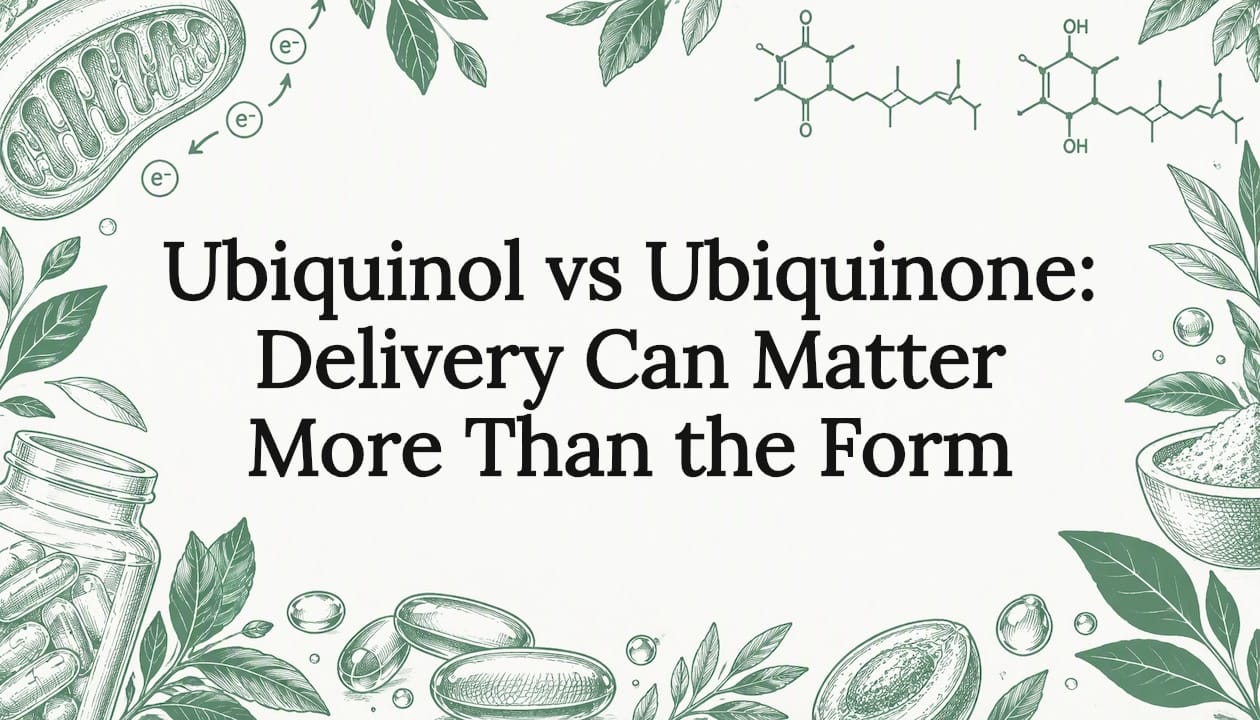
Ubiquinol often produces higher blood CoQ10 levels than ubiquinone, but formulation can matter more than the form itself. If you are older, have impaired mitochondrial function, or want a quick rise in blood levels, ubiquinol makes sense. Otherwise, a well-formulated ubiquinone is a cost-efficient choice.
TL;DR:
- A crossover trial found cocrystal ubiquinol produced 2.20 times peak concentration and 2.01 times total exposure versus reference ubiquinone, but it tested one specific formulation.
- A 2023 review of 28 clinical trials found most cardiovascular outcome evidence came from ubiquinone, while comparable long term ubiquinol trials remain lacking.
- Prioritize a named delivery method, such as an oil carrier or solubilization technology, and independent testing; dry powder may absorb poorly regardless of form.
- General use typically calls for 100 to 300 mg daily with a meal containing fat, while larger doses may be split across meals.
- Anyone taking warfarin should consult their prescriber before using either form, because CoQ10 may weaken anticoagulation and may require closer INR monitoring.
Table of Contents
- What are ubiquinone and ubiquinol, and how does your body switch between them?
- What does the research say about absorption and blood levels?
- Why can formulation matter more than the redox form?
- Who benefits most from ubiquinol, and who is fine with ubiquinone?
- How much should you take, and what should you check for safety?
- Is ubiquinol worth the premium?
- How do you choose a CoQ10 supplement? A shopping checklist
- Our take: how we would apply this checklist to a real shopper
- What does our review process look for in CoQ10 products?
- FAQ
- Sources
What are ubiquinone and ubiquinol, and how does your body switch between them?
CoQ10 is a fat-soluble compound that sits in the inner membrane of your mitochondria, the structures that turn food into usable cellular energy. It does two jobs. It shuttles electrons along the electron transport chain, which is how your cells build ATP, and it acts as an antioxidant that protects membranes from oxidative damage.
The two names describe the same molecule in two chemical states. Ubiquinone is the oxidized form: it has picked up oxygen and is ready to accept electrons. Ubiquinol is the reduced form: it has accepted those electrons and can hand them off or neutralize free radicals. During normal metabolism each molecule flips back and forth between the two, over and over, like a rechargeable battery cycling between empty and full.
That interconversion is the single most useful fact for understanding this debate. When you swallow ubiquinone, your gut cells and liver convert much of it to ubiquinol, and the CoQ10 circulating in your blood after absorption is predominantly ubiquinol anyway. So a ubiquinone capsule is not a dead end, and a ubiquinol capsule is not a shortcut to some entirely different destination. The question is how efficiently each product gets CoQ10 into your bloodstream, and how well your body handles the conversion step.
A few terms will come up repeatedly in the studies below:
- Bioavailability is the share of a dose that actually reaches your systemic circulation.
- Cmax is the peak concentration of CoQ10 in your plasma after a dose.
- AUC (area under the curve) measures total exposure over time. AUC0-t covers the sampling window, while AUC0-∞ extrapolates to infinity.
- Baseline correction subtracts the CoQ10 your body already makes, so researchers see only the effect of the supplement.
Because the body can convert in both directions, both forms can work. The practical differences come down to how much of each product gets absorbed, who might convert less efficiently, and what each costs. The sections below take those in turn. For a deeper ingredient profile with dosing and product notes, our CoQ10 ingredient page covers the basics.
What does the research say about absorption and blood levels?
The headline from pharmacokinetic work is consistent in direction, if not in size: ubiquinol formulations tend to produce higher plasma CoQ10 than the ubiquinone reference they are tested against. Ubiquinol can produce higher Cmax or AUC than ubiquinone, and a PubMed-indexed analysis argues that ubiquinol is superior to ubiquinone for raising CoQ10 levels in the blood. The honest caveat is that results vary by study and by product.
The most recent and most detailed example is a randomized, double-blind, two-treatment, two-period crossover trial in healthy adults. It compared a novel cocrystal ubiquinol softgel with a reference ubiquinone formulation. Here is what it found, as reported in the full study record and its PubMed entry:
The baseline-corrected peak concentration (Cmax) for the cocrystal ubiquinol was about 2.20 times that of the ubiquinone reference, with AUC0-t about 2.01 times and AUC0-∞ about 3.43 times, meaning substantially higher plasma exposure.

Those numbers are real, but read them carefully. The trial was small, individual responses varied widely, and the test product was a specially engineered cocrystal ubiquinol, not a generic ubiquinol softgel. It tells you that a stabilized, well-designed ubiquinol can beat a ubiquinone reference. It does not tell you that every bottle labeled “ubiquinol” will do the same.
Why the numbers differ from study to study
When trials show different results, the gap usually traces back to a handful of design choices:
- Baseline correction. Subtracting endogenous CoQ10 changes the ratios, sometimes dramatically, because the correction removes a large fixed background.
- Subject age and health. Older adults and people with compromised metabolism may convert ubiquinone less efficiently, which widens the gap.
- Dose and dosing schedule. Single-dose studies capture absorption speed; multi-week studies capture steady-state levels, and the difference between forms can shrink with repeated dosing.
- Formulation. The reference ubiquinone is sometimes a plain powder in oil, while the test ubiquinol may use an advanced delivery system. That is a formulation comparison as much as a redox-form comparison.
- Food. Taking CoQ10 with a fat-containing meal changes absorption for both forms.
What this means for clinical outcomes
Blood levels are a stand-in, not the finish line. A 2023 review that evaluated 28 clinical trials found that most of the clinical evidence for cardiovascular benefit and reduced cardiovascular mortality comes from ubiquinone studies. Comparable long-term outcome trials for ubiquinol are lacking, and the review noted that the concentrations that produced benefit in ubiquinone studies were often lower than those tested in the few ubiquinol trials.
Put those two findings side by side and you get a more useful picture than “one form is better.” Ubiquinol has the stronger absorption data in many head-to-head pharmacokinetic comparisons. Ubiquinone has the deeper bank of outcome trials. If your goal is a measurable rise in blood CoQ10 with the least dose, the absorption evidence leans toward ubiquinol, especially a stabilized one. If your goal is to take the form tied to the most long-term clinical results, ubiquinone has the longer track record, and a quality formulation closes much of the absorption gap.
Why can formulation matter more than the redox form?
CoQ10 is a large, waxy, fat-loving molecule that tends to sit as crystals and barely dissolves in water. Your intestine absorbs it poorly when it arrives in a dry, crystalline state. That is the core problem, and it is why a product’s delivery system often decides how much CoQ10 reaches your blood, regardless of whether the label says ubiquinone or ubiquinol. Researchers working on a bioavailability comparison in the Journal of Agricultural and Food Chemistry make this point: because CoQ10 is hydrophobic, the delivery mechanism, such as oil bases and solubilization technologies, can be a bigger factor than the redox form.

That has a practical consequence. A well-formulated ubiquinone can outperform a poorly formulated ubiquinol, and trials of solubilized ubiquinone products, including water-soluble inclusion complexes and crystal-processed versions, have matched or exceeded the exposure of standard ubiquinol. Meanwhile, ubiquinol is chemically less stable than ubiquinone, so a sloppy ubiquinol product can oxidize back to ubiquinone on the shelf and lose its theoretical advantage.
The main delivery strategies
Manufacturers use several approaches to get around CoQ10’s poor solubility:
- Oil carriers. Dissolving or suspending CoQ10 in a lipid base, such as in a softgel, gives the molecule something to ride on through digestion.
- Crystal dispersion. Breaking the crystals into smaller or less ordered particles increases the surface area that can dissolve.
- Cocrystals. Pairing CoQ10 with a second molecule in a single crystal structure can improve both stability and dissolution, which is the approach behind the ubiquinol cocrystal trial above.
- Water-soluble complexes. Inclusion complexes and emulsified or nano-sized formats let CoQ10 mix with the watery environment of the gut.
- Stabilization for ubiquinol. Protective processing and packaging keep ubiquinol from oxidizing before you take it.
Label cues worth looking for
You usually cannot see the delivery technology, but labels leave clues. Look for these on the bottle or product page:
- Words such as “solubilized,” “water-soluble,” “cocrystal,” or “emulsified.”
- A named delivery technology rather than a vague claim like “high absorption.”
- An explicit description of the carrier oil in the supplement facts or other ingredients.
- A third-party testing statement, ideally with a seal from an independent lab.
- A stated form (ubiquinone or ubiquinol) alongside a per-serving milligram amount, not a total blend weight.
Pro Tip: If a label brags about absorption but names no technology, no carrier oil, and no testing, treat the claim as marketing and move on to a product that shows its work.
Plain, dry-powder CoQ10 in a hard capsule sits at the bottom of this hierarchy for most people, regardless of form. When you compare two products, compare how each one delivers the CoQ10 before you compare the redox state.
Who benefits most from ubiquinol, and who is fine with ubiquinone?
The answer depends mostly on age and on how well your cells handle the conversion between the two forms. The NIH Office of Dietary Supplements, in its health professional fact sheet on primary mitochondrial disorders, describes a split that many clinicians follow: adults under about 60 with healthy metabolism can often reach sufficient CoQ10 status with enhanced-delivery ubiquinone, while ubiquinol is preferred for adults over 60 or for people with compromised mitochondrial function.
Here is how that plays out by reader type:
- Younger, healthy adults. Your body converts ubiquinone to ubiquinol without trouble. A high-quality, enhanced-delivery ubiquinone is usually the better value, and there is little reason to pay extra.
- Adults over 60. Natural CoQ10 production declines with age, and conversion may become less efficient. Ubiquinol is a reasonable first choice, particularly if you want faster increases in blood levels.
- People with impaired mitochondrial function. Clinical guidance favors ubiquinol here, because the point is to deliver the already-reduced, active form without relying on a stressed conversion pathway.
- Statin users. Statins block part of the same pathway your body uses to make its own CoQ10. The Linus Pauling Institute notes that statins can lower CoQ10 levels by up to about 40%. Both ubiquinone and ubiquinol have been used to replenish it, and the choice often comes down to budget, formulation, and what your clinician prefers. Our article on CoQ10 benefits for heart failure and statin-related muscle pain walks through those clinical contexts in more detail.
For primary mitochondrial disorders, the therapeutic range sits well above what most consumers take:
The standard therapeutic dose for primary mitochondrial disorders is 2–8 mg/kg/day of ubiquinol, per the NIH fact sheet.
The dose can be substantial, and it is medically supervised, not a wellness-shelf dose. Ubiquinol is preferred when the goal is therapeutic, not casual.
If you are unsure which bucket you fall into, a useful rule is this: start from your age and your health. Under 60 and generally healthy, begin with a well-formulated ubiquinone. Over 60, managing a chronic condition, or taking a statin and wanting to restore levels efficiently, ubiquinol earns a closer look. A fuller discussion of the evidence on both forms is also available in the Kikaboni breakdown of ubiquinol and ubiquinone, which weighs the clinical trial base behind each.
How much should you take, and what should you check for safety?
For general use, typical supplement doses run from 100 to 300 mg per day. StatPearls describes CoQ10 as an endogenous, fat-soluble compound that is generally well tolerated, and the same pharmacology summary notes that toxicity is unlikely at very high intakes; it cites a figure of up to 1,200 mg per day in its safety discussion. That is a ceiling from the safety literature, not a target. Most people never need to approach it.
A few dosing basics apply to both forms:
- Take it with food that contains fat. Absorption improves with a meal, because the fat helps dissolve CoQ10 in the gut.
- Split larger doses. For a larger dose, dividing it across meals may help with absorption.
- Give it time. Blood levels build over days to weeks, so judge a product after a few weeks of consistent use, not a few days.
- Match the dose to the form’s evidence. Ubiquinol studies often use lower milligram amounts for a given rise in plasma, which is part of why the price comparison below is not as lopsided as it first looks.
For primary mitochondrial disorders, doses are body-weight based and belong in specialist care with monitoring, not in self-directed supplementing.
The interaction you must check first: warfarin
The one interaction every reader should clear before starting CoQ10 involves the blood thinner warfarin. CoQ10 is structurally similar to vitamin K2, and warfarin works by opposing vitamin K. Reports describe that taking CoQ10 alongside warfarin can reduce warfarin’s anticoagulant effect in some people. This is not a reason for everyone to avoid CoQ10, but it is a firm reason to involve your prescriber.
If you take warfarin, do this before your first dose:
- Tell the prescriber you plan to start CoQ10, whichever form you choose.
- Ask whether more frequent INR monitoring is appropriate after you begin.
- Do not start, stop, or change the dose on your own while on the anticoagulant.
Other situations also call for a conversation with a clinician first: pregnancy or breastfeeding, a planned surgery, a chronic condition, or any prescription medication where an interaction is plausible. A pharmacist can check a full medication list quickly and at no cost, which makes it an easy step to add.
Is ubiquinol worth the premium?
Ubiquinol almost always costs more per milligram than ubiquinone. Whether the premium pays off depends on how much of that price is buying you real absorption and how much is just a label. The cocrystal ubiquinol crossover trial found higher plasma exposure for its test formulation than for the ubiquinone reference, but results depend on the products compared. The 2023 cardiovascular review reminds us that ubiquinone has the more established outcome record.
A simple way to decide:
- Start with your profile. If you are over 60, have a mitochondrial concern, or specifically want a faster rise in blood CoQ10, ubiquinol’s extra cost has a plausible justification.
- If you are younger and healthy, price the ubiquinone first. Choose a product with a named delivery technology and third-party testing, and compare its cost per effective dose, not per capsule.
- Compare milligrams of CoQ10 per dollar, then adjust for formulation. A cheap bottle of poorly absorbed CoQ10 is not a bargain, and an expensive bottle with no testing is not a safeguard.
- Buy the larger bottle only after you tolerate it. Once you have confirmed a proven formulation works for you, bulk sizes lower the monthly cost.
- Skip stacked add-ons you do not need. Paying extra for proprietary blends that dilute the CoQ10 dose is the fastest way to lose value.
The best value is rarely the cheapest or the most expensive option. It is the product whose delivery system and testing you can verify.
How do you choose a CoQ10 supplement? A shopping checklist
Run any product page through this list before you buy:
- Confirm the form. The label should state ubiquinone or ubiquinol plainly, not just “CoQ10.”
- Check the per-serving dose. Look for milligrams of CoQ10 itself per serving, not a total weight that includes other ingredients.
- Look for delivery technology. Solubilized, cocrystal, water-soluble, or a clearly described oil carrier beat an unexplained powder.
- Find the testing statement. A third-party seal or an available certificate of analysis shows that the amount on the label is what is inside.
- Read the full ingredient list. Skip products that hide the CoQ10 amount inside a proprietary blend.
- Plan to take it with a meal. Pair it with food that contains fat for better uptake.
Pro Tip: Check the “other ingredients” line first. A named oil, such as rice bran, olive, or MCT, tells you the maker thought about absorption. A list that is mostly fillers and a powder is a warning sign.
Sensible starting points
These are consumer starting ranges, not prescriptions:
- General wellness: 100 mg per day with a meal.
- Stronger support, such as statin users or older adults: 100 to 300 mg per day, with larger doses split across meals.
- Specialist or clinical situations: follow your clinician’s dosing, which may be weight-based, as in the 2 to 8 mg/kg/day ubiquinol range used for primary mitochondrial disorders.
When to bring in a clinician
Talk to a doctor or pharmacist before you start if you take warfarin or other anticoagulants, manage a heart or mitochondrial condition, or are pregnant or nursing. Blood CoQ10 testing is rarely needed for general use, but it can be useful in specialist care when a clinician is tracking a particular condition or adjusting a therapeutic dose. If you would like to see how products stack up against checks like these, the broader ingredient library explains the delivery technologies behind many supplements, and a longevity-focused view appears in our best longevity supplements list.
Our take: how we would apply this checklist to a real shopper
Picture an older adult who takes a statin and is deciding between two bottles. One is a plain ubiquinone at a low price. The other is a ubiquinol that costs more. We would not reach for the cheaper bottle by default, and we would not assume the pricier one is better either. We would first ask whether either label names a delivery system, then check for third-party testing, and then run the choice past the person’s prescriber, especially if warfarin is anywhere in the picture. If the budget is tight, an enhanced-delivery ubiquinone is a sound starting point. If conversion is a concern or faster levels matter, ubiquinol is the better bet.
Here is the cue our team treats as a strong sign of careful formulation: explicit crystal processing, such as a stated cocrystal or a named solubilization method. A brand willing to describe how it handled CoQ10’s crystalline problem has usually done the harder work elsewhere too. The reverse also holds: vague absorption claims with no technology behind them rarely survive scrutiny. We publish ingredient pages and evidence-based reviews so you can see these checks applied to real products.
— matteo
What does our review process look for in CoQ10 products?
When we rank supplements, we weigh the same things this article walks through. We look at the formulation and delivery system, compare the per-serving dose against what clinical studies actually used, and check whether independent third-party testing backs up the label. We do not move a product up or down for commercial reasons, and our methodology and corrections are public, which is the reason you can check our work instead of taking it on faith.
Here is where to go next:
- Read our CoQ10 ingredient page for benefits, dosing, and product notes.
- See curated picks that meet our formulation and dosing checks on our best general health supplements page.
- Browse our ingredient library if you want the science behind delivery technologies before you decide.
Start with the general health list, apply the checklist above to each product you shortlist, and you will be comparing options on evidence instead of on packaging.
This article is general information, not a substitute for advice from a qualified doctor. Consult a qualified healthcare professional about your own circumstances before acting on anything here.
FAQ
Should I get ubiquinol or ubiquinone?
Choose ubiquinol if you are over 60, have impaired mitochondrial function, or want the fastest rise in blood levels. If you are younger and healthy, a high-quality, enhanced-delivery ubiquinone is usually enough, as the NIH fact sheet describes.
Which form of CoQ10 is best?
There is no single best form for everyone. Ubiquinol often shows higher absorption in head-to-head studies, but formulation can outweigh the redox form, so a well-delivered ubiquinone can match it. Judge the product’s delivery technology and testing, not just the name on the front.
Why is ubiquinol so expensive?
Ubiquinol is less stable than ubiquinone, so it needs more careful processing, protective packaging, and often a specialized delivery system to avoid oxidizing. Those costs show up in the price per milligram. The premium is easiest to justify if you fall into a group that converts ubiquinone less efficiently.
Can I take CoQ10 instead of ubiquinol?
Yes. Standard CoQ10 is ubiquinone, and your body converts much of it to ubiquinol after you absorb it. A well-formulated ubiquinone taken with a fatty meal can be an effective substitute, particularly for younger, healthy adults.