
TL;DR:
- Proper supplement timing enhances absorption and effectiveness by aligning intake with food, mineral interactions, and circadian rhythms. Simple routines, like separating calcium and iron by at least two hours and taking fat-soluble vitamins with meals containing healthy fats, improve nutrient uptake. Consistency in a manageable schedule is more beneficial than complex or perfect timing routines.
Supplement timing is defined as the practice of taking specific nutrients at specific times of day to maximize their absorption and physiological effect. Done correctly, it can meaningfully change how well your supplements actually work. The core principle is simple: your body absorbs different nutrients differently depending on what you have eaten, what other supplements you take alongside them, and where you are in your daily circadian cycle. Fat-soluble vitamins like A, D, E, and K absorb up to 50% better when paired with dietary fat. Minerals like calcium and iron compete directly for absorption pathways. Getting supplement timing right, step by step, is not about being obsessive. It is about making every dollar you spend on supplements actually count.
What does supplement timing step by step actually look like?
Supplement timing, in clinical and sports nutrition contexts, is often called “nutrient periodization” or “supplement scheduling.” Both terms describe the same goal: matching each supplement to the biological window when your body can use it best. The step-by-step approach breaks your supplement stack into categories, assigns each category to a time window, and builds a daily routine around those windows.
The three main variables that drive every timing decision are food composition, mineral interactions, and your body’s circadian rhythm. Food composition determines whether fat-soluble vitamins can be absorbed at all. Mineral interactions determine whether two supplements taken together cancel each other out. Circadian rhythm determines whether a supplement supports or disrupts your energy and sleep. Mastering all three is what separates a well-designed supplement intake schedule from a random pile of capsules taken at breakfast.
How should you time fat-soluble vitamins for best absorption?
Fat-soluble vitamins require dietary fat to be absorbed through the intestinal wall. Without fat in the same meal, a meaningful portion of your dose passes through unabsorbed. This applies to vitamins A, D, E, and K, as well as fat-dependent supplements like Omega-3 fatty acids and CoQ10.

Research confirms that fat-soluble vitamins absorb up to 50% better when taken with a meal containing healthy fats. That 50% gap is the difference between a supplement working and a supplement being expensive urine.
Which meals work best for fat-soluble vitamins?
The ideal pairing is any meal that contains at least one source of healthy fat. Strong options include:
- Breakfast with eggs and avocado, a natural fit for vitamin D and vitamin K2
- Lunch with olive oil-dressed salad, works well for vitamin A and CoQ10
- Dinner with salmon or nuts, ideal for Omega-3s and vitamin E
- A handful of almonds or walnuts as a snack, sufficient fat to support a single fat-soluble capsule
The fat content does not need to be large. A tablespoon of olive oil or half an avocado provides enough dietary fat to trigger the bile release your body needs to absorb these vitamins.
Pro Tip: Never take fat-soluble vitamins on an empty stomach. Even a small amount of fat, like a teaspoon of nut butter, dramatically improves absorption and prevents the wasted dose that comes from dry-swallowing a vitamin D capsule before your morning coffee.
How do you manage mineral supplements to avoid absorption conflicts?
Mineral timing is where most fitness enthusiasts make their biggest mistakes. Several common minerals compete for the same intestinal transport proteins, meaning they block each other when taken together. The most studied conflict is calcium and iron.
Calcium reduces iron absorption by 50 to 60% at doses of 300 mg or higher. That means taking your calcium supplement alongside your iron supplement can cut your iron absorption in half. For anyone managing iron-deficiency anemia or building endurance capacity, that conflict is clinically significant.
Key mineral conflicts and separation times
| Minerals in conflict | Effect when combined | Recommended separation |
|---|---|---|
| Calcium + Iron | Calcium blocks iron absorption by 50 to 60% | At least 2 hours apart |
| Zinc + Iron | Compete for the same transport proteins | At least 2 hours apart |
| Calcium + Zinc | Calcium reduces zinc uptake | At least 2 hours apart |
| Magnesium + Calcium | High doses of one reduce absorption of the other | Take at different meals |
| Iron + Coffee or Tea | Polyphenols reduce iron absorption by up to 60% | Wait 30 to 60 minutes after coffee |
The coffee and tea conflict is one most people miss entirely. Caffeine and polyphenols in coffee and tea reduce non-heme iron absorption by up to 60%. If you take your iron supplement with your morning coffee, you are likely absorbing less than half of the dose.
The two-window strategy
The most practical solution is a two-window schedule: one group of supplements in the morning and a separate group in the evening. This approach reduces mineral competition without requiring you to track exact hourly intervals throughout the day. Morning typically holds iron, zinc, and B vitamins. Evening holds calcium, magnesium, and vitamin D (if you prefer it with dinner).
Taking 8 to 10 supplements simultaneously creates absorption competition that undermines the entire stack. Splitting doses across two meals is the single most effective structural change most people can make to their supplement routine.
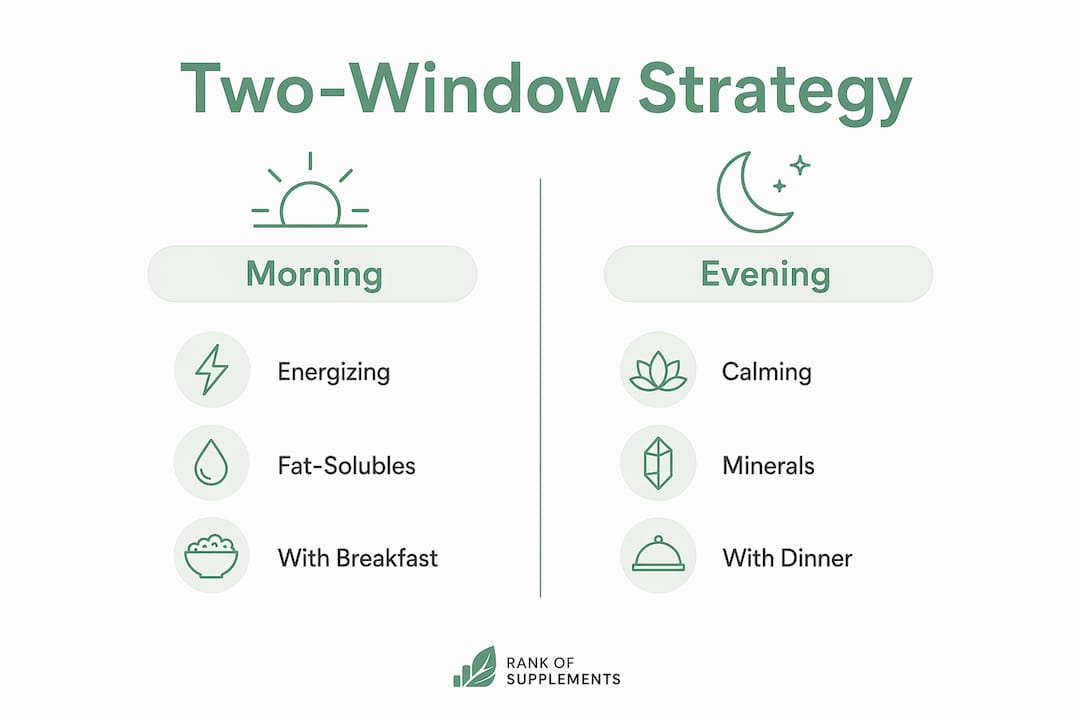
Pro Tip: Organize your supplements into two labeled containers, one for morning and one for evening. Keep them next to your toothbrush or coffee maker. Physical placement at the point of habit is more reliable than any reminder app.
When should you take energizing versus calming supplements?
Supplement timing aligns naturally with the body’s energy cycle. Energizing supplements taken in the morning support alertness during the day. Calming supplements taken in the evening support recovery and sleep. This is not just a convenience framework. Matching supplement timing to circadian rhythms actively supports the body’s natural energy and recovery processes.
Morning supplements (energizing)
Take these with or shortly after breakfast:
- B vitamins (B1, B2, B3, B6, B12), support cellular energy production and cognitive function
- Vitamin C, supports immune function and, when taken with iron, roughly doubles non-heme iron absorption
- Iron, best absorbed in the morning, away from calcium and coffee
- Zinc, supports testosterone and immune function; take with food to prevent nausea
- Rhodiola rosea or adaptogenic herbs, support stress resilience and morning focus
Taking stimulating supplements like high-dose B vitamins or adaptogenic herbs in the afternoon or evening can delay sleep onset. The body’s natural cortisol peak occurs in the morning, and energizing supplements work with that peak rather than against it.
Evening supplements (calming)
Take these with dinner or 30 to 60 minutes before bed:
- Magnesium glycinate, taken 30 to 60 minutes before bed, it supports sleep quality through glycine’s calming effect and GABAergic activity
- L-theanine, promotes relaxation without sedation; pairs well with magnesium
- Calcium, supports bone metabolism overnight and avoids morning conflict with iron
- Vitamin D, works well with dinner if you prefer evening dosing with a fat-containing meal
Pro Tip: If you train in the evening, shift magnesium glycinate to 60 minutes post-workout rather than immediately before bed. Your body uses magnesium for muscle recovery, and the timing still supports sleep while serving the recovery window first.
How do you build a supplement timing routine that actually sticks?
Building a sustainable supplement schedule requires four steps. The goal is a routine simple enough to follow on a busy Tuesday, not just on a perfect Sunday morning.
Step 1: Categorize your supplements
List every supplement you take and assign it to one of four categories:
- Fat-soluble (vitamins A, D, E, K, Omega-3, CoQ10), needs a fat-containing meal
- Minerals (calcium, iron, zinc, magnesium), needs separation from competing minerals
- Energizing (B vitamins, vitamin C, iron, adaptogens), morning window
- Calming (magnesium glycinate, L-theanine, calcium), evening window
Step 2: Assign supplements to two daily windows
Use the two-window framework. Morning window covers energizing supplements and fat-solubles that pair with breakfast. Evening window covers calming supplements and fat-solubles that pair with dinner. Midday dosing is only necessary if you take a supplement that requires spacing from both morning and evening groups.
Step 3: Pair supplements with existing habits
Attach your morning supplements to breakfast preparation. Attach your evening supplements to dinner or your pre-sleep routine. The two-window approach works because it reduces complexity and ties supplements to meals you already eat, rather than requiring new standalone habits.
Step 4: Troubleshoot common problems
| Problem | Likely cause | Fix |
|---|---|---|
| Nausea after taking supplements | Taken on an empty stomach | Pair with food to reduce GI discomfort |
| Feeling wired at night | Energizing supplements taken too late | Move B vitamins and adaptogens to morning |
| Poor iron levels despite supplementing | Calcium or coffee taken at the same time | Separate iron from calcium by 2+ hours; wait after coffee |
| Forgetting doses | Too many separate timing windows | Consolidate to two windows maximum |
| Supplement fatigue | Overloaded morning stack | Split fat-solubles between breakfast and dinner |
Consistency drives results more than perfect timing. A supplement taken at a slightly suboptimal time every day outperforms a perfectly timed supplement taken only three days a week. Build the routine around your real life, not an idealized schedule.
Pro Tip: If your supplement stack feels complicated, cut it down to the two or three supplements with the strongest evidence base for your specific goal. A focused, consistent routine beats a complex, inconsistent one every time. You can always balance diet and supplements more precisely once the basics are locked in.
Key Takeaways
Supplement timing works because matching each nutrient to the right biological window, food composition, and mineral separation schedule maximizes absorption and minimizes the conflicts that waste your investment.
| Point | Details |
|---|---|
| Fat-soluble vitamins need fat | Take vitamins A, D, E, K, Omega-3, and CoQ10 with a meal containing healthy fats for up to 50% better absorption. |
| Separate competing minerals | Keep calcium and iron at least 2 hours apart to prevent a 50 to 60% reduction in iron absorption. |
| Use a two-window schedule | Split supplements into morning (energizing) and evening (calming) groups to reduce conflicts and improve adherence. |
| Avoid coffee with iron | Polyphenols in coffee reduce iron absorption by up to 60%; wait 30 to 60 minutes after coffee before taking iron. |
| Consistency beats perfection | A slightly imperfect timing routine followed daily delivers better results than a perfect routine followed inconsistently. |
Why I think most people overcomplicate supplement timing
Most fitness enthusiasts I have worked with arrive with a spreadsheet of supplements and a minute-by-minute dosing schedule they found online. Within two weeks, they have abandoned the whole thing because it is exhausting to maintain. The irony is that the complexity itself becomes the obstacle.
The science on timing is real. The 50% absorption difference for fat-soluble vitamins is real. The calcium-iron conflict is real. But the practical ceiling on how much timing precision actually matters in daily life is lower than most people expect. The body is not a laboratory. A vitamin D capsule taken with a meal that has slightly less fat than ideal still absorbs meaningfully. An iron supplement taken 90 minutes after calcium instead of 120 minutes is not a catastrophic error.
What I have observed consistently is that the people who get the best results from supplements are the ones who pick two or three high-priority supplements, build a simple two-window routine, and stick to it for months. They are not the ones who rotate through eight supplements on a precise hourly schedule for three weeks before burning out.
The one timing rule I would never compromise on is the calcium-iron separation. That conflict is large enough and well-documented enough that ignoring it genuinely undermines your iron status. Everything else is worth getting roughly right, not perfectly right. If you want to go deeper on which supplements are actually worth prioritizing for your specific goal, the supplement decision workflow at Rankofsupplements is a good place to start before you build your timing routine.
The best supplement schedule is the one you actually follow.
matteo
What Rankofsupplements offers for your supplement routine
Knowing when to take your supplements is only half the equation. Knowing which supplements are worth taking for your specific health goal is the other half.
Rankofsupplements publishes science-backed reviews and rankings across dozens of health categories, from muscle building and weight management to immune support and gut health. The Supplement Ingredient Library gives you detailed breakdowns of how each ingredient works, what the research says, and how it interacts with other nutrients. For fitness-focused readers, the best supplement rankings cover the most-researched options by goal. Use both resources to build a supplement stack worth timing correctly.
FAQ
What is supplement timing and why does it matter?
Supplement timing is the practice of taking specific nutrients at specific times to maximize absorption and effectiveness. Factors like food composition, mineral interactions, and circadian rhythms all affect how well your body uses each supplement.
Should I take all my supplements at once?
Taking 8 to 10 supplements simultaneously creates absorption competition that reduces effectiveness. Splitting your stack into a morning window and an evening window reduces conflicts and improves results.
Can I take calcium and iron together?
Calcium reduces iron absorption by 50 to 60% at doses of 300 mg or higher. Always separate calcium and iron by at least 2 hours to protect your iron uptake.
When is the best time to take magnesium?
Magnesium glycinate taken 30 to 60 minutes before bed supports sleep quality and muscle recovery through its calming effect on the nervous system.
Does coffee affect supplement absorption?
Caffeine and polyphenols in coffee reduce non-heme iron absorption by up to 60%. Wait at least 30 to 60 minutes after drinking coffee before taking your iron supplement.
Recommended
- Related article: How to Balance Diet and Supplements for Better Health
- Top list: Best Immune Support Supplements 2026
- Specific product: Nutrigo Lab Strength Review
- Guide: Your Supplement Routine for Fitness: A 2026 Guide