B vitamins are eight water‑soluble coenzymes your cells need every day to convert food into energy, build DNA, and keep your nerves and blood cells healthy. None of them get stored in meaningful amounts, so your body depends on a steady supply from food or supplements to keep hundreds of enzyme reactions running. According to a PubMed Central review, these vitamins act as cofactors for axonal transport, neurotransmitter synthesis, and the metabolic pathways that turn carbohydrates, fats, and proteins into usable fuel.
The practical takeaway: most healthy adults who eat a varied diet cover their B vitamin needs without trying hard. But specific groups, older adults, strict vegans, people on certain medications, and anyone with a malabsorption condition, run real risk of deficiency and should ask a clinician about targeted testing rather than guessing with a multivitamin. The NIH Office of Dietary Supplements publishes the reference intakes and lab‑testing guidance clinicians use to make that call, and Rankofsupplements maintains a supplement ingredient library for readers who want to compare products once testing points to an actual gap.
Here’s what to keep in mind before you go further:
- All eight B vitamins are water‑soluble, meaning excess amounts pass out in urine rather than accumulate in fat tissue.
- Each vitamin has distinct jobs, but most converge on energy metabolism, DNA synthesis, or nervous system maintenance.
- Deficiency in B12 or folate can cause irreversible nerve damage if it goes uncorrected for too long.
- High‑dose supplementation isn’t automatically safe. B6 and folic acid both carry documented risks at excessive intakes.
Key Takeaways
B vitamins function as coenzymes that convert food into cellular energy, build DNA, and maintain nerve and blood cell health, and testing beats guessing for anyone in a higher-risk group.
| Point | Details |
|---|---|
| Shared mechanism | All eight B vitamins are water-soluble coenzymes requiring daily replenishment since the body stores almost none. |
| B12 and folate carry the highest stakes | Untreated deficiency in either can cause megaloblastic anemia or irreversible nerve damage. |
| Folic acid can mask B12 problems | High-dose folic acid corrects anemia symptoms while underlying B12-related nerve damage keeps progressing. |
| B6 has a real toxicity threshold | Doses at or above 200 mg/day are linked to peripheral neuropathy, unlike most other B vitamins. |
| Risk groups need targeted testing | Vegans, adults over 60, metformin or PPI users, and post-bariatric-surgery patients should ask about serum B12, MMA, or RBC folate testing. |
Table of Contents
- What Is the Role of B Vitamins in the Body?
- What Does Each B Vitamin Do? A Vitamin‑by‑Vitamin Breakdown
- How Do B Vitamin Deficiencies Develop, and What Should Worry You?
- What Foods Provide the Most B Vitamins?
- When Should You Test or Supplement B Vitamins?
- How Rankofsupplements Evaluates B Vitamin Evidence
- Diet First, Testing Second, Supplements Third
- Where to Read More on B Vitamins
- Sources
- FAQ
What Is the Role of B Vitamins in the Body?
Think of B vitamins as ignition keys for enzymes. Without the right key, the enzyme just sits there, unable to start the reaction it’s built for. A registered dietitian’s shorthand for this: B vitamins act as “on switches,” and no substitute nutrient flips that switch the same way.
The group includes thiamine (B1), riboflavin (B2), niacin (B3), pantothenic acid (B5), pyridoxine (B6), biotin (B7), folate (B9), and cobalamin (B12). They share three traits that explain why nutrition science lumps them together instead of treating them as unrelated nutrients:
- They’re all water‑soluble. Your body absorbs what it needs and excretes the rest, which is why chronic low intake catches up with people faster than it would with a fat‑soluble vitamin like D or E.
- Most function as coenzymes. They attach to enzymes and enable reactions in the citric acid cycle, the pathway that generates ATP, along with reactions involving NAD, NADP, and coenzyme A, three molecules central to how cells extract energy from food.
- Several are essential for DNA and RNA synthesis. Folate and B12 in particular are required for making new DNA, which is why rapidly dividing cells (bone marrow, gut lining) show damage first when either vitamin runs short.
A Cleveland Clinic overview puts it plainly: the core job of B vitamins is turning food into energy your cells can actually use, while also supporting DNA repair and red blood cell formation. That’s the throughline connecting a vitamin that helps runners produce ATP mid‑race and a vitamin that prevents neural tube defects in early pregnancy. Different downstream effects, same upstream mechanism.
Certain groups run structurally higher risk of falling short: people over 60 (stomach acid declines with age, and B12 absorption depends on it), vegans and vegetarians (B12 is essentially absent from plant foods), anyone on metformin or long‑term proton pump inhibitors, people who’ve had bariatric surgery, and heavy alcohol users. If you fall into one of these categories, the rest of this article gets a lot more relevant to you personally. For a broader look at how B vitamins fit alongside other micronutrients, Rankofsupplements’ guide to vitamin benefits covers the wider picture.
What Does Each B Vitamin Do? A Vitamin‑by‑Vitamin Breakdown
Each B vitamin has its own biochemical identity, its own deficiency signature, and its own safety profile. Scan the one relevant to you, or read through all eight if you want the full clinical picture.
Vitamin B1 (Thiamine): Powers Carbohydrate Metabolism
Thiamine’s active form, thiamine pyrophosphate (TPP), is a coenzyme for pyruvate dehydrogenase and alpha‑ketoglutarate dehydrogenase, two enzymes that sit right at the entry point of the citric acid cycle. Without TPP, carbohydrate metabolism stalls before it even gets started.
- Clinical role: nerve conduction, cardiac muscle function, carbohydrate breakdown.
- Food sources: whole grains, pork, legumes, fortified cereals, sunflower seeds.
- Deficiency signs: beriberi (wet beriberi affects the heart, causing edema and heart failure; dry beriberi causes peripheral neuropathy). Wernicke‑Korsakoff syndrome, seen most often in chronic alcohol use, is a severe thiamine deficiency affecting the brain.
- RDA: 1.2 mg/day for adult men, 1.1 mg/day for adult women, per NIH guidance.
- Safety notes: No established toxicity from oral intake. Thiamine is one of the few B vitamins with essentially no upper‑limit concern at typical supplemental doses.
Vitamin B2 (Riboflavin): The Antioxidant Enzyme Partner
Riboflavin converts to flavin mononucleotide (FMN) and flavin adenine dinucleotide (FAD), coenzymes involved in the electron transport chain and in recycling glutathione, one of the body’s central antioxidants.
- Clinical role: energy production, antioxidant defense, activation of other B vitamins (including B6 and folate).
- Food sources: dairy, eggs, lean meats, green leafy vegetables, fortified grains.
- Deficiency signs: cracked lips (cheilosis), sore throat, inflamed tongue, skin disorders. Riboflavin deficiency rarely occurs in isolation. It usually shows up alongside other B vitamin shortfalls.
- RDA: 1.3 mg/day for men, 1.1 mg/day for women.
- Safety notes: No known toxicity from food or supplements; excess is excreted (sometimes turning urine bright yellow, a harmless and common effect).
Vitamin B3 (Niacin): Builds NAD and NADP
Niacin is the precursor for NAD and NADP, the two coenzymes involved in more redox reactions than almost anything else in human biochemistry. If you’ve ever wondered why niacin shows up in so many “energy” supplement blends, this is why: it’s structurally central to how cells move electrons during energy production.
- Clinical role: DNA repair, cellular energy metabolism, cholesterol modulation at pharmacologic doses.
- Food sources: poultry, fish, beef, peanuts, fortified grains; the body can also synthesize a small amount from the amino acid tryptophan.
- Deficiency signs: pellagra, classically described by its “three D’s”: dermatitis, diarrhea, and dementia. Untreated pellagra can be fatal.
- RDA: 16 mg NE/day for men, 14 mg NE/day for women.
- Safety notes: High‑dose niacin (used clinically for cholesterol management) can cause flushing, liver toxicity, and glucose intolerance. This is a prescription‑level concern, not something typical multivitamin doses trigger.
Vitamin B5 (Pantothenic Acid): The Coenzyme A Builder
Pantothenic acid is the backbone of coenzyme A, a molecule involved in fatty acid synthesis and breakdown, and in the citric acid cycle itself. Deficiency is genuinely rare because pantothenic acid is present in nearly every food group (the name comes from the Greek word for “everywhere”).
- Clinical role: fatty acid metabolism, hormone synthesis, energy production.
- Food sources: meat, avocado, whole grains, mushrooms, sunflower seeds.
- Deficiency signs: fatigue, irritability, numbness or burning sensation in feet (“burning feet syndrome”), typically only seen in severe malnutrition.
- RDA: 5 mg/day for adults (an adequate intake, not a full RDA, because deficiency data is limited).
- Safety notes: No documented toxicity at typical intake levels.
Vitamin B6 (Pyridoxine): Essential for Neurotransmitters, but Watch the Dose
Pyridoxal 5′‑phosphate (PLP) is B6’s active coenzyme form, and it’s involved in over 100 enzyme reactions, more than any other vitamin coenzyme in the body. That includes synthesis of serotonin, dopamine, and GABA, which is why B6 status affects mood and cognitive function more directly than most people realize.
- Clinical role: neurotransmitter synthesis, hemoglobin formation, amino acid metabolism.
- Food sources: chickpeas, salmon, poultry, potatoes, fortified cereals.
- Deficiency signs: microcytic anemia, dermatitis, depression, confusion; deficiency is uncommon in developed countries outside of specific drug interactions (isoniazid use, for example).
- RDA: 1.3 mg/day for adults under 50, rising to 1.5–1.7 mg/day after 50.
Statistic Callout: Peripheral neuropathy from B6 supplementation has been documented at high doses of B6 supplementation, according to safety reviews of B vitamin interactions and risks. That’s more than 100 times the RDA, but it’s a real threshold, not a theoretical one, and it’s the reason B6 shows up in nearly every list of “vitamins you can actually overdose on.”
Safety notes: unlike B1 or B5, B6 toxicity is documented and dose‑dependent. Symptoms (numbness, tingling, difficulty walking) typically improve after stopping supplementation, but recovery isn’t always complete.
Vitamin B7 (Biotin): Overhyped for Hair, Underappreciated for Metabolism
Biotin functions as a coenzyme for carboxylase enzymes involved in fatty acid synthesis, amino acid catabolism, and gluconeogenesis (making glucose from non‑carbohydrate sources). Its reputation as a hair‑and‑nail supplement outpaces the actual evidence base, a gap Rankofsupplements breaks down in detail in its biotin supplement guide.
- Clinical role: fatty acid synthesis, gluconeogenesis, gene regulation.
- Food sources: egg yolks, organ meats, seeds, nuts, sweet potatoes.
- Deficiency signs: hair thinning, skin rash, brittle nails; deficiency is rare and mostly seen with raw egg white overconsumption (raw egg whites contain avidin, which binds biotin and blocks absorption) or certain genetic disorders.
- RDA: 30 micrograms/day for adults (an adequate intake).
- Safety notes: Biotin supplementation can interfere with certain lab tests, including thyroid panels and troponin tests used to diagnose heart attacks, sometimes producing false results. Tell your doctor if you’re taking biotin before bloodwork.
Vitamin B9 (Folate): Critical for DNA Synthesis and Pregnancy
Folate converts to tetrahydrofolate, the active coenzyme form involved in synthesizing DNA, RNA, and the amino acid methionine. Folic acid is the synthetic form used in fortified foods and supplements; it converts to the same active form but requires an extra metabolic step, which matters for people with certain genetic variants affecting that conversion.
- Clinical role: DNA/RNA synthesis, red blood cell formation, neural tube development in early pregnancy.
- Food sources: leafy greens, legumes, fortified grains, citrus fruits.
- Deficiency signs: megaloblastic anemia, neural tube defects in a developing fetus, elevated homocysteine.
- RDA: 400 micrograms DFE/day for adults, 600 micrograms DFE/day during pregnancy.
Statistic Callout: High‑dose folic acid supplementation can mask the hematologic signs of vitamin B12 deficiency, correcting the anemia while nerve damage from low B12 continues to progress silently, which is a recognized clinical concern. Harvard Health flags this as a genuine clinical concern, not a rare edge case, especially relevant for anyone taking a folic acid supplement without also confirming B12 status.
Safety notes: folic acid has an upper limit of 1,000 micrograms/day from supplements and fortified food combined for adults, set specifically because of the B12‑masking risk described above.
Vitamin B12 (Cobalamin): The One Most Likely to Actually Run Low
Methylcobalamin and adenosylcobalamin are B12’s two active coenzyme forms. One supports the same folate‑dependent DNA synthesis pathway mentioned above; the other is required for a step in fatty acid metabolism inside mitochondria. B12 also depends on intrinsic factor, a protein made in the stomach, for absorption, which is exactly why aging, gastric surgery, and acid‑suppressing medications all raise deficiency risk.
- Clinical role: DNA synthesis, red blood cell formation, myelin maintenance (the insulating sheath around nerves).
- Food sources: meat, fish, eggs, dairy; virtually absent from plant foods unless fortified.
- Deficiency signs: megaloblastic anemia, peripheral neuropathy, memory problems, and if left untreated long enough, irreversible nerve damage.
- RDA: 2.4 micrograms/day for adults, per NIH ODS guidance.
- Safety notes: No established toxicity even at high supplemental doses, since absorption capacity is limited and excess is excreted. The real risk with B12 is missing a deficiency, not overdosing on it.
How Do B Vitamin Deficiencies Develop, and What Should Worry You?
Deficiency rarely comes from diet alone in people who eat regularly. It usually comes from something interfering with absorption or increasing the body’s turnover of a specific vitamin.
The most common culprits: long‑term metformin use (reduces B12 absorption), chronic proton pump inhibitor or H2 blocker use (lowers stomach acid needed for B12 release from food), bariatric surgery (removes or bypasses the stomach segment where intrinsic factor and acid do their work), celiac disease or Crohn’s disease (damage the small intestine where B vitamins get absorbed), and regular heavy alcohol use (impairs absorption of thiamine, B6, and folate simultaneously while also increasing the body’s needs).
- Megaloblastic anemia: large, immature red blood cells, caused by either B12 or folate deficiency; distinguishing between the two requires blood testing, not guessing.
- Peripheral neuropathy: numbness, tingling, or burning in the hands and feet, seen with B12 deficiency, severe B1 deficiency, or B6 toxicity, three very different causes producing similar symptoms.
- Beriberi: thiamine deficiency affecting the heart (wet) or nervous system (dry), historically tied to diets of polished white rice, now more often seen in alcohol use disorder.
- Pellagra: niacin deficiency causing dermatitis, diarrhea, and cognitive decline, now rare in developed countries but still seen in chronic alcoholism or severe malnutrition.
Statistic Callout: The safety math here cuts both ways. High supplemental doses of B6 carry documented neuropathy risk, while inadequate B6, B12, or folate intake causes its own distinct set of neurological symptoms. More isn’t automatically safer, and less isn’t automatically fine either. Dosing in the right range matters more than defaulting to “more vitamins are better.”
What Foods Provide the Most B Vitamins?
Food covers most people’s needs without a single pill, provided the diet includes some variety across animal and plant sources. The exception is B12, which comes almost exclusively from animal foods, making it the one B vitamin vegans need to plan around deliberately.
- B1 (thiamine): pork, whole grains, sunflower seeds, fortified cereal.
- B2 (riboflavin): dairy, eggs, almonds, spinach.
- B3 (niacin): poultry, tuna, peanuts, brown rice.
- B6: chickpeas, salmon, potatoes, bananas.
- B9 (folate): lentils, spinach, asparagus, fortified bread.
- B12: clams, salmon, beef, eggs, fortified nutritional yeast for vegans.
Folate and folic acid absorb differently. Natural folate from food has roughly 50% bioavailability, while synthetic folic acid from fortified grains or supplements is closer to 85% to 100% bioavailable when taken with food, according to established nutrition science. That’s part of why fortification programs use folic acid rather than relying on folate‑rich foods alone to prevent neural tube defects.
Nutritional yeast deserves a specific mention for anyone eating plant‑based: it’s naturally rich in several B vitamins and frequently fortified with B12 in a form the body can actually use, unlike most other plant foods where B12 claims (spirulina, tempeh) don’t hold up under testing. Rankofsupplements covers this gap in more depth in its guide to vegan supplementation.

A simple day’s meal pattern that covers most bases: eggs or fortified cereal at breakfast, a legume‑and‑leafy‑green lunch, and fish or poultry at dinner, with a piece of fruit as a snack.
Pro Tip: If you’re over 60, ask your doctor about a B12 status check even if you eat meat regularly. Stomach acid production declines with age, and that decline, not diet, is the more common reason older adults become B12 deficient.
When Should You Test or Supplement B Vitamins?
Testing beats guessing, especially for B12 and folate, where the consequences of missing a deficiency (irreversible nerve damage) outweigh the minor inconvenience of a blood draw. Here’s when it’s worth pursuing:
- You’re in a documented risk group. Vegans, adults over 60, anyone on long‑term metformin or acid‑reducing medication, people with a history of bariatric surgery, and those with diagnosed malabsorption conditions should all discuss baseline testing with a clinician.
- You have symptoms that fit the pattern. Persistent fatigue, tingling or numbness in hands and feet, memory changes, or unexplained mouth soreness all warrant a look at B vitamin status rather than an assumption it’s “just stress.”
- The right tests depend on which vitamin is in question. Serum B12 is the standard first check, but methylmalonic acid (MMA) is a more sensitive functional marker, since serum B12 can look normal even when tissue levels are inadequate. Homocysteine testing helps flag both B12 and folate issues. RBC folate reflects longer‑term status better than serum folate, which fluctuates with recent meals.
- Correction follows the deficiency, not a blanket dose. Standard RDAs (2.4 micrograms/day for B12, 400 micrograms DFE/day for folate) apply to prevention in healthy people. Confirmed deficiency typically calls for therapeutic doses well above the RDA, sometimes delivered by injection for B12 when absorption is the underlying problem, under a clinician’s supervision and with follow‑up labs to confirm correction.
Statistic Callout: The RDA for B12 sits at 2.4 micrograms/day per NIH ODS guidance, a number that reflects prevention in people with normal absorption, not the higher therapeutic amounts used to correct a confirmed deficiency.
One more point worth being direct about: if your levels are already adequate, taking extra B vitamins for an “energy boost” has no solid evidence behind it. The fatigue relief people sometimes report from B‑complex supplements in replete individuals is more consistent with correcting an undiagnosed mild deficiency than with any effect above‑and‑beyond normal levels. For athletes specifically curious about B12 and energy claims, this breakdown from Racepack covers the sports nutrition angle in more detail.
How Rankofsupplements Evaluates B Vitamin Evidence
Rankofsupplements builds its supplement content around clinical and government sources first, then layers in practical buying guidance. For this article, that meant leaning on the NIH Office of Dietary Supplements factsheets, PubMed Central reviews, and clinical guidance from institutions like Harvard Health and Cleveland Clinic rather than manufacturer claims.
- The site’s Supplement Ingredient Library breaks down individual nutrients, including B vitamins, with sourcing and dosage context.
- Related guides, including the vitamin benefits overview and the biotin deep dive, expand on specific vitamins covered briefly here.
Use these resources alongside actual lab testing, not as a replacement for it. A ranking of B12 supplements only matters once bloodwork confirms you need one.
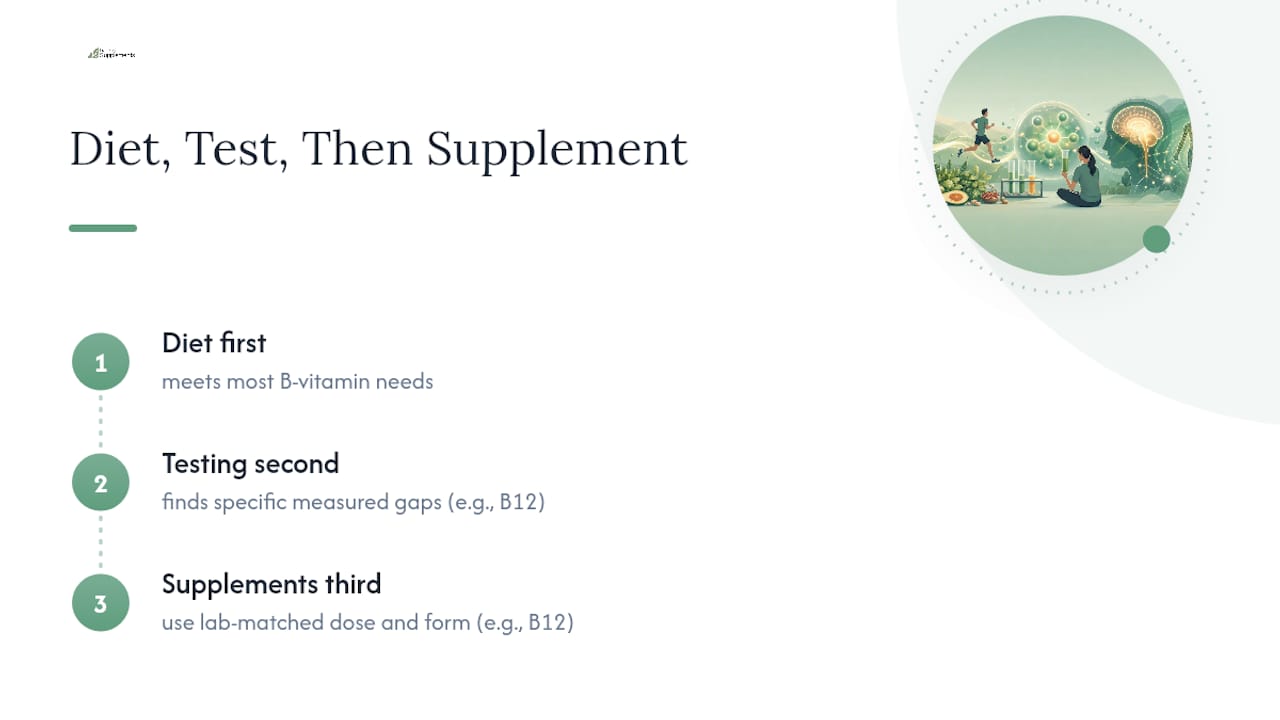
Diet First, Testing Second, Supplements Third
The order matters more than most supplement marketing wants you to believe. Diet handles most B vitamin needs for most people. Testing catches the specific cases where diet isn’t enough, whether that’s a vegan with a decade of unmonitored B12 intake or an older adult whose stomach acid has quietly declined. Supplements come last, matched to an actual measured gap rather than a hopeful guess.
Take the vegan‑with‑low‑B12‑risk scenario seriously if it applies to you. It’s one of the clearest, most predictable deficiency patterns in nutrition, and it’s also one of the easiest to prevent with a fortified food or a basic B12 supplement once you know your number. Rankofsupplements reviews products against that kind of evidence standard: does the dose match what the deficiency literature actually supports, and is the form (methylcobalamin versus cyanocobalamin, for instance) backed by absorption data. Browse the Supplement Ingredient Library before you buy anything, and let a lab result, not a marketing claim, decide what you actually need.
Where to Read More on B Vitamins
- NIH ODS Vitamin B12 Fact Sheet: dosing, absorption, and clinical testing guidance.
- PMC review on B vitamin functions: mechanisms and metabolic roles across all eight vitamins.
- Harvard Health on B12 deficiency: clinical consequences and folic acid interaction risk.
- NHS B vitamins guidance: patient-facing roles and food sources.
This article is general information, not a substitute for advice from a qualified doctor. Consult a qualified healthcare professional about your own circumstances before acting on anything here.
Sources
- B Vitamins: Functions and Uses in Medicine - PMC
- A Close Look at Each of the B Vitamins: Benefits, Food Sources and More - Cleveland Clinic
- Vitamin B12 deficiency: A to Z - Harvard Health
- Vitamin B12 — Health Professional Fact Sheet - ODS/NIH
- Vitamins and minerals - B vitamins and folic acid - NHS
FAQ
What are the 5 major functions of B vitamins?
B vitamins primarily support energy metabolism (converting carbs, fats, and protein into ATP), DNA and RNA synthesis, red blood cell formation, nervous system maintenance, and neurotransmitter production.
Which B vitamin deficiency is most serious?
Vitamin B12 deficiency is generally considered the most serious because it can cause megaloblastic anemia and irreversible nerve damage if left uncorrected for too long.
Can you take too much vitamin B6?
Yes. Supplemental B6 at doses of 200 mg/day or higher has been linked to peripheral neuropathy, making it one of the few B vitamins with a documented toxicity risk.
Do vegans need to supplement B12?
Most vegans need a B12 supplement or fortified food source since B12 occurs almost exclusively in animal products and plant-based claims like spirulina don’t provide a reliably absorbable form.
How do you test for vitamin B12 deficiency?
Serum B12 is the standard first test, but methylmalonic acid (MMA) and homocysteine testing offer more sensitive detection when serum levels look borderline or normal despite symptoms.