Pumpkin seed oil (PSO) does appear to help some people with pattern hair loss, and the evidence is stronger than most natural remedies can claim. The most rigorous trial to date, a randomized, double-blind, placebo-controlled study involving 76 men with androgenetic alopecia, found that 400 mg/day of PSO for 24 weeks produced a mean hair-count increase of roughly 40% in the treatment group versus roughly 10% in the placebo group. That gap is statistically significant and clinically meaningful for a supplement. The practical next step: confirm your hair-loss type with a dermatologist, then consider a time-limited trial at the clinical dose of 400 mg/day for at least three to six months before drawing conclusions.
Key Takeaways
Pumpkin seed oil at 400 mg/day showed roughly 40% hair-count improvement versus roughly 10% for placebo in the strongest published RCT, making it a reasonable low-risk option for early androgenetic alopecia when used at clinical dosing for at least three to six months.
| Point | Details |
|---|---|
| Strongest evidence | A 24-week RCT in 76 men showed ~40% hair-count increase with 400 mg/day PSO vs ~10% placebo. |
| Clinical dose | Use 400 mg/day of single-ingredient, third-party-tested PSO to match trial conditions. |
| Realistic timeline | Expect 3–6 months before visible density changes; hair grows only ~0.25 inches per month. |
| Safety note | Side effects are generally mild; discuss with your provider if you take anti-androgens or blood thinners. |
| Rankofsupplements | The ingredient library and best hair loss supplements list identify PSO products that meet clinical-dosing standards. |
Table of Contents
- What the human clinical trials actually show
- How pumpkin seed oil might work on hair follicles
- Who is most likely to benefit from PSO
- Forms, dosing, and what to look for in a product
- Safety profile and precautions
- How PSO compares to established hair-loss treatments
- A practical action plan for trialing PSO
- The evidence is promising, but the bar for “proven” is higher than this
- Rankofsupplements can help you find the right PSO supplement
- Sources
- FAQ
What the human clinical trials actually show
The evidence base for pumpkin seed oil hair growth is small but real. Two human randomized trials stand out, and both have limitations worth knowing before you spend money on a supplement.
| Trial | Design | Population | Dose / Form | Duration | Key Outcome |
|---|---|---|---|---|---|
| Cho et al., 2014 | RCT, double-blind, placebo-controlled | 76 men, mild-to-moderate androgenetic alopecia | 400 mg/day oral PSO capsules | 24 weeks | ~40% hair-count increase (PSO) vs ~10% (placebo) |
| Female FPHL trial | Randomized comparative | ~60 women with female pattern hair loss | PSO vs minoxidil 5% foam | 12 weeks | Significant increase in dermoscopic regrowing-hair markers in PSO group |
The 2014 Cho trial is the anchor study. Seventy-six men were enrolled, half received PSO capsules and half received a placebo, and neither participants nor investigators knew who got what until the data were unblinded. Both blinded investigator assessments and self-assessments favored PSO at 24 weeks. The authors themselves called for replication, which is the honest thing to say when a single trial drives a conclusion.
The female trial, published in a peer-reviewed comparative format, enrolled approximately 60 women and compared PSO directly to minoxidil 5% foam over three months. Dermoscopic measurements showed significant increases in upright regrowing hairs in the PSO group, which is a meaningful marker. But three months is a short window, and the sample size limits how far you can generalize.
Three limitations matter most:
- Sample sizes are small. Seventy-six men and roughly 60 women are not enough to establish broad efficacy across populations.
- Follow-up is short. Twenty-four weeks is the longest published human trial; long-term maintenance data do not exist.
- Formulations vary. The clinical dose of 400 mg/day used in trials does not match many retail products, which differ in concentration, extraction method, and standardization. Results from a non-standardized product may not mirror trial outcomes.
Additional indexed clinical reports provide supportive data, but they vary in methodology and are best treated as secondary corroboration rather than independent proof.
How pumpkin seed oil might work on hair follicles
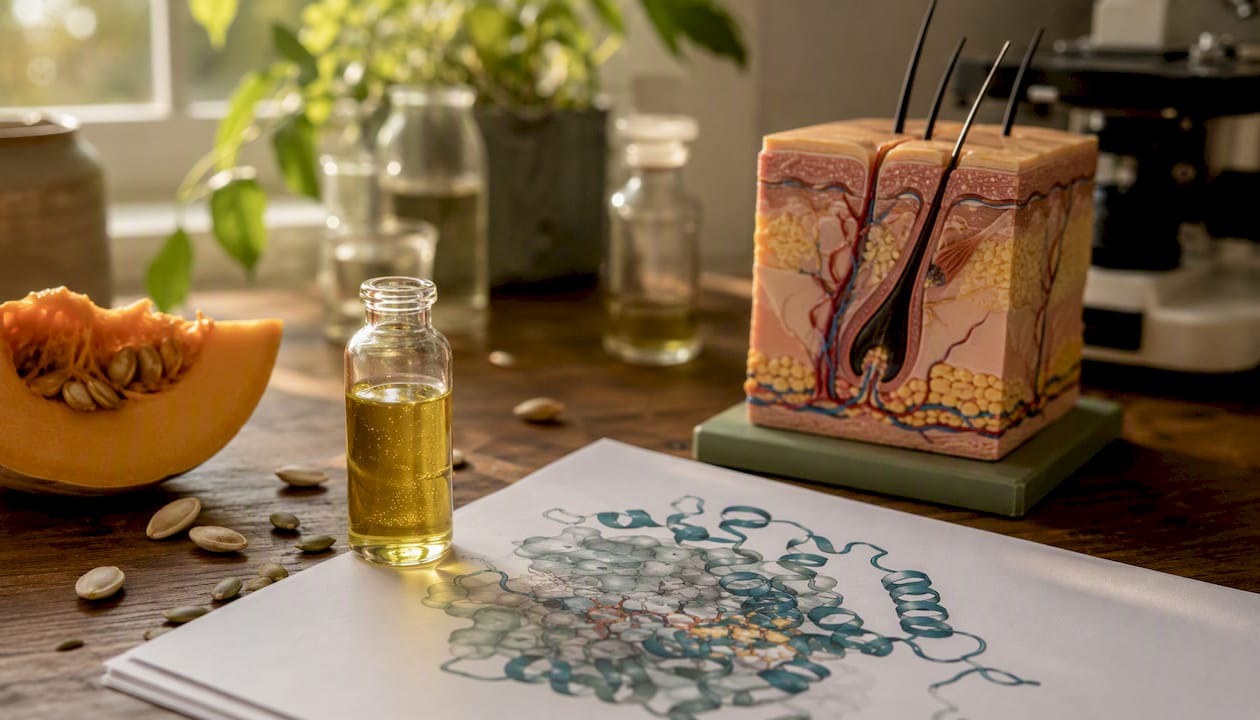
The leading hypothesis is that PSO inhibits 5-alpha-reductase (5αR), the enzyme that converts testosterone into dihydrotestosterone (DHT). In androgenetic alopecia, excess DHT binds to follicle receptors and progressively miniaturizes the hair shaft. Blocking or slowing that conversion is the same mechanism targeted by prescription finasteride, though PSO’s effect appears considerably weaker.
Finasteride is FDA-indicated for men only. Women who are or may become pregnant must not handle crushed or broken finasteride tablets, due to the risk of harm to a male fetus. It can also cause sexual side effects (reduced libido, erectile dysfunction) in a minority of men, which usually resolve after stopping treatment. Discuss these risks with a physician before starting.
Three plausible mechanisms, based on biochemical and animal-model literature:
- Phytosterols (beta-sitosterol, delta-7-sterols): These plant compounds are structurally similar to cholesterol and can competitively inhibit 5αR activity, potentially reducing local DHT levels at the follicle.
- Antioxidant and anti-inflammatory effects: PSO is rich in tocopherols (vitamin E) and carotenoids. Chronic scalp inflammation is a contributing factor in follicle miniaturization, and reducing oxidative stress may support a healthier follicle environment.
- Essential fatty acids: Linoleic and oleic acids in PSO support the lipid barrier of the scalp and may improve nutrient delivery to follicle cells.
A PMC review of phytosterols and plant oil bioactivity supports the biochemical plausibility of these pathways, though it also makes clear that direct human mechanistic proof is limited.
The key mechanistic point: PSO’s phytosterols may reduce excess DHT modestly without the systemic hormonal potency of prescription anti-androgens. That lower potency explains both its generally favorable safety profile and its likely lower ceiling for efficacy compared to finasteride.
One honest caveat: most mechanistic evidence comes from cell studies and animal models. The 2014 RCT showed that PSO worked in men with pattern hair loss; it did not measure why at the hormonal level. The mechanism is plausible and consistent with the trial outcome, but it has not been directly confirmed in humans.
Who is most likely to benefit from PSO
PSO’s evidence is concentrated in one specific condition: androgenetic alopecia, also called pattern hair loss. That matters because hair loss has many causes, and using the wrong treatment wastes months.
Most likely to see benefit:
- Men and women with androgenetic alopecia (genetic pattern thinning at the crown or temples)
- Early-to-moderate stages, where follicles are miniaturized but not yet permanently lost
- People who prefer a supplement-first approach before or alongside prescription options
Unlikely to benefit:
- Telogen effluvium (diffuse shedding triggered by stress, illness, or nutritional deficiency): the cause is systemic, not DHT-driven
- Scarring alopecias (lichen planopilaris, frontal fibrosing alopecia): follicle destruction is irreversible
- Hair loss from medication side effects or autoimmune conditions (alopecia areata): different mechanisms entirely
Special-population cautions:
- Pregnancy and breastfeeding: PSO has not been studied in pregnant or breastfeeding women. Its phytosterol content and potential hormonal activity make it a supplement to avoid during these periods without explicit medical clearance.
- Hormone-sensitive conditions: Anyone with a history of hormone-sensitive cancers or conditions should discuss PSO with their provider before starting.
The Cleveland Clinic’s dermatology guidance is direct on this point: get a professional diagnosis first. Starting any hair-loss treatment without knowing the cause risks spending months on something that cannot address the actual problem.
Forms, dosing, and what to look for in a product
Human trials have used oral PSO capsules at 400 mg/day. That is the only dose with direct clinical evidence behind it. Topical PSO appears in some products, but no published human RCT has established an effective topical dose or application protocol for hair loss specifically.
What the evidence used:
- Oral capsules, not topical oil
- 400 mg/day, typically split into two 200 mg doses with meals
- Standardized pumpkin seed oil extract, not a blend with other oils or botanicals
Product-selection checklist:
- Dose per serving: confirm the label shows 400 mg of PSO per daily serving, not per capsule if you are expected to take multiple
- Ingredient purity: single-ingredient PSO products are easier to evaluate; blends make it impossible to know whether PSO alone is driving any effect
- Third-party testing: look for NSF International, USP, or Informed Sport certification to confirm label accuracy and absence of contaminants
- Extraction method: cold-pressed or CO₂-extracted PSO retains more phytosterols than heat-processed versions
For a broader look at how PSO fits among other evidence-backed options, the guide to supplements for hair thinning at Rankofsupplements covers the full ingredient landscape with the same evidence-first lens.
Timeline: Hair grows roughly 0.25 inches per month, so even a meaningful reduction in shedding takes three to six months to show up as visible density. Trials measure at 12 and 24 weeks for exactly this reason. Stopping at six weeks because you see no change is the most common mistake.
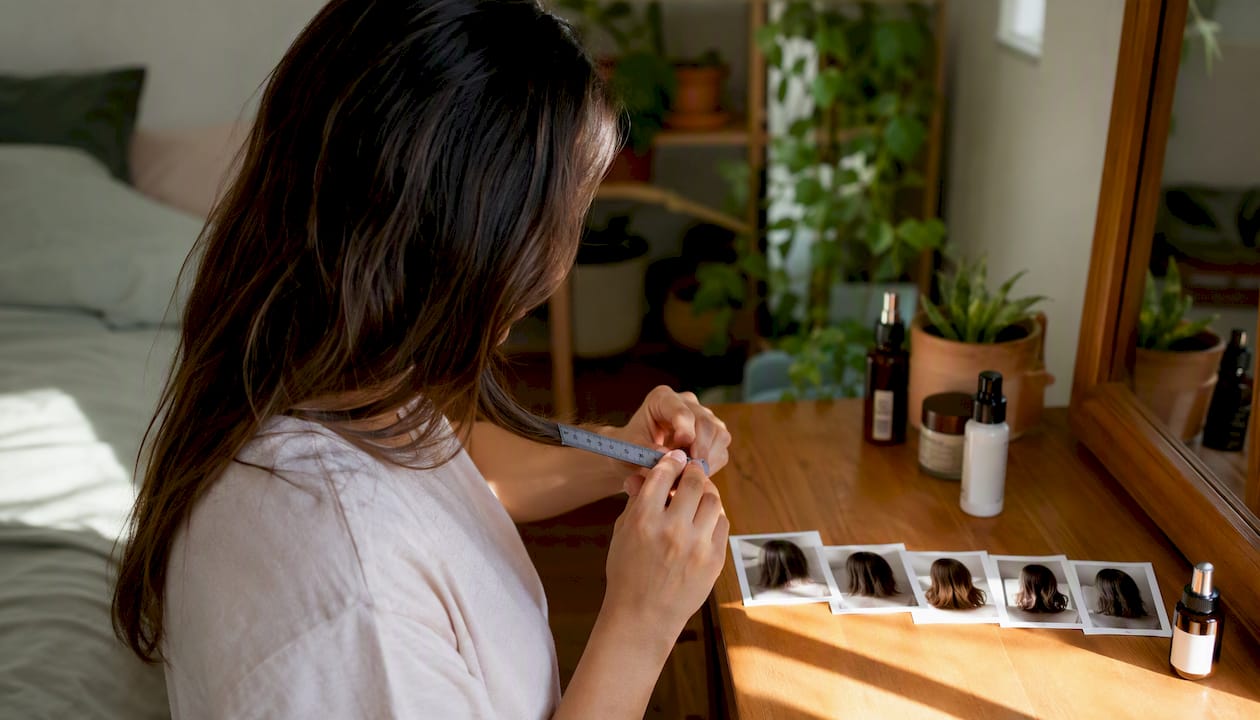
Pro Tip: Take monthly photos under consistent lighting from the same angle. Subjective perception of hair density is unreliable over short periods; a photo series gives you objective data to assess at the three-month mark.
Tracking shedding counts (hairs on the pillow or in the shower drain) alongside photos gives you two independent signals. If both are trending in the right direction at three months, continue to six. If neither has moved, the product is likely not working for you.
For practical guidance on combining PSO with other supplements and tracking your results, the hair health supplement guide at Rankofsupplements walks through the full protocol.
Safety profile and precautions
PSO has a favorable safety record at clinical doses. The 2014 RCT reported no serious adverse events, and the side-effect profile in published trials is mild.
Reported side effects (generally mild):
- Gastrointestinal discomfort (nausea, loose stools) at higher doses
- Allergic reactions in people with pumpkin or cucurbit seed allergies
- No major hormone-disrupting effects documented at 400 mg/day in published trials
Drug interaction considerations:
- Anti-androgens (finasteride, dutasteride): combining PSO with prescription 5αR inhibitors may compound DHT-lowering effects; discuss with your prescriber
- Blood thinners (warfarin, aspirin): PSO’s vitamin E content may have mild anticoagulant properties; monitor if you are on anticoagulation therapy
- Hormone therapies: PSO’s phytosterol activity is a reason for caution if you are on estrogen, testosterone, or other hormone treatments
Discuss PSO with your healthcare provider before starting, particularly if you are already on prescription hair-loss medications or any of the above drug categories, and consider consulting this step-by-step herbal supplement guide to ensure safe and informed integration of herbal supplements into your routine. This is general information, not a substitute for professional medical advice.
How PSO compares to established hair-loss treatments
PSO vs. minoxidil: Minoxidil has decades of large-scale trial data and FDA approval behind it. PSO has one well-designed RCT and one small comparative trial. The female trial did show PSO producing significant dermoscopic improvements comparable to minoxidil 5% foam over three months, but that is one small study. Minoxidil’s evidence base is simply much larger. PSO’s advantage is tolerability: no scalp irritation, no initial shedding phase, and no twice-daily topical application.
PSO vs. finasteride: Finasteride is the most effective oral option for male androgenetic alopecia in terms of evidence volume. Its mechanism (direct 5αR inhibition) is more potent than PSO’s phytosterol-mediated effect. The tradeoff is a real side-effect profile, including sexual dysfunction in a subset of men, and it is not appropriate for women of childbearing age. PSO carries none of those risks at clinical doses.
PSO vs. saw palmetto: Both work through similar phytosterol-mediated pathways and have comparable evidence quality: small trials, promising signals, no large confirmatory RCTs. Saw palmetto has a slightly longer research history in this space. Neither has enough data to declare superiority over the other.
Combining PSO with proven therapies: PSO can reasonably be used alongside minoxidil, since the mechanisms are different (DHT modulation vs. follicle vasodilation). Combining PSO with finasteride is theoretically additive but also means stacking two DHT-lowering agents; that combination warrants a conversation with your dermatologist to monitor for compounded hormonal effects.
A practical action plan for trialing PSO
If you have confirmed androgenetic alopecia and want to try PSO, a structured approach gives you the best chance of getting a real answer from the trial.
- Confirm your diagnosis. See a dermatologist or trichologist before starting. Knowing you have androgenetic alopecia (not telogen effluvium or another cause) is the prerequisite for PSO being a rational choice.
- Choose a product that matches clinical dosing. Use the checklist from the dosing section: 400 mg/day of single-ingredient PSO, third-party tested, cold-pressed or CO₂-extracted.
- Start at the clinical dose. Take 400 mg/day with food, split into two doses if the capsule size allows. Do not exceed this without medical guidance.
- Track from day one. Take baseline photos under consistent lighting. Log weekly shedding counts. Note any side effects in the first two weeks.
- Assess at three months. Compare photos and shedding logs. Significant improvement in shedding is the earliest signal; visible density changes typically require the full six months.
- Decide at six months. If you see measurable improvement, continue. If there is no change, PSO is unlikely to be the right tool for your hair loss, and escalating to minoxidil or a dermatologist consultation about finasteride is the logical next step.
Escalation criteria: If your hair loss is progressing rapidly, if you are losing hair in patches rather than diffuse thinning, or if you are more than five years into significant thinning, do not rely on PSO alone. These scenarios call for a dermatologist’s assessment and likely a prescription-level intervention.
For women specifically, the hair growth supplements guide for women at Rankofsupplements covers the female pattern hair loss evidence in more detail, including the PSO vs. minoxidil trial data.
Rankofsupplements reviews each ingredient against the same evidence criteria used here: trial design, sample size, dose standardization, and third-party testing. The best hair loss supplements list applies that framework to current retail products so you can skip the label-reading guesswork.
The evidence is promising, but the bar for “proven” is higher than this
PSO shows a genuinely interesting signal in the 2014 RCT. A 40% hair-count increase versus 10% in placebo, in a blinded trial, is not noise. But one trial with 76 participants does not establish a treatment. The honest read is that PSO is a reasonable, low-risk option for people with early androgenetic alopecia who want to try a supplement before or alongside prescription therapies. It is not a replacement for minoxidil or finasteride in moderate-to-severe cases, and it is not a treatment for hair loss caused by anything other than DHT-driven follicle miniaturization.
What frustrates me about how PSO gets covered is the binary framing: either it is dismissed as unproven or it is sold as a natural cure. Neither is accurate. The evidence is limited but real, the mechanism is plausible, and the safety profile is favorable. That combination makes it worth a structured trial for the right person. It does not make it worth abandoning treatments with decades of evidence behind them.
For anyone with rapidly progressing loss or loss that started suddenly, a dermatologist visit comes before any supplement. PSO is a reasonable addition to a hair-health protocol, not a standalone solution.
Rankofsupplements can help you find the right PSO supplement
Choosing a PSO supplement that actually matches the clinical dose is harder than it looks. Most retail products do not disclose whether their formulation matches the 400 mg/day used in trials, and blended products make it impossible to isolate PSO’s effect.
Rankofsupplements reviews hair-loss supplements against the same evidence criteria this article uses: trial design, standardized dosing, third-party testing, and ingredient transparency. The ingredient library covers PSO alongside every other evidence-backed hair-loss ingredient, with dose ranges, mechanism summaries, and safety notes in one place. For a curated shortlist of products that meet clinical-dosing standards, the best hair loss supplements list is the fastest route to a vetted recommendation. Check the ingredient library to find a PSO product that matches what the trials actually used.
Sources
- Effect of Pumpkin Seed Oil on Hair Growth in Men with Androgenetic Alopecia: A Randomized, Double-Blind, Placebo-Controlled Trial
- Pumpkin seed oil vs. minoxidil 5% topical foam for the treatment of female pattern hair loss: A randomized comparative trial
- What Pumpkin Seed Oil Could Do for Your Hair
- Pumpkin Seed Oil: Hair Health Benefits and More
- PMC review article (plant oils/phytosterols relevance to health)
- Relevant PubMed-indexed trial/article
FAQ
Is pumpkin seed oil a DHT blocker?
PSO contains phytosterols that may inhibit 5-alpha-reductase, the enzyme that converts testosterone to DHT, but its effect is modest compared to prescription anti-androgens like finasteride. It is more accurate to call it a mild DHT modulator than a blocker.
What is the downside of pumpkin seed oil for hair?
The main downsides are limited evidence (the largest trial enrolled only 76 men), formulation inconsistency across retail products, and a slow timeline: visible results typically require three to six months at clinical dosing. Mild gastrointestinal side effects are possible at higher doses.
Is pumpkin seed oil or saw palmetto better for hair loss?
Both work through similar phytosterol-mediated pathways and have comparable evidence quality: small trials with promising signals but no large confirmatory RCTs. Neither has enough data to establish clear superiority over the other; PSO has the advantage of one well-designed blinded RCT.
How long does pumpkin seed oil take to stop hair loss?
Trials measure outcomes at 12 and 24 weeks because hair grows only about 0.25 inches per month. Expect a minimum of three months before shedding changes become apparent and up to six months for visible density improvement; stopping earlier gives you no useful information.