For most people, NAC is the smarter starting supplement, not glutathione itself. It costs less, has decades of clinical use behind it, and gives your body the raw material to build glutathione on its own instead of asking a fragile molecule to survive your stomach acid intact.
Here’s the short version:
- Mechanism: NAC supplies cysteine, the rate-limiting ingredient your cells need to manufacture glutathione internally, while oral glutathione has to survive digestion mostly intact to do anything at all.
- Bioavailability: Standard oral glutathione is broken down during digestion, which is why liposomal, sublingual, or IV delivery exists in the first place.
- Cost and evidence: NAC is cheaper per effective dose and backed by far more clinical trial data across more conditions.
One safety note before anything else: NAC is the clinical standard for acetaminophen overdose, given intravenously in hospitals to rapidly restore glutathione stores. That’s a medical emergency protocol, not a reason to self-dose NAC at home if you’ve taken too much Tylenol. If you’re pregnant, have kidney disease, take nitroglycerin or other nitrate medications, or suspect an acetaminophen overdose, stop reading supplement forums and call a doctor or Poison Control.
Key Takeaways
NAC is the more cost-effective, better-evidenced default for raising glutathione in most healthy adults, with direct glutathione reserved for targeted or rapid-repletion needs.
| Point | Details |
|---|---|
| NAC is the default starting point | It’s cheaper, better absorbed orally, and backed by decades of clinical trial data. |
| Standard oral glutathione underperforms | Most of the dose is degraded during digestion before it reaches your bloodstream. |
| Liposomal or IV glutathione has a role | Choose these when rapid or direct delivery matters more than cost. |
| Give it four to eight weeks | Measurable glutathione changes from oral NAC typically take four to eight weeks. |
| Rankofsupplements weighs clinical role first | Its recommendation prioritizes clinical evidence, absorption, and cost, in that order. |
This article is general information, not a substitute for advice from a qualified doctor. Consult a qualified healthcare professional about your own circumstances before acting on anything here.
Table of Contents
- NAC vs Glutathione: A Side-by-Side Comparison
- How Do NAC and Glutathione Raise Antioxidant Levels?
- Which Has Stronger Clinical Evidence: NAC or Glutathione?
- Which Delivery Form Actually Raises Glutathione?
- Dosing, Timeline, and Safety: What to Actually Expect
- How Should You Decide Between NAC and Glutathione?
- Where to Go Next After Choosing NAC or Glutathione
- Sources
- FAQ
NAC vs Glutathione: A Side-by-Side Comparison
The core distinction is simple once you see it laid out: NAC is a precursor, glutathione is the finished product. Whether that difference matters to you depends on what you’re trying to fix.
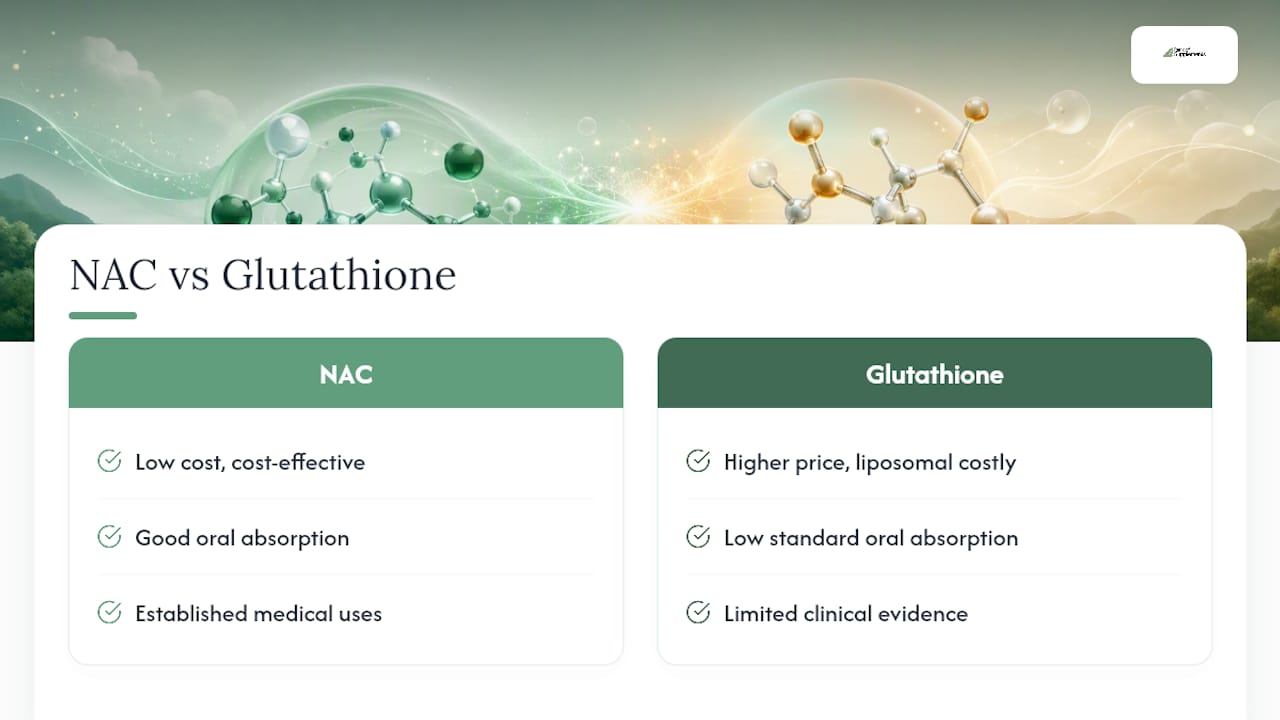
Three things drive most people’s decision here. Cost tops the list. NAC runs a fraction of the price of liposomal glutathione for a comparable antioxidant effect, and a dose-matched cysteine comparison suggests NAC remains the more cost-effective route for most healthy adults. Absorption comes second: if you’re taking standard oral glutathione capsules without a protected delivery system, you’re likely getting a fraction of the labeled dose. Clinical role comes third. NAC has an established medical use that glutathione supplements simply don’t carry.
Pro Tip: Liposomal or sublingual glutathione earns its higher price when you need faster, more direct antioxidant support, such as during a heavy detox protocol or when NAC alone hasn’t moved your labs. For general daily maintenance, that premium usually isn’t necessary.
How Do NAC and Glutathione Raise Antioxidant Levels?
The mechanism difference explains almost everything else in this comparison. NAC is a modified form of the amino acid cysteine. Once absorbed, it crosses into cells and becomes the rate-limiting building block your body uses to manufacture glutathione, the master antioxidant your liver and immune system depend on. Because NAC is a small, stable molecule, it survives digestion well and gets where it needs to go.

Glutathione (GSH) is the finished tripeptide itself, made from cysteine, glutamine, and glycine. The logic behind supplementing it directly seems obvious: skip the synthesis step and just take the antioxidant. The problem is structural. Oral glutathione is largely broken down by digestive enzymes before it reaches the bloodstream, so standard capsules deliver far less active antioxidant than the label suggests.
Picture it this way: NAC is like shipping raw lumber to a construction site where your body’s own carpenters (enzymes) assemble it into glutathione on demand. Standard oral glutathione is like shipping a finished piece of furniture through a shredder, then hoping enough survives to be useful. Liposomal, sublingual, and IV forms exist specifically to solve that shredder problem, wrapping the molecule in fat-based carriers, letting it absorb under the tongue, or injecting it directly into the bloodstream.
- NAC path: oral NAC → absorbed intact → converted to cysteine → intracellular glutathione synthesis.
- Standard oral GSH path: swallowed → degraded by stomach acid and gut enzymes → minimal intact absorption.
- Liposomal/sublingual/IV GSH path: protected delivery → bypasses digestive breakdown → higher intact absorption.
This bioavailability gap is the single biggest reason NAC remains the default recommendation for most people trying to raise glutathione through supplementation rather than through direct antioxidant intake.
Which Has Stronger Clinical Evidence: NAC or Glutathione?
Evidence strength varies sharply by condition, and this is where the two supplements really diverge. NAC has decades of clinical trial history behind it. Glutathione, especially in its protected delivery forms, has a thinner but growing research base.
Acetaminophen overdose: the clinical standard
This is NAC’s best-documented use, full stop. IV NAC is the gold-standard treatment for acetaminophen toxicity in emergency departments, because it rapidly replenishes the glutathione the liver needs to neutralize the toxic metabolite of Tylenol overdose. Evidence strength: strong. This protocol uses weight-based loading and maintenance dosing under medical supervision. It is not a model for a daily supplement routine.
Liver disease and hepatoprotection
NAC shows real promise here beyond its overdose role. A review of NAC’s hepatoprotective mechanisms found it prevents liver damage in experimental and some clinical studies, working through antioxidant activity and modulation of injury-related signaling pathways. Evidence strength: moderate to strong, depending on the specific liver condition studied. Direct glutathione, particularly liposomal formulations, has far less human liver-outcome data. Most of what supports liposomal GSH here comes from inflammation and oxidative stress markers rather than hard clinical endpoints.
Respiratory and mucolytic uses
NAC has an independent benefit that has nothing to do with glutathione production: it breaks disulfide bonds in mucus, thinning it out. This is why it’s been used as a respiratory mucolytic for decades, a role documented across its broad clinical applications. Evidence strength: strong for mucus reduction in chronic respiratory conditions. Glutathione supplements have no comparable independent respiratory mechanism.

Psychiatric and neuro contexts
NAC’s ability to modulate glutamate signaling, separate from its antioxidant role, has driven interest in psychiatric research, with emerging adjunctive use noted in broader NAC reviews. Evidence strength: weak to moderate. This is an active research area, not an established protocol, and glutathione supplements have even less data here.
General antioxidant and aging claims
A Stanford-run trial framework matched cysteine content between NAC and glutathione arms specifically to isolate delivery differences from raw precursor availability when measuring inflammation and oxidative stress outcomes. That kind of dose-matched design matters because it separates marketing claims from real mechanistic comparison. Evidence strength: moderate for both approaches in this narrower context, with liposomal glutathione holding its intact structure better than standard oral GSH.
Measuring red blood cell glutathione, rather than plasma levels, gives a more accurate picture of what’s actually happening inside your cells, and functional outcomes like symptom relief often track better with real benefit than blood numbers alone.
That distinction, drawn from research on intracellular glutathione measurement, matters if you’re tempted to judge a supplement purely by a lab report. Feeling less fatigued or breathing easier can be a more honest signal than a single glutathione blood test.
Which Delivery Form Actually Raises Glutathione?
Not every product labeled “glutathione” behaves the same way once it hits your gut. The form you choose determines whether you’re getting a meaningful dose or mostly wasting your money.
- Oral NAC: absorbed intact through the small intestine, converted to cysteine, then used for intracellular glutathione synthesis. This is the most practical daily option for most people.
- Standard oral reduced glutathione: degraded significantly by stomach acid and gut enzymes before absorption. Cheap, but much of the dose never reaches your bloodstream intact.
- Liposomal glutathione: wrapped in a fat-based carrier that helps it survive digestion better than standard capsules, at a meaningfully higher price point.
- S-acetyl glutathione (sublingual): designed to absorb partly through the tissue under the tongue, skipping some digestive breakdown, though long-term human data is still limited.
- IV glutathione: delivered straight into the bloodstream, used in clinical settings for rapid repletion, not something you administer yourself at home.
For daily use in the United States, oral NAC and liposomal glutathione are the two realistic options for most households. Standard oral GSH capsules remain widely available but deliver the weakest results for the price given the absorption problem built into the molecule itself. IV glutathione stays confined to clinics and medical spas, not a shelf product.
One combination worth knowing about: GlyNAC, which pairs NAC with glycine. Since glycine availability can become a limiting factor in glutathione production as we age, this combination may offer an edge for older adults specifically, an angle worth discussing with a clinician rather than assuming it applies broadly.
Dosing, Timeline, and Safety: What to Actually Expect
Most clinical research on NAC uses daily doses between 600 and 1,800 mg, typically split into two doses because NAC has a short half-life and splitting keeps intracellular cysteine available throughout the day. Liposomal glutathione studies more commonly use moderate daily doses.
Timelines differ too. Oral NAC supplementation tends to show measurable glutathione changes over four to eight weeks of consistent use. Liposomal glutathione, when it’s genuinely well-formulated, may show changes somewhat faster, often cited around two to four weeks, though individual results vary based on baseline status and dose.
Common side effects and interactions:
- NAC can cause mild gastrointestinal upset (nausea, stomach discomfort) and a noticeable sulfur smell in some formulations.
- Glutathione supplements are generally well tolerated but liposomal versions can cause mild digestive upset in sensitive individuals.
- NAC may interact with nitroglycerin and other nitrate medications, amplifying blood vessel dilation effects.
- Anyone with kidney disease, anyone pregnant or breastfeeding, and anyone on regular prescription medication should talk to a doctor before starting either supplement.
- If you suspect an acetaminophen overdose, this is a medical emergency requiring IV NAC in a hospital setting, not an at-home supplement decision.
Pro Tip: If you’re already taking prescription medication for a chronic condition, bring your supplement list to your next appointment rather than researching interactions alone. A five-minute conversation can catch a nitrate interaction or kidney concern that a supplement label never will.
Red flags that mean stop and call a doctor: unusual fatigue paired with yellowing skin or eyes, persistent vomiting, dark urine, or any suspected acetaminophen overdose regardless of supplement use.
How Should You Decide Between NAC and Glutathione?
Work through this in order:
- Define your goal first. Routine antioxidant support, liver protection, respiratory symptom relief, and targeted repletion after a health event each point toward different starting choices.
- Check your budget against the evidence. If cost matters and you’re generally healthy, oral NAC at 600 to 1,800 mg daily is the most defensible starting point.
- Ask your clinician three things: which baseline labs are worth checking (liver enzymes, kidney function), whether any current medications interact with NAC or glutathione, and whether your kidney or liver status changes the safe dose range.
- Match the form to the situation. Routine support: NAC. Liver protection around acetaminophen exposure: medical-grade NAC protocols, not self-dosing. Respiratory support: NAC’s mucolytic effect. Targeted repletion after NAC alone hasn’t worked: consider liposomal glutathione as a next step, ideally with clinician input.
Straight talk on how RankOfSupplements weighed this comparison
I built this comparison around three filters: clinical trial data, sourcing from NCBI and PMC rather than marketing pages, and whether a dose was clear enough to actually act on. NAC won the default recommendation because it clears all three bars more consistently than direct glutathione supplements do, not because glutathione doesn’t work. The weighting came down to clinical role plus absorption plus cost, in that order. If you want a deeper look at how antioxidant supplements stack up more broadly, our antioxidant supplement roundup covers adjacent options worth knowing about.
Where to Go Next After Choosing NAC or Glutathione
Picking between NAC and glutathione is really the first decision, not the last one. If your goal is liver support specifically, our best detoxification supplements roundup breaks down which formulations pair well with NAC and which ones duplicate its effects without adding value.
If you’re stacking antioxidants rather than choosing just one, alpha-lipoic acid is worth understanding before you combine it with NAC, since both affect similar oxidative stress pathways; our alpha-lipoic acid ingredient page covers dosing and interaction notes. For a broader look at how antioxidants work across categories, including topical and systemic delivery differences, this overview of natural antioxidant types is a useful companion read. And once you’ve settled on a supplement category, our full ingredient library lets you look up exact dosing, sourcing, and safety data for NAC, glutathione, and dozens of related compounds before you buy anything.
This article contains affiliate links, and Rankofsupplements may earn a commission if you purchase through one. That never changes which product we recommend first. If you have kidney disease, liver disease, or take regular prescription medication, get your labs checked and talk to a clinician before starting either supplement.
Sources
FAQ
Can I take glutathione and NAC together?
Yes, taking both is generally considered safe for healthy adults, and some people combine them when targeting both intracellular synthesis (NAC) and direct antioxidant support (glutathione). Check with a clinician first if you take regular medication or have kidney or liver disease.
Which is better for the liver, glutathione or NAC?
NAC has stronger clinical evidence for liver protection, with documented hepatoprotective mechanisms in experimental and clinical studies, while direct glutathione has less liver-specific human data.
Why do I feel so good after taking NAC?
Some people notice improved energy, clearer breathing, or reduced brain fog on NAC, likely tied to its antioxidant and mucolytic effects plus its role in glutamate modulation, though individual response varies and isn’t fully explained by lab measures alone.
How long does it take for NAC to increase glutathione?
Most research shows measurable increases in glutathione from oral NAC supplementation over four to eight weeks of consistent daily use, typically at doses between 600 and 1,800 mg per day.