
TL;DR:
- Reading supplement labels helps verify ingredient quality, dosage accuracy, and product safety before purchase. The Supplement Facts panel is the only legally regulated section, and understanding serving size, % Daily Value, and third-party seals ensures informed decisions. Avoid proprietary blends and misleading marketing claims by cross-referencing label data with clinical research and certification databases.
Reading supplement labels is the skill of analyzing regulated label information to verify dosage accuracy, ingredient quality, and product safety before you buy. The FDA does not pre-approve dietary supplements before they reach store shelves, which means the label is your primary defense. The Supplement Facts panel, governed by the Dietary Supplement Health and Education Act (DSHEA) of 1994, is the only legally regulated section of any supplement package. Third-party testing marks from organizations like USP, NSF International, and BSCG add another layer of verification. This guide walks you through every section of a supplement label so you can make smarter, safer choices.
How to read supplement labels: serving size and daily dose
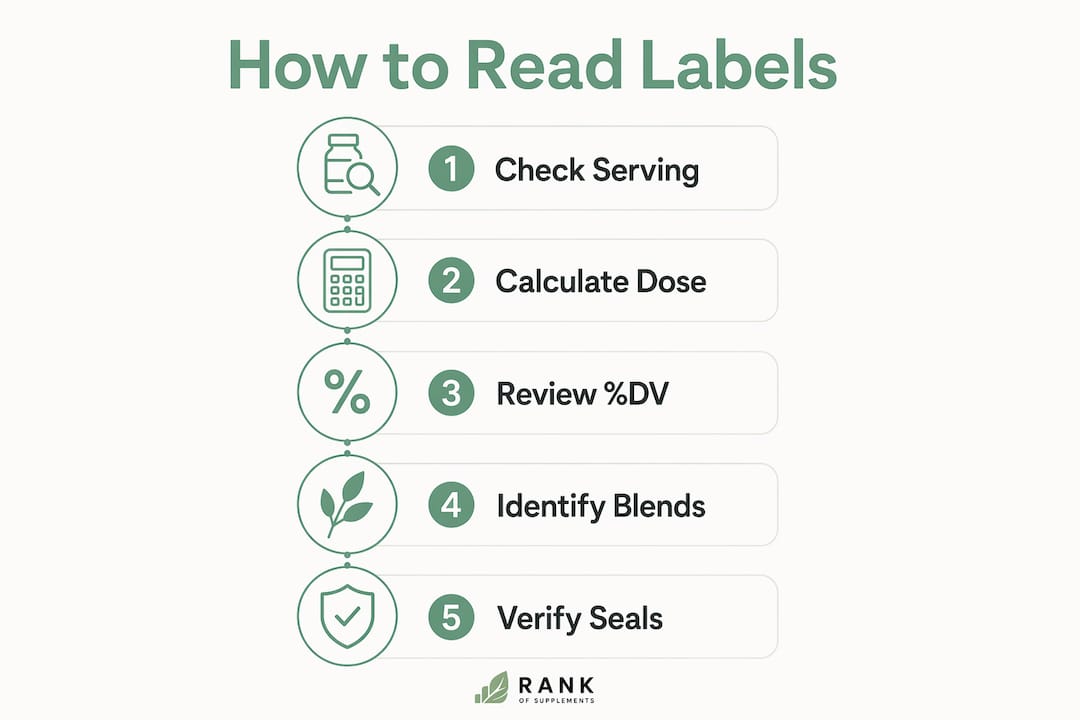
Serving size is the single most misread element on any supplement label, and the confusion costs people real results. Most consumers treat the serving size as the recommended daily dose. It is not. Serving size simply tells you the amount of product that corresponds to the nutrient data listed in the Supplement Facts panel.
Here is how to calculate your actual daily intake correctly:
- Find the serving size. This is listed at the top of the Supplement Facts panel. It might say “1 capsule,” “2 tablets,” or “1 scoop.”
- Read the suggested use instructions. These appear separately on the label, often on the back or side panel. They specify how many servings to take and how often. A label might say “Take 3 capsules daily with meals.”
- Multiply serving size by frequency. If the serving size is 1 capsule and the suggested use is 3 capsules daily, your actual daily dose is 3 times the amount listed per serving. A supplement showing 100 mg of magnesium per capsule delivers 300 mg per day under that protocol.
- Check servings per container. This number tells you how many total servings the bottle contains. Divide it by your daily serving frequency to find out how many days the product will last.
- Compare against research doses. Once you know your actual daily intake, check it against clinically studied doses. A product listing 50 mg of ashwagandha per serving sounds reasonable until you realize the suggested use multiplies servings to three times daily, or conversely, delivers far less than the 300 to 600 mg range used in clinical trials.
Many consumers misunderstand serving size as the full recommended daily intake. This misreading leads to both accidental overdosing and chronic underdosing, neither of which serves your health goals.
Pro Tip: Before buying any supplement, do the math. Multiply the serving size by the suggested daily frequency and compare the result against published clinical doses for each active ingredient. This single step eliminates most dosing mistakes.
What does the Supplement Facts panel actually tell you?
The Supplement Facts panel is the regulated core of every dietary supplement label, and reading it correctly requires understanding three distinct data points: the amount per serving, the unit of measurement, and the % Daily Value.
Amount Per Serving is expressed in milligrams (mg), micrograms (mcg), or International Units (IU), depending on the nutrient. Milligrams cover most minerals and many herbal extracts. Micrograms apply to nutrients like vitamin B12, folate, and vitamin D. IU is an older unit still used for fat-soluble vitamins like vitamin A and vitamin E, though many labels now convert these to mcg for clarity.
% Daily Value (%DV) tells you how much of the recommended daily allowance a single serving provides. The FDA benchmark is straightforward: 5% DV or less is low, and 20% DV or more is high for any given nutrient. A calcium supplement showing 35% DV per serving is a high-concentration source. A multivitamin listing 4% DV for magnesium is contributing very little to your daily needs.
The critical nuance most label readers miss is that %DV reflects RDA thresholds designed to prevent deficiency in the general population, not therapeutic or performance-optimizing doses. A vitamin D supplement showing 100% DV delivers 800 IU. Many researchers and clinicians work with doses of 2,000 to 5,000 IU for specific health outcomes. The %DV tells you where you stand relative to basic sufficiency, not relative to what the science supports for your goal.
| %DV Range | What It Means | Practical Example |
|---|---|---|
| 5% or less | Low concentration | 4% DV magnesium in a multivitamin |
| 6% to 19% | Moderate concentration | 15% DV zinc in a standalone mineral |
| 20% or more | High concentration | 35% DV calcium in a bone support formula |
| No %DV listed | No established daily value | Most herbal extracts, e.g. ashwagandha |
When no %DV is listed next to an ingredient, it means the FDA has not established a reference daily intake for that compound. This is common with botanical extracts like turmeric, rhodiola, and berberine. For these, you must compare the listed amount directly against doses used in published studies.
Pro Tip: Use %DV as a quick orientation tool, not a final verdict. For any ingredient without a %DV, cross-reference the amount per serving against clinical research doses before deciding whether the product is worth buying.
Spotting red flags: proprietary blends, fillers, and misleading claims
The front of a supplement bottle is a marketing brochure. The front label claims like “maximum potency,” “advanced formula,” or “clinically studied” are not regulated and carry no legal weight. Only the Supplement Facts panel is legally required to reflect actual contents. Knowing where to look, and what to avoid, separates informed buyers from everyone else.
Proprietary blends are the most significant red flag in the supplement industry. A proprietary blend lists a group of ingredients under a single umbrella name with one combined weight, such as “Neuro Blend 450 mg.” The label does not disclose how much of each individual ingredient is present. Proprietary blends mask exact amounts and are frequently used to hide underdosed active ingredients while padding the formula with cheap fillers.
The industry term for this practice is “pixie dusting.” A manufacturer includes a trace amount of an expensive, well-researched ingredient like lion’s mane mushroom or citicoline to justify listing it on the label. The actual dose is far below anything studied in clinical trials, but the marketing copy can still reference it by name. Transparent labels that list exact amounts for every ingredient reflect higher manufacturing standards and give you the data you need to evaluate the product honestly.
Here are the specific red flags to check before purchasing any supplement:
- Proprietary blends with no individual breakdown. If the label shows a blend total but no per-ingredient amounts, you cannot verify whether any active ingredient is present at an effective dose.
- Vague ingredient names. Terms like “herbal matrix” or “performance complex” without specific plant names, extract ratios, or standardization percentages are meaningless.
- Artificial colors and titanium dioxide. The Other Ingredients section often contains titanium dioxide, FD&C dyes, and synthetic coatings. These additives serve no nutritional purpose and some carry emerging safety concerns.
- Undisclosed allergens. Soy, gluten, dairy, and shellfish derivatives appear in many supplement fillers and coatings. If the label does not clearly state allergen status, contact the manufacturer directly.
- Unverified front-label claims. Phrases like “boosts immunity by 300%” or “doctor recommended” require no substantiation under current FDA rules. Treat them as noise.
- Missing lot number or expiration date. These are basic traceability markers. Their absence suggests poor manufacturing practices.
Registered dietitians treat supplement labels as critical safety documents, specifically because undisclosed ingredients and underdosed actives create real risks for people managing health conditions or taking prescription medications.
Decoding quality indicators: third-party seals and safety warnings
Third-party certification is the most reliable external signal of supplement quality, because it means an independent organization has tested the product and confirmed it matches what the label claims. USP, NSF, and BSCG seals each indicate independent testing for purity, potency, and label accuracy. Their presence does not guarantee a supplement will work for you, but it does confirm the product contains what it says and nothing it does not.
Each seal has a slightly different focus. USP (United States Pharmacopeia) verifies that the product contains the declared ingredients at the stated potency and dissolves properly for absorption. NSF International tests for over 270 substances banned in sport, making it the standard for athletes. BSCG (Banned Substances Control Group) offers the most rigorous testing for competitive athletes and is widely used by professional sports organizations.
Beyond seals, check these quality indicators on every label:
- Manufacturer name and contact information. A physical address and phone number indicate a traceable, accountable company. PO boxes with no other contact details are a warning sign.
- Lot number and expiration date. These allow you to trace a product back to its production batch, which matters if a recall occurs.
- Storage instructions. Proper storage guidance (away from heat, light, or moisture) signals that the manufacturer understands ingredient stability.
- Allergen statements. Look for clear “Contains” or “Free From” declarations for the top eight allergens: milk, eggs, fish, shellfish, tree nuts, peanuts, wheat, and soybeans.
- Dosage warnings. Statements like “Do not exceed recommended dose” or “Consult a physician if pregnant” are legally required for certain ingredient categories and signal the manufacturer is following regulatory standards.
Pro Tip: Cross-reference any third-party seal you see against the certifying organization’s online database. USP, NSF, and BSCG all maintain searchable product lists. A fake or expired seal is more common than most buyers realize.
How to compare supplements using labels and make informed choices
Applying everything above to a real purchase decision requires a structured approach. The goal is to compare two or more products on the same criteria so emotion and marketing do not drive the choice. This is where reading dietary supplement labels becomes a genuine competitive advantage.
Use this checklist when comparing any two supplements side by side:
- Serving size and daily dose. Calculate actual daily intake for both products using the method above.
- Active ingredient dose. Identify the primary active ingredient in each product and compare the daily dose against clinical research ranges.
- Ingredient form. Magnesium glycinate absorbs differently than magnesium oxide. Vitamin K2 as MK-7 has a longer half-life than MK-4. The form matters as much as the dose.
- Proprietary blends. Reject or heavily discount any product that hides ingredient amounts inside a blend.
- %DV context. Use the %DV table above to assess concentration, then check whether the dose aligns with your specific health goal.
- Other Ingredients. Compare filler lists. Fewer unnecessary additives generally indicate a cleaner product.
- Third-party seals. Confirm the seal is current and listed in the certifying body’s database.
Here is a practical side-by-side comparison to illustrate the process:
| Label Feature | Product A | Product B |
|---|---|---|
| Serving size | 2 capsules | 1 capsule |
| Suggested use | Once daily | Three times daily |
| Actual daily dose | 2 capsules | 3 capsules |
| Magnesium per daily dose | 200 mg (glycinate) | 150 mg (oxide) |
| Proprietary blend | No | Yes |
| Third-party seal | USP verified | None |
| Artificial additives | None listed | Titanium dioxide |
Product A delivers a higher total dose of a superior ingredient form, with full transparency and independent verification. Product B costs less per bottle but hides its formula and uses a lower-bioavailability form. The label tells you everything you need to know.
Pro Tip: Combine label reading with reputable review resources. Rankofsupplements publishes science-backed rankings that cross-reference label data against clinical evidence, which helps you verify whether a product’s doses actually match what the research supports for your health goal.
Key takeaways
Reading supplement labels accurately is the single most effective way to protect yourself in a market where FDA pre-approval does not exist and marketing claims carry no legal weight.
| Point | Details |
|---|---|
| Serving size is not daily dose | Multiply serving size by suggested use frequency to find your actual daily intake. |
| %DV signals concentration, not optimality | 5% DV is low, 20% DV is high, but %DV reflects deficiency prevention, not therapeutic targets. |
| Proprietary blends hide underdosed actives | Prefer labels that disclose exact amounts for every ingredient to avoid pixie dusting. |
| Third-party seals confirm label accuracy | USP, NSF, and BSCG each independently verify purity and potency claims. |
| Front label claims are unregulated | Trust only the Supplement Facts panel for factual ingredient and dose information. |
Why label literacy is the most underrated health skill
I have reviewed hundreds of supplement labels over the years, and the pattern that surprises most people is how rarely the front of the bottle reflects what is actually inside. A product with “2000 mg” printed in large font on the front might be delivering a proprietary blend where the active ingredient accounts for 50 mg of that total. The rest is filler, and the math is buried in small print.
The serving size confusion is the most consistent mistake I see. People buy a protein powder, see “25g protein per serving,” and assume they are getting 25g every time they scoop. Then they discover the suggested use calls for two scoops, or that the scoop size listed is 60g of powder, not 30g. The label was accurate. The reader was not.
My honest recommendation is to treat the front of any supplement bottle the same way you treat an advertisement. It is designed to sell, not inform. Flip to the Supplement Facts panel immediately. Check the serving size, calculate the daily dose, look for proprietary blends, and verify the ingredient form. If a product cannot pass that four-step check, no amount of front-label marketing should change your decision.
The supplements worth buying are the ones that have nothing to hide. Full ingredient transparency, a recognized third-party seal, and doses that align with published research are not premium features. They are the baseline. Learning to check supplement quality through label analysis gives you a filter that most buyers never develop, and it pays dividends every time you make a purchase.
matteo
Put your label-reading skills to work
Reading a label is step one. Knowing whether the doses and ingredients inside actually deliver results is step two. Rankofsupplements maintains a detailed supplement ingredient library where you can look up clinical dose ranges, bioavailability comparisons, and safety profiles for hundreds of compounds. Cross-reference what you find on any label against that database before you buy. For product-level guidance, the site’s science-backed supplement reviews evaluate real formulas against clinical evidence, so you can see exactly how a product’s label holds up under scrutiny. Use both tools together to move from label literacy to confident, informed purchasing.
FAQ
What is the Supplement Facts panel?
The Supplement Facts panel is the legally regulated section of a dietary supplement label that discloses serving size, ingredient amounts, and % Daily Value. It is the only part of the label required by the FDA to accurately reflect the product’s contents.
How do I calculate my actual daily supplement dose?
Multiply the serving size by the number of times per day the suggested use instructions direct you to take the product. If one capsule contains 200 mg and the label says take three capsules daily, your actual daily dose is 600 mg.
What does % Daily Value mean on a supplement label?
% Daily Value shows how much of the FDA’s recommended daily allowance one serving provides. A %DV of 5% or less is considered low, while 20% or more is considered high. These benchmarks reflect deficiency prevention, not necessarily optimal or therapeutic doses.
Are proprietary blends a problem?
Proprietary blends list a combined ingredient weight without disclosing individual amounts, which makes it impossible to verify whether any active ingredient is present at an effective dose. Transparent labels with exact per-ingredient amounts are a stronger indicator of product quality.
Which third-party seals should I look for on supplements?
USP, NSF International, and BSCG are the three most credible third-party certification marks. Each independently tests for purity, potency, and label accuracy. Verify any seal you see against the certifying organization’s searchable online database to confirm it is current and legitimate.