
TL;DR:
- Supplement cycling involves alternating planned periods of supplement use with deliberate breaks to prevent tolerance buildup and optimize effectiveness. Creatine, whey protein, magnesium, omega-3s, and BCAAs generally do not require cycling, while stimulants, adaptogens, fat-soluble vitamins, and melatonin benefit from structured cycles aligned with training phases. Implementing phase-specific protocols, adding one supplement at a time, and thoroughly tracking key indicators maximize muscle gains and minimize setbacks.
Supplement cycling for bodybuilding is the practice of alternating planned periods of use with deliberate breaks to prevent tolerance, avoid accumulation, and keep your body responding to each compound. Most lifters buy the right products and then undermine their own results by taking everything daily, indefinitely, without a protocol. The cycling approach prevents tolerance buildup and maintains supplement responsiveness, especially for fat-soluble vitamins and adaptogens where accumulation becomes a real risk. This guide gives you a stepwise system for knowing which supplements to cycle, how long each cycle should run, and how to match your stack to your training phases for maximum muscle gain.
How to cycle supplements for bodybuilding: which ones actually need it
Not every supplement requires cycling, and treating them all the same is one of the most common and costly mistakes in bodybuilding nutrition. The decision to cycle a supplement depends on two factors: whether your body builds tolerance to it, and whether it accumulates to potentially harmful levels.
Supplements that do not require cycling:
- Creatine monohydrate. Strength improvements appear in 2 to 4 weeks with daily use at 3 to 5g, and the evidence for cycling it is weak. Creatine saturates muscle tissue and stays effective with continuous use. Stopping it simply depletes your stores without benefit.
- Whey protein. This is a food-derived macronutrient source, not a pharmacological agent. Creatine, whey protein, and caffeine have robust evidence supporting continuous use for muscle growth. Whey has no tolerance mechanism.
- Magnesium, omega-3s, and vitamin C. Water-soluble vitamins require consistent replenishment because the body excretes excess daily. Magnesium and omega-3s address baseline deficiencies that limit performance. These are foundation supplements, not cycling candidates.
- BCAAs. The evidence here is straightforward: BCAAs show no significant benefit requiring cycling, and their impact is minimal when protein intake is already adequate.
Supplements that benefit from cycling:
- Caffeine and stimulant-based pre-workouts. Receptor downregulation happens fast. Most lifters notice diminishing returns within 3 to 4 weeks of daily use, which is exactly when a break becomes necessary.
- Adaptogens such as ashwagandha, rhodiola rosea, and ginseng. These compounds modulate the stress response, and continuous use blunts that effect over time.
- Fat-soluble vitamins including vitamin D3 and vitamin K2. Unlike vitamin C, these accumulate in tissue. Periodic reassessment and structured breaks reduce toxicity risk.
- Melatonin. Regular use suppresses the body’s natural melatonin production. Short cycles of 2 to 4 weeks with breaks preserve your baseline sleep architecture.
Pro Tip: Before cycling any supplement, check whether it is fat-soluble or water-soluble. Fat-soluble compounds accumulate; water-soluble ones do not. That single distinction determines 80% of your cycling decision.
How do you design an effective supplement cycling protocol?
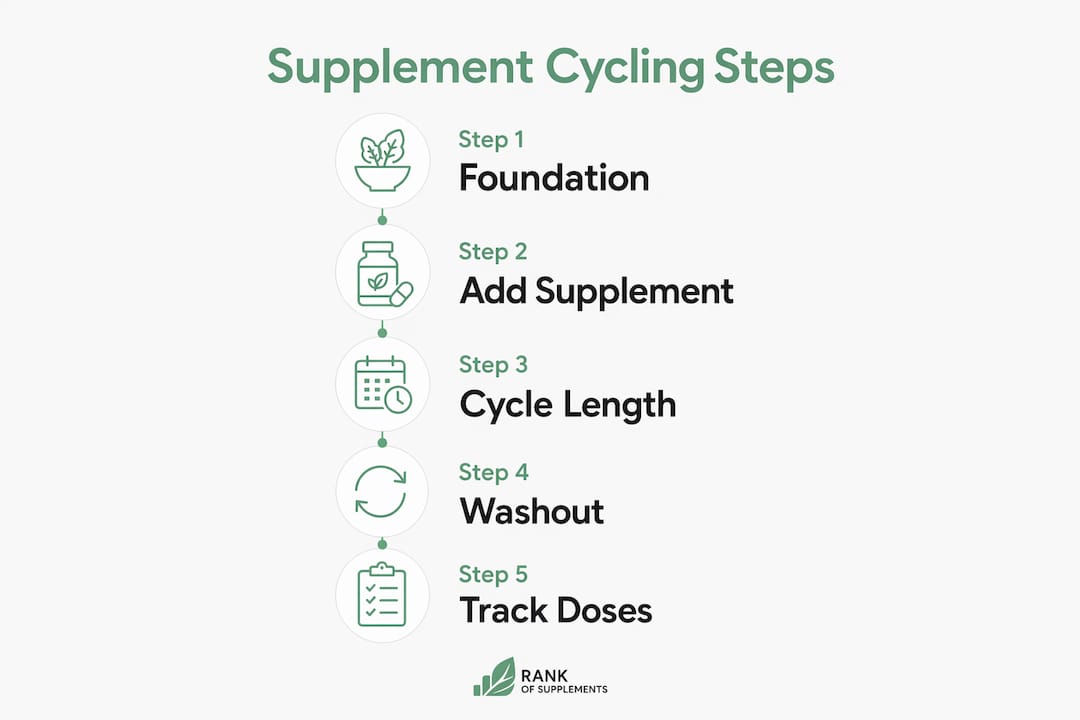
Designing a bodybuilding supplement cycle starts with layering, not loading. You build from the foundation up, one compound at a time, so you always know what is working.

Step 1: Establish your foundation first.
Foundation supplements like magnesium, vitamin D3, and omega-3s should be in place before you add performance-focused compounds. These address nutrient deficiencies that limit the efficacy of everything else you take. If your vitamin D is low and your sleep is poor, no pre-workout will fix your training output.
Step 2: Add one performance supplement at a time.
Adding supplements individually with 2 to 4 week intervals provides clearer feedback on efficacy and safety. This is the single most important rule in supplement cycling. If you add creatine, a new pre-workout, and an adaptogen in the same week, you will never know which one caused the strength gain or the headache.
Step 3: Apply cycle durations based on supplement category.
Use the table below as your reference framework.
| Supplement category | Cycle duration (on) | Break duration (off) | Notes |
|---|---|---|---|
| Stimulants (caffeine, pre-workout) | 4 weeks | 1 to 2 weeks | Prevents receptor downregulation |
| Adaptogens (ashwagandha, rhodiola) | 6 to 8 weeks | 2 to 4 weeks | Maintains stress-response sensitivity |
| Fat-soluble vitamins (D3, K2) | 8 to 12 weeks | 2 to 4 weeks (or per bloodwork) | Avoids tissue accumulation |
| Creatine monohydrate | Continuous | None required | No tolerance mechanism |
| Melatonin | 2 to 4 weeks | 1 to 2 weeks | Preserves natural production |
Breaks reduce receptor adaptation and side effects like overstimulation and sleep disruption. This is not theoretical. Lifters who run caffeine continuously for months report needing 400mg to feel what 150mg once delivered.
Step 4: Use washout periods to test real impact.
The most overlooked step in cycling is the washout period. Stopping one supplement at a time, typically for 2 to 4 weeks, tells you exactly what that compound was contributing. Most lifters skip this step and then wonder why their stack stopped working.
Step 5: Start doses at the low end and track everything.
Incremental dose increases starting at the low end, combined with thorough tracking of adherence and side effects, optimize efficacy and safety during cycling. Track sleep quality, training performance, digestion, and mood. These four indicators tell you more than any subjective “feel” assessment.
Pro Tip: Use a simple spreadsheet or a notes app to log your supplement, dose, start date, and weekly performance markers. Three weeks of data will show you patterns that six months of guessing never will.
What are the most common mistakes when cycling bodybuilding supplements?
Most supplement cycling failures come from the same short list of errors. Knowing them in advance saves you months of wasted effort and money.
-
Overstacking from day one. Starting five new supplements simultaneously makes it impossible to identify what is working. Most failed supplement stacks lack a formal protocol with clear stop criteria and measurement plans. The result is that you cannot attribute benefits or problems to any single compound.
-
Cycling supplements that have no tolerance mechanism. Cycling creatine, whey protein, or omega-3s does not improve their effectiveness. It just creates unnecessary gaps in your nutrition. Reserve cycling for compounds where the physiology actually demands it.
-
Ignoring mineral absorption conflicts. Calcium and iron supplements interfere with each other’s absorption when taken simultaneously. Alternating them or separating timing by at least two hours improves overall absorption. This applies to zinc and copper as well. Stacking minerals without understanding their interactions is a common source of deficiency despite supplementation.
-
Running stimulants through deload weeks. Your central nervous system needs recovery just as your muscles do. Continuing high-stimulant pre-workouts during low-intensity training blocks defeats the purpose of the deload and accelerates tolerance.
-
Failing to document responses. If you are not tracking sleep, digestion, mood, and performance week by week, you are operating blind. Deliberate experimentation with one supplement at a time every 2 to 4 weeks allows precise tracking of effects and side effects for optimized cycling.
“Cycling is not about taking breaks for the sake of it. It is about preserving your body’s ability to respond. Every break is an investment in the next cycle’s effectiveness.”
The rebound effect from stimulant dependency is real and underestimated. Lifters who run high-dose caffeine for 12 weeks straight often experience two to three weeks of fatigue, poor focus, and reduced training output when they stop. A planned one to two week break every four weeks prevents that crash entirely.
You can cross-reference evidence-based supplement stacks to see which combinations are worth building a protocol around and which are marketing noise.
How does supplement cycling align with bodybuilding training phases?
The most experienced lifters do not run the same stack year-round. They match their supplements to their training calendar the same way they match their calorie intake to their bulk or cut.
Experienced lifters match supplement intake to training cycles rather than uniform daily use, switching from high-stimulant to recovery-based stacks in coordination with workout intensity and recovery needs. This is the difference between a supplement strategy and a supplement habit.
Here is how phase-specific cycling looks in practice:
-
Bulking phase (high volume, high intensity). This is when stimulant-based pre-workouts, creatine, and beta-alanine earn their place. Training demands are high, recovery windows are short, and performance output is the priority. Run your stimulant cycle here, 4 weeks on, then reassess.
-
Cutting phase (caloric deficit, moderate intensity). Appetite suppression and thermogenic compounds become relevant. Adaptogens like ashwagandha help manage cortisol, which rises during caloric restriction. This is also when incorporating cycling with training phases prevents CNS fatigue and receptor downregulation from compounding the stress of a deficit.
-
Deload weeks (low intensity, active recovery). Drop stimulants entirely. Shift to magnesium glycinate for sleep quality, omega-3s for inflammation management, and vitamin D3 if bloodwork indicates a need. Your nervous system is recovering. Let it.
-
Competition prep or peaking phase. This is not the time to introduce new supplements. Run only compounds you have already tested and tolerated. Introducing an untested adaptogen two weeks before a competition is a risk no result justifies.
| Training phase | Recommended supplements | Supplements to reduce or stop |
|---|---|---|
| Bulking | Creatine, stimulant pre-workout, beta-alanine | Melatonin (if sleep is adequate) |
| Cutting | Adaptogens, omega-3s, thermogenics | High-dose stimulants (after 4-week cycle) |
| Deload | Magnesium, omega-3s, vitamin D3 | All stimulants |
| Competition prep | Tested stack only, creatine, electrolytes | Any new or untested compounds |
Matching your vitamin and mineral cycling to these phases adds another layer of precision that most recreational lifters never apply.
Key takeaways
Effective supplement cycling requires matching each compound’s on/off schedule to its tolerance mechanism and your training phase, not applying a single protocol to every product in your stack.
| Point | Details |
|---|---|
| Not all supplements need cycling | Creatine, whey, and omega-3s work best with continuous use; cycle only tolerance-prone compounds. |
| Use phase-specific protocols | Stimulants run 4 weeks on/1 to 2 off; adaptogens run 6 to 8 weeks on/2 to 4 off. |
| Add one supplement at a time | Introduce compounds individually with 2 to 4 week gaps to accurately track effects. |
| Match cycles to training phases | Use stimulants during high-intensity blocks and shift to recovery supplements during deloads. |
| Track four key indicators | Monitor sleep, digestion, mood, and performance weekly to evaluate each supplement’s real impact. |
Why most lifters get supplement cycling wrong from the start
Here is what I have seen consistently: lifters spend real money on quality supplements and then run every single one of them the same way, every day, for months. No breaks, no tracking, no protocol. Then they wonder why their pre-workout stopped working or why their sleep is wrecked despite taking magnesium nightly.
The uncomfortable truth is that most supplement cycling failures are not product failures. They are protocol failures. The supplement did exactly what it was supposed to do for the first few weeks. Then tolerance set in, or accumulation became a problem, and nobody noticed because nobody was tracking.
I am also skeptical of the idea that cycling is always necessary. The evidence for cycling creatine, for example, is essentially nonexistent. I have seen lifters stop creatine for a month every quarter out of habit, not science, and lose the saturation they spent weeks building. That is a real cost with no real benefit.
What actually works is simpler than most cycling guides suggest. Start with your foundation. Add one compound. Give it three to four weeks. Track four things: sleep, digestion, mood, and training output. Then decide whether to continue, adjust, or stop. That process, repeated consistently, beats any rigid protocol you find online.
The other thing I would push back on is the idea that more supplements equal more gains. The best bodybuilding supplements are the ones you have actually tested on yourself, tolerated well, and cycled intelligently. A two-supplement stack with a real protocol outperforms a ten-supplement stack with no plan every single time.
matteo
Find the right supplements for your bodybuilding cycle
Building a supplement cycling plan only works when you know exactly what each ingredient does and how it interacts with your training. Rankofsupplements maintains a detailed supplement ingredient library that breaks down the evidence behind every major compound, from creatine and ashwagandha to beta-alanine and vitamin D3. Each entry covers dosing, timing, and known interactions so you can build your cycle on facts, not marketing claims.
For a broader starting point, the best bodybuilding supplements rankings on Rankofsupplements are updated with 2026 evidence and ranked by actual performance data. You can also browse by health goal and condition to find compounds matched to your specific training objectives, whether that is muscle gain, fat loss, or recovery.
FAQ
What does it mean to cycle supplements for bodybuilding?
Supplement cycling means alternating planned periods of use with deliberate breaks to prevent tolerance and maintain effectiveness. The duration of each cycle depends on the supplement type and its physiological mechanism.
Does creatine need to be cycled?
Creatine does not require cycling. Daily use at 3 to 5g produces consistent strength and performance improvements without tolerance buildup, making continuous use the evidence-supported approach.
How long should a stimulant pre-workout cycle last?
A stimulant cycle of 4 weeks on followed by 1 to 2 weeks off prevents receptor downregulation and avoids the rebound fatigue that comes from extended continuous use.
Can you take all your supplements at the same time?
Not always. Calcium and iron interfere with each other’s absorption when taken together, and several minerals compete for the same uptake pathways. Timing separation of at least two hours resolves most conflicts.
How do you know if a supplement is working during a cycle?
Track sleep quality, digestion, mood, and training performance weekly. A washout period of 2 to 4 weeks, where you stop one supplement at a time, confirms its specific contribution to your results.