
TL;DR:
Prioritize brands with cGMP certification, FDA-recall history, and transparent labeling.
Check for third-party certifications like NSF, USP, or Informed Sport to verify quality.
Evaluate ingredient sourcing, effective dosages, and formula quality for true value.
Walk into any health store or scroll through Amazon, and you’ll face hundreds of supplement brands all claiming to be the best. The problem is that most shoppers pick based on price, packaging, or a five-star review from a stranger. That approach can cost you money and, more importantly, your health. The supplement industry generates over $50 billion annually in the U.S. alone, and not every brand earning a slice of that revenue deserves your trust. This guide gives you a repeatable, step-by-step framework to compare supplement brands on what actually matters: safety, transparency, ingredient quality, and real value.
Table of Contents
Key Takeaways
Point Details
Check regulatory basics Verifying cGMP compliance and avoiding brands with recalls protects your safety.
Prioritize transparency Brands with clear ingredient lists and third-party certifications are more trustworthy.
Compare ingredients and value Assess formula efficacy and calculate cost per effective dose to find the best option.
Watch for warning signs Avoid brands making disease claims or lacking transparent contact details.
Follow a step-by-step process A systematic comparison leads to safer, more effective supplement choices.
Know the regulations: What to check first
Before you compare formulas or prices, you need to understand the legal landscape. Unlike prescription drugs, dietary supplements do not go through pre-market FDA approval. That single fact changes everything about how you shop. The FDA regulates supplements as food under the Dietary Supplement Health and Education Act (DSHEA), meaning manufacturers are responsible for ensuring their products are safe before they hit shelves. The FDA steps in after the fact, usually when problems are already reported.
This is why understanding supplement regulations is your first line of defense. The most important standard to look for is cGMP, which stands for Current Good Manufacturing Practices. Brands following cGMP are held to consistent quality controls for production, testing, and labeling. If a brand cannot confirm cGMP compliance, that is a serious concern.
Here is what to check in your first pass at any brand:
-
FDA recall history: Search the FDA’s recall database for the brand name. A single recall is not always a dealbreaker, but a pattern is.
-
cGMP certification: Look for this on the brand’s website or product label. It should be easy to find.
-
Disease treatment claims: Supplements cannot legally claim to treat, cure, or prevent diseases. If a brand says its product “addresses” anything, walk away.
-
Registered facility: U.S.-based brands should manufacture in FDA-registered facilities. International brands should meet equivalent standards.
-
Contact information: A legitimate brand always lists a physical address and customer service contact.
“The absence of pre-market approval means consumers must do their own vetting. Brands that voluntarily exceed minimum requirements, through cGMP compliance and third-party testing, signal they have nothing to hide.”
Learning to monitor supplement safety as an ongoing habit, not just a one-time check, puts you ahead of most consumers. Regulatory compliance is the floor, not the ceiling. Use it to eliminate bad actors fast, then move to deeper evaluation.
Assess product transparency and certifications
Once you’ve confirmed a brand clears the regulatory basics, the next step is evaluating how openly they communicate about their products. Transparency is not just a buzzword here. It is a measurable quality you can check in minutes.
High-quality brands list every active and inactive ingredient with precise amounts. Proprietary blends, where multiple ingredients are grouped under one vague label with no individual dosages, are a red flag. You cannot evaluate effectiveness or safety if you do not know how much of each ingredient you are actually getting.
The NIH recommends you look for transparent labels and third-party certifications when evaluating supplement quality. Third-party certifications mean an independent organization tested the product and confirmed it contains what the label says, in the amounts stated, without harmful contaminants.
Here are the most respected certification bodies to look for:
-
NSF International: Tests for contaminants, label accuracy, and manufacturing quality.
-
USP (U.S. Pharmacopeia): Verifies ingredient identity, strength, and purity.
-
Informed Choice / Informed Sport: Specifically tests for banned substances, important for athletes.
-
ConsumerLab: Independent testing with publicly available results.
-
Banned Substances Control Group (BSCG): Another strong option for sport-specific supplements.
Certification Tests for Best for
NSF International Contaminants, label accuracy General consumers
USP Purity, potency, identity Health-focused buyers
Informed Sport Banned substances Athletes
BSCG Banned substances, purity Competitive athletes
Understanding supplement transparency helps you quickly separate brands that invest in accountability from those relying on clever marketing. And when you combine transparency with a recognized supplement certification, you have strong early evidence that a brand is worth considering.
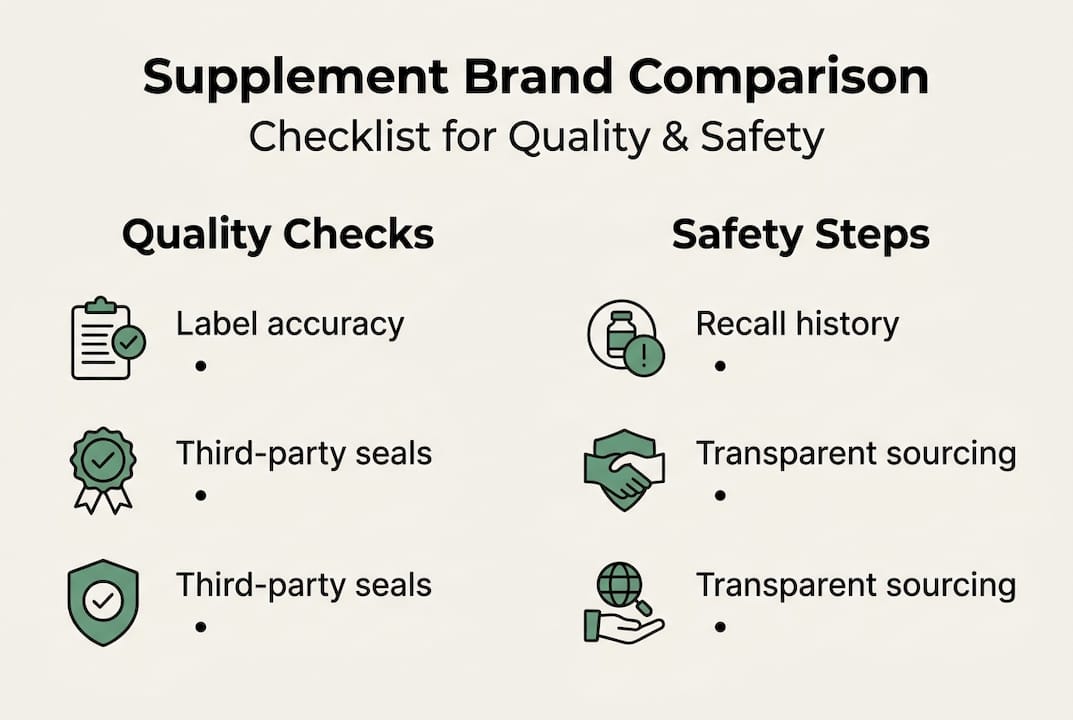
Pro Tip: If a brand’s website buries its certifications or makes them hard to verify, that tells you something. Brands proud of their certifications display them prominently and link to the certifying body’s database so you can confirm independently.
Always cross-reference certification claims with the actual certifying organization’s website. Some brands use logos that look official but are not backed by recognized testing programs. Checking evidence for supplement effectiveness alongside certification status gives you a much fuller picture.
Compare sources, formula quality, and value
With transparency and certifications evaluated, you are ready to look at what is actually inside the bottle and whether it is worth your money. This is where most comparison guides stop short, and where you can gain a real edge.

Ingredient sourcing matters more than most people realize. Organic, non-GMO, and region-specific sourcing can affect both potency and purity. For example, fish oil sourced from cold-water, wild-caught fish tends to have a better omega-3 profile than farmed alternatives. Turmeric from specific regions carries higher curcumin concentrations. These details are not just marketing. They affect outcomes.
Always buy from reputable sources like pharmacies, brand websites, or established retailers to avoid counterfeits. Third-party marketplaces can carry counterfeit or improperly stored products that look identical to the real thing.
Here is what to evaluate when comparing formulas:
-
Clinical dosages: Does the product contain each ingredient at the dose used in published research? Many products underdose key ingredients.
-
Bioavailability: Are ingredients in forms the body actually absorbs? Magnesium glycinate absorbs far better than magnesium oxide, for instance.
-
Synergistic combinations: Some ingredients work better together. Vitamin D3 paired with K2 is one well-documented example.
-
Unnecessary fillers: Artificial colors, excessive binders, and allergens with no functional role are signs of cost-cutting.
Factor What to check Why it matters
Ingredient source Organic, region, wild-caught Affects potency and purity
Dosage Matches clinical research Determines actual effectiveness
Form Glycinate vs. oxide, etc. Affects absorption rate
Fillers Artificial additives Signals quality priorities
Pro Tip: Calculate cost per effective dose, not cost per serving. A cheaper product with a 50% underdose of the active ingredient is actually more expensive when you account for what you are actually getting.
If you are building a supplement stack, reviewing safe supplement combinations before purchasing multiple products can prevent redundancy and potential interactions. For goal-specific guidance, exploring top men’s health supplements gives a useful benchmark for what quality looks like in a specific category.
Watch for red flags and make the final call
You have done the research. Now it is time to make a decision, but first, run your shortlisted brands through a final red flag check. This step catches problems that earlier filters might miss.
Some warning signs are obvious. Others are subtle. Here is what to watch for:
-
Disease treatment claims: Phrases like “reverses diabetes” or “addresses joint pain” are illegal for supplement brands and signal a willingness to mislead.
-
No physical address or customer service contact: Legitimate brands are reachable. Anonymous brands are not accountable.
-
Overwhelmingly positive reviews with no specifics: Authentic reviews mention specific experiences. Suspiciously uniform five-star ratings often indicate manipulation.
-
Recall history without explanation: A brand that has faced recalls and never addressed them publicly has a transparency problem.
-
Pressure tactics: “Limited time only” urgency combined with extraordinary claims is a classic manipulation strategy.
Checking recall history and steering clear of brands making disease claims is a non-negotiable step before any purchase. It is also worth reviewing whether any reported supplements and drug interactions apply to your situation, especially if you take prescription medications.
“The strongest brands welcome scrutiny. They publish their testing results, respond to customer concerns publicly, and update their formulas when science evolves. Brands that resist transparency are usually protecting something you would not want to consume.”
For women specifically, checking safe supplements for women provides category-specific guidance on what reputable options look like. And committing to monitor supplement safety after purchase ensures you catch any post-market issues that emerge.
Once you have run both brands through every filter, the decision becomes straightforward. Pick the brand with the strongest combined evidence: regulatory compliance, transparent labeling, recognized certifications, quality sourcing, clinically dosed formulas, and a clean safety record. Price and popularity should be tiebreakers, not primary criteria.
A smarter way to approach supplement choices
Most shoppers approach supplement shopping the same way they browse social media: they scroll until something catches their eye, check a few reviews, and buy. That process feels efficient but skips every step that actually protects you.
Here is what experienced supplement users do differently. They treat brand evaluation as a one-time investment of effort that pays off repeatedly. Once you have vetted a brand thoroughly and found it trustworthy, reordering is simple. The research compounds over time.
The uncomfortable truth is that marketing budgets and supplement quality have almost no relationship. Some of the most aggressively advertised brands in the fitness space fail basic transparency checks. Meanwhile, some of the most rigorously tested brands barely advertise at all.
Relying on evidence-based supplement choices rather than trending products is the single habit that separates consumers who get real results from those who cycle through disappointing purchases. The framework in this guide is not complicated. It is just consistent. And consistency is what most shoppers skip.
Find trustworthy supplement brands with RankOfSupplements
Applying this framework takes time, especially when you are starting fresh with a new health goal or product category. That is exactly why RankOfSupplements exists.
The platform provides independent, science-backed rankings and reviews across dozens of supplement categories, so you can skip the preliminary vetting and go straight to comparing quality-verified options. Whether you are looking at a Nutrigo Lab Strength review or browsing best eye health supplements, every recommendation is grounded in the same evidence-first criteria covered in this guide. Start exploring top supplement reviews to find brands that have already cleared the bar.
Frequently asked questions
How do I know if a supplement brand is reputable?
Check for proper labeling, third-party certifications, a clean safety record, and sales through legitimate retail channels like pharmacies or official brand websites.
What certifications should I look for on supplement labels?
Look for seals from NSF International, USP, or Informed Choice, which confirm third-party testing for quality, purity, and accurate labeling.
Are all supplements regulated by the FDA?
Supplements are regulated as food under DSHEA, meaning they do not require pre-market approval but must follow cGMP manufacturing standards.
What are some red flags for unsafe supplement brands?
Avoid brands that make disease treatment claims, hide ingredient amounts in proprietary blends, lack contact information, or have a recall history without public explanation.
How can I compare cost and value between two supplement brands?
Confirm both formulas use clinically effective doses, then compare cost per dose rather than cost per serving to get a true apples-to-apples comparison.