
TL;DR:
- Verifying supplement quality involves checking third-party certification seals like USP Verified, NSF/ANSI 173, and FDA cGMP compliance to ensure product purity and safety. Consumers should critically read labels, request batch-specific Certificates of Analysis, and cross-check certifications with official databases and independent testing tools such as Labdoor and ConsumerLab. Most importantly, thorough verification helps distinguish between legitimate brands and misleading or subpar products, ensuring safer supplement choices.
Supplement quality assessment is the process of verifying that a dietary product contains what its label claims, at the stated dose, free from harmful contaminants. Knowing how to check supplement quality before you buy protects you from wasted money and genuine health risks. The U.S. supplement market operates under a post-market regulatory model, meaning the FDA does not approve supplements before they reach store shelves. That gap makes third-party certifiers like USP, NSF International, and ConsumerLab your most reliable line of defense. This guide walks you through every practical step, from reading certification seals to requesting batch-specific lab documents.
How to check supplement quality using certifications
Certification seals are the fastest signal of verified quality, but not all seals carry equal weight. Three programs stand above the rest: USP Verified, NSF/ANSI 173, and FDA cGMP compliance.
What the USP Verified mark actually confirms
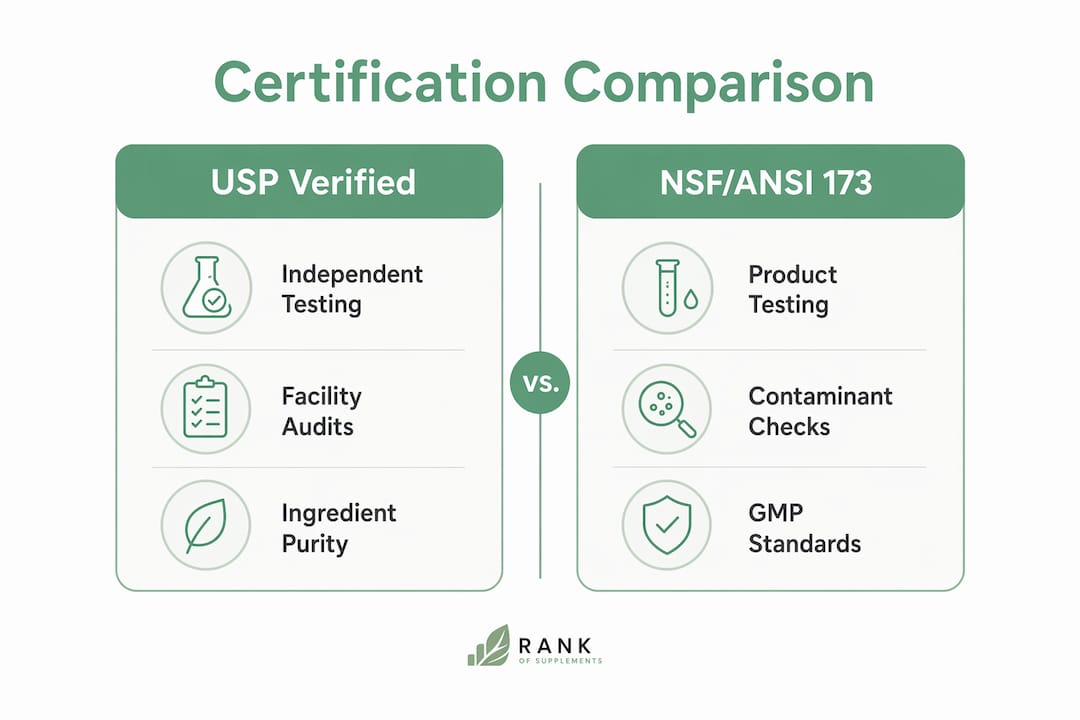
The USP Verified mark requires independent product testing and facility auditing, confirming that supplements meet United States Pharmacopeia standards for GMP compliance, ingredient identity, and purity. This is not a self-declared badge. A manufacturer pays for and submits to third-party scrutiny, and USP can pull the certification if standards slip. For consumers, the USP mark on a bottle means the product was tested by an organization with no financial stake in the outcome.
What NSF/ANSI 173 certification covers
NSF/ANSI 173 certification combines a technical review, product and contaminant testing, and GMP certification to validate supplement contents and safety. Only GMP-certified facilities are even eligible to apply, which filters out lower-quality manufacturers before testing begins. Products that pass earn the NSF Contents Certified mark, one of the most recognized seals in the industry. Amazon now requires supplements sold on its platform to meet elements of NSF/ANSI 173, which signals how seriously retailers are treating this standard.
Understanding FDA cGMP as the baseline
FDA’s cGMP regulations (21 CFR Part 111) require manufacturers to test raw materials and finished products, maintain quality controls, and document every step of production. The FDA requires identity testing of each botanical ingredient lot and batch product testing before distribution. cGMP compliance is the legal floor, not the ceiling. A product can be cGMP-compliant and still contain inaccurate label claims if no independent body has verified the finished product.
Pro Tip: Cross-check any certification seal you see on a label against the certifier’s official product database. Certification claims can be misleading if the certifier’s listings don’t include the exact product or specify what tests were performed.
Here is a direct comparison of the three major certification programs:
| Certification | Who tests | What is tested | Facility audit |
|---|---|---|---|
| USP Verified | USP (independent) | Identity, purity, potency, GMP | Yes |
| NSF/ANSI 173 | NSF International | Contents, contaminants, GMP | Yes |
| FDA cGMP | FDA (periodic inspection) | Manufacturing process | Yes, but infrequent |
What does a quality supplement label look like?
A supplement label is a transparency document. When manufacturers hide behind vague language or omit standard information, that omission tells you something meaningful about the product.

A quality label includes a complete Supplement Facts panel with exact ingredient amounts, not proprietary blends that obscure individual doses. It lists the ingredient source where relevant, for example “Vitamin D3 from lanolin” versus a generic “Vitamin D.” It carries an expiration date and a lot number, both of which allow you to trace the product back to a specific production batch. Supplements missing clear dosage or side-effect information, or those making unrealistic claims, should be approached with caution.
Watch for these red flags on any label:
- Claims like “addresses,” “treats,” or “prevents” a disease. These are pharmaceutical claims that supplements cannot legally make.
- No lot number or expiration date. Without these, you cannot request or verify batch-specific testing.
- Proprietary blends with no individual ingredient doses. You cannot assess safety or efficacy without knowing exact amounts.
- Missing allergen disclosures or manufacturing facility information.
- Exaggerated benefit claims with no scientific citations or qualifications.
Pro Tip: Scan the QR code or barcode on the packaging and search the manufacturer’s website for a Certificate of Analysis linked to that specific lot number. Brands that publish this information proactively are signaling confidence in their product.
Many brands now include QR codes that link directly to third-party lab reports. If that link leads to a generic company page rather than a specific test document, treat it as a yellow flag. Authentic transparency means the data is one click away, not buried in a contact form.
How to verify manufacturer practices and batch quality
Knowing a manufacturer follows good practices requires more than reading their marketing copy. Here is a practical sequence for verifying what actually happens in production.
-
Search the FDA’s warning letter database. The FDA publishes enforcement actions against supplement manufacturers at fda.gov. A company with recent warning letters for cGMP violations is a company you should avoid, regardless of how polished their website looks.
-
Request a Certificate of Analysis for your specific lot. A batch-specific CoA provides actionable verification tied to an exact production lot, which is far more meaningful than generalized GMP claims. Email the manufacturer with your lot number and ask for the corresponding CoA. Reputable brands respond promptly.
-
Verify the testing lab on the CoA is independent. A CoA issued by the manufacturer’s own in-house lab carries less weight than one from an ISO 17025-accredited third-party laboratory. Look for lab names like Eurofins, NSF International, or Covance on the document.
-
Check whether the certifier’s database lists your exact product. NSF, USP, and ConsumerLab all maintain searchable online databases of certified products. If a product claims NSF certification but does not appear in NSF’s official list, the claim is unverified. This step takes under two minutes and catches a surprising number of misleading labels.
-
Look for the manufacturer’s physical address and contact information. Brands that list only a P.O. box or no address at all are harder to hold accountable. A real facility address you can cross-reference with FDA inspection records is a positive signal.
-
Check for third-party sport certifications if relevant. Athletes should look for NSF Certified for Sport or Informed Sport certification, both of which include testing for banned substances beyond standard contaminant panels.
Generic GMP claims printed on a label cost nothing to make. Batch-specific evidence costs the manufacturer real money and effort, which is exactly why it separates serious brands from opportunistic ones.
Which online tools help you evaluate supplements?
Several independent platforms aggregate supplement testing data and make it searchable, giving you a quality check that goes beyond what any single label can tell you.
Labdoor tests top-selling vitamins in FDA-registered labs and publishes ratings for purity and ingredient accuracy. Their scoring system grades products on label accuracy, product purity, nutritional value, ingredient safety, and projected efficacy. A product scoring above 80 on Labdoor’s scale has passed a meaningful independent review. ConsumerLab operates on a subscription model and tests hundreds of products annually, publishing detailed reports on what was found versus what was claimed. NSF’s certified product lookup at nsf.org is free and lets you search by product name, brand, or certification type.
Here is a quick reference for the major online verification tools:
| Tool | Cost | What it checks | Best for |
|---|---|---|---|
| Labdoor | Free | Purity, label accuracy, safety | General consumers |
| ConsumerLab | Subscription | Potency, contaminants, label claims | Deep research |
| NSF product lookup | Free | Certification status | Confirming seals |
| USP verified database | Free | Certification status | USP-marked products |
A few important caveats when using these platforms. Third-party certifications confirm label accuracy and contaminant absence, but they do not guarantee safety or effectiveness for every individual. A supplement that passes every purity test can still interact with a medication you take or be inappropriate for your health condition. Always consult a healthcare provider before adding a new supplement, particularly if you have a chronic condition or take prescription drugs.
The Rankofsupplements Supplement Ingredient Library is another resource worth bookmarking. It aggregates ingredient-level data so you can research specific compounds before committing to a product.
Common mistakes in supplement quality assessment
Most consumers make the same errors when evaluating supplements, and the consequences range from wasted money to genuine harm.
Trusting the label without verifying the seal. A certification logo printed on packaging costs nothing to fake. Always confirm the seal against the certifier’s official database before trusting it. This single step eliminates a large category of misleading products.
Ignoring dosage context. A product can contain the right ingredient and still be useless if the dose is below the threshold studied in clinical research. Check the dose on your label against published research or resources like Examine.com, which catalogs evidence-based dosage ranges for hundreds of compounds.
Skipping the interaction check. St. John’s Wort reduces the effectiveness of birth control pills and several anticoagulants. Vitamin K interferes with warfarin. These are not obscure edge cases. Before starting any supplement, run it by a pharmacist or physician, especially if you take prescription medications.
Prioritizing price over evidence. The cheapest option on a shelf is often cheap because it skipped third-party testing. The cost of NSF/ANSI 173 certification is real, and brands that absorb it are making a statement about their standards.
Pro Tip: When a supplement deal looks too good to be true on a marketplace like Amazon or eBay, search the product name plus “counterfeit” or “fake” before buying. Counterfeit supplements are a documented problem, particularly for popular products like fish oil, protein powders, and weight-loss formulas.
“The supplement industry’s self-regulatory model places the burden of verification squarely on the consumer. The tools exist to do this well. Most people just don’t know where to look.”
For a structured approach to evaluating supplements by health goal, the women’s supplement checklist at Rankofsupplements offers a practical framework that applies many of these principles in a step-by-step format.
Key takeaways
Reliable supplement quality assessment requires verifying third-party certifications, reading labels for transparency, requesting batch-specific CoA documents, and cross-checking claims with independent databases like Labdoor, ConsumerLab, and NSF’s product lookup.
| Point | Details |
|---|---|
| Verify certification seals | Cross-check USP, NSF, or cGMP claims against the certifier’s official product database. |
| Read labels critically | Look for lot numbers, expiration dates, exact ingredient doses, and no disease claims. |
| Request a batch CoA | Ask manufacturers for a Certificate of Analysis tied to your specific lot number. |
| Use independent testing tools | Labdoor and ConsumerLab provide lab-tested ratings beyond what labels disclose. |
| Consult a healthcare provider | Third-party certification confirms purity but not personal safety or drug interactions. |
Why I think most consumers are checking supplements the wrong way
I’ve spent years reviewing supplement products, reading lab reports, and watching consumers make the same avoidable mistakes. The most common one is treating a certification seal as the finish line rather than the starting point.
Here’s what I’ve actually found: a USP or NSF seal is necessary but not sufficient. I’ve seen products with legitimate certifications that still contained doses far below what the clinical literature supports for their claimed benefit. The certification confirmed the label was accurate. It said nothing about whether the dose was meaningful. That distinction matters enormously, and most consumers miss it entirely.
The batch-specific CoA is the most underused tool available to supplement buyers. I’ve requested CoAs from dozens of manufacturers over the years. The ones who respond within 24 hours with a clean, third-party-issued document are almost always the ones whose products hold up under scrutiny. The ones who deflect, send a generic quality statement, or go silent are telling you something important.
My pragmatic advice: spend five minutes on verification before you spend money on a product. Check the certifier’s database. Search Labdoor. Google the brand name plus “FDA warning letter.” These steps take less time than reading the marketing copy on the bottle, and they give you far more useful information. The resources exist. The question is whether you use them.
The supplement industry is not uniformly bad. There are manufacturers who invest seriously in quality and transparency. Your job as a consumer is to find them, and the tools described in this article make that job genuinely manageable.
matteo
Find verified supplement reviews at Rankofsupplements
Rankofsupplements publishes science-backed reviews and rankings that go beyond label claims. Every review on the platform examines ingredient quality, dosage evidence, and manufacturing transparency so you can make a purchase decision grounded in real data. If you want to see how a specific product holds up under scrutiny, the Nutrigo Lab Strength review is a strong example of the depth Rankofsupplements brings to quality assessment. For broader research, browse supplements by health condition to find ranked options for your specific goal, or explore the top wellness supplements that have earned their place on the list in 2026.
FAQ
What certifications should I look for on a supplement label?
Look for USP Verified, NSF/ANSI 173, or NSF Certified for Sport marks. These require independent product testing and facility auditing, unlike self-declared GMP claims.
How do I know if a certification seal is real?
Search the certifier’s official product database at nsf.org or usp.org using the exact product name and brand. If the product does not appear in the database, the seal is unverified.
What is a Certificate of Analysis and why does it matter?
A Certificate of Analysis is a lab document tied to a specific production lot that confirms the product’s ingredient identity, potency, and contaminant levels. Batch-specific CoAs are more meaningful than general quality statements because they reflect the exact product you purchased.
Are supplements sold on Amazon safe to buy?
Amazon requires supplements sold on its platform to meet elements of NSF/ANSI 173 certification, which raises the baseline. Still, verify the specific product’s certification status independently before purchasing.
Can a certified supplement still be unsafe for me personally?
Yes. Third-party certification confirms label accuracy and contaminant absence but does not account for individual health conditions, medications, or allergies. Always consult a healthcare provider before starting a new supplement.