
TL;DR:
- Most hair supplements require at least three to six months of consistent use before visible results emerge. Hair growth cycles and biology set the pace, making rapid changes impossible, and individual factors greatly influence outcomes. Effective results depend on treating underlying deficiencies, choosing quality products, and maintaining patience over time.
You started taking a hair supplement three weeks ago and you’re staring at the mirror, wondering if it’s doing anything. You’re not alone. The question of how long does it take for hair supplements to work is one of the most searched and most misunderstood topics in the hair health space. The honest answer sits squarely in biology, not marketing. Hair growth is slow by design, and the supplements that support it work on the same biological clock. What follows is a science-based breakdown of realistic timelines, what actually influences your results, and how to tell if what you’re doing is working.
Table of Contents
- Key takeaways
- How hair grows and why it controls your results timeline
- What the science actually says about supplement timelines
- Why your results will differ from someone else’s
- Setting realistic expectations and building your plan
- My take on patience, biotin myths, and what actually works
- Find the right hair supplement faster with Rankofsupplements
- FAQ
Key takeaways
| Point | Details |
|---|---|
| Minimum wait is 3 to 6 months | Most people need at least 90 to 180 days of consistent use before judging whether a supplement is working. |
| Hair growth biology sets the pace | Hair grows roughly half an inch per month, meaning visible improvements are physically limited by your growth cycle. |
| Biotin has real limitations | A 2026 systematic review found biotin does not consistently improve hair growth unless a deficiency is confirmed. |
| Root cause matters most | Supplements work best when paired with a diagnosis. Supplementing without knowing your cause often leads to wasted months. |
| Quality and consistency decide outcomes | Third-party tested supplements taken daily without interruption outperform cheaper, inconsistently used alternatives. |
How hair grows and why it controls your results timeline
Before you can understand the hair supplement results timeline, you need to understand how your hair actually grows. Each strand on your head is not in constant growth mode. It cycles through three distinct phases, and where any given follicle sits in that cycle determines when you will see hair growth from a supplement.
The three phases work like this:
- Anagen (growth phase): This is the active phase where the follicle is producing hair. It lasts anywhere from two to seven years, depending on genetics. About 85 to 90 percent of your hair is in this phase at any given time.
- Catagen (transition phase): A short, two to three week transitional period where the follicle shrinks and detaches from the blood supply. No new hair is produced here.
- Telogen (resting phase): This phase lasts two to four months. The old hair sits in the follicle before shedding to make room for new growth. Roughly 10 to 15 percent of your hair is resting at any moment.
Why does this matter for supplements? Because hair grows about half an inch per month on average. Even if a supplement successfully stimulates a follicle that was previously struggling, you will not see the resulting hair length or density for several months. The follicle has to complete its cycle. A hair that just entered anagen because of improved nutrition will not be visible above the scalp for weeks, and noticeably longer for months.
This is also why shedding can actually increase in the first few weeks of using a supplement. When a follicle transitions from telogen back into anagen, it pushes out the old resting hair first. Many people see this temporary increase in shedding and assume their supplement is making things worse. It is often a sign that the cycle is reactivating.
Pro Tip: Take a photo of your hairline or part in the same lighting every four weeks. Progress in hair density is too gradual to notice day to day, but side-by-side monthly comparisons tell a much clearer story.

What the science actually says about supplement timelines
This is where things get specific. Clinical trials measuring the effectiveness of hair supplements do not use two-week endpoints. They use two to six month measurement windows for objective reasons. Hair density, strand thickness, and growth rate cannot meaningfully change faster than biology allows.
Here is what the evidence shows for the most commonly used ingredients:
| Ingredient | Clinical trial duration | Reported outcomes |
|---|---|---|
| SesZen-Bio (sesame seed extract) | 56 days | 25% increase in hair density and improved thickness in randomized trial |
| Saw palmetto | 3 to 6 months | Modest improvements in hair count and scalp coverage in men with androgenic alopecia |
| Biotin | Variable (4 to 6 months in studies) | No consistent benefit in people without confirmed deficiency |
| Multivitamin formulas (iron, zinc, vitamin D) | 3 to 6 months | Effective when used to correct confirmed deficiencies |
| Marine collagen and keratin blends | 90 to 180 days | Improvements in strand strength and reduced breakage in some trials |
The SesZen-Bio result at 56 days is one of the more promising short-timeline findings in recent research, but it is worth noting that this was a randomized, double-blind trial with controlled dosing (500 mg/day). Most over-the-counter supplement blends contain far lower concentrations of any single ingredient.
“Brand timelines claiming noticeable results in two to four weeks are almost never supported by clinical evidence. Real-world results consistently appear after three to six months of consistent, uninterrupted use.” (Informed by evidence discussion from EatingWell’s review of hair supplement research)
The biotin picture deserves special attention. Biotin is the most marketed hair supplement ingredient in the world, but a 2026 systematic review found that biotin monotherapy does not consistently improve objective hair outcomes unless a deficiency is present. Even more concerning, high-dose biotin can interfere with common blood immunoassays, potentially throwing off lab results for thyroid and cardiac markers. This is a real medical risk that most supplement labels do not mention.
Pro Tip: Before spending months on a biotin supplement, ask your doctor to test your biotin, iron, ferritin, vitamin D, and thyroid levels. If none are low, biotin is unlikely to move the needle for you.
Why your results will differ from someone else’s
Two people can take the exact same supplement for the exact same duration and get completely different outcomes. The timeframe for hair growth supplements is highly individual, and understanding why can save you months of frustration or premature quitting.
The biggest factors that determine how fast you respond include:
- Underlying nutrient deficiencies. If you are iron deficient or low in vitamin D, correcting that deficiency can produce noticeable improvement in hair within three to four months. If your levels are already normal, the same supplement will accomplish very little. Harvard Health stresses that supplements alone lack solid evidence without first identifying what is actually causing your hair loss.
- The type of hair loss you have. Telogen effluvium (diffuse shedding triggered by stress, illness, or hormonal shifts) responds much better to nutritional supplements than androgenic alopecia (pattern baldness), which has a genetic and hormonal driver that supplements cannot fully override.
- Your genetics. Follicle sensitivity to androgens, baseline hair density, and growth cycle duration are all genetic. Two people with identical diets and supplement regimens can have completely different responses because of their inherited follicle biology.
- Lifestyle and stress load. Chronic stress elevates cortisol, which pushes more follicles into the telogen phase simultaneously. A supplement cannot fully compensate for an ongoing physiological stress response. Sleep, exercise, and stress management are not optional add-ons. They are part of the same system.
- Consistency and duration. Stopping supplements too early, before the three to six month minimum, is one of the most common reasons people report disappointing results. Missing doses frequently has a similar effect. The hair follicle needs sustained nutritional support across full growth cycles, not intermittent boosts.
- The root cause going unaddressed. According to Cleveland Clinic experts, hair loss clinicians see supplements produce meaningful results primarily in people with confirmed, correctable causes. Taking a hair vitamin to address undiagnosed thyroid disease, for example, will not work. The thyroid condition needs treatment first.
The through-line here is this: supplements are a support tool, not a cure. The fastest path to results runs through understanding your specific cause, not through buying whatever is marketed most aggressively.
Setting realistic expectations and building your plan
Now that you understand the biology and the evidence, here is how to approach this practically. The goal is not just to wait patiently. It is to set up the right conditions for success and monitor progress intelligently.
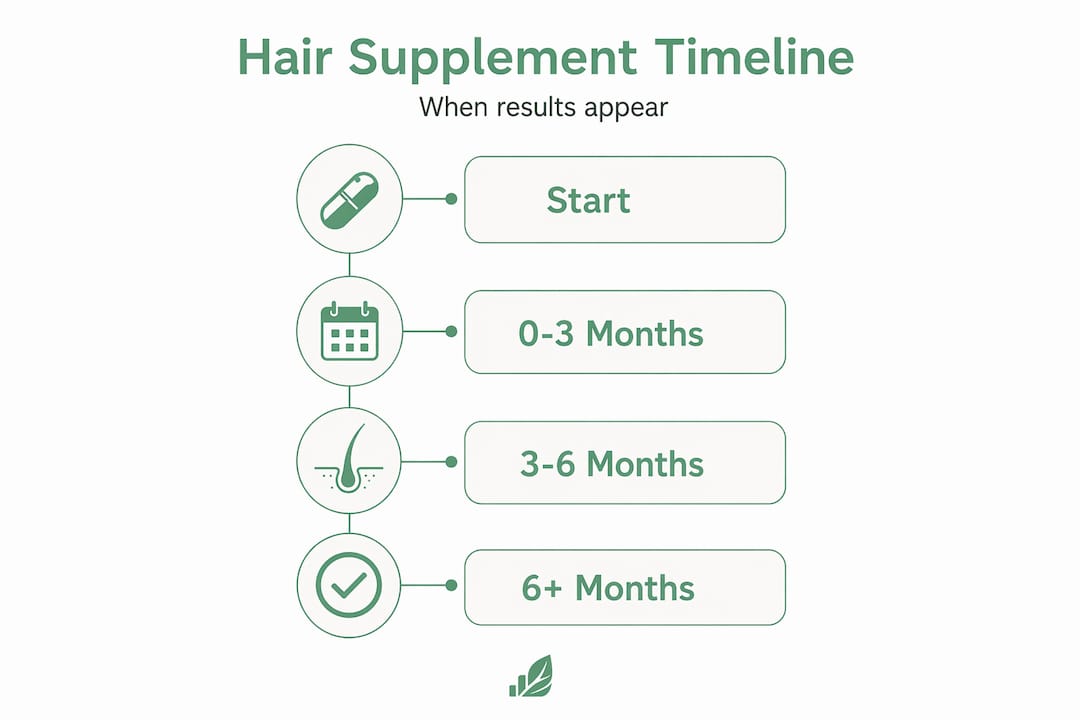
The recommended minimum: 3 to 6 months
Most dermatologists and trichologists (hair and scalp specialists) recommend committing to any hair supplement regimen for at least 90 days before evaluating it, and preferably 180 days. This is not arbitrary. It accounts for the time needed for a telogen follicle to reactivate, enter anagen, produce visible hair, and generate enough length to see at the scalp. Anything shorter than 90 days tells you almost nothing.
What to watch for at each stage
- Weeks 1 to 4: No visible changes are expected. You may notice slightly more shedding, which can be a sign of follicle cycle reactivation. This is normal.
- Weeks 5 to 8: Some people notice reduced shedding volume and minor improvements in existing hair texture or shine. This is an early positive signal.
- Months 2 to 3: New, short growth (often called baby hairs) may become visible around the hairline or part. This is your clearest early evidence that the supplement is supporting follicle activity.
- Months 4 to 6: Density improvements become measurable. This is the window where most clinical trials document their primary outcomes.
Choosing a supplement worth taking
The supplement market is largely unregulated, which means product quality varies wildly. Before you buy anything, check these criteria:
| What to look for | What to avoid |
|---|---|
| Third-party tested (NSF, USP, or Informed Sport certified) | No third-party certification of any kind |
| Clinically studied ingredients at studied doses | Proprietary blends that hide individual doses |
| Transparent label showing all ingredient amounts | Dosages far below what clinical trials used |
| Manufactured in a cGMP-certified facility | Claims of results in under 60 days |
Rankofsupplements reviews hair loss supplements against exactly these criteria, which is worth using as a filter before making a purchase.
Work with a provider, not around one
If you have been experiencing significant thinning for more than six months, the single most effective step you can take is getting a diagnostic workup. Blood panels for ferritin, vitamin D, B12, thyroid function, and androgens take about 30 minutes and can tell you precisely which direction to go. Hair loss specialists consistently note that supplements produce the best results when they address confirmed deficiencies, not guessed-at ones.
Pair your supplement with scalp care. Scalp massage (five to ten minutes daily) has modest evidence for improving blood flow to follicles. Avoiding harsh chemical treatments and heat during your supplement period removes one variable that could mask progress.
My take on patience, biotin myths, and what actually works
by matteo
I’ve spent years reviewing evidence on hair supplements, and the pattern I keep seeing is the same: people expect results in weeks, quit in month two, and then tell everyone that hair supplements don’t work. The supplements didn’t fail. The timeline expectations did.
What I’ve found is that the people who see the best results from hair supplements are almost never the people who grabbed the most heavily advertised product. They are the ones who got bloodwork done, identified an actual deficiency or correctable condition, chose a supplement with studied ingredients at studied doses, and then stayed consistent for six full months without wavering.
The biotin situation genuinely frustrates me. It is sold everywhere, it is cheap, and it is almost completely useless unless you are actually deficient, which most people in developed countries are not. Worse, I’ve seen cases where high-dose biotin muddied blood test results, making a thyroid problem harder to diagnose. That is a real cost that no one talks about on the label.
My honest recommendation: resist the urge to start with a supplement and skip the doctor. Get the bloodwork. If everything is normal, look at clinically backed formulas with ingredients like saw palmetto, marine collagen, or well-dosed vitamin D and zinc, rather than mega-dose biotin. Then commit. Give it six months. Track it with photos. Do not decide it is not working at week ten.
The biology is working for you, not against you. But it runs on its own clock, and the only thing that disrupts results faster than a bad supplement is not giving a good one enough time.
matteo
Find the right hair supplement faster with Rankofsupplements
If you are ready to move from research to action, the challenge now is sorting through hundreds of products to find ones that actually hold up to scrutiny.

Rankofsupplements was built exactly for this problem. The platform reviews hair supplements against clinical evidence, checking ingredient quality, dosage accuracy, and third-party testing status so you do not have to. You can browse the supplement ingredient library to look up specific compounds like saw palmetto or marine collagen and see what the research says about each one. For direct product comparisons, the hair thinning guide organizes the best-reviewed options by evidence quality and user outcomes. Whether you are just starting your search or reconsidering a product you are already using, these resources cut through the noise and point you toward what the evidence actually supports.
FAQ
How long before I see results from hair supplements?
Most people need at least three to six months of consistent daily use before seeing measurable improvements in hair density or growth. Anything shorter than 90 days is not enough time for a full hair growth cycle to complete.
Do hair supplements really work for everyone?
No. The effectiveness of hair supplements depends heavily on the underlying cause of your hair loss. People with confirmed nutrient deficiencies or correctable conditions respond best, while those with genetic pattern baldness typically see limited results from supplements alone.
How fast do hair vitamins work compared to prescription treatments?
Hair vitamins generally work more slowly than prescription options like minoxidil or finasteride. Clinical trials for supplements use three to six month endpoints, while prescription treatments can show measurable results in similar timeframes but with stronger mechanisms of action.
Is biotin worth taking for hair loss?
Only if you have a confirmed biotin deficiency, which is uncommon. A 2026 systematic review found biotin does not consistently improve hair outcomes without deficiency, and high doses can interfere with certain lab tests.
What are signs that a hair supplement is starting to work?
Early signs include reduced daily shedding, improved hair texture, and the appearance of short new hairs around the hairline or part. These typically appear between weeks five and twelve, with more substantial density changes visible at months four to six.
Recommended
- Related article: Supplements for Women Checklist: Your 6-Step Guide
- Top list: Best Hair Loss Supplements 2026
- Specific product: Best Supplement Reviews and Rankings 2026
- Guide: Best Supplements for Hair Thinning and Loss: Evidence-Based Guide