Goli Nutrition Ashwagandha Gummies generate a steady stream of negative reviews, and the complaints are specific enough to take seriously. The most common problems are digestive upset (nausea, loose stools, diarrhea), drowsiness, and headaches. A smaller number of users report worsened anxiety, skin breakouts, and in rare cases, symptoms consistent with liver stress. These are not fringe reports buried in one-star rants, they track closely with the adverse events documented in clinical and case-report literature and flagged by Harvard Health.
Three additional signals matter before you buy:
- Digestive upset (nausea, diarrhea, stomach cramps) is the most frequently cited complaint across retailer reviews and forums.
- Drowsiness and fatigue appear often enough that timing the dose matters, many users report it catches them off guard mid-day.
- Headaches and irritability show up in a meaningful minority of reviews, sometimes in users who had no prior history with either.
- Rare but serious: a small number of case reports link ashwagandha to liver injury (jaundice, dark urine, severe abdominal pain). Stop immediately and seek care if you notice these.
- Regulatory red flags: The National Advertising Division (NAD) recommended Goli modify or drop certain efficacy claims, and the class-action lawsuit Caputo et al. v. Goli Nutrition alleged false advertising of weight-loss and performance benefits, per Truth in Advertising.
For most healthy adults with no contraindications, the risk profile is manageable, but the legal and advertising context adds a layer of skepticism worth carrying into any purchase decision.
Key Takeaways
Goli Nutrition Ashwagandha Gummies carry a real but manageable side-effect profile for healthy adults, but the NAD advertising action, class-action litigation, and clear contraindications make due diligence non-negotiable before purchase.
| Point | Details |
|---|---|
| Most common side effects | Nausea, diarrhea, drowsiness, and headaches are the most frequently reported complaints across retailer reviews and clinical literature. |
| Rare serious signals | Liver injury symptoms (jaundice, dark urine, severe abdominal pain) require stopping immediately and seeking medical care. |
| Legal and advertising context | The NAD recommended Goli modify certain claims; Caputo et al. v. Goli Nutrition alleged false advertising of weight-loss and performance benefits. |
| Who should avoid | Pregnant or breastfeeding individuals, and those with thyroid, autoimmune, or hormone-sensitive conditions, should not take ashwagandha without medical advice. |
| Rankofsupplements guidance | The Rankofsupplements ingredient library maps clinical dosing and contraindications to help you compare evidence-backed alternatives. |
Table of Contents
- What are Goli Nutrition Ashwagandha Gummies, exactly?
- What do Goli Nutrition Ashwagandha Gummies negative reviews actually say?
- What legal and advertising actions have been taken against Goli?
- Who should avoid Goli Ashwagandha Gummies?
- What does the clinical evidence say about ashwagandha’s benefits and risks?
- What should you do if you experience side effects?
- Should you try Goli Ashwagandha Gummies or avoid them?
- An honest read on what these reviews actually tell you
- Rankofsupplements has the evidence-based research you need
- Sources
- FAQ
What are Goli Nutrition Ashwagandha Gummies, exactly?
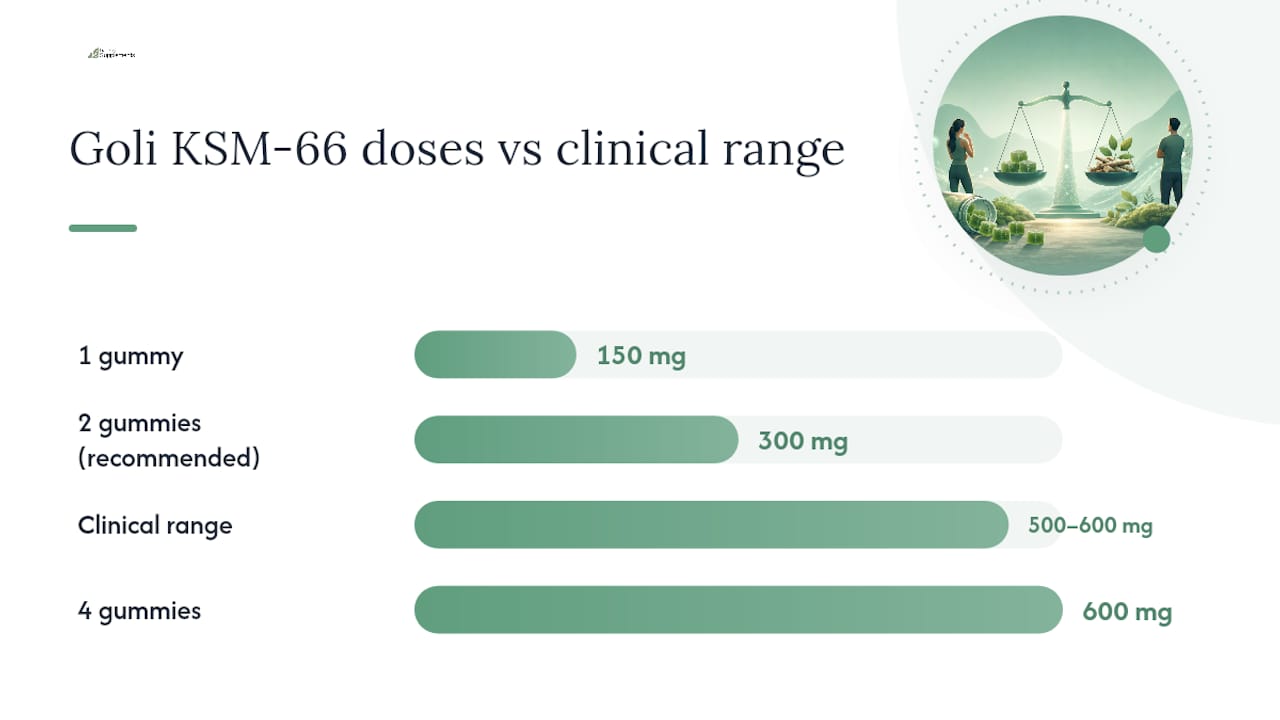
Each gummy delivers 150 mg of KSM-66. The recommended serving is two gummies per day, putting the daily dose at 300 mg, which is below the dose range used in most clinical trials showing measurable stress and sleep benefits, per the NIH Office of Dietary Supplements.
Each gummy also contains vitamin D2 and added sugar from tapioca syrup and cane sugar. The bottle holds 60 gummies, which equates to about a month’s supply at the recommended two gummies per day. The gummies are pectin-based (not gelatin), which makes them vegan-friendly but also more sensitive to heat and humidity during shipping.
Key label facts at a glance:
- KSM-66 ashwagandha per gummy: 150 mg
- Daily dose (2 gummies): 300 mg
- Vitamin D2 per gummy: 12.5 mcg (500 IU)
- Added sugar per serving: 2 g
- Gummies per bottle: 60 (30-day supply)
- Format: pectin-based, vegan
Goli sells directly through its website and through major retailers including Amazon, Walmart, and Target. A purity and dosage audit by SupplementReportCard found transparent labeling with no proprietary blend, but noted limited publicly available third-party batch testing (Certificates of Analysis), which is a gap worth flagging.
Pro Tip: If you want to match the doses used in clinical trials (500 to 600 mg/day), two Goli gummies per day won’t get you there. You’d need four gummies daily, which doubles your sugar intake and cost per day.
What do Goli Nutrition Ashwagandha Gummies negative reviews actually say?
The pattern across Amazon, Walmart, Reddit, and supplement forums is consistent. Digestive complaints dominate: nausea within an hour of taking the gummies, loose stools, and in some cases full diarrhea that resolved only after stopping. Drowsiness is the second most common theme, users describe feeling foggy or unusually tired, especially when taking the gummies in the morning.
Most frequently reported complaints:
- Nausea and upset stomach, often within 30 to 60 minutes of dosing
- Loose stools or diarrhea, sometimes persisting for days
- Drowsiness or fatigue, described as disproportionate to the dose
- Headaches, typically in the first week of use
- Worsened anxiety or disrupted sleep in a subset of users
- Skin breakouts, noted by a smaller group
Beyond the physiological complaints, a notable cluster of reviews targets product quality. Gummies arriving melted, clumped together, or hardened from temperature exposure during shipping are a recurring theme. This is a pectin-specific problem, as pectin gummies are more vulnerable to heat than gelatin-based ones, and it drives a real share of one-star reviews that have nothing to do with the ingredient itself.
Aggregated review analysis by Better Gut Daily found that overall positivity for Goli products remains high, but a measurable subset reports these negatives, and texture/shipping complaints account for a significant portion of the lower-rated reviews. That distinction matters: a melted gummy is not a safety event, but it is a quality-control failure that erodes trust.

What legal and advertising actions have been taken against Goli?
Two separate actions have put Goli’s marketing claims under scrutiny, and neither is minor.
The NAD, the advertising industry’s self-regulatory body, reviewed Goli’s claims for its Ashwagandha Gummies and recommended the company modify or discontinue certain efficacy claims it could not substantiate. The challenged claims included benefits related to weight management, sexual function, and physical performance. The NAD’s process is not a government enforcement action, but its recommendations carry real weight, brands that ignore them risk referral to the FTC.
Separately, the class-action lawsuit Caputo et al. v. Goli Nutrition alleged that Goli made false and misleading advertising claims about the same categories of benefits. According to Truth in Advertising, the plaintiffs alleged consumers paid a premium for benefits the product could not deliver.
The core allegation in Caputo et al. v. Goli Nutrition was that Goli’s marketing overstated what the science supports, not that the product caused widespread harm.
What this means practically:
- The NAD action and the lawsuit target advertising claims, not product safety. No recall has been issued.
- The challenged claims (weight loss, sexual function, performance) are not well-supported by ashwagandha research at the doses Goli uses.
- Regulatory scrutiny affects how much you should trust the label’s benefit promises, it does not mean the product is dangerous for healthy adults.
- No government safety action (FDA recall, warning letter) has been publicly issued against Goli Ashwagandha Gummies as of this writing.
The takeaway: Goli’s marketing has been more aggressive than the evidence warrants. That’s a reason to calibrate your expectations, not necessarily a reason to panic about safety.
Who should avoid Goli Ashwagandha Gummies?
Ashwagandha is not appropriate for everyone, and the gummy format doesn’t change that calculus. Memorial Sloan Kettering Cancer Center’s integrative medicine database and Harvard Health both list clear contraindications.
Avoid without medical supervision if you:
- Are pregnant or breastfeeding (ashwagandha has potential abortifacient effects and no established safety data in pregnancy)
- Have a thyroid disorder, ashwagandha can affect thyroid hormone levels, and case reports document both hypothyroid and thyrotoxicosis effects
- Have an autoimmune disease (lupus, rheumatoid arthritis, multiple sclerosis), ashwagandha may stimulate immune activity
- Have a hormone-sensitive cancer or condition (breast, uterine, prostate cancer), the herb may raise testosterone and affect hormone balance, per WebMD’s supplement database
- Take sedatives, benzodiazepines, or anticonvulsants, additive CNS depression is a real risk
- Take thyroid medications (levothyroxine), ashwagandha may alter thyroid hormone levels and require dose adjustment
- Take immunosuppressants, ashwagandha’s immune-modulating effects may counteract these drugs
- Take blood pressure or blood sugar medications, ashwagandha can have additive effects
Pro Tip: Before your next doctor’s appointment, write down every OTC supplement, herbal product, and gummy you take. Pharmacists are often better than physicians at catching supplement-drug interactions, a five-minute conversation at the pharmacy counter can prevent a serious problem.
What does the clinical evidence say about ashwagandha’s benefits and risks?
The honest summary: modest benefits, real but usually mild side effects, and a few rare serious signals that deserve respect.
Randomized trials and a meta-analysis indexed on PubMed show small but measurable improvements in sleep quality and stress measures with certain ashwagandha extracts, typically after more than eight weeks of consistent use. The operative word is “certain extracts”, KSM-66 and Sensoril are the two most studied. Goli uses KSM-66, which is a point in its favor.
The NIH Office of Dietary Supplements notes that most trials ran 8 to 12 weeks at doses around 500 to 600 mg/day. Goli’s recommended two-gummy serving delivers 300 mg/day, half the lower end of that range. You’d need four gummies daily to reach 600 mg, which the label doesn’t recommend as a starting point.
Documented adverse events from clinical and case-report literature:
- GI upset (nausea, diarrhea, vomiting), most common, usually mild and dose-related
- Drowsiness and sedation, consistent across multiple trial reports
- Thyroid effects, both hypothyroid and thyrotoxicosis documented in case reports
- Rare hepatotoxicity, liver injury cases have been reported; the MSD Manuals professional entry explicitly flags this, and the PMC safety review notes that symptoms resolved after stopping in documented cases
Dose mapping for Goli’s product:
| Serving | KSM-66 Dose | vs. Clinical Trial Range (500 to 600 mg/day) |
|---|---|---|
| 1 gummy | 150 mg | Well below studied range |
| 2 gummies (recommended) | 300 mg | Below studied range |
| 4 gummies | 600 mg | Matches upper clinical range |
The limitation worth stating plainly: most trials lasted 8 to 12 weeks, used capsule formats, and didn’t study the specific populations most likely to buy a gummy supplement. Long-term safety beyond three months is genuinely unknown.
What should you do if you experience side effects?
Stop taking the gummies first. Don’t wait to finish the bottle or “push through” symptoms, that’s a common supplement mistake that delays recovery and makes it harder to identify the cause.
Step-by-step response:
- Stop taking the product immediately and note the date.
- Keep the bottle, including the lot number and expiration date on the label.
- Write down your symptoms, when they started, and how severe they are.
- For mild symptoms (nausea, loose stools, headache): monitor for 48 to 72 hours after stopping. Most resolve on their own.
- For severe symptoms, jaundice (yellowing of skin or eyes), dark urine, severe abdominal pain, shortness of breath, seek emergency care immediately. These may indicate liver stress.
- Contact Goli’s customer service with your order number, batch details, and a description of your symptoms to request a refund or replacement.
- Report the adverse event to FDA MedWatch online or by calling 1-800-FDA-1088. This is how safety signals get tracked nationally.
- If you suspect poisoning or a severe reaction, call Poison Control at 1-800-222-1222.
Pro Tip: When you file an FDA MedWatch report, you don’t need a diagnosis, just describe what happened, when, and what you took. These reports are how the FDA identifies patterns across thousands of consumers that no single doctor would see.
Common supplement mistakes like stacking multiple herbal products simultaneously make it harder to isolate which one caused a reaction. If you’re taking more than one supplement, stop them one at a time to identify the culprit.
Should you try Goli Ashwagandha Gummies or avoid them?
The answer depends on who you are.
They may be worth trying if you:
- Are a healthy adult with no thyroid, autoimmune, or hormone-sensitive conditions
- Take no medications that interact with ashwagandha (sedatives, thyroid meds, immunosuppressants)
- Are not pregnant or breastfeeding
- Start with one gummy per day with food and monitor for digestive symptoms before increasing
- Have realistic expectations: stress and sleep benefits, if they appear, typically take 8+ weeks
Avoid them (or consult a provider first) if you:
- Fall into any of the contraindicated groups listed in the safety section above
- Have a history of liver disease or elevated liver enzymes
- Are already taking multiple supplements or herbal products
The NAD advertising action and the Caputo lawsuit are worth keeping in mind when you read the label’s benefit claims. The product may deliver modest stress and sleep support, the ingredient has real evidence behind it, but the specific claims Goli has made about weight loss and performance are not well-supported at the doses in this product.
Pro Tip: Take the gummies with a full meal, not just a snack. Most GI complaints in reviews describe dosing on an empty or near-empty stomach. Food slows absorption and significantly reduces nausea risk with ashwagandha.
For a deeper look at ashwagandha’s evidence, dosing, and contraindications, the Rankofsupplements ingredient library covers the clinical picture in full.
An honest read on what these reviews actually tell you
There’s a pattern in how people interpret supplement reviews that consistently leads them astray: they treat every one-star complaint as a safety signal and every five-star review as proof of efficacy. Neither is accurate.
A meaningful share of Goli’s negative reviews are about melted gummies, not adverse reactions. Pectin gummies shipped in summer or stored in a warm warehouse arrive as a single sticky mass. That’s a supply-chain failure, not a pharmacological one. Conflating it with nausea or drowsiness inflates the apparent safety risk and muddies the signal for people who genuinely need to know whether the ingredient is causing harm.
The clinical adverse events, GI upset, drowsiness, rare thyroid and liver effects, are real and documented independently of any review platform. Those deserve weight. The texture complaints don’t belong in the same category, but they end up there because star ratings don’t distinguish between “this made me sick” and “this arrived as a gummy brick.”
What the legal context actually tells you is narrower than most readers assume. The NAD recommendation and the Caputo lawsuit challenge specific marketing claims, not the ingredient’s safety profile. Ashwagandha has a legitimate evidence base for stress and sleep at the right doses. Goli’s problem is that it marketed benefits beyond what the science supports at 300 mg/day, not that the product is inherently dangerous.
The most useful thing you can do before buying is check your medications against a credible interaction checker, confirm you’re not in a contraindicated group, and set your expectations at “modest stress support after two months” rather than “weight loss and peak performance.” That’s what the evidence actually supports.
Rankofsupplements has the evidence-based research you need
Sorting through conflicting reviews, legal filings, and clinical studies takes time most people don’t have. Rankofsupplements cuts through that by applying a consistent, evidence-first methodology to every supplement it covers, ingredient quality, clinical dosing, third-party testing, and real contraindications, not marketing copy.
For ashwagandha specifically, the Rankofsupplements ingredient library maps the clinical evidence to real-world products, so you can see at a glance whether a product’s dose matches what trials actually used. If Goli’s formulation doesn’t fit your needs, the adaptogen wellness guide covers alternatives with comparable or stronger evidence. For readers concerned about supplement safety more broadly, the fake supplements safety guide explains how to verify third-party testing before you buy. Check the ingredient library now to compare options backed by real clinical data.
Sources
- Ashwagandha benefits, side effects, and safety concerns, Harvard Health
- Ashwagandha: Health Professional Fact Sheet, NIH Office of Dietary Supplements
- Goli Nutrition Ashwagandha Gummies, Truth in Advertising (class-action summary)
- PubMed index entry for ashwagandha clinical research
- PMC article on ashwagandha safety and case reports
- Ashwagandha, Memorial Sloan Kettering Cancer Center (integrative medicine herb page)
This article is general information, not a substitute for advice from a qualified doctor. Consult a qualified healthcare professional about your own circumstances before acting on anything here.
FAQ
What are the negative effects of Goli Ashwagandha Gummies?
The most commonly reported side effects are nausea, upset stomach, diarrhea, drowsiness, and headaches. Rare but serious signals include symptoms of liver injury such as jaundice, dark urine, and severe abdominal pain, which require immediate medical attention.
Do Goli Ashwagandha Gummies actually work?
Clinical evidence supports modest stress and sleep benefits from KSM-66 ashwagandha, but typically at 500 to 600 mg/day after 8+ weeks of use. Goli’s recommended two-gummy serving delivers only 300 mg/day, which falls below the doses used in most trials showing measurable effects.
What is the Goli Nutrition lawsuit about?
The Caputo et al. v. Goli Nutrition class-action alleged that Goli made false and misleading advertising claims about weight loss, sexual function, and physical performance benefits. Separately, the NAD recommended Goli modify or discontinue certain efficacy claims it could not substantiate.
What are the cons of taking ashwagandha gummies?
The gummy format adds sugar (2 g per serving for Goli), is sensitive to heat during shipping, and typically delivers lower doses than capsule-based products. Ashwagandha itself carries real contraindications for pregnant individuals, people with thyroid or autoimmune conditions, and those on sedatives or thyroid medications.
Are Goli Ashwagandha Gummies safe for everyone?
No. Pregnant and breastfeeding individuals should avoid them entirely due to potential abortifacient effects. People with thyroid disorders, autoimmune diseases, hormone-sensitive cancers, or those taking sedatives, anticonvulsants, or thyroid medications should consult a healthcare provider before use.