TL;DR:
- Glucosamine sulfate at 1,500 mg daily is the most studied supplement for knee osteoarthritis, especially with pharmaceutical-grade preparations. Hydrolyzed collagen peptides and undenatured Type II collagen offer alternative mechanisms targeting connective tissue support and immune modulation. A trial of several months with baseline measurement helps determine individual effectiveness for joint health.
For symptomatic knee osteoarthritis, glucosamine sulfate at 1,500 mg/day is the better-studied first choice, with Cochrane-reviewed RCTs showing pain and function improvements, particularly in trials using the pharmaceutical-grade Rotta preparation. For tendon and ligament support, or general connective tissue maintenance, hydrolyzed collagen peptides have stronger mechanistic rationale and growing trial support. Undenatured Type II collagen (UC-II) at a low clinical dose is a third distinct option that works through a different pathway entirely.
The short version:
- Symptomatic knee OA: Try glucosamine sulfate first. The ACR/Arthritis Foundation currently recommends against it in formal guidelines, but that stance reflects concerns about industry-sponsored heterogeneous trials, not a clean verdict against the Rotta-specific evidence.
- Tendon, ligament, or active-loading pain: Hydrolyzed collagen peptides (2.5 to 10 g/day, taken pre-exercise with vitamin C) have the most relevant trial design for this scenario.
- Immune-mediated or inflammatory joint component: Undenatured Type II collagen (UC-II, ~40 mg/day) targets a different mechanism and suits a different patient profile.
- General prevention in older adults: Either hydrolyzed collagen or glucosamine sulfate is reasonable; combination strategies are common and appear safe.
Give any of these a trial lasting several months. Track a baseline pain score (VAS or WOMAC) before you start so you have something to measure against.
Table of Contents
- How do glucosamine and collagen compare for joint health?
- What glucosamine and collagen actually do in your joints
- What does the clinical evidence actually show?
- Safety, side effects, and drug interactions
- How to choose a product and dose it correctly
- How Rankofsupplements evaluated the evidence for this article
- Scenario-based advice: what to try first and when to stop
- Key Takeaways
- The evidence gap most people ignore when choosing between these two
- Where to find evidence-backed joint supplement picks
- Useful sources
- FAQ
How do glucosamine and collagen compare for joint health?
| Feature | Glucosamine sulfate | Hydrolyzed collagen | Undenatured Type II (UC-II) | Chondroitin sulfate |
|---|---|---|---|---|
| Primary tissue target | Proteoglycan matrix (cartilage) | Collagen scaffold (tendon, ligament, cartilage) | Cartilage (immune-mediated) | Cartilage matrix |
| Mechanism | Substrate for glycosaminoglycan synthesis | Bioavailable peptides reach joint tissues | Oral tolerance / immune modulation | Resists cartilage compression |
| Typical clinical dose | 1,500 mg/day (500 mg × 3) | 2.5 to 10 g/day | ~40 mg/day | 800 to 1,200 mg/day |
| Onset / trial length | 6 to 12 weeks minimum; 6 months for structural signal | 3 to 6 months | 3 to 6 months | Often combined with glucosamine |
| Evidence strength (OA) | Moderate (Rotta trials); mixed overall | Moderate; variable study design | Moderate; consistent low-dose signal | Moderate; often studied in combination |
| Best-use scenario | Symptomatic knee OA | Tendon/ligament load; general connective tissue | Inflammatory or immune component | OA cartilage support (add-on) |
| Monthly cost (rough range) | Often bundled with glucosamine |
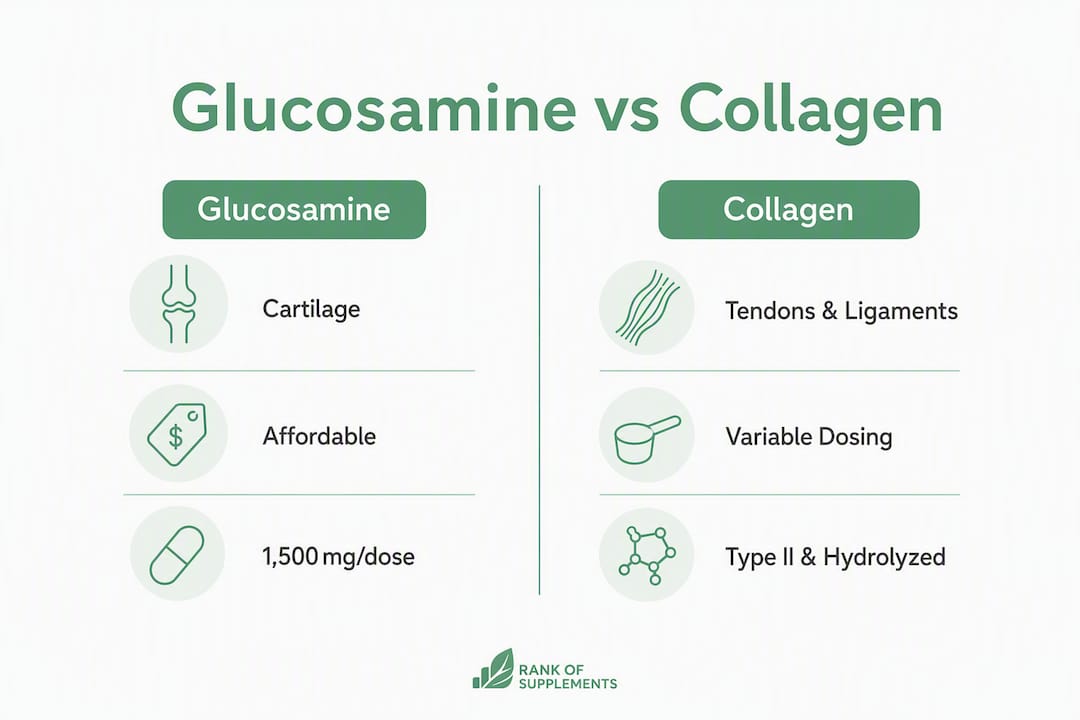
A few things worth flagging on cost: glucosamine sulfate is generally the most affordable standalone option for knee OA. Hydrolyzed collagen powder at therapeutic doses (5 to 10 g/day) costs more per month than capsule-based glucosamine, and the price gap widens over a 6-month trial. UC-II’s low dose (~40 mg/day) keeps its per-capsule cost manageable, but the clinical evidence base is narrower.
Pro Tip: Chondroitin sulfate is not a standalone alternative to either glucosamine or collagen. It works on a related but distinct part of the cartilage matrix and is most commonly studied alongside glucosamine. If your product bundles them, that is not a red flag, but do not count chondroitin as a replacement for either primary ingredient.
What glucosamine and collagen actually do in your joints
These two supplements are not interchangeable. They target different tissues and work through different biological pathways, which is exactly why the “which is better?” question does not have a single answer.
Glucosamine: substrate for cartilage matrix
Glucosamine is an amino sugar your body uses to build glycosaminoglycans, the long-chain molecules that form the proteoglycan matrix of cartilage. Think of that matrix as the spongy shock-absorbing layer inside a joint. When it degrades, as in osteoarthritis, the joint loses cushioning and the bones begin to grind.

Two forms dominate the market. Glucosamine sulfate is the form used in the Rotta pharmaceutical preparation and in most positive clinical trials. Glucosamine hydrochloride (HCl) contains more glucosamine by weight but lacks the sulfate group, and the evidence for HCl is weaker. The NCCIH notes that both forms are sold in the US as dietary supplements, but the clinical evidence is not equivalent between them.
Collagen supplements: two very different mechanisms
Hydrolyzed collagen peptides and native undenatured Type II collagen share a name but not a mechanism. Hydrolyzed collagen is broken down into small peptides that are absorbed through the gut and can reach joint, tendon, and ligament tissues, where they supply the amino acid building blocks (glycine, proline, hydroxyproline) for new collagen synthesis. This is a substrate-delivery model.

Undenatured Type II collagen (UC-II) works differently. It is not broken down before ingestion. Instead, it reaches gut-associated lymphoid tissue largely intact, where it appears to trigger oral tolerance, essentially training the immune system to reduce its attack on cartilage collagen. The dose is correspondingly tiny: around 40 mg/day versus grams for hydrolyzed peptides.
The practical implication: hydrolyzed collagen is better suited to tendon and ligament loading scenarios, where you are literally supplying raw material for tissue repair. UC-II is more relevant when there is an inflammatory or immune-mediated component to the joint damage.
Pro Tip: For tendon-loading protocols, trials have used hydrolyzed collagen peptides taken 30 to 60 minutes before exercise, combined with vitamin C, to maximize tendon collagen synthesis. The vitamin C is not optional in those protocols; it is a required cofactor for collagen cross-linking. A plain collagen capsule taken at bedtime without the exercise stimulus is a different intervention entirely.
What does the clinical evidence actually show?
Glucosamine: the Rotta problem and why it matters
The Cochrane systematic review on glucosamine pooled 25 RCTs involving 4,963 patients and found heterogeneous results. The headline finding is mixed, but the detail matters: trials using the Rotta pharmaceutical-grade glucosamine sulfate preparation consistently showed superiority over placebo for pain and function, and some showed a signal for slowing radiographic joint-space narrowing. Trials using other formulations, particularly glucosamine HCl or non-standardized preparations, showed weaker or null effects.
This is not a minor footnote. When you pool a strong-signal formulation with several weak-signal ones, the average looks mediocre. That is exactly what happened in many meta-analyses, and it is why the ACR/Arthritis Foundation’s 2019 recommendation against glucosamine does not necessarily apply to pharmaceutical-grade glucosamine sulfate specifically. The Merck Manual notes that the European Society for Clinical and Economic Aspects of Osteoporosis and Osteoarthritis (ESCEO) takes a more favorable position, supporting pharmaceutical-grade glucosamine sulfate for knee OA.
“Trials using the Rotta glucosamine preparation reported superiority over placebo for pain and function in knee OA, and some showed possible slowing of radiographic progression, effects that are diluted when heterogeneous formulations are pooled together in meta-analyses.”
Cochrane Review: Glucosamine for Osteoarthritis
Collagen: promising but variable
Clinical studies on both hydrolyzed collagen and UC-II report symptomatic improvements in pain and function, but the evidence base has a design problem: hydrolyzed collagen trials have used daily doses ranging from roughly 720 mg to 10 g, with different collagen sources (bovine, marine, chicken), different durations, and different outcome measures. That variability makes pooling difficult and weakens the overall evidence grade.
UC-II trials are more consistent in dose (~40 mg/day) and show a cleaner signal, partly because the mechanism is more specific. A 12-week RCT on enzymatic hydrolyzed collagen found meaningful reductions in pain and improved function scores, with a tolerability profile comparable to placebo.
Head-to-head: glucosamine sulfate vs. native Type II collagen
A randomized comparative study pitted native Type II collagen at 40 mg/day against glucosamine sulfate at 1,500 mg/day in patients with grade 2 and grade 3 primary knee OA over 12 weeks. Both groups showed significant within-group improvements on WOMAC and VAS pain scores. The between-group difference at 12 weeks was not statistically significant. Neither supplement clearly outperformed the other at that timeframe.
What that tells you: for symptomatic knee OA, both are reasonable options over a 12-week window. What it does not tell you is whether one produces better structural outcomes over 6 to 12 months, because the trial did not run that long. Short follow-up is a recurring limitation in this literature.
Industry funding and what to do about it
The glucosamine evidence base has a well-documented sponsorship problem. Guideline positions differ partly because of concerns about industry-sponsored bias and heterogeneous formulations. When evaluating any positive trial, check whether the manufacturer of the specific preparation funded the study. Rotta-sponsored trials are not automatically invalid, but they warrant scrutiny. Prefer independent replications where they exist.
Safety, side effects, and drug interactions
The overall safety profile for both glucosamine and collagen is reassuring. Pooled safety analyses from Cochrane and other reviews found no significant increase in serious adverse events compared to placebo; GI upset is the most commonly reported complaint for glucosamine.
Glucosamine:
- Most common side effects: nausea, diarrhea, heartburn, and stomach upset (usually mild and dose-related).
- Shellfish allergy: Most commercial glucosamine is derived from shellfish shells. If you have a confirmed shellfish allergy, look for a corn-derived or synthetic glucosamine product, or consult your allergist before starting.
- Warfarin interaction: Several case reports have flagged a potential interaction between glucosamine (especially when combined with chondroitin) and warfarin, with increased INR values. If you are on anticoagulant therapy, discuss this with your prescriber before adding glucosamine.
- Diabetes: Some early concerns about glucosamine affecting insulin sensitivity have not been confirmed in controlled trials, but people managing blood sugar closely should monitor and consult their clinician.
Collagen (hydrolyzed and UC-II):
- Generally well tolerated. Mild GI symptoms are occasionally reported.
- UC-II is derived from chicken sternum cartilage; people with poultry allergies should check the source.
- No well-documented drug interactions at standard doses, but data are limited for people on immunomodulatory drugs (relevant given UC-II’s immune-tolerance mechanism).
Pregnancy and breastfeeding: Adequate safety data are not available for either supplement in pregnant or breastfeeding individuals. The default recommendation is to avoid or consult an OB-GYN first.
For more on spotting low-quality products, the Rankofsupplements guide on avoiding fake supplements covers the specific red flags to check before buying.
How to choose a product and dose it correctly
Evidence-based dosing at a glance
| Ingredient | Clinical trial dose | Frequency | Form | Notes |
|---|---|---|---|---|
| Glucosamine sulfate | 1,500 mg/day | 500 mg × 3 or 1,500 mg once | Capsule or tablet | Rotta-type preparation preferred |
| Glucosamine HCl | 1,500 mg/day | 500 mg × 3 | Capsule | Weaker evidence than sulfate form |
| Hydrolyzed collagen | 2.5 to 10 g/day | Once daily (pre-exercise for tendon) | Powder or capsule | Higher doses for tendon protocols |
| UC-II (native Type II) | ~40 mg/day | Once daily | Capsule | Very low dose; do not substitute hydrolyzed collagen |
| Chondroitin sulfate | 800 to 1,200 mg/day | Once or split | Capsule | Often combined with glucosamine |
What to look for on a product label
- Full-amount disclosure: The label must state the exact milligrams of each active ingredient. Proprietary blends that list a combined weight without breaking out individual doses are a red flag.
- Third-party testing: Look for USP Verified, NSF Certified for Sport, or an independent certificate of analysis. These confirm the product contains what it claims at the stated dose.
- Source labeling: For collagen, the source matters: bovine (Type I/III), marine (Type I), or chicken sternum (Type II for UC-II). These are not interchangeable.
- Vitamin C co-ingredient: For hydrolyzed collagen targeting tendons, some products include vitamin C. If yours does not, take 200 to 500 mg separately around the same time.
- Chondroitin presence: Not required, but reasonable to include for OA-focused stacks. Check that the chondroitin dose is in the 800 to 1,200 mg range, not a token amount.
For collagen peptide product selection, pay attention to added sugars and fillers in powder formats, which can add up over a multi-month trial.
Timeline and what “working” looks like
The minimum meaningful trial is 3 months. Most RCTs that detect structural or functional changes run 6 months. A clinically meaningful improvement on the WOMAC scale is generally considered a reduction of around 9 to 10 points on the 0 to 96 total score; on a 0 to 10 VAS pain scale, a 1.5 to 2 point reduction is typically considered meaningful. Set your baseline before you start, not after you have already been taking the supplement for a few weeks.
Stopping early is one of the most common mistakes. Consistent use for at least 3 to 6 months is often required to detect clinically meaningful changes, and many people quit at 4 to 6 weeks when they do not feel an immediate effect. That is not a fair test of the supplement.
How Rankofsupplements evaluated the evidence for this article
The review for this comparison prioritized the following:
- Study design hierarchy:, RCTs and systematic reviews first, then guideline statements (ACR/Arthritis Foundation, ESCEO, NCCIH), then well-designed observational data.
This approach means the article does not simply reflect the most optimistic reading of the literature. The Rotta heterogeneity issue, the ACR/ESCEO disagreement, and the dose variability in collagen trials are all genuine limitations that affect how confidently you should expect any supplement to work.
Scenario-based advice: what to try first and when to stop
Recommended first-line choices by scenario
- Symptomatic knee OA (mild to moderate): Start with glucosamine sulfate 1,500 mg/day. The Merck Manual and Rotta trial data support this as the highest-evidence option for this specific scenario. Add chondroitin sulfate 800 to 1,200 mg/day if budget allows.
- Tendon or ligament pain from exercise loading: Hydrolyzed collagen peptides (5 to 10 g/day, taken 30 to 60 minutes pre-exercise with vitamin C). Glucosamine has no meaningful trial evidence for tendon tissue.
- Older adults, general joint maintenance, no acute OA diagnosis: Either glucosamine sulfate or hydrolyzed collagen is reasonable. Collagen peptides have a broader tissue target (skin, tendon, cartilage) which some people find appealing for general use.
- Inflammatory or immune-mediated joint component: UC-II (~40 mg/day) is worth considering. Do not substitute a larger dose of hydrolyzed collagen; the mechanism is different and the dose is not equivalent.
Step-by-step action plan
- Choose a validated product. Confirm full-dose disclosure, third-party testing, and the correct form (sulfate, not HCl, for glucosamine; UC-II specifically labeled for native Type II collagen).
- Record a baseline. Score your pain on a 0 to 10 VAS and note your functional limitations in writing. Date it.
- Start at the evidence-based dose. Do not halve the dose to “ease in” unless you have a specific GI concern.
- Re-evaluate at 3 months. Compare your current VAS and function to baseline. A 1.5 to 2 point VAS reduction is a meaningful signal to continue.
- Continue to 6 months if you see partial benefit. Structural changes, if any, take longer to manifest than symptom changes.
- If no benefit at 6 months, stop. Non-response at 6 months is a reasonable stopping point. Consult your physician about prescription options or physical therapy escalation.
When to combine glucosamine and collagen
Stacking glucosamine sulfate with hydrolyzed collagen is mechanistically logical: they target different tissues (proteoglycan matrix vs. collagen scaffold) and have no known negative interaction. If you want to run a clean trial to isolate which ingredient is helping, start one at a time. If you are more interested in maximizing joint support than in knowing which ingredient is responsible, a combination is reasonable from the start.
Stopping rules and red flags: Discontinue and seek medical review if you develop unexplained bruising or bleeding (especially on warfarin), significant GI symptoms that do not resolve within 2 weeks, or any allergic reaction. Joint pain that worsens significantly or is accompanied by swelling, warmth, or fever is not a supplement problem; see a physician.
For morning joint stiffness specifically, the timing and combination strategies differ slightly from general OA management.
Key Takeaways
Glucosamine sulfate and hydrolyzed collagen target different joint tissues through different mechanisms, making them complementary rather than interchangeable, and the right choice depends on your specific joint complaint and a trial lasting several months.
| Point | Details |
|---|---|
| Glucosamine sulfate for knee OA is the best-supported supplement; Rotta-preparation trials show the strongest signal. | |
| Collagen type determines use | Hydrolyzed peptides suit tendon/ligament loading; UC-II (~40 mg/day) suits immune-mediated joint inflammation. |
| Minimum trial length | Give any supplement at least 3 months before judging; structural benefits may require 6 months. |
| Product quality is non-negotiable | Choose products with full-dose disclosure and USP or NSF third-party testing to match clinical trial conditions. |
| Rankofsupplements resources | The best joint health supplements list filters by formulation quality and clinical-dose evidence. |
The evidence gap most people ignore when choosing between these two
The debate over glucosamine vs. collagen for joints tends to get framed as a head-to-head competition, but that framing misses the more useful question: which joint tissue are you actually trying to support?
Most people buying joint supplements have a vague sense that their knees hurt and that “joint supplements” should help. The problem is that glucosamine and collagen do not fix the same thing. Glucosamine feeds the proteoglycan matrix, the part of cartilage that gives it compressive resilience. Collagen peptides supply the structural scaffold, the fibrous network that holds cartilage, tendons, and ligaments together. Treating them as substitutes is like choosing between rebar and concrete for a building repair without knowing which one failed.
The Rotta heterogeneity issue is the piece of this story that most generic articles skip entirely. When you read that “glucosamine doesn’t work” based on a Cochrane pooled analysis, you are reading the average of a well-characterized pharmaceutical preparation mixed with a collection of inconsistently formulated dietary supplements. That average is not informative for someone who specifically buys pharmaceutical-grade glucosamine sulfate. The signal is there in the Rotta subgroup; it just gets diluted.
The same logic applies to collagen. A 720 mg/day hydrolyzed collagen trial and a 10 g/day trial are not testing the same intervention, even if both call the product “collagen.” Dose matters, timing matters, and the exercise stimulus matters for tendon protocols. Buying a collagen capsule and taking it at bedtime with no exercise is not the same as the pre-loading protocol used in tendon trials.
The practical takeaway: read the label, match the dose to the trial evidence, and commit to a real evaluation window. Stopping at six weeks because you “don’t feel anything” is not a fair test of a supplement that requires months to work through cartilage turnover.
Where to find evidence-backed joint supplement picks
Sorting through joint supplement labels is tedious, and most products on the market either underdose the active ingredient, hide it in a proprietary blend, or lack any independent testing. Rankofsupplements cuts through that by reviewing products against clinical trial doses and flagging third-party testing status.
The ingredient library covers glucosamine sulfate, hydrolyzed collagen, UC-II, and chondroitin with full mechanism summaries, evidence grades, and dosing references. For ready-made picks, the best joint health supplements list ranks products by formulation quality and clinical-dose match. If you want a condition-specific workflow, the joint pain guide walks through scenario-based recommendations from mild OA to post-exercise tendon recovery.
Before you buy, run the product through a quick checklist: full-dose disclosure, third-party testing certificate, correct form (sulfate not HCl for glucosamine; UC-II specifically labeled for native Type II), and a realistic trial plan of at least 3 months. Then track your baseline pain score so you have an objective measure when you re-evaluate. Start with the ingredient library to match your specific complaint to the right ingredient.
This article is for general informational purposes only and does not constitute medical advice. Consult a qualified healthcare professional before starting any supplement, especially if you take prescription medications or have a diagnosed medical condition.
Useful sources
- Glucosamine and Chondroitin for Osteoarthritis, NCCIH
- Collagen Supplementation for Joint Health: The Link between Composition and Scientific Knowledge, PMC
- Glucosamine for Osteoarthritis, Cochrane
- Glucosamine, Merck Manual Professional Edition
- Efficacy and Tolerance of Enzymatic Hydrolyzed Collagen (EHC), PMC
- Collagen for Bone Health: What You Need to Know, Bone Health Sacramento
FAQ
Can I take collagen and glucosamine together?
Yes. They target different joint tissues through different mechanisms, so combining them is both safe and mechanistically logical. No known negative interaction exists between glucosamine sulfate and hydrolyzed collagen at standard doses.
What is the most effective joint supplement?
For symptomatic knee OA, pharmaceutical-grade glucosamine sulfate at 1,500 mg/day has the strongest evidence base, particularly from Rotta-preparation trials reviewed by Cochrane. For tendon and ligament support, hydrolyzed collagen peptides at 5 to 10 g/day taken pre-exercise with vitamin C have the most relevant trial design.
Is there a downside to taking glucosamine?
The main risks are mild GI upset, a potential interaction with warfarin (monitor INR if you are on anticoagulants), and shellfish-derived sourcing (relevant for shellfish allergies). Serious adverse events are uncommon; pooled safety analyses show rates comparable to placebo.
Can I take a collagen supplement with citalopram?
No well-documented interaction between collagen supplements and citalopram (an SSRI antidepressant) has been established in the clinical literature. That said, if you are on any prescription medication, confirm with your pharmacist or prescriber before adding a new supplement, as individual circumstances vary.
How long before glucosamine or collagen starts working?
Most RCTs that detect meaningful symptom changes run at least 12 weeks; structural benefits may require 6 months of consistent use. Setting a baseline pain score before you start and re-evaluating at 3 months gives you an objective measure rather than a subjective impression.