
TL;DR:
- Most prostate supplements alleviate urinary symptoms but do not reliably reduce prostate volume according to clinical evidence.
- While ingredients like saw palmetto may improve how men feel, they do not shrink the gland, and medical evaluation remains essential.
If you’ve been shopping for prostate supplements, you’ve probably seen packaging that strongly implies the product will physically shrink an enlarged gland. The medical term for prostate enlargement is benign prostatic hyperplasia, or BPH, and it affects the majority of men over 50. The real question: do prostate supplements actually shrink the prostate, or do they just make you feel like they do? The answer matters because choosing a supplement based on a misunderstood claim could lead you to delay treatment that actually works. Here’s what the science says, without the marketing spin.
Table of Contents
- Key Takeaways
- Understanding BPH and Why Men Turn to Supplements
- What the Science Says About Prostate Shrinkage
- Symptom relief vs. actual size reduction
- Practical guidance if you’re considering supplements
- My honest take after reviewing the evidence
- Find the right prostate supplement with confidence
- FAQ
Key Takeaways
| Point | Details |
|---|---|
| Supplements rarely shrink the prostate | Most clinical evidence shows symptom relief, not measurable reduction in prostate volume. |
| Saw palmetto is the most-studied ingredient | A Cochrane review of 27 trials found no significant improvement in prostate size or symptoms versus placebo. |
| Symptom relief and size reduction are different | Feeling better urinary flow does not mean your prostate got physically smaller. |
| Formulation quality matters | Different saw palmetto extracts vary widely in potency, which explains mixed study results. |
| Medical evaluation comes first | If BPH is affecting your health, delaying evidence-based treatment while taking supplements can worsen outcomes. |
Understanding BPH and Why Men Turn to Supplements
Benign prostatic hyperplasia is not cancer. It is a non-malignant enlargement of the prostate gland that begins affecting most men somewhere between their 40s and 60s. The prostate wraps around the urethra, so as it grows, it can squeeze that tube and cause a frustrating set of urinary symptoms.
If you’ve experienced any of the following, BPH may already be part of your life:
- A weak or interrupted urine stream
- Feeling like your bladder never fully empties
- Waking up two or more times per night to urinate (nocturia)
- Sudden urgent need to urinate
- Difficulty starting urination
These symptoms directly affect sleep, work, and quality of life. That’s exactly why the global prostate supplement market has grown so aggressively. Men want relief, and they want it without the side effects that come with prescription medications like alpha-blockers or 5-alpha reductase inhibitors.
The supplements most commonly marketed for prostate health include saw palmetto, beta-sitosterol, pygeum africanum, pumpkin seed extract, lycopene, and zinc. You’ll find these on store shelves and in dozens of online products. The marketing language often implies shrinkage, using words like “supports prostate health,” “promotes normal prostate size,” or “reduces nighttime urges.” That language is carefully chosen. Whether those claims hold up under scientific scrutiny is a separate matter entirely.
Understanding why men consider supplements is also about cost and access. Prescription BPH medications are effective but come with side effects including sexual dysfunction, dizziness, and retrograde ejaculation. Supplements feel like a gentler alternative. The problem is that feeling gentler and being effective at reducing prostate size are two very different things.
What the Science Says About Prostate Shrinkage
This is where the marketing and the evidence part ways significantly. Most clinical studies on prostate supplements measure urinary symptoms using a standardized questionnaire called the International Prostate Symptom Score (IPSS). Far fewer studies actually measure prostate volume using imaging like ultrasound or MRI. That distinction is the root of enormous confusion.

Saw palmetto: the most-studied ingredient
Saw palmetto is the ingredient you’ll find in nearly every prostate supplement on the market. It’s extracted from the berries of Serenoa repens and has been used in herbal medicine for over a century. The theory is that it inhibits 5-alpha reductase, the enzyme that converts testosterone to DHT, which drives prostate cell growth.
The theory sounds promising. The clinical data is far less impressive. A Cochrane review of 27 trials involving 4,656 men concluded that saw palmetto shows no meaningful improvement in prostate volume or urinary symptoms compared to placebo. That’s not a small study. That’s the gold standard of evidence synthesis, and the conclusion is clear.
Harvard Health echoes this: there is no consistent evidence that saw palmetto reduces prostate size in men 40 and older. Despite this, it remains one of the most widely purchased supplements in the men’s health category.
One important nuance is extract formulation quality. Different saw palmetto products use different extraction methods and concentrations of free fatty acids. A randomized double-blind trial of 80 men using USPlus PRO, a free fatty acid-rich extract, showed statistically significant improvement in IPSS scores and sexual function after 12 weeks. But the trial measured symptoms, not prostate volume. This is a recurring pattern. Better-quality extracts may improve how you feel without changing the actual size of the gland.
Beta-sitosterol and pygeum
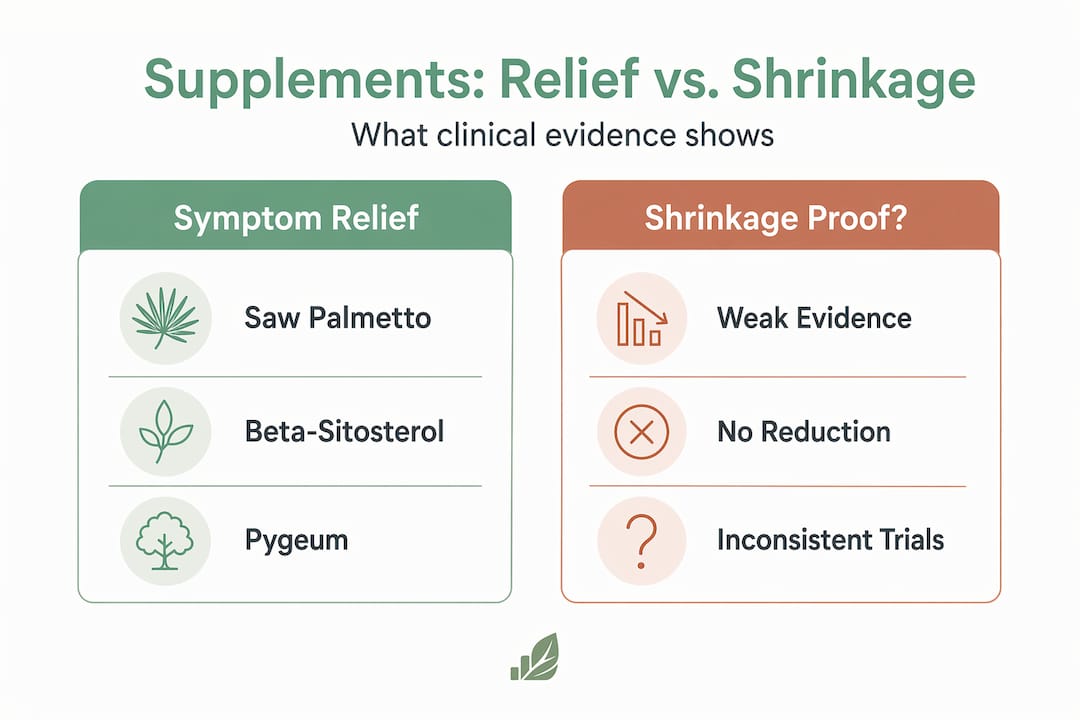
Beta-sitosterol, a plant sterol found in foods like nuts and plant oils, and pygeum, derived from African cherry tree bark, both have some supportive research. Meta-analyses suggest modest symptom relief evidence for both, but the sample sizes are small and the trials don’t consistently measure prostate volume. There is no strong evidence that either shrinks the prostate. They may reduce inflammation or affect urinary muscle tone, which can ease symptoms without touching the underlying tissue growth.
Pro Tip: When evaluating any prostate supplement, check whether the clinical study measured actual prostate volume via imaging. If it only measured symptom scores, it tells you nothing about physical size reduction.
Here’s a side-by-side look at what the evidence actually supports:
| Ingredient | Symptom relief evidence | Prostate volume reduction evidence |
|---|---|---|
| Saw palmetto | Weak to none (Cochrane review) | Not demonstrated |
| Beta-sitosterol | Moderate, small trials | Not demonstrated |
| Pygeum africanum | Moderate, limited data | Not demonstrated |
| Pumpkin seed extract | Mild, low-quality evidence | Not demonstrated |
| Lycopene | Preliminary, antioxidant only | Not demonstrated |
The pattern is consistent. Prostate volume is not meaningfully reduced by any of these ingredients across well-designed trials. What some ingredients may do is take the edge off your symptoms, which is worth something, but it is not the same as physically reducing the size of the gland.
For a thorough breakdown of what saw palmetto can and can’t do, the team at Rankofsupplements has published a detailed saw palmetto ingredient review covering the clinical data, dosing, and what to look for in a quality product.
Symptom relief vs. actual size reduction
This distinction deserves its own section because it explains why so many men swear by their prostate supplements even though the objective evidence is underwhelming.
Here is a simplified picture of what actually happens in BPH:
- The prostate gland grows due to hormonal changes over time.
- That growth narrows the urethra and weakens bladder muscle coordination.
- Urinary symptoms appear as a result of both the physical obstruction and nerve and muscle changes in the bladder.
- Some supplements may affect bladder muscle tone, reduce localized inflammation, or relax urethral smooth muscle.
- These effects improve your symptom score without reducing the prostate’s physical size.
This is why patient-reported improvements often don’t correspond to any measured change in prostate volume on imaging. You feel better, but the gland hasn’t gotten smaller. That’s not nothing. If you’re sleeping better and visiting the bathroom less frequently at night, your quality of life has improved. But if your goal was to actually reduce the size of the gland and prevent long-term complications like urinary retention, you may still be headed for those problems.
Placebo effects also play a real role here. Symptom improvements seen in trials sometimes reflect expectations and attention from participation, not pharmacological action. Saw palmetto in particular has been shown in high-quality trials to perform no better than placebo for BPH symptoms, yet many men report feeling significantly better when taking it.
This doesn’t mean the improvement you feel is fake. Subjective symptom relief is real and valuable. What it means is that clinical trials measuring prostate volume consistently fail to find the structural changes that some supplement companies imply are happening.
“Most prostate supplement studies measure symptom scales like the IPSS, not direct prostate size reduction by imaging. This leads to the misconception that supplements shrink the prostate when gland volume is not objectively reduced.”, Proactive Prostate
The implications for your health decisions are significant. If you’re relying on how you feel to gauge whether treatment is working, you may be missing important information about what’s actually happening inside.
Practical guidance if you’re considering supplements
None of this means you should throw away your prostate supplement or feel foolish for taking one. It means you should use it with clear, realistic expectations. Here’s how to think through this practically.
- Set the right goal. If you’re taking a supplement hoping to physically shrink your prostate, current evidence says that’s not what these products reliably do. If you’re hoping for modest symptom improvement that helps you sleep better or reduces urgency, that’s a more realistic outcome for some products.
- Choose quality over marketing. Not all saw palmetto or beta-sitosterol products are the same. Formulation differences strongly influence efficacy. Look for products with standardized extracts, third-party testing, and transparent labeling.
- Track your symptoms objectively. Use the IPSS questionnaire, which is freely available online, to score your symptoms before starting any supplement. Recheck your score after 8 to 12 weeks. This removes the bias of memory and impression from your evaluation.
- Tell your doctor. Many men don’t mention supplements to their physicians. Some supplements interact with medications, and your doctor may have relevant context about your prostate health that changes the risk-benefit calculation.
- Don’t let supplements delay real treatment. This is the most critical point. Delayed medical therapy for clinically significant BPH can lead to complications including urinary retention, kidney damage, and bladder dysfunction. Supplements do not prevent or reliably reverse significant prostate enlargement.
- Support supplement use with lifestyle changes. Diet, weight, physical activity, and alcohol intake all affect urinary symptoms. Reducing evening fluid intake, cutting caffeine and alcohol, and maintaining a healthy body weight can improve BPH symptoms as much or more than supplements.
Pro Tip: Before spending money on a prostate supplement, get a PSA test and a baseline prostate volume measurement from your urologist. This gives you objective data to compare against, so you know whether anything is actually changing.
Men who want to compare evidence-based options can check out Rankofsupplements’ curated list of best prostate supplements in 2026, which evaluates products based on ingredient quality, clinical backing, and user safety.
My honest take after reviewing the evidence
I’ve spent a significant amount of time reviewing clinical research on prostate supplements, and the pattern I keep running into is the same. The gap between what these products are marketed to do and what they actually do in well-designed studies is substantial. That gap isn’t an accident. It’s a result of how supplement companies choose which outcomes to highlight.
What frustrates me most is the “prostate health” framing that implies shrinkage without ever quite claiming it. Technically, a supplement that makes your bathroom trips slightly less urgent does support prostate health. But men over 40 who are worried about BPH are usually thinking about something more concrete. They want the gland to stop growing or get smaller. That’s a completely different biological target, and the current evidence says no supplement on the market reliably does that.
What I do think is worth acknowledging is that some men genuinely experience symptom relief from beta-sitosterol or high-quality saw palmetto extracts. If you’re in that group, that’s a real benefit worth something. I wouldn’t tell someone to stop taking something that’s safely improving their quality of life.
But I’d also say this: if your prostate symptoms are significantly affecting you and you’ve been managing them with supplements alone for more than six months, you’re probably past the window where supplements are the right primary strategy. BPH treatment guidelines in 2025 and 2026 are focused on objective clinical markers, not symptom diaries. Get measured. Know your prostate volume. Know your PSA. Then make decisions based on actual data, not how you feel on a Tuesday morning after a good night’s sleep.
Supplements can have a role in a broader prostate health plan. They’re not a replacement for medical evaluation, and they are not a reliable way to shrink the prostate. Both things can be true at the same time.
matteo
Find the right prostate supplement with confidence
Sorting through hundreds of prostate supplement products is genuinely hard when the marketing all sounds the same. Rankofsupplements was built exactly for this. The platform reviews supplements based on clinical evidence, ingredient quality, and transparency, not on which companies pay for promotion.
Whether you’re looking for a specific ingredient breakdown or want to compare the top-rated products in 2026, Rankofsupplements has you covered. The ingredient library covers every major compound used in prostate supplements, including the clinical data behind each one. If you want to browse supplements by health condition and find options specifically evaluated for prostate and urinary health, the health conditions directory gives you a direct, organized path to the most relevant products. Make a decision based on evidence, not a label claim.
FAQ
Do prostate supplements actually reduce prostate size?
No supplement has been shown to reliably reduce prostate volume in well-designed clinical trials. Most studies measure urinary symptom scores, not physical gland size, which is a critical distinction.
Is saw palmetto effective for BPH?
A Cochrane review of 27 trials found saw palmetto performs no better than placebo for prostate symptoms or volume. Some high-quality extracts show symptom improvement, but not consistent prostate size reduction.
What’s the difference between symptom relief and prostate shrinkage?
Symptom relief means urinary symptoms like urgency or weak flow improve, often due to effects on bladder muscle or inflammation. Prostate shrinkage means the gland physically decreases in volume, which supplements do not reliably achieve.
Can beta-sitosterol shrink an enlarged prostate?
Beta-sitosterol may offer modest urinary symptom relief based on limited trials, but there is no consistent evidence it reduces prostate volume. It’s better viewed as a symptom management option than a structural treatment.
When should I see a doctor instead of relying on supplements?
If your BPH symptoms are moderate to severe, if they’ve been worsening over several months, or if you’re relying on supplements as your only strategy, consult a urologist. Delaying proven medical treatment can lead to complications including urinary retention.
Recommended
- Saw Palmetto: Benefits, Dosage and Best Supplements for BPH, A deep dive into the most researched prostate ingredient on the market
- Best Prostate Health Supplements 2026, Rankofsupplements’ ranked list of the most evidence-backed prostate products this year
- Best Urinary Tract Support Supplements 2026, For men whose primary concern is urinary flow and bladder comfort
- Supplement Ingredient Library, Your go-to reference for understanding every compound used in prostate and men’s health supplements