TL;DR:
- Current research shows that NAD+ blood levels do not significantly decline with age, challenging previous assumptions. While supplements like NR and NMN reliably raise NAD biomarkers, their long-term health benefits remain unproven. NAD supplements are best viewed as metabolic support within a comprehensive healthy aging strategy rather than a standalone solution.
You have probably seen the headlines: NAD supplements can reverse aging, restore energy, and add years to your life. The claims sound compelling, especially if you are in your 40s and starting to feel the gap between how old you feel and how old you want to feel. But do NAD supplements really slow aging, or is the wellness industry selling you an expensive promise built on incomplete science? The answer is more nuanced than either the enthusiasts or the skeptics admit, and the latest 2026 research has shifted some of what we thought we knew.
Table of Contents
- Key takeaways
- Do NAD supplements really slow aging? Understanding the biology first
- What the clinical research actually shows
- Risks, side effects, and the misconceptions you should know
- Integrating NAD supplements into a real anti-aging strategy
- My honest take on NAD supplements after years of reviewing the evidence
- Find the right supplements for your anti-aging goals
- Recommended
- FAQ
Key takeaways
| Point | Details |
|---|---|
| NAD biology is real | NAD+ plays a genuine role in mitochondrial function and DNA repair, both linked to biological aging. |
| Blood levels stay stable | A 2026 Nature Metabolism study found whole-blood NAD+ does not reliably decline with age. |
| Supplements raise biomarkers | NR and NMN raise NAD-related markers in blood, but clinical outcomes remain inconsistent. |
| Risks exist | Theoretical cancer cell growth concerns and GI side effects are real considerations before starting. |
| Context is everything | NAD supplements work best as metabolic support alongside diet, exercise, and sleep, not instead of them. |
Do NAD supplements really slow aging? Understanding the biology first
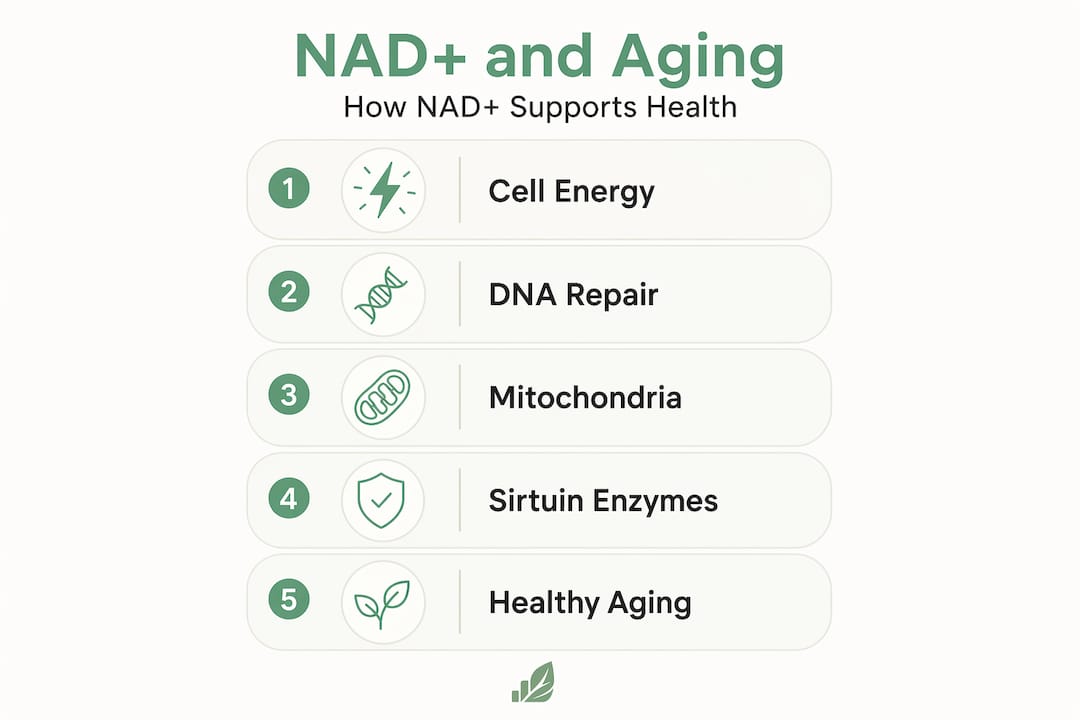
Before you can evaluate the claims, you need to understand what NAD actually does in your body. NAD stands for nicotinamide adenine dinucleotide. It is a coenzyme found in every living cell, and it plays a central role in converting food into cellular energy. Without NAD, your cells cannot produce ATP, the fuel that powers virtually every biological process.
More relevant to aging, NAD+ is deeply involved in two critical repair systems. The first is mitochondrial function and DNA repair, both of which deteriorate as you age. Mitochondria are the energy factories inside your cells, and when they start declining, you feel it in your fatigue levels, recovery time, and cognitive sharpness. The second system involves sirtuins, a class of proteins that regulate genomic stability and cellular stress responses. These proteins are heavily dependent on NAD+ availability to function correctly.
The hypothesis that drove the supplement industry’s interest in NAD was straightforward: if NAD+ levels drop as you age, and NAD+ is critical for cellular repair, then restoring NAD+ levels should slow down aging. That logic is not unreasonable. But here is where things get complicated.
You cannot simply swallow NAD+ and expect it to reach your cells intact. NAD+ is a large molecule that does not absorb efficiently through the gut wall. This is why most supplements on the market use precursors instead. The two most studied are:
- NR (Nicotinamide Riboside): A form of vitamin B3 that the body converts into NAD+ after absorption.
- NMN (Nicotinamide Mononucleotide): Another precursor that enters NAD+ biosynthesis pathways at a different step, and has attracted significant research interest since 2020.
Both NR and NMN have shown the ability to raise NAD-related biomarkers in human studies. What those raised biomarkers actually translate to in terms of long-term health is the core of the debate.
Pro Tip: If you see a supplement marketed simply as “NAD+” rather than NR or NMN, check the label carefully. Direct NAD+ supplementation faces serious absorption limitations that precursor forms do not.
What the clinical research actually shows
Here is where the story gets genuinely interesting, and where a lot of popular coverage gets it wrong.
The dominant narrative around NAD supplements anti-aging claims has been built on a foundational assumption: that NAD+ levels fall significantly as you age, making supplementation necessary. A 2026 Nature Metabolism study challenged that assumption directly. Researchers found that whole-blood NAD+ levels remain remarkably stable with age and are not meaningfully altered by lifestyle interventions. That is a significant finding. If blood NAD+ does not actually decline the way the marketing suggests, the core premise of supplementation needs re-examination.
That said, blood levels may not tell the full story. Blood NAD+ may not reflect tissue-specific dynamics in organs like the brain, liver, or muscle, where aging-related NAD changes may matter more. This is a critical limitation in current research and part of why the science remains genuinely unsettled.
Here is what the current clinical data does and does not support:
| Outcome Measured | Evidence Level | Notes |
|---|---|---|
| Raised NAD+ biomarkers | Consistent across studies | NR and NMN reliably increase blood markers |
| Improved energy metabolism | Preliminary, inconsistent | Some positive signals, not replicated reliably |
| Enhanced cognitive function | Very limited evidence | Short-term trials only, mixed results |
| Physical performance gains | Small studies, mixed data | No large-scale confirmation |
| Slowed biological aging | No confirmed human evidence | Animal data promising but not translated |
| Extended human lifespan | No evidence | Not studied in long-term human trials |
A 2026 PRISMA systematic review synthesized existing trial data and found that while oral NR and NMN supplements do increase biochemical NAD-related biomarkers, their effects on actual health and wellness outcomes are inconsistent. The biological activity is real. The clinical payoff remains unclear.
As of 2026, major medical commentary confirms that there is not enough human evidence to state that oral NAD+ supplements slow aging or extend lifespan. The research is still developing, and long-term benefits and risks are not yet established.
The core limitations across nearly all human trials include:
- Most studies run for 12 weeks or less, making it impossible to measure effects that unfold over years or decades.
- Sample sizes are often small, sometimes under 50 participants.
- Studies measure biomarkers rather than functional aging outcomes like disease incidence or lifespan.
- Populations vary widely, making results difficult to generalize.
Pro Tip: When evaluating any NAD supplement study, ask one question: did they measure an actual health outcome, or just a blood marker? A rising biomarker is not the same as a clinical benefit.
Risks, side effects, and the misconceptions you should know
The marketing around NAD supplements and longevity often skips the part about risks. That is a problem, because several real concerns deserve your attention before you spend money on a high-dose NMN or NR protocol.
The most commonly reported side effects from oral supplementation are mild but worth knowing: nausea, diarrhea, and general GI discomfort. These appear to be dose-dependent, meaning higher doses increase the likelihood of symptoms. At moderate doses, most people tolerate both NR and NMN reasonably well. But “tolerated well” and “proven effective” are not the same thing.
The bigger concern, and one that is not discussed nearly enough in wellness circles, is a theoretical risk connected to cancer cell growth. Because NAD+ supports cellular energy production broadly, there is a hypothesis that elevated NAD+ levels could also fuel the growth of cancer cells. This is not a confirmed risk at standard supplementation doses, but the Cleveland Clinic flags it as a theoretical concern that requires more research before being ruled out. Anyone with a personal or family history of cancer should absolutely discuss NAD supplementation with a physician before starting.
Then there are intravenous NAD+ infusions, which have become a major business in wellness clinics across the US. These are marketed as delivering NAD+ directly to the bloodstream for faster, stronger effects. The problem is that IV NAD+ faces biochemical barriers that limit how efficiently it enters cells. NAD+ does not have an easy door into cells, which means the infusions are expensive, time-consuming, and not supported by strong evidence. Reports of side effects from infusions include cramping and nausea during the procedure itself.
“The enthusiasm for NAD supplements is high, but large, long-term human studies are needed before drawing conclusions on anti-aging benefits.”, NPR
A common misconception worth addressing directly: the popular belief that NAD+ levels inevitably decline with age in ways that supplementation can fix is not well supported by current blood-level data. The popular idea that NAD+ inevitably declines may be overstated, at least as measured in whole blood. This does not mean NAD biology is irrelevant to aging. It means the supplement industry’s story is significantly ahead of the evidence.
Integrating NAD supplements into a real anti-aging strategy
If you are between 30 and 60 and genuinely interested in slowing biological aging, the most useful framing for NAD supplements is this: they are potentially useful metabolic support, not a standalone intervention. NAD supplementation works best within a broader longevity strategy that addresses the foundational drivers of aging through lifestyle.
Here is how to build that context practically:
-
Prioritize lifestyle foundations first. Exercise is the single most studied intervention for preserving NAD-dependent cellular processes, particularly in muscle tissue. Resistance training and high-intensity intervals both appear to support mitochondrial health more reliably than any supplement currently on the market.
-
Support NAD levels through diet. Foods rich in vitamin B3 and its precursors, including turkey, chicken, salmon, peanuts, and whole grains, provide the raw material your body uses to synthesize NAD+. Caloric restriction and time-restricted eating have also shown links to NAD pathway activity in animal models.
-
Protect your sleep. NAD-dependent repair processes, including DNA repair via PARP enzymes, are strongly tied to circadian rhythm and deep sleep. A sleep-disrupted metabolic environment accelerates oxidative stress in ways no supplement fully compensates for.
-
Evaluate supplements critically. When you look at an NR or NMN product, check for third-party testing, transparent ingredient disclosure, and clinical data behind the specific form used. Rankofsupplements provides detailed, evidence-based supplement reviews to help you cut through marketing claims and focus on what is actually supported.
-
Consult your doctor before starting. This is especially true if you have any metabolic conditions, take medications, or have a personal or family cancer history. NAD+ influences so many cellular pathways that interactions and individual variability are real considerations, not just legal disclaimers.
-
Set realistic expectations. If you start an NMN supplement hoping to feel dramatically younger within two months, you will likely be disappointed. If you view it as one piece of a larger metabolic health effort, the calculus looks different. The best outcomes with NAD supplements in human studies have appeared in people who already maintain strong lifestyle habits, not as replacements for them.
The adults who get the most value from understanding NAD biology are not the ones buying the most expensive supplements. They are the ones using that knowledge to make smarter, more informed decisions about a complete strategy for healthy aging and longevity.
My honest take on NAD supplements after years of reviewing the evidence
I have spent years reading supplement research, and I will be direct with you: the NAD space is one of the most interesting and one of the most overhyped corners of the longevity industry at the same time.
The biology is genuinely fascinating. The role NAD+ plays in mitochondrial function, DNA repair, and sirtuin activity is well-established science. When I read about animal studies showing lifespan extension with NMN supplementation, I understand why people get excited. So do I. But animal studies have a long history of not translating to human outcomes, and NAD is not an exception to that pattern yet.
What bothers me most is not the science. It is the marketing that has raced ahead of it. When a wellness clinic charges $500 for an IV NAD+ infusion and tells customers it will reverse their biological age, they are making a claim the evidence does not support. The people most vulnerable to those claims are also the most motivated to believe them, because they genuinely care about their health and are willing to invest in it.
Here is what I have found after reviewing this category closely: the people who seem to benefit most from NAD precursor supplementation are those who have serious nutritional gaps, are managing metabolic conditions, or are working with a physician in a monitored protocol. Not the average healthy adult adding it to a stack of ten other supplements.
The most uncomfortable truth about the NAD and longevity question is this. If you sleep poorly, do not exercise consistently, eat a poor diet, and manage chronic stress badly, no supplement, including NMN or NR, will meaningfully slow your aging. The mechanisms NAD supplements are supposed to support require a functional baseline to build on.
My recommendation is to treat NAD supplements the way you would treat a quality B-vitamin: potentially useful, unlikely harmful at standard doses, definitely not a substitute for the hard work of living well.
matteo
Find the right supplements for your anti-aging goals
If you are serious about understanding which supplements genuinely support healthy aging and which ones are marketing dressed up as science, Rankofsupplements is built for exactly that purpose. The platform provides science-backed supplement rankings with transparent methodology, so you are not guessing which NR or NMN products are actually formulated well and third-party tested.
You can explore the full supplement ingredient library to understand exactly what NR, NMN, and other NAD-related compounds are, how they are studied, and what the current evidence says about each one. For adults focused on longevity and metabolic health, the supplements by health goal section organizes top-ranked options by specific outcomes, so you can make choices aligned with your actual health priorities rather than the latest wellness trend.
The goal is not to tell you what to buy. It is to give you the information you need to decide for yourself, with confidence.
Recommended
- Science-backed supplements for vision and aging
- Best longevity supplements in 2026
- Top-ranked supplement reviews and ratings
- Evidence-based guide to supplements for skin aging
FAQ
Do NAD supplements actually slow down aging in humans?
As of 2026, no confirmed human evidence shows that oral NAD supplements slow aging or extend lifespan. They raise NAD-related biomarkers reliably, but whether that translates to meaningful anti-aging outcomes remains unproven.
What is the difference between NAD+, NR, and NMN?
NAD+ is the active coenzyme your cells use, but it absorbs poorly when taken orally. NR and NMN are precursor molecules that your body converts into NAD+ after absorption, and they are the forms used in most supplements and clinical trials.
Are NAD supplements safe to take?
Most adults tolerate NR and NMN at standard doses with only mild GI side effects. However, a theoretical cancer cell growth concern exists, and anyone with a health condition or cancer history should consult a physician before starting.
Do NAD levels actually decline with age?
A 2026 Nature Metabolism study found that whole-blood NAD+ levels do not reliably decline with age, which challenges a core assumption behind much of the supplement marketing. Tissue-level dynamics may differ, but blood-level decline is not as established as commonly claimed.
Are NAD IV infusions better than oral supplements?
No strong evidence supports IV NAD+ infusions as superior to oral precursors. IV NAD+ faces cellular uptake barriers that reduce efficiency, and the infusions commonly cause unpleasant side effects like nausea and cramping during administration.