
TL;DR:
- Collagen supplements can help reduce joint pain when taken at proper doses over 12 to 24 weeks.
- Effective forms include hydrolyzed collagen peptides (10g daily) and undenatured type II collagen (40mg daily).
- Combined with lifestyle changes, these supplements offer moderate but meaningful improvements in joint function and pain relief.
If you’re dealing with stiff knees, aching hips, or the grinding discomfort of worn-down cartilage, you’ve probably seen collagen supplements marketed as a near-miraculous fix. The reality is more nuanced. Do collagen supplements help with joint pain? The short answer is yes, but conditionally. Research shows real benefits, particularly with the right form, the right dose, and enough time. What the research does not support is treating collagen as a standalone cure. This article breaks down exactly what the science says, which type of collagen actually works for joints, and how to use it intelligently as part of a broader strategy.
Table of Contents
- Key takeaways
- Do collagen supplements help with joint pain? Here’s what science says
- What the clinical research actually shows
- How to choose the right collagen supplement for joints
- Building a joint health strategy that actually works
- Side effects, risks, and common misconceptions
- My take on collagen for joint pain
- Find the right collagen supplement with Rankofsupplements
- FAQ
Key takeaways
| Point | Details |
|---|---|
| Collagen shows real benefits | Clinical evidence supports moderate improvements in joint pain and function, especially in osteoarthritis. |
| Dose and form matter significantly | Effective relief requires at least 10g daily of hydrolyzed peptides or 40mg of UC-II, not the small doses in most beauty products. |
| Results take weeks, not days | Studies consistently show benefits emerge after 12 to 24 weeks of consistent daily use. |
| Collagen works best as a complement | Physical activity, weight management, and medical care remain the primary tools for joint health. |
| Not all products are equal | Look for “hydrolyzed collagen” on the label to confirm proper absorption potential before buying. |
Do collagen supplements help with joint pain? Here’s what science says
To understand why collagen supplements even entered the joint pain conversation, you need to understand what collagen actually does inside a joint.
The structure collagen builds
Collagen is the most abundant structural protein in the human body. It forms the scaffolding for skin, tendons, ligaments, and cartilage. For joints specifically, Type II collagen is the most critical player. It makes up roughly 90 percent of the collagen in articular cartilage, the smooth tissue that cushions the ends of your bones where they meet. Type I collagen supports tendons and ligaments that hold joints together. Without adequate collagen, that cushioning layer breaks down, friction increases, and pain follows.
Here’s what matters for supplement users: your body produces less collagen as you age. Production starts declining around your mid-20s, and by your 40s and 50s, the drop is significant. For people already living with osteoarthritis or repetitive-strain joint pain, this decline accelerates the wear on cartilage that’s already compromised. The logic behind supplementing is sound at a biological level. You’re giving your body the building blocks it needs to maintain and support the cartilage matrix.
The main collagen types relevant to joint health:
- Type I: Found in tendons, ligaments, and bone. Supports the structural integrity around joints.
- Type II: The primary component of articular cartilage. The most clinically relevant type for osteoarthritis and knee pain.
- Type III: Often found alongside Type I. Supports soft tissue around joints.
Pro Tip: If your primary concern is knee or hip joint pain from cartilage wear, prioritize a supplement specifically containing Type II collagen rather than a generic multi-collagen blend. The targeted form is what clinical trials have actually tested.
What the clinical research actually shows
This is where the conversation gets more precise. A review of 113 clinical trials published by March 2026 found that collagen supplementation was linked to moderate improvements in joint pain and muscle health, with benefits building gradually over time. That word “moderate” is doing a lot of work. It means real, measurable improvement, not dramatic reversal of joint damage.
“Collagen peptides are a useful but limited tool in joint pain management, best when part of a holistic plan including physical therapy and weight control.”, Dr. John McCallum, via Hartford HealthCare
The clinical trials that produced meaningful outcomes used specific dosages over specific timeframes. Research confirms that daily doses of 10g hydrolyzed collagen peptides or 40mg of undenatured type II collagen (UC-II) are required for symptom relief in knee osteoarthritis, typically over 12 to 24 weeks. That’s a long runway. Most people who try collagen for two weeks and feel nothing have simply not waited long enough.
Here’s a breakdown of what the evidence shows across key outcome measures:
| Outcome measure | Evidence strength | Typical timeframe |
|---|---|---|
| Reduced knee pain (VAS scale) | Moderate to strong | 12 to 24 weeks |
| Improved physical function | Moderate | 12 to 24 weeks |
| Reduced stiffness (WOMAC index) | Moderate | 12 to 24 weeks |
| Cartilage regeneration | No evidence | Not applicable |
| Complete pain elimination | No evidence | Not applicable |
Individual responses vary considerably. Younger individuals with mild to moderate joint wear tend to respond better than those with advanced osteoarthritis where cartilage is severely degraded. People who are physically active also tend to see better results, possibly because movement encourages the distribution of collagen peptides to joint tissues. According to expert commentary from Dr. McCallum, supplements are not guaranteed solutions and must complement other treatments rather than replace them.
For deeper research on how collagen peptide dosing translates to outcomes, the evidence-based breakdown at Rankofsupplements covers optimal dosing and treatment length in useful clinical detail.
How to choose the right collagen supplement for joints
Not all collagen products on the shelf are built to help your joints. Many are formulated for skin and hair, and while there’s overlap, the doses used in beauty products are often far too low to produce joint benefits. This distinction matters enormously when you’re buying.

Hydrolyzed collagen peptides vs. UC-II
These are the two forms with the most clinical backing for joint pain.
Hydrolyzed collagen peptides (also called collagen hydrolysate) are broken down into smaller amino acid chains through an enzymatic process. This breakdown is what makes them absorbable. Pharmacist Dr. Pupinder Ghatora has stated that absorption matters more than source, and hydrolyzed collagen is more effective precisely because of better peptide breakdown. You can get hydrolyzed collagen from bovine (cow) or marine (fish) sources. Both work. Marine collagen tends to have slightly smaller peptides, which may improve absorption marginally, but the research does not show clinically significant differences between sources. If you have a fish allergy, stick to bovine.
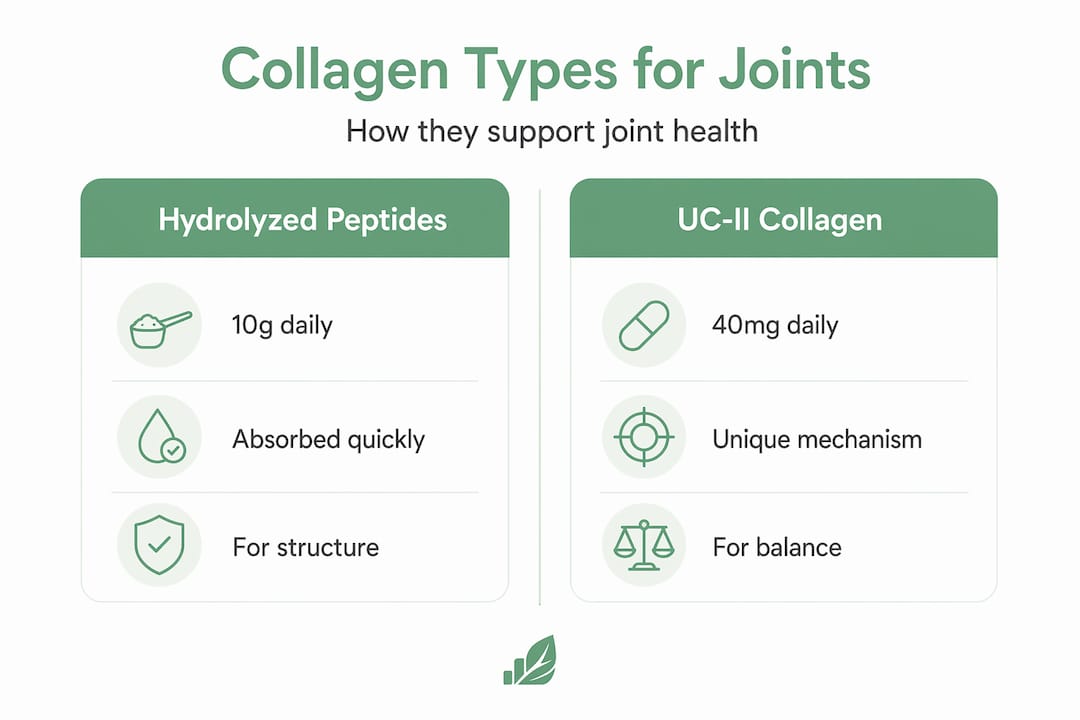
Undenatured type II collagen (UC-II) works through a different mechanism entirely. Rather than providing building blocks, UC-II is thought to work through oral tolerance, a process where a small, intact protein fragment signals the immune system to reduce its inflammatory attack on cartilage. This is why UC-II works at a much lower dose (40mg vs. 10g). It’s particularly relevant for people with inflammatory joint conditions.
| Feature | Hydrolyzed collagen peptides | Undenatured type II (UC-II) |
|---|---|---|
| Effective daily dose | 10g | 40mg |
| Mechanism | Supplies amino acid building blocks | Modulates immune response via oral tolerance |
| Best for | General joint support, active individuals | Inflammatory joint pain, early osteoarthritis |
| Source options | Bovine, marine | Typically chicken sternum |
| Typical product format | Powder, capsule | Capsule |
Pro Tip: When reading a collagen product label, the word “hydrolyzed” or “peptides” must appear. If the label just says “collagen protein,” the molecular weight is likely too high for meaningful absorption in joint tissue. Many consumer products labeled for beauty use contain doses far below what joints require.
For athletes and active individuals, research on how peptides support joint recovery offers additional context on why the form and dose combination determines outcomes.
Building a joint health strategy that actually works
Collagen works. But collagen alone, taken sporadically, is not a strategy. If you’re serious about reducing joint pain, here’s how to integrate collagen intelligently.
-
Start with the foundations. Research consistently shows that lifestyle modifications like gentle movement and healthy weight are foundational for managing arthritis-related joint pain. Low-impact exercise such as swimming, cycling, and walking reduces joint load while maintaining the muscle support that joints depend on. Losing even 10 pounds reduces compressive force on knee joints by roughly 40 pounds per step.
-
Add collagen at the right dose. Once your activity and weight management plan is in place, bring in 10g daily of hydrolyzed collagen peptides or 40mg of UC-II. This is the dosage range that clinical trials actually used. Going lower is likely insufficient.
-
Be consistent. Consistency over time is the deciding factor in whether collagen produces meaningful joint benefits. Short-term or sporadic use yields minimal effects. Commit to a minimum of 12 weeks before evaluating whether it’s working.
-
Time it around exercise when possible. There is no universally best time to take collagen, but taking it 30 to 60 minutes before physical activity may enhance delivery to joint and muscle tissue while those areas have increased blood flow. This is a practical optimization, not a strict rule.
-
Track your baseline. Before you start, rate your typical pain level on a simple 1 to 10 scale and note your range of motion limitations. Reassess at 6 weeks and 12 weeks. Subjective improvement is easy to miss when it happens gradually, and having a baseline prevents you from dismissing real progress.
-
Keep your doctor in the loop. Collagen is generally safe, but if you’re managing a diagnosed condition like rheumatoid arthritis or have advanced osteoarthritis, your treatment plan should be supervised. Collagen is a complement to medical care, not an alternative.
For a broader look at what works alongside collagen, Rankofsupplements has a well-researched guide on natural anti-inflammatory supplements that pair well with a collagen protocol.
Side effects, risks, and common misconceptions
The safety profile of collagen supplements is generally good. Most people tolerate them well, and serious adverse effects are rare. That said, there are things worth knowing before you start.
Typical mild side effects include:
- Digestive discomfort such as bloating or a feeling of fullness, especially with powder forms
- A slight aftertaste with some marine-sourced products
- Rare allergic reactions in people with fish or shellfish allergies (relevant for marine collagen only)
Beyond side effects, the bigger risk with collagen supplements is misplaced expectations.
Common misconceptions to clear up:
- “Collagen will rebuild my cartilage.” It won’t. Clinical evidence confirms that collagen does not reverse established osteoarthritis or regrow lost cartilage. The benefits are analgesic and functional. That’s still worth pursuing, but it’s a different promise.
- “More collagen means faster results.” Dosage above the clinical threshold doesn’t accelerate outcomes. Doubling up on collagen powder doesn’t double the benefit.
- “If it worked for someone else, it’ll work for me.” Individual response varies based on the stage of joint disease, activity level, body weight, and diet. Someone with mild joint wear will likely see more improvement than someone with bone-on-bone arthritis.
- “Any collagen supplement will do.” As covered above, product quality and form matter significantly. A low-dose beauty collagen is not a joint health supplement.
My take on collagen for joint pain
I’ve spent years reviewing supplement research and talking with people who are genuinely frustrated by joint pain. And here’s what I’ve learned: the people who benefit most from collagen are the ones who treat it as one piece of a system, not a shortcut.
In my experience, the biggest failure mode isn’t buying the wrong product. It’s expecting collagen to compensate for habits that haven’t changed. I’ve seen people add 10g of collagen daily and keep sedentary routines, then conclude “it doesn’t work.” The research is clear that collagen works best as a complementary adjunct to foundational practices. Without movement and load management, you’re missing the context that makes collagen useful.
What I find genuinely underappreciated is the UC-II mechanism. Most of the public conversation focuses on hydrolyzed collagen peptides because they’re easier to market as a powder you add to coffee. But for people with inflammatory joint pain, the immune-modulating pathway of UC-II is fascinating and potentially more relevant. The dose is tiny, the mechanism is distinct, and it’s largely ignored outside of clinical circles.
My honest recommendation: if you’re considering collagen for joints, start with a 12-week commitment to a quality hydrolyzed collagen product at 10g daily, combined with a consistent low-impact exercise routine. Reassess honestly at the end of that window. If improvement is modest, consider switching to UC-II. The collagen for joint health guide at Kudu Nutrition offers a practical framework for structuring this kind of phased approach. Either way, be patient. Gradual and real beats fast and fictional.
matteo
Find the right collagen supplement with Rankofsupplements
Knowing the science is one thing. Choosing a product that actually delivers the right form and dose is another challenge entirely.
Rankofsupplements exists to close that gap. The platform’s supplement ingredient library gives you detailed, science-backed breakdowns of collagen types, bioavailability data, and clinical dosage standards, so you can evaluate any product label with confidence. For ready-to-use guidance, the best joint health supplements rankings for 2026 include thoroughly reviewed collagen formulations vetted against clinical dosage thresholds. You won’t find filler-heavy beauty products dressed up as joint supplements here. Just honest, evidence-based rankings built for people who want real relief.
FAQ
Do collagen supplements really help with joint pain?
Yes, clinical evidence supports moderate improvements in joint pain and physical function, particularly for knee osteoarthritis, but results require consistent use over 12 to 24 weeks at therapeutic doses.
How much collagen do you need for joint health benefits?
Research shows that effective joint relief requires at least 10g daily of hydrolyzed collagen peptides or 40mg of undenatured type II collagen (UC-II). Most beauty-focused products fall below these thresholds.
How long before collagen supplements reduce joint pain?
Most clinical trials showing meaningful outcomes ran for 12 to 24 weeks. Expecting noticeable results in two to four weeks is unrealistic based on current evidence.
Is hydrolyzed collagen better than regular collagen for joints?
Yes. Hydrolyzed collagen’s smaller peptide chains are significantly better absorbed by the body, which is why it outperforms non-hydrolyzed collagen in clinical joint pain studies.
Can collagen supplements help with arthritis?
Collagen can provide modest pain relief and functional improvement for osteoarthritis, and UC-II may help with inflammatory joint conditions. However, collagen does not reverse joint damage and should be used alongside medical treatment, not instead of it.
Recommended reading
- Related article: Top 4 Natural Anti-Inflammatory Supplements for Arthritis Alternatives 2026
- Top list: Best Joint Health Supplements 2026
- Specific ingredient: Collagen Peptides: Benefits, Dosage & Best Supplements
- Condition guide: Best Supplements for Joint Pain & Osteoarthritis