
CLA produces small, often negligible reductions in body weight and fat mass in humans, and the effect is nowhere near what the marketing suggests. The best pooled estimate from a 2023 dose-response meta-analysis puts the average loss at roughly 0.09 kg per week at a dose of about 3.2 grams daily. That works out to a modest amount per month for most people, and it assumes you’re one of the responders.
If you’re already overweight or obese and want to test it, a cautious trial of a few weeks at around 3 grams a day is reasonable. If you have liver disease, diabetes, or you’re pregnant or breastfeeding, skip it. Diet and activity still do the heavy lifting here; CLA is, at best, a minor assist.
The magnitude, in plain terms: at the dose most trials use, you’re looking at roughly 0.09 kg (about 0.2 lb) lost per week attributable to CLA specifically, based on pooled data from randomized trials. Stack that over 12 weeks and you get a little over a pound, on average, with meaningful person-to-person variation and some studies finding nothing at all.
Key Takeaways
CLA produces small, dose-dependent reductions in weight and fat mass in some overweight or obese adults but the effect size is modest and inconsistent across high-quality trials.
| Point | Details |
|---|---|
| Realistic verdict | Expect roughly 0.09 kg per week of fat loss at best, not dramatic results, based on pooled trial data. |
| Who might benefit | Overweight or obese adults at doses of 3 grams or more daily show the clearest, though still modest, subgroup signal. |
| Trial dose and timeline | Use about 3 grams daily for 6 to 12 weeks; effects tend to plateau rather than keep climbing with higher doses. |
| Safety red flags | Stop and consult a clinician for persistent GI symptoms, unusual fatigue, or jaundice; avoid CLA with liver disease, diabetes, or pregnancy. |
| Next step | Check product-specific dosing and testing status on Rankofsupplements before choosing a CLA supplement to trial. |
Table of Contents
- What Is CLA and Where Does It Come From?
- How Is CLA Supposed to Help With Fat Loss?
- What Do the Clinical Trials Actually Show?
- How Much CLA Should You Take, and in What Form?
- What Side Effects and Safety Concerns Should You Know About?
- Does CLA Interact With Medications or Other Supplements?
- Should You Try CLA, and How Do You Run a Fair Trial?
- An Honest Take on Where CLA Fits
- Where to Check CLA Products Before You Buy
- Sources
- FAQ
What Is CLA and Where Does It Come From?
Conjugated linoleic acid is a family of fatty acids found naturally in beef, lamb, and dairy fat, and sold separately as a concentrated supplement. The two isomers you’ll actually encounter matter more than the umbrella term “CLA” suggests, and most people never learn the difference before buying a bottle.
The two forms researchers focus on are cis-9, trans-11 (the dominant isomer in dairy and meat) and trans-10, cis-12 (the one most implicated in fat metabolism in lab studies). Commercial supplements almost always use a roughly 50/50 blend of both, manufactured from safflower or sunflower oil rather than extracted from animal fat. That’s a meaningfully different product from what’s naturally in a steak or a glass of whole milk, and it changes both the isomer ratio and, potentially, the effect you get.
- Natural food sources deliver small amounts of primarily the 9,11 isomer, often less than 100 mg per serving.
- Supplements deliver concentrated doses, typically 1,000 to 1,200 mg per softgel, aiming for the 3 gram range trials used.
- Grass-fed dairy and beef contain higher natural CLA levels than grain-fed sources, but still nowhere close to supplemental doses.
- Manufacturing origin (safflower/sunflower oil) means the isomer composition differs from ruminant-derived CLA, and this rarely appears on the label.
Most labels list “CLA” as a single ingredient without breaking out the isomer ratio, which is a real problem if you’re trying to compare products or replicate a specific study’s dosing.
Pro Tip: Check the supplement facts panel for the actual milligrams of CLA per serving, not just “1,000 mg fish oil blend” style labeling. Some products bury the real CLA content behind filler oils, so you’d need three or four capsules to hit the 3 gram dose most trials tested.
How Is CLA Supposed to Help With Fat Loss?
The proposed mechanisms come almost entirely from rodent studies, and the gap between what happens in a mouse and what happens in a person taking a softgel every morning is enormous.
Fat cell metabolism
In animal models, CLA appears to shift how fat cells store and release energy, partly by influencing enzymes involved in lipogenesis (fat creation) and encouraging some fat cells toward apoptosis, or programmed cell death. Some research also points to increased fat oxidation, meaning cells burn more fat for fuel rather than storing it.

Isomer-specific effects
The trans-10, cis-12 isomer is the one most tied to these metabolic changes in lab settings, while cis-9, trans-11 seems metabolically closer to neutral. Since commercial supplements blend both isomers roughly evenly, you’re only getting a partial dose of whichever isomer actually does the work, diluted by one that mostly doesn’t.
Why mice respond and people mostly don’t
Mouse studies often use doses far higher, relative to body weight, than anything a human would tolerate or that manufacturers include in a bottle. Mice also have different fat distribution, activity levels, and metabolic rates than humans. Add in inconsistent compliance in human trials, variable diets that aren’t controlled, and isomer ratios that vary by manufacturer, and you get the muted, inconsistent results seen across the human literature. Consumer health reviews note that CLA may preferentially affect subcutaneous fat over visceral fat in animal models, and human data doesn’t convincingly show the same metabolically favorable pattern.
There’s also a subtler issue: fat-free mass. A few trials show CLA nudging lean mass up slightly while fat mass drops slightly, but these findings appear mostly in specific subgroups, like women or people already overweight, not across the board.
What Do the Clinical Trials Actually Show?
The human evidence, taken as a whole, supports a small effect at best, and the higher-quality the trial, the smaller that effect tends to look.
The most current pooled analysis, a 2023 systematic review and dose-response meta-analysis, found only small decreases in body mass, BMI, and waist circumference across the trials it reviewed. Translated into a weekly rate, that comes out to about 0.09 kg per week at roughly 3.2 grams daily. An earlier meta-analysis reached a similar conclusion: modest fat-mass reductions at the same dose range, with a dose response effect that appears to plateau by around six months rather than continuing indefinitely.
Subgroup data adds an important wrinkle. Benefits concentrate in overweight or obese participants taking at least 3 grams daily, not in lean, active people. And separately, studies with stronger methodology are less likely to find a significant fat-loss effect than the lower-quality trials that get cited most often in marketing copy. That’s a pattern worth taking seriously: it suggests some of the “CLA works” narrative rests on the weaker end of the evidence base.
The heterogeneity problem: trials differ wildly in isomer ratio, placebo composition, participant baseline weight, and duration. A 2015 clinical evidence review compiling these RCTs found modest effects in some studies alongside flagged concerns about insulin and lipid changes in others, which is exactly the kind of mixed signal that should make you skeptical of any single study waved around as proof. Placebo choice matters too: when a trial’s placebo fatty acid profile isn’t carefully matched to the CLA group, the “difference” researchers measure may partly reflect the placebo, not the CLA.
How Much CLA Should You Take, and in What Form?
Trials testing CLA for fat loss have mostly clustered in a narrow dose range, and going higher hasn’t reliably meant better results.
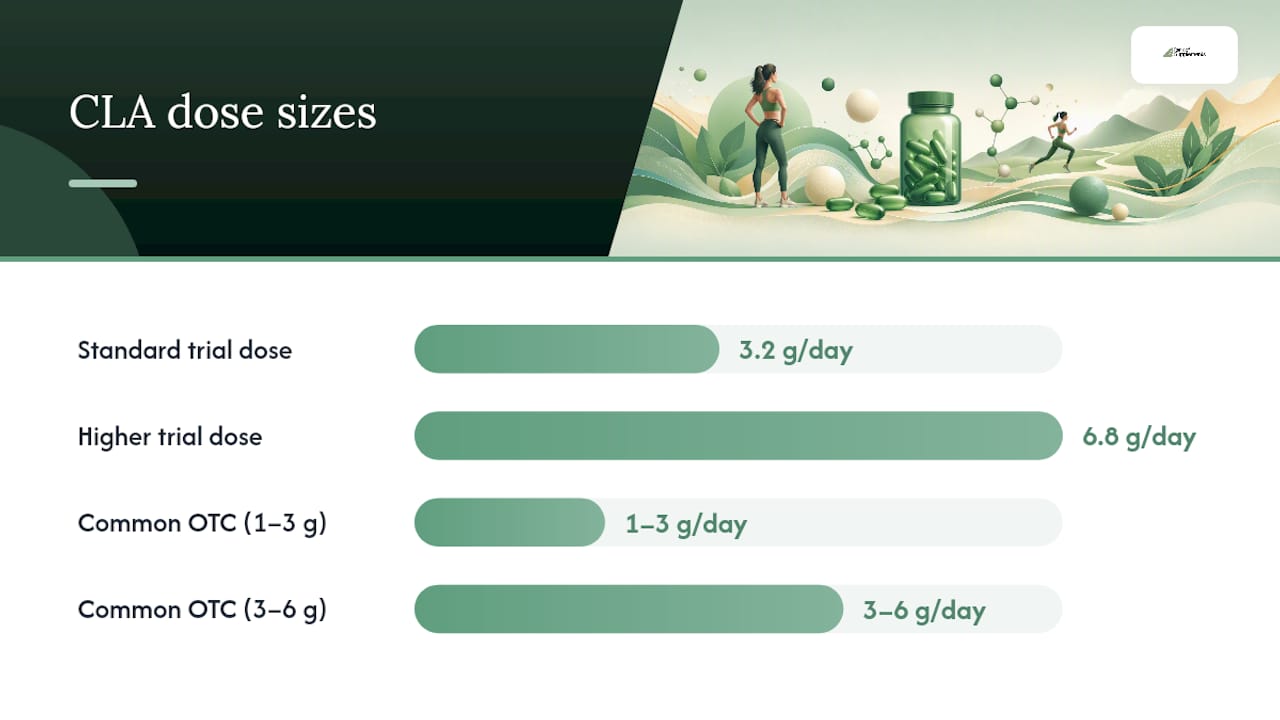
Most effective trials landed between 3 and 3.2 grams per day, though some studies pushed as high as 6.8 grams daily without proportionally larger benefits. This isn’t a case where doubling the dose doubles the outcome. The dose response relationship that does exist appears to level off rather than climb linearly, which means megadosing mostly buys you extra cost and a higher chance of gastrointestinal side effects, not extra fat loss.
| Parameter | Trial dose used | Common OTC label dose | Suggested trial length | Dose-dependent? |
|---|---|---|---|---|
| Standard protocol | 3.2 g/day | 1,000 to 3,000 mg/day (varies by brand) | 6 to 12 weeks | Yes, up to a point, then plateaus |
| Higher-dose protocol | Up to 6.8 g/day | 3,000 to 6,000 mg/day | 12+ weeks | Minimal added benefit past ~3.2 g |
On form: mixed-isomer softgels dominate the market, almost all sourced from safflower or sunflower oil rather than animal fat. Single-isomer products exist but are rare and harder to verify, since most labels don’t disclose the actual isomer breakdown. Whole-food approaches (grass-fed beef, full-fat dairy) supply far smaller amounts and won’t get you anywhere near trial doses.
Before buying, check the label for:
- Total milligrams of CLA per serving, not just total softgel weight.
- Isomer ratio disclosure, if the manufacturer provides it (most don’t).
- Third-party testing seals (NSF, USP, or Informed Choice).
- Allergen information, since safflower and sunflower oils carry their own allergen risks.
- Serving size needed to reach 3 grams daily, since some products require four or more capsules.
If verifying any of this feels like guesswork, Rankofsupplements’ guide to spotting fake or mislabeled supplements walks through exactly what testing seals and label claims actually mean.
What Side Effects and Safety Concerns Should You Know About?
The most common complaints are digestive, but there are a handful of signals worth taking more seriously before you commit to a bottle.
- Gastrointestinal symptoms: nausea, diarrhea, and stomach discomfort are the most frequently reported side effects across trials.
- Rare case reports of liver injury have surfaced in clinical literature, though this remains uncommon rather than a dominant safety signal.
- Some studies report adverse shifts in lipid profiles or reduced insulin sensitivity in certain participants, particularly at higher doses.
- Long-term safety data beyond about six months to a year is thin, so anyone considering extended use is working with an incomplete picture.
The safety verdict in one line: CLA supplements aren’t reviewed by the FDA the way prescription drugs are, so quality and purity vary by brand, and you should stop and check with a clinician if you notice persistent GI symptoms, unusual fatigue, or signs of jaundice. The FDA’s GRAS notification framework covers certain food-use levels up to 1.5 grams per serving, which is a different regulatory lane entirely from the 3 gram supplemental doses used in weight-loss trials.
People who should avoid CLA or talk to a doctor first: anyone with existing liver disease, people with diabetes or prediabetes (given the insulin sensitivity signal), pregnant or breastfeeding people, and anyone on blood thinners or multiple prescription medications.
Does CLA Interact With Medications or Other Supplements?
If you take anything that affects blood clotting, blood sugar, or liver function, this section matters more than the dosing chart above.
- Blood thinners and antiplatelet medications: theoretical interaction risk, given CLA’s reported effects on lipid and clotting-related markers in some studies.
- Diabetes medications: because some trials link CLA to reduced insulin sensitivity, stacking it with glucose-lowering drugs warrants monitoring.
- Other weight-loss supplements: combining CLA with stimulant-based fat burners or additional fatty-acid supplements compounds GI side effect risk without added benefit.
- Statins or other lipid-modifying drugs: some studies note lipid profile shifts with CLA, so a baseline and follow-up lipid panel is a reasonable precaution.
Before starting, ask for baseline liver enzymes, a lipid panel, and, if you have any metabolic risk factors, a glucose or HbA1c check. Recheck those markers around 8 to 12 weeks in, which lines up conveniently with a typical trial length.
A simple script for that conversation: “I’m considering a 3 gram daily CLA supplement for about 8 to 12 weeks to see if it affects my weight or waist circumference. Given my [list your conditions/medications], is there anything I should test before and after, or any reason to avoid it?” If you’re already managing multiple supplements or medications, it’s worth reviewing how they interact as a whole before adding one more variable, something Rankofsupplements’ stacking guide covers in more depth.
Should You Try CLA, and How Do You Run a Fair Trial?
A short, structured trial is the only way to know if CLA does anything for you specifically, since population averages won’t tell you about your own response.
You’re a reasonable candidate if you’re an overweight or obese adult without liver disease, without diabetes, and not pregnant or breastfeeding. You’re not a good candidate if any of those apply, or if you’re already lean and hoping for a shortcut past diet and training, since the subgroup data simply doesn’t support benefit there.
- Get a baseline. Record your weight, waist circumference, and body composition if you have access to a scale that measures it. Note any existing GI issues so you can tell them apart from new side effects.
- Pick your dose and stick with it. Use approximately 3 grams daily, split across meals, matching what most trials tested.
- Hold diet and activity steady. Don’t start a new workout program or diet overhaul at the same time, or you won’t know what caused any change.
- Track weekly. Weight, waist measurement, and any side effects, for 6 to 12 weeks.
- Reassess at the midpoint. By week 6, you should see early signals if you’re going to respond at all, given that most benefit shows up early before plateauing.
- Decide: continue, adjust, or stop. No measurable change plus no side effects means it’s probably not worth continuing. Any adverse signal, like persistent GI upset or unusual fatigue, means stop and check in with a clinician regardless of the numbers.
Pro Tip: Weigh yourself at the same time of day, same conditions, and track a 7-day rolling average instead of daily numbers. Day-to-day weight swings from water and food volume will otherwise drown out the small, real signal you’re trying to detect.
Given that the average effect across trials is roughly a fraction of a pound per week, expect a modest number by the end of your trial, not a dramatic one. If you don’t see any movement by week 8 to 10, that’s useful information, not a failure on your part.

An Honest Take on Where CLA Fits
The evidence-first read on CLA is that it’s a minor player dressed up as a major one. The animal data is genuinely striking, and that’s exactly the problem: it created a marketing narrative years before the human trials caught up, and the human trials never delivered anything close to what the mouse studies promised.
What gets underestimated is how much the subgroup data matters here. Lumping “does CLA work” into a single yes/no question obscures the more useful finding: it seems to do something, barely, in overweight or obese adults at specific doses, and essentially nothing in everyone else. That’s a narrower, more honest claim than most product pages make, and it’s worth remembering the next time you see a bottle promising visible results in weeks.
Rankofsupplements exists to sort exactly this kind of signal from noise, and this analysis reflects that evidence-first approach rather than any brand’s marketing claims. If you’re weighing CLA against your options, treat it as a small potential adjunct at most, never a replacement for the two levers that actually move the needle: consistent diet changes and regular activity.
Where to Check CLA Products Before You Buy
Rankofsupplements gives you a shortcut past the label-reading guesswork covered above: independent breakdowns of ingredient dosing, isomer sourcing, and third-party testing status, all in one place, instead of piecing it together from a dozen product pages.

The supplement ingredient library breaks down CLA and related fat-loss ingredients with the same evidence-first standard used throughout this article, including dosing ranges and known interactions. If you’re specifically comparing fat-loss formulas rather than plain CLA softgels, the Fat Burn Active review walks through one tested option and how its formulation stacks up against the dosing benchmarks covered here. And if you’d rather browse a full evidence-ranked list before committing to any single product, the weight management supplement guide ranks options by the strength of their supporting data, not marketing claims. Start there before you spend money on a bottle that doesn’t disclose its isomer ratio.
Sources
For anyone who wants to verify the numbers above or dig into methodology, these are the sources worth checking first.
- Effects of conjugated linoleic acid supplementation on anthropometrics and body composition indices in adults: a systematic review and doseresponse metaanalysis | British Journal of Nutrition | Cambridge Core
- Conjugated Linoleic Acid: A Fatty Acid With Health Benefits
- Efficacy of conjugated linoleic acid for reducing fat mass: a meta-analysis in humans
- Conjugated Linoleic Acid : Overview, Uses, Side Effects, Precautions, Interactions, Dosing and Reviews
This article is general information, not a substitute for advice from a qualified doctor. Consult a qualified healthcare professional about your own circumstances before acting on anything here.
FAQ
Does CLA really work for weight loss?
It produces small, inconsistent reductions in weight and fat mass, roughly 0.09 kg per week at 3.2 grams daily in the best pooled analysis, with the strongest studies showing weaker effects than the weaker ones.
Which is better, CLA or L-carnitine?
Neither has strong, consistent evidence for meaningful fat loss on its own; L-carnitine’s evidence base has similar limitations, and choosing between them depends on your specific goals and tolerance, which the Rankofsupplements comparison of L-carnitine’s dosing and effects breaks down further.
What is the fastest way for a woman to lose weight?
There’s no supplement shortcut that outperforms a sustained calorie deficit combined with resistance training and adequate protein intake; ingredients like CLA offer at most a marginal assist, not a fast track, and the Rankofsupplements weight loss vitamins guide covers which options actually have supporting data.
What should you not mix with CLA?
Avoid combining it with blood thinners or diabetes medications without medical supervision, since some studies link CLA to lipid and insulin sensitivity changes that could compound those drugs’ effects.
How long does it take to see results from CLA?
Most measurable change, if it happens at all, appears within 6 to 12 weeks, with effects tending to plateau by around six months rather than continuing to improve.
Is CLA safe for everyone to try?
No. Avoid it if you have liver disease, diabetes or prediabetes, or are pregnant or breastfeeding, and stop immediately if you notice persistent gastrointestinal symptoms or signs of liver trouble.