TL;DR:
- Berberine cannot replace Ozempic because they target different biological pathways and have varying efficacy levels. Ozempic effectively induces significant weight loss and blood sugar control through GLP-1 receptor activation, supported by large, high-quality clinical trials. In contrast, berberine works via AMPK activation with modest effects shown in small, low-quality studies, and it lacks FDA approval or regulation for diabetes or weight loss.
Medical disclaimer: This article is general health information, not medical advice. Never stop or adjust a prescribed medication without consulting your clinician. For personalized guidance on semaglutide or any diabetes treatment, refer to the full prescribing information and speak with your healthcare provider.
Berberine cannot replace Ozempic. That is the short answer, and it matters enough to lead with. The two work through entirely different biological pathways, the clinical evidence supporting them differs by an order of magnitude in quality and scale, and one is a regulated prescription drug while the other is an over-the-counter supplement with no FDA approval for diabetes or weight loss.
TL;DR:
- Mechanism gap: Ozempic (semaglutide) activates GLP-1 receptors in the brain and gut to suppress appetite and slow gastric emptying. Berberine activates AMPK, a cellular energy sensor. These are fundamentally different mechanisms with different clinical expectations.
- Effectiveness gap: Semaglutide trials show substantial mean percent weight loss versus placebo in large, high-quality RCTs. Berberine trials show modest, slower effects in small studies with significant heterogeneity.
- Regulatory gap: Ozempic is FDA-approved (initial U.S. approval: 2017) for type 2 diabetes and cardiovascular risk reduction. Berberine is sold as a dietary supplement, unregulated for efficacy or purity.
Pro Tip: If you are currently prescribed semaglutide or any GLP-1 therapy, do not substitute it with berberine or any other supplement without a supervised transition plan from your prescriber. The risks of unmanaged blood sugar are serious.
Table of Contents
- How Ozempic (semaglutide) works and what it actually delivers
- What berberine is and how it works at the cellular level
- Comparing weight-loss evidence: semaglutide vs berberine
- How each option affects blood sugar and HbA1c
- Safety profiles and drug interactions you need to know
- Who should not replace GLP-1 therapy with berberine
- Dosing, timelines, and what each option actually costs
- Why the evidence base for berberine is not yet strong enough
- When berberine might be worth considering and how to choose a quality product
- What the research synthesis and expert guidance actually say
- Key Takeaways
- The evidence gap is wider than most supplement content admits
- Rankofsupplements can help you find quality berberine supplements
- Useful sources
- FAQ
How Ozempic (semaglutide) works and what it actually delivers
Ozempic is a GLP-1 receptor agonist. GLP-1 (glucagon-like peptide-1) is a hormone your gut releases after eating. Semaglutide mimics that hormone, binding to GLP-1 receptors in the pancreas, brain, and stomach. The result: your pancreas releases more insulin when blood sugar rises, your liver produces less glucose, your stomach empties more slowly, and your brain receives stronger satiety signals. Appetite drops, caloric intake falls, and blood sugar improves.

The FDA prescribing information for Ozempic outlines a weekly subcutaneous injection starting at 0.25 mg for the first four weeks, stepping up to 0.5 mg, then 1 mg, and up to 2 mg if additional glycemic control is needed. Each dose increase requires at least four weeks on the prior dose. Wegovy, the higher-dose semaglutide formulation approved specifically for chronic weight management, follows a similar titration to 2.4 mg weekly. Mounjaro (tirzepatide), a dual GIP/GLP-1 agonist, uses a related but distinct mechanism and has shown even larger weight-loss effects in pivotal trials, though it is a separate drug class.
Key clinical signals from semaglutide trials:
- Substantial weight loss versus placebo shown in multiple large, phase 3 RCTs
- Meaningful HbA1c reductions in type 2 diabetes populations across multiple pivotal studies
- Cardiovascular risk reduction: Ozempic is also indicated to reduce major adverse cardiovascular events in adults with type 2 diabetes and established cardiovascular disease
- Common adverse reactions reported in ≥5% of patients: nausea, vomiting, diarrhea, abdominal pain, and constipation
The GI side effects are real and often the reason people look for alternatives. That is understandable. But the clinical power of GLP-1 agonism is not something a plant alkaloid currently matches.
What berberine is and how it works at the cellular level
Berberine is a yellow alkaloid extracted from plants including Berberis vulgaris (barberry), Coptis chinensis (goldenseal), and related species. It has been used in traditional Chinese and Ayurvedic medicine for centuries, primarily for gastrointestinal and metabolic conditions. Today it is sold widely as a dietary supplement in the U.S. typically as berberine hydrochloride (HCl).

Its primary proposed mechanism is activation of AMPK (AMP-activated protein kinase), an enzyme sometimes called the body's "metabolic master switch." When AMPK is activated, cells take up more glucose, hepatic glucose production decreases, and fat oxidation increases. Berberine also appears to influence the gut microbiome, inhibit certain digestive enzymes, and modulate lipid metabolism. These are real biological effects, but they operate at the cellular energy level, not through the appetite and satiety circuits that GLP-1 drugs target.
As UCSF's Dr. Lisa Kroon notes, the "Nature's Ozempic" label is marketing-driven. Berberine works by AMPK activation, not GLP-1 agonism. Calling it a natural version of semaglutide conflates two distinct pharmacological pathways.
Practical limitations worth knowing:
- Berberine has a short half-life, requiring divided dosing (typically 2 to 3 times daily) to maintain blood levels
- Supplement quality varies widely; berberine is not FDA-regulated for efficacy or purity
- Product labeling inconsistencies mean the dose on the label may not match what is in the capsule
- Third-party testing (USP, NSF International, or Informed Sport certification) is the most reliable quality signal
Pro Tip: Look for products labeled "berberine HCl" (berberine hydrochloride) with a clear milligram dose per capsule and a certificate of analysis (COA) from a third-party lab. Avoid blends where berberine is one of many unlisted "proprietary" ingredients.
Comparing weight-loss evidence: semaglutide vs berberine
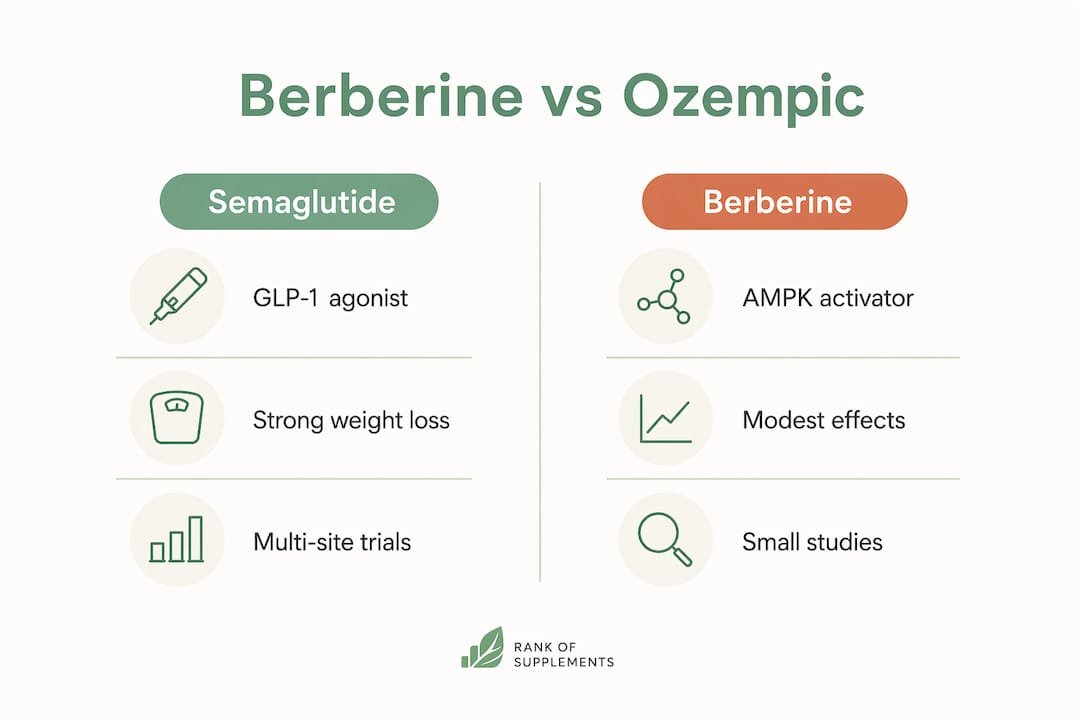
This is where the gap becomes hard to ignore. Semaglutide's weight-loss evidence comes from large, multi-site, placebo-controlled phase 3 trials with thousands of participants and rigorous endpoints. The STEP 1 trial, for instance, enrolled a large adult obesity cohort and showed substantial body weight reduction with semaglutide 2.4 mg versus placebo over a prolonged treatment period. Berberine's weight-loss data comes from small trials, often with fewer than 100 participants, short follow-up periods, and inconsistent dosing protocols.
A 2025 systematic review in BMC Complementary Medicine and Therapies found promising signals for berberine across metabolic markers but rated the overall evidence quality as low to moderate. The review authors explicitly called for larger, standardized RCTs before recommending berberine as a medical alternative to established drugs.
| Feature | Semaglutide (Ozempic/Wegovy) | Berberine |
|---|---|---|
| Mechanism | GLP-1 receptor agonism | AMPK activation |
| Avg. weight loss | Substantial (large phase 3 RCTs) | Modest (small trials, short follow-up) |
| Trial quality | Large, high-quality RCTs | Low-to-moderate quality; heterogeneous |
| Speed of effect | Weeks to months (titration-dependent) | 3 to 6 months for measurable changes |
| Regulatory status | FDA-approved (2017) | Dietary supplement; no FDA approval |
| Administration | Weekly subcutaneous injection | Oral capsules, 2 to 3x daily |
The honest summary: semaglutide produces clinically meaningful weight loss in a way that berberine's current evidence base does not support at equivalent magnitude. For someone with obesity or type 2 diabetes who qualifies for GLP-1 therapy, the two are not interchangeable.
How each option affects blood sugar and HbA1c
Semaglutide's glycemic effects are well-documented across the SUSTAIN trial program. In adults with type 2 diabetes, it produces meaningful HbA1c reductions alongside weight loss, and Ozempic carries an FDA indication specifically for glycemic control in type 2 diabetes. The mechanism is direct: enhanced glucose-dependent insulin secretion, reduced glucagon, and slower gastric emptying all work together.
Berberine does show real effects on blood glucose. Clinical summaries from Ohio State report modest reductions in blood sugar and lipid markers, with HbA1c improvements typically not appearing until 3 to 6 months of consistent use. Some small RCTs have compared berberine to metformin in type 2 diabetes and found comparable short-term glucose-lowering effects, which is genuinely interesting. But those trials are small, short, and not replicated at scale.
What the glycemic evidence shows:
- Semaglutide: clinically significant HbA1c reductions in large, well-controlled trials; effects begin within weeks of reaching therapeutic dose
- Berberine: modest A1c reductions in small trials; effects emerge slowly over months; evidence quality is low to moderate
- Berberine may be a reasonable adjunct for mild insulin resistance or prediabetes under clinical supervision, not a replacement for prescription therapy in diagnosed type 2 diabetes
- Combining berberine with metformin or other antidiabetic agents requires monitoring; additive glucose-lowering effects can increase hypoglycemia risk
For people with insulin resistance who are not yet on prescription therapy, berberine's modest glycemic effects may be worth discussing with a clinician. For anyone already managing type 2 diabetes with medication, it is an adjunct conversation, not a substitution decision.
Safety profiles and drug interactions you need to know
Semaglutide's safety profile is well-characterized. The most common adverse reactions (nausea, vomiting, diarrhea, abdominal pain, constipation) affect a meaningful proportion of users, particularly during dose escalation. More serious warnings from the FDA prescribing information include:
- Acute pancreatitis (discontinue if suspected)
- Diabetic retinopathy complications (monitor patients with history)
- Hypoglycemia risk when combined with insulin or insulin secretagogues
- Acute kidney injury risk from volume depletion (GI losses)
- Thyroid C-cell tumor signal in rodents (unknown human relevance; contraindicated in patients with personal or family history of medullary thyroid carcinoma or MEN 2)
- Severe GI adverse reactions; not recommended in patients with severe gastroparesis
Berberine's safety profile looks milder on the surface, but the interaction risk is underappreciated. Berberine modifies CYP450 enzyme pathways, which means it can raise or lower blood concentrations of drugs metabolized by those enzymes, including blood thinners (warfarin), beta-blockers, certain antihypertensives, and metformin itself. GI side effects (nausea, cramping, diarrhea) are common, especially at higher doses.
Red flags for self-substitution:
- Taking anticoagulants (warfarin, apixaban) or antihypertensives
- Using metformin or other antidiabetic agents without medical oversight
- Pregnancy or breastfeeding (berberine is contraindicated)
- Type 1 diabetes or insulin-dependent type 2 diabetes
- History of liver disease (berberine is hepatically metabolized)
Avoiding common supplement mistakes matters here. Adding berberine to an existing medication regimen without telling your prescriber is one of the more consequential errors people make.
Who should not replace GLP-1 therapy with berberine
Cleveland Clinic experts are direct on this point: patients should not discontinue prescribed diabetes medications to take berberine. The following groups face the highest risk from unsupervised substitution:
- Anyone prescribed semaglutide, tirzepatide, or another GLP-1 agonist by a clinician for diabetes or obesity management
- Type 1 diabetics: berberine has no insulin-replacement capacity; blood sugar can become dangerously uncontrolled
- Insulin-dependent type 2 diabetics: same risk; stopping or reducing insulin without supervision is dangerous
- Pregnant or breastfeeding people: berberine crosses the placenta and is contraindicated in pregnancy
- People on interacting medications: anticoagulants, certain antihypertensives, and antifungals all interact via CYP450 pathways
- Children and adolescents: no adequate safety data; use only under direct clinical supervision
- People with severe gastroparesis: semaglutide is already contraindicated here; berberine's GI effects add further risk
If you are in any of these groups and want to explore berberine as an adjunct, the conversation starts with your prescriber, not a supplement retailer. A supervised transition plan, if clinically appropriate, is the only safe path.
Dosing, timelines, and what each option actually costs
Berberine dosing in clinical trials typically runs up to 1,500 mg per day, divided across two or three doses taken with meals. The divided dosing is not optional: berberine's short half-life means a single large dose produces a spike-and-crash blood level profile, and taking it in divided doses also reduces GI side effects. Cleveland Clinic guidance also notes that practitioners often recommend cycling (several weeks on, one week off) to limit potential microbiome disruption from continuous use.
Semaglutide dosing follows the titration schedule in the prescribing information: 0.25 mg weekly for four weeks, then 0.5 mg, then up to 1 mg or 2 mg as needed for glycemic control. Wegovy's weight-management titration goes higher. These are not self-adjustable; dose changes require clinician oversight.
| Berberine | Semaglutide (Ozempic) | |
|---|---|---|
| Typical dose | Up to 1,500 mg/day, divided 2 to 3x | 0.25 to 2 mg weekly (titrated) |
| Administration | Oral capsule with meals | Weekly subcutaneous injection |
| Time to measurable effect | 3 to 6 months (HbA1c, weight) | Weeks to months (dose-dependent) |
| Prescription required | No | Yes |
| Insurance coverage | Not covered | Covered for type 2 diabetes; variable for obesity |
The cost difference is stark. Berberine's accessibility is a real advantage for people with cost or coverage barriers, which is exactly why the evidence quality conversation matters so much. A cheaper option that does not work for your condition is not a bargain.
Why the evidence base for berberine is not yet strong enough
The 2025 BMC systematic review put it plainly: berberine shows promising signals across metabolic markers, but the confidence interval around those effect sizes is wide because of heterogeneity and small trial populations. The review called for larger, standardized RCTs before recommending berberine as a medical alternative to established drugs.
Common limitations across berberine studies:
- Small sample sizes (often fewer than 100 participants per arm)
- Short follow-up periods (weeks to a few months, rarely longer)
- Inconsistent dosing protocols and formulations across trials
- Lack of blinding or allocation concealment in some studies
- No regulatory oversight of the supplement used in trials (product variability)
- Publication bias toward positive results in smaller studies
Semaglutide, by contrast, has been evaluated in multi-thousand-participant, multi-year, placebo-controlled trials with pre-registered endpoints and independent adjudication. The evidence hierarchy is not close. That does not mean berberine is useless; it means the confidence in its effect size is genuinely lower, and anyone claiming otherwise is overstating what the data supports.
When berberine might be worth considering and how to choose a quality product
Berberine is a reasonable conversation to have with your clinician if you have mild insulin resistance or prediabetes, face significant cost or insurance barriers to prescription therapy, or want to support metabolic health alongside lifestyle changes. It is not appropriate as a standalone treatment for diagnosed type 2 diabetes or as a replacement for any prescribed medication.
Monitoring checklist if you and your clinician decide to try berberine:
- Baseline HbA1c and fasting glucose before starting
- Recheck HbA1c at 3 months (minimum) to assess response
- Liver enzyme panel if using long-term or at higher doses
- Watch for signs of hypoglycemia if combining with other glucose-lowering agents
- Disclose berberine use to every prescriber managing your medications
Buying checklist for a quality berberine supplement:
- Labeled as "berberine HCl" (berberine hydrochloride) with a clear mg dose per capsule
- Third-party tested: look for USP, NSF International, or Informed Sport certification
- Certificate of analysis (COA) available from the manufacturer
- No proprietary blends that obscure the actual berberine dose
- Purchased from a reputable retailer with transparent sourcing
The Rankofsupplements berberine ingredient page covers dosage evidence, product quality signals, and buying guidance in detail. For a broader look at supplement options for blood sugar support, the best blood sugar supplements list is a useful starting point.
Pro Tip: Spread your berberine dose across three meals rather than two. The shorter half-life means three smaller doses maintain more consistent blood levels than two larger ones, and the smaller per-dose amount is easier on the stomach.
What the research synthesis and expert guidance actually say
The expert consensus is consistent across institutions. UCSF's Dr. Lisa Kroon has stated that the "Nature's Ozempic" label is a marketing construct that obscures the mechanistic and evidence gaps between berberine and GLP-1 drugs. Cleveland Clinic clinicians advise against unsupervised substitution of prescription diabetes medications with supplements. The 2025 BMC systematic review found promising but limited evidence, with heterogeneity and small trials producing wide confidence intervals.
Key trial metrics from the research base:
| Source | Population | Primary endpoint | Observed change |
|---|---|---|---|
| BMC Systematic Review (2025) | Mixed metabolic populations | Lipids, glucose, HbA1c | Modest improvements; low-to-moderate evidence quality |
| Ohio State clinical summary | Type 2 diabetes / prediabetes | Blood glucose, lipids | Modest reductions; A1c changes at 3 to 6 months |
| Ozempic prescribing info (FDA) | Type 2 diabetes adults | HbA1c, weight, CV events | Clinically significant; large phase 3 RCTs |
The pattern is clear: semaglutide's evidence base is built on large, well-powered trials with pre-specified endpoints. Berberine's is built on smaller, shorter studies with more variable methodology. Both can be true at once: berberine has real metabolic effects AND those effects are not equivalent to GLP-1 therapy in magnitude or consistency.
For readers exploring herbal supplement options more broadly, the evidence quality question applies across the category. Berberine is among the better-studied plant-based weight-loss supplements, which is worth noting, but "better-studied than most supplements" is a different bar than "equivalent to a phase 3-approved drug."
Key Takeaways
Berberine and Ozempic work through different mechanisms, produce different magnitudes of effect, and are supported by evidence bases that are not comparable in scale or quality.
| Point | Details |
|---|---|
| Mechanism difference | Semaglutide activates GLP-1 receptors; berberine activates AMPK. These are distinct pathways with different clinical outcomes. |
| Effectiveness gap | Semaglutide shows substantial weight loss in large RCTs; berberine shows modest effects in small, low-to-moderate quality trials. |
| Safety and interactions | Berberine modifies CYP450 pathways and can alter concentrations of blood thinners, beta-blockers, and metformin. |
| Who must not substitute | Anyone prescribed GLP-1 therapy, type 1 diabetics, pregnant people, and those on interacting medications should not self-substitute. |
| Rankofsupplements guidance | The Rankofsupplements berberine ingredient page provides evidence-based dosage, quality signals, and buying criteria for readers exploring supplementation. |
The evidence gap is wider than most supplement content admits
The "Nature's Ozempic" framing has done real damage to how people evaluate berberine. Not because berberine is worthless, but because the comparison sets an expectation the supplement cannot meet, and people make medical decisions based on that expectation.
Berberine has genuine metabolic effects. The AMPK pathway is real, the glucose-lowering signals in small trials are real, and for someone with prediabetes or mild insulin resistance who cannot access or afford prescription therapy, it may be worth a supervised trial. That is a legitimate use case.
What it is not: a substitute for semaglutide in someone who has been prescribed it for type 2 diabetes or obesity. The mechanisms differ, the evidence differs, and the clinical monitoring that comes with a prescription drug does not transfer to an OTC supplement. Someone who stops Ozempic to take berberine is not making an equivalent swap. They are removing a well-characterized intervention and replacing it with one whose effect size, at their specific dose and formulation, is genuinely uncertain.
The right frame for berberine is adjunct or entry point, not replacement. And even in that role, it belongs in a conversation with a clinician, not a decision made after reading a social media post.
Rankofsupplements can help you find quality berberine supplements
Sorting through berberine products is harder than it should be. Doses vary, formulations differ, and third-party testing is inconsistent across brands. Rankofsupplements cuts through that by applying the same evidence-first methodology to supplement reviews that clinical researchers apply to trials: sourced dosage data, quality certification checks, and transparent criteria.
The ingredient library covers berberine in depth, including the clinical dosage evidence, what to look for on a label, and which quality certifications actually matter. For readers comparing options across the blood sugar support category, the best supplements to lower blood sugar naturally guide ranks products by evidence quality and value. If you are exploring weight management supplements more broadly, the weight management supplement guide organizes options by goal and evidence tier. Start with the ingredient library, check the quality signals, and bring your shortlist to your clinician before adding anything to your regimen.
Useful sources
- Ozempic full prescribing information (DailyMed/FDA): Primary regulatory source for semaglutide dosing, indications, contraindications, and adverse reactions. Consult this for complete prescribing guidance.
- Cleveland Clinic: Berberine, benefits, dosage & side effects: Institutional clinical guidance on berberine dosing, safety, and the explicit caution against stopping prescribed diabetes medications.
- Ohio State Health: Berberine for weight loss: Clinical summary covering berberine's glycemic effects, CYP450 interactions, and realistic timelines for HbA1c changes.
- BMC Complementary Medicine and Therapies systematic review (2025): The most recent systematic review of berberine's metabolic effects; concludes evidence quality is low to moderate and calls for larger RCTs.
- Verywell Health: Berberine and the "Nature's Ozempic" claim: Includes expert commentary from UCSF's Dr. Lisa Kroon on the mechanistic and marketing distinctions between berberine and GLP-1 drugs.
- WebMD: Berberine health benefits and safety: Consumer-facing overview of supplement quality variability and the importance of third-party testing.
- Ozempic safety profile summary: Prescribing and safety summary listing common adverse reactions and trial outcomes for semaglutide.
Consult the full prescribing information and your healthcare provider for personalized advice on any prescription medication or supplement regimen.
FAQ
Is berberine as effective as Ozempic for weight loss?
No. Semaglutide produces substantially greater weight loss in large, high-quality RCTs than berberine has shown in small, heterogeneous trials. The 2025 BMC systematic review rated berberine's evidence quality as low to moderate.
How quickly will I lose weight on berberine?
Berberine's effects on weight and HbA1c typically take 3 to 6 months to become measurable, and the absolute changes seen in trials are modest compared to GLP-1 medications.
What is the closest supplement to Ozempic?
No supplement currently approved for OTC sale replicates GLP-1 receptor agonism. Berberine is the most studied weight-loss supplement in this context, but it works via AMPK activation, a different mechanism with a different and smaller clinical effect.
What are the main downsides of taking berberine?
GI side effects (nausea, cramping, diarrhea) are common, especially at higher doses. Berberine also modifies CYP450 enzyme pathways, creating clinically significant interactions with blood thinners, beta-blockers, and metformin. Supplement quality varies widely without FDA oversight.
Can I take berberine alongside Ozempic?
Only under medical supervision. Both lower blood glucose, and combining them without monitoring increases hypoglycemia risk. Disclose berberine use to your prescriber before adding it to any existing medication regimen.