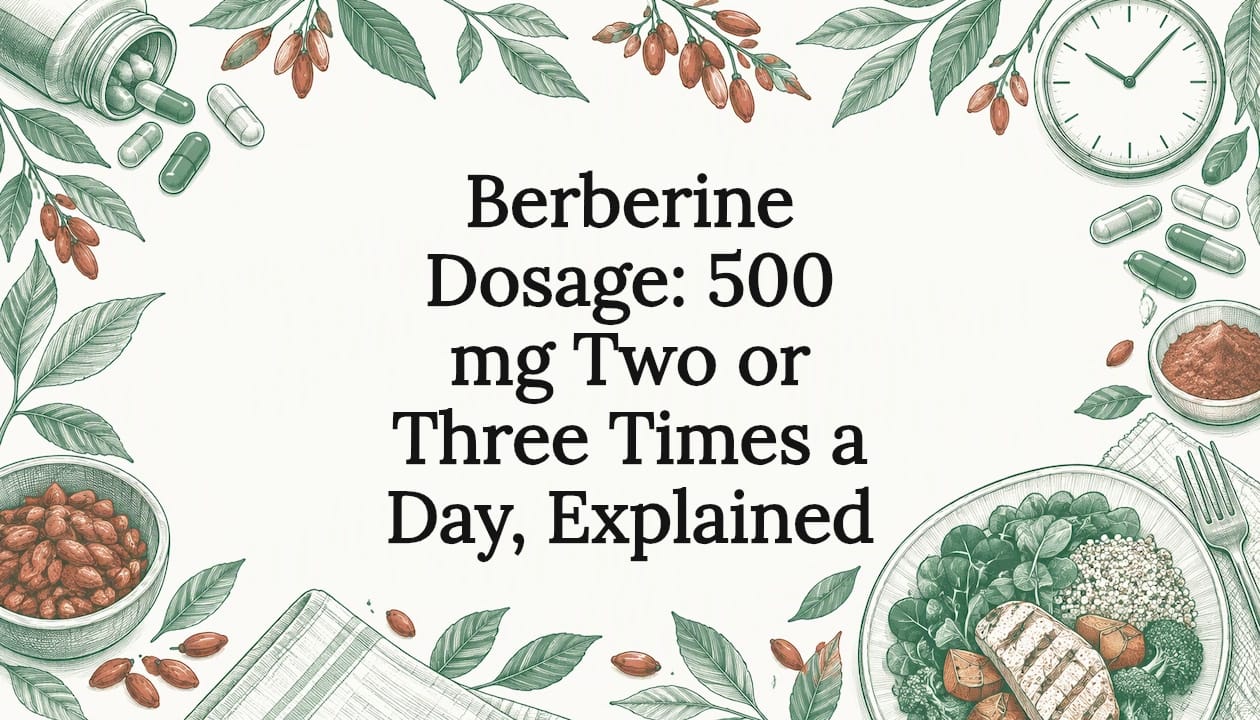
The usual berberine dose is 500 mg taken two or three times a day, shortly before meals, for 1,000 to 1,500 mg per day. That matches the Cleveland Clinic’s typical dosing of 500 mg twice daily, up to 1,500 mg a day split into three doses. It also matches the best-known human trial. There is no officially established dose for weight loss, and the most solid data are for blood sugar, not the scale. Below: what the studies used, how to space and time your capsules, how to ramp up without wrecking your stomach, and when to talk to a clinician first.
TL;DR
- Common range: 500 mg two to three times daily (1,000 to 1,500 mg per day), taken before or between meals, not all at once.
- Start low and build up. In the classic diabetes trial, about a quarter of participants needed a lower dose because of GI side effects.
- Berberine has a short half-life, so splitting the dose matters more than the total number on the label.
- Weight loss is modest in studies, a couple of kilograms on average, and there is no proven weight-loss dose.
- Check with your doctor or pharmacist first if you take metformin, cyclosporine, omeprazole, losartan, blood thinners or other prescription drugs, or if you are pregnant or breastfeeding.
Table of Contents
- What dose have human studies actually used?
- How much berberine to take per day
- How to take a 500 mg berberine capsule
- Berberine dose for weight loss
- Berberine vs. cinnamon: which dose, which job?
- Side effects at each dose level
- Interactions and who should skip it
- How long to take it, and how to know if it is working
- What to look for on a berberine label
- Perspective
- Find a berberine product that matches the dose
- Related reading
- FAQ
- Sources
What dose have human studies actually used?
The trial most people end up citing is a small 2008 pilot study. In it, 18 people with type 2 diabetes took 500 mg of berberine three times daily at the start of each major meal for 13 weeks. HbA1c fell from 9.5% to 7.5% and fasting glucose from 10.6 to 6.9 mmol/L. The study had a metformin comparison and no placebo group, and it was small. It is the origin of the “500 mg, three times a day” figure you see on supplement labels, not proof that this is right for everyone.
Researchers have tried far more than that single regimen. Examine’s database notes studies spanning very wide ranges, but you do not need to mimic the extremes. What matters is the pattern the guidance converges on:
| Source | Suggested regimen | Daily total |
|---|---|---|
| Cleveland Clinic | 500 mg twice a day before meals, up to three doses | Up to 1,500 mg |
| Ohio State Health & Discovery | Label directions often say 500 mg three times daily before meals | 1,000 to 1,500 mg |
| WebMD | 250 or 500 mg, two or three times a day | 500 to 1,500 mg |
| Verywell Health | AANP notes 500 mg three times daily; most studies show benefit at 900 to 1,500 mg | 900 to 1,500 mg |
The ceiling across all of these is 1,500 mg per day from a 500 mg capsule, taken as separate doses. Nobody in this list recommends a single 1,500 mg hit.
How much berberine to take per day
Pick the daily total first, then divide it.
- Starting dose: 500 mg per day (one capsule, before your largest meal), for several days to a week.
- Standard dose: 1,000 mg per day (500 mg twice daily, for instance before breakfast and before dinner).
- Upper typical dose: 1,500 mg per day (500 mg three times daily before meals).
That is a practical way to apply the published ranges, not a prescription. Going above 1,500 mg per day is not supported by the mainstream guidance above, and more is not better: the side effects are dose-related in practice, and the GI trouble described below shows up fast.
Why you split the dose
Berberine is cleared quickly. Because of its short half-life, the Cleveland Clinic advises spreading doses across the day, two to three times, before meals. Ohio State makes the same point: with a half-life of several hours, berberine works best earlier in the day rather than at night. A person who swallows 1,500 mg at breakfast gets a spike and then little coverage by evening, plus a much higher chance of cramps.
A scenario we see often: someone buys a bottle of 1,000 mg “one a day” capsules because it looks simpler. They get stomach upset by day three and quit. The same total as 500 mg two times daily would likely have been better tolerated, and it follows what the trials did.
How to take a 500 mg berberine capsule
Labels differ, so read yours. As a reference, the NIH Dietary Supplement Label Database lists one 500 mg berberine HCl product whose directions say to take one capsule with 6 to 8 oz of water or juice 15 minutes before meals, no more than three capsules per day, and not on an empty stomach. The same label tells new users to increase gradually.
A workable routine built on that:
- Week 1: one 500 mg capsule, 15 to 30 minutes before your biggest meal, with a full glass of water.
- Week 2: add a second capsule before another meal if you feel fine.
- Week 3 onward: if you and your clinician want the higher dose, add a third capsule before the third meal. Stop at three.
- Skip the late capsule: if your last meal is late, drop the bedtime-adjacent dose rather than taking it at night.
Before meals, with meals, or in between?
The guidance is not perfectly uniform here. The trial gave capsules at the beginning of each major meal. Ohio State says berberine is not meant to be taken with food, but before or in between meals. Cleveland Clinic’s wording is before meals. The consistent thread is the start of the meal or just ahead of it. If a pre-meal capsule upsets your stomach, taking it with the first bites is a reasonable adjustment to raise with your clinician, and it is better than abandoning the supplement or skipping the split.
What if you miss a dose?
Skip it and take the next one at the normal time. Do not double up: the label guidance caps you at three capsules a day, and doubling on one occasion invites exactly the GI symptoms you are trying to avoid.
Berberine dose for weight loss
This is the biggest search in the cluster, and the honest answer is that no weight-loss-specific dose has been established. The same 500 mg up to three times daily pattern is what clinicians point to. Cleveland Clinic’s Dr. Tumah recommends starting slowly and working up to 500 mg up to three times a day, before or between meals.
What that dose gets you is modest:
- A 2020 meta-analysis of 12 randomized trials found an average drop of 2.07 kg in body weight, 0.47 kg/m² in BMI and 1.08 cm in waist circumference.
- A 2022 review found significant changes in weight and BMI at more than 1 gram per day for 8 or more weeks, which fits the 1,000 to 1,500 mg range and tells you it is a weeks-to-months supplement, not a two-week one.
- Ohio State notes some studies show weight loss of 5% to 7% of body weight, but there are not enough studies to say with certainty what any one person will lose.
- Harvard Health states there is no rigorous scientific evidence that berberine suppresses appetite and promotes weight loss.
The fair reading: the numbers vary by trial, the average is a couple of kilograms, and berberine is best used as one piece of a plan. Dr. Tumah says a supplement as the only approach to weight loss will not be efficient or enough, and pairs it with diet, exercise, and medication when needed. If you are comparing it with prescription drugs, our breakdown in Berberine vs Ozempic goes through the evidence side by side.
Berberine vs. cinnamon: which dose, which job?
People search these two together because both get pitched for blood sugar. They are different ingredients with different dosing, and they should not be treated as swaps. Berberine’s human record is built on the 500 mg, two-to-three-times-daily regimen above. Cinnamon is a spice-derived supplement dosed on a different basis, and cassia and Ceylon types are not the same product, so check which one is in the bottle before comparing anything.
If you want to build a stack, the practical rule is to change one thing at a time. Add berberine on its own for several weeks and see how your stomach and your numbers respond. Layering two blood-sugar-active products at once makes it impossible to know which did what, and raises the chance of glucose dropping too low if you also take diabetes medication. Our guide to berberine for insulin resistance covers what the evidence supports, and our bitter melon trial review covers another herbal option people compare it to.
Side effects at each dose level
GI effects are the main issue. In the 2008 trial, 34.5% of participants had transient GI problems over 13 weeks: flatulence in 19.0%, diarrhea in 10.3%, constipation in 6.9% and abdominal pain in 3.4%. And 24.1% had their dose cut from 500 mg to 300 mg three times daily because of those symptoms.

That tells you two practical things. First, if you get symptoms at 500 mg three times a day, dropping to a smaller dose is a normal, studied response, not a failure. Second, the ramp-up schedule above is not optional politeness. It is how you reduce the chance that you join that quarter. The Cleveland Clinic lists nausea, abdominal discomfort, constipation and diarrhea as the common complaints. For a deeper look, see what actually happens with berberine side effects.
Interactions and who should skip it
This is where the dose conversation stops being about you alone.
- Medications: Cleveland Clinic warns that berberine can interact with metformin, cyclosporine, omeprazole and losartan. Harvard Health adds that berberine can change how quickly the liver breaks down medications, including anti-clotting drugs and immunosuppressants. If you take any of these, ask your prescriber or pharmacist before the first capsule, and do not adjust your prescription on your own.
- Blood pressure: WebMD notes berberine’s blood pressure-lowering effect could push pressure too low in some people. If you take blood pressure medication, mention it to your clinician.
- Blood sugar medication: since berberine lowers glucose, combining it with diabetes drugs is a conversation for your doctor. For a plain-language overview of day-to-day glucose management, these guidelines on managing blood sugar from a primary care practice are a good companion.
- Pregnancy, breastfeeding, children: Cleveland Clinic says berberine is not recommended for babies and children and should not be taken while pregnant or breastfeeding. WebMD notes early evidence of uterine contractions and miscarriage.
- Surgery: herbal supplements like berberine are generally stopped 2 to 3 weeks before surgery. Our guide on supplements to avoid before surgery lists the others.
How long to take it, and how to know if it is working
Long-term data are thin. Cleveland Clinic notes the lack of long-term studies proving safety and efficacy. Ohio State suggests a sensible structure: take berberine for three months, then get blood work to see whether your A1C went down and re-check your weight.
Turn that into a plan:
- Before you start, get a baseline: A1C, fasting glucose, weight, waist measurement.
- Run the ramp-up, then hold at your chosen dose (1,000 to 1,500 mg a day) for about 12 weeks.
- Repeat the labs and measurements. If nothing moved, that is useful information and a reason to talk with your clinician about other options, not to raise the dose.
What to look for on a berberine label
Harvard Health points out the FDA does not regulate dietary supplements, so there is no guarantee how much berberine is in a product. Dose advice only works if the capsule contains what it says. Our scoring looks at four things on every review: trial-matched dosing, third-party testing, label accuracy and clinical evidence. For berberine specifically, check:
- Berberine HCl per capsule, clearly stated in mg (500 mg is the standard unit).
- Serving size honesty: a label that says “1,000 mg” for two capsules is 500 mg per capsule, not 1,000 mg per capsule. Count in milligrams of berberine, not of a “blend.”
- Third-party testing seals or published certificates of analysis.
- Underdosing: some products list fractions of the studied amount. A bottle giving 200 mg a day is not the regimen described above.
Perspective
We read berberine dosing the way we read every supplement: start from the trial, then ask what a person can actually do with it. The trial regimen is 500 mg three times daily before meals. Labels copy it, and so do clinicians. What gets lost is the part that decides whether anyone sticks with it: the ramp-up, the split, and the fact that about a quarter of trial participants needed a smaller dose.
Our method is to score products on trial-matched dosing, third-party testing and label accuracy. We check and report when a popular product is underdosed against the clinical research, and we do not move a product up a ranking for commercial reasons. For berberine, that means we care less about a bigger number on the front of the bottle and more about whether 500 mg per capsule is real, tested, and easy to split across the day.
Our advice is simple: pick a product you can verify, start with one capsule, build to the dose your clinician agrees with, and measure your results at 12 weeks. A supplement is a tool in a plan, and a good ranking is the shortcut to a reliable tool.
matteo
Find a berberine product that matches the dose
If you are ready to compare products, we rank supplements against the dosing in the clinical research, and flag the ones that fall short. Start with our weight loss supplements ranking, or browse supplements by health goal and condition to see where berberine fits next to other options.
Every review we publish is independent of paid placements and free samples, and our methodology is public.
Related reading
- Related article: Berberine side effects: what actually happens and who should skip it
- Top list: Best weight loss supplements
- Product-focused page: Berberine: benefits, dosage and best supplements for blood sugar
- Guide: Supplements to avoid before surgery
FAQ
How much berberine should I take per day?
Most guidance lands between 1,000 and 1,500 mg per day, as 500 mg two or three times daily before meals. Begin with a single 500 mg capsule and build up over two to three weeks. Do not exceed three 500 mg capsules daily, and check with your clinician first if you take any medication.
Can I take 1,500 mg of berberine at once?
No. Berberine is cleared within hours, so the standard approach splits it into separate 500 mg doses spread across the day. A single large dose raises the odds of cramps and diarrhea without extending coverage.
What is the best berberine dose for weight loss?
There is no dose proven for weight loss. Clinicians point to the same 500 mg up to three times daily, and trial reviews saw changes at more than 1 gram per day over 8 or more weeks. Expect a modest effect, around 2 kg on average in one meta-analysis, alongside diet and exercise.
Is berberine or cinnamon better for blood sugar?
They are different supplements and are not interchangeable. Berberine has the clearer human record at 500 mg two to three times daily, including the 2008 diabetes trial. Whichever you consider, introduce one at a time and tell your doctor, especially if you take glucose-lowering medication.
How should I take a 500 mg berberine capsule?
Take one capsule with a full glass of water about 15 minutes before a meal, and do not take it on an empty stomach. Build up gradually rather than starting at three a day. If you miss a dose, skip it and do not double the next one.
Sources
- Efficacy of Berberine in Patients with Type 2 Diabetes (PMC)
- Berberine for Weight Loss, Ohio State Health & Discovery
- Berberine: What It Is, Benefits & Side Effects, Cleveland Clinic
- Berberine for Weight Loss: Does It Work?, Cleveland Clinic
- Berberine for PCOS: Benefits and Risks, Cleveland Clinic
- Berberine: Benefits, Side Effects, and Weight Loss, WebMD
- The Best Time to Take Berberine, Verywell Health
- Berberine HCL 500 mg label, NIH Dietary Supplement Label Database
- Can berberine help me lose weight?, Harvard Health
- Berberine Is Not Nature’s Ozempic, Nutraceuticals World